


Key cautions
- Buy food-grade oil and follow heating/storage directions for that specific product.
- Discard rancid oil and avoid repeated smoking or overheating. Whole-seed allergy considerations are not automatically resolved by choosing an unrefined oil.
What’s inside
Triglycerides containing variable proportions of linoleic and oleic acids, plus tocopherols whose amounts depend on product and processing. It is not a concentrated sunflower-seed protein food.
Uses in brief

- Cooking and food manufacture
- Dressings and finished foods
History, folklore and reported uses
History, folklore and traditional uses
Introduced/cultivated and processed: Ukraine, Romania, Bulgaria and Hungary.
Cultivated/processed: United States, including North Dakota.
Traditional, historical and reported uses
- Cooking and food manufacture
Food or household practiceWhy this label?
The linked sources document this material-specific use; no treatment outcome or universal safety is inferred.
European crop reporting and Polish food guidance document sunflower as an edible oilseed. The pressed or refined oil functions as an ingredient in meals and manufactured foods.
- Dressings and finished foods
Food or household practiceWhy this label?
The linked sources document this material-specific use; no treatment outcome or universal safety is inferred.
Culinary-labelled sunflower oils can supply neutral or seed-like flavour according to refining. This is a different food form from adding intact sunflower kernels to a dish.
2 supported material-specific uses; practices are not proof of treatment efficacy.
Historical-use additions reviewed 2026-10-09
Growing notes
This preparation comes from Sunflower seed. The growing guide concerns the living plant, not making or extracting this product.
Read the source plant’s growing notesRegional reading paths
These sourced notes describe cultivation, trade, food traditions or material history. A regional connection does not claim exclusive origin.
Europe
Introduced/cultivated and processed: Ukraine, Romania, Bulgaria and Hungary.
Edible seed oil for cooking; ordinary and high-oleic grades differ.
North America
Cultivated/processed: United States, including North Dakota.
Culinary pressed or refined seed oil; distinct from whole seeds.
Identity & detailed reference
Identity
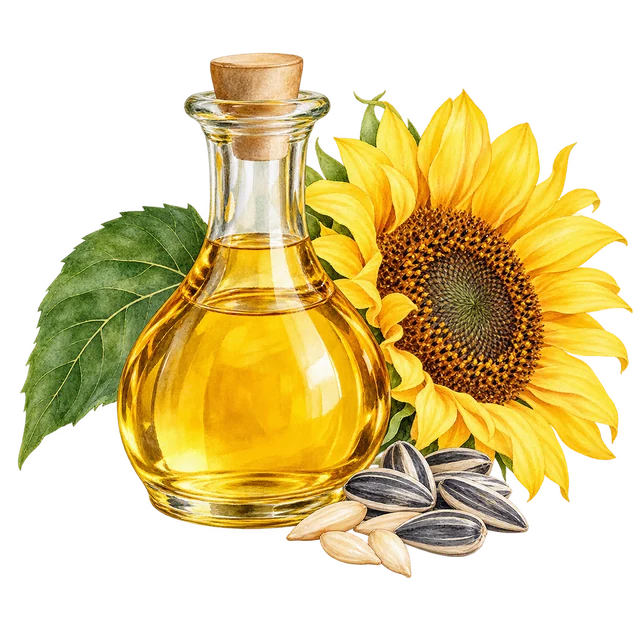
Sunflower oil is the fixed oil extracted from Helianthus annuus seeds. Conventional, mid-oleic and high-oleic varieties have materially different fatty-acid profiles.
Ingredient details, preparation and research
Also known as: Sunflower seed oil; High-oleic sunflower oil
Source plant or material
Helianthus annuus L.
Plant family / material: Asteraceae
Forms and route
Refined edible oil and cold-pressed culinary oil. Whole kernels, cosmetic formulations and industrial products are separate forms.
Vitamins and minerals
The oil provides energy and fat, with no meaningful fibre compared with whole kernels. Vitamin E content varies; no unsourced serving value or nutrient ranking is assigned.
Absorption and preparation
As a meal fat it can support absorption of fat-soluble compounds. It does not make another ingredient medicinal or compensate for a poorly balanced diet.
Practical preparation
Store tightly closed in a cool, dark place. Select the stated oil type for the recipe; high-oleic and conventional oils should not be assumed chemically identical.
Combination notes
Use an appropriate culinary product as the fat in a recipe; keep whole-seed and oil portions conceptually separate.
Traditional and reported uses
- Cooking and food manufacture
- Dressings and finished foods
Contraindications and cautions
- Buy food-grade oil and follow heating/storage directions for that specific product.
- Discard rancid oil and avoid repeated smoking or overheating. Whole-seed allergy considerations are not automatically resolved by choosing an unrefined oil.
Similar items and how they compare
- Sunflower seeds
Both derive from Helianthus annuus.
Oil lacks the intact kernels’ fibre and protein.
Cultivar changes the oil
Codex lists compositional distinctions between sunflower oil categories. Research or cooking guidance tied to a high-oleic product should not be applied automatically to every bottle.
Cross-continental agriculture
European production includes Romania, Bulgaria and Hungary, while the assigned North American sources document United States sunflower cultivation and trials. Neither connection changes the crop’s botanical identity.
Evidence limits
No treatment claim is made from fatty-acid composition alone. Oil composition is not evidence that a particular finished food is nutritionally superior.
Entry sources
- European Commission: Agricultural outlook 2022, oilseed complex
- Polish food-quality inspectorate: ABC olejów roślinnych
- NDSU: Sunflower Variety Trials
- NDSU Extension: Are seed oils good or bad for health?
- FAO/WHO Codex: Named vegetable oil identity and fatty-acid composition
Reference entry 372 · Recorded content review: 2026-10-09 · Review scope and dates