


Key cautions
- Never eat raw cassava or use taste to determine cyanogenic safety. Peeling, brief soaking or ordinary boiling cannot be assumed sufficient for an unknown variety.
- Choose reputable, properly processed food products and follow their instructions. Do not drink raw root-processing liquid or improvise fermentation to make unsafe material edible.
What’s inside
Mainly starch, with relatively little protein. Naturally occurring cyanogenic glycosides, including linamarin, make cultivar-appropriate processing a central safety requirement.
Uses in brief

- Cooked root dishes
- Processed flour foods
History, folklore and reported uses
History, folklore and traditional uses
Cassava is an American domesticate with deep cultivation histories in Brazil and Peru. Introduced cultivation made it a major crop in Nigeria and DR Congo, and established it in Belize, the Caribbean including Trinidad and Tobago, and Pacific islands including Fiji. Local food traditions rely on appropriate processing; geography does not establish that an unknown root is ready to eat.
A closer look at its history
Casabe in a Taíno account of creation
The Smithsonian’s National Museum of the American Indian presents a Taíno ceramic zemí from Andrés in the Dominican Republic, dated AD 1200–1500. In José Barreiro’s interpretation, Deminán and his brothers obtain fire, casabe and tobacco for people. Cassava bread thus appears within a creation narrative, not only as a source of calories.
An object anchors the story without dating the first crop
The museum describes casabe as a continuing Taíno food tradition. The ceramic’s date anchors this particular object, not cassava’s first cultivation or the invention of bread. Cultural evidence deserves that distinction. It also does not replace the careful processing required for edible cassava or make raw roots safe.
Casabe is living knowledge, not only an ancient artifact
In 2024 UNESCO inscribed cassava-bread knowledge and practice through a joint nomination by Cuba, the Dominican Republic, Haiti, Honduras and Venezuela. The record emphasizes household and community transmission and connections with Indigenous and African heritage. Texture, size and flavor differ across communities; the recognition is of shared knowledge with local variation, not one standardized recipe.
The processing skill is part of the heritage
The UNESCO record describes bitter as well as sweet cassava in breadmaking. That distinction makes skilled processing central to the story. A heritage description is not a verified home detoxification procedure, and the cultural importance of the food must never be read as evidence that raw cassava is safe.
Additional history reviewed 2026-10-12
Traditional, historical and reported uses
- Cooked root dishes
Food or household practiceWhy this label?
The source supports the named food, cosmetic or material practice; no treatment effect is inferred and the card’s form and safety limits remain attached.
IITA and FAO document cooked cassava-root foods across regions. The starting material must already be suitable for the intended preparation; thorough cooking alone is not a universal solution for every cassava variety.
- Processed flour foods
Food or household practiceWhy this label?
The source supports the named food, cosmetic or material practice; no treatment effect is inferred and the card’s form and safety limits remain attached.
FAO describes multiple root-processing traditions. Finished flour is a distinct product from intact root or purified starch, and should carry food-grade quality and preparation information.
2 sourced featured uses; cultural or material records are not clinical efficacy evidence.
Historical-use additions reviewed 2026-10-09
Story sources
- IITA: Cassava crop profile
- Belize Agriculture: Agricultural market prices, February 2020
- UWI: Faculty of Food and Agriculture Handbook 2022–2023
- UWI conference: National Agricultural Diversification Programme selected crops
- INIA: Los cultivos nativos en las comunidades del Perú
- Embrapa: Tucupi publications, fermentation, cooking and cyanide
- University of Hawaiʻi CTAHR: Pacific Crops
- University of Hawaiʻi: Pacific Food Guide, Food Preferences
- FAO: Roots, tubers, plantains and bananas in human nutrition; cooking and processing
- FAO: Traditional processing and utilization of cassava in Africa
Growing notes
Manihot esculenta edible-crop cultivars; yuca is not the ornamental genus Yucca. Growing does not make raw roots or leaves safe.
- Climate and lifecycle
- A tropical perennial grown for storage roots. UF’s Miami-Dade planting window is mainly February–April, not a nationwide calendar. Elsewhere, ask local extension whether the warm season is sufficient; avoiding frost alone is not enough. [1]
- Propagation and cultivar
- Use healthy, legally obtained stem cuttings of a known food cultivar, not a root from the produce aisle. Low- and high-cyanogenic types require different processing expertise. The label “sweet” is not permission to eat a raw root. [1] [2]
- Sun, drainage and water
- Choose full sun and moist, well-drained sandy loam. Supply water during establishment even though established shrubs tolerate drought. NParks notes that taking leaves from a root crop can reduce root yield; decide which crop is intended. [2]
- Time to harvest
- UF gives 8–12 months for Florida roots; tropical accounts can be earlier. Lifted roots deteriorate quickly, so plan prompt safe processing. Storage-root production does not require pollination. [1] [2]
- Pests and nutrition
- Use soil-test guidance for potassium; excess nitrogen favors foliage. UF records root-knot nematode constraints. Start with healthy material and obtain local diagnosis. [1]
Growing sources and regional guidance
Growing notes reviewed 2026-10-12
Regional reading paths
These sourced notes describe cultivation, trade, food traditions or material history. A regional connection does not claim exclusive origin.
Africa
Introduced/cultivated: tropical America to Africa; major crop in Nigeria and DR Congo.
Properly processed and cooked starchy root; never assume raw cassava is safe.
North America
Introduced/cultivated: Belize and Caribbean, including Trinidad and Tobago.
Processed and thoroughly cooked starchy root; cyanogenic compounds require appropriate preparation.
South America
native domesticate and cultivated; Peru, Brazil
Starchy roots requiring appropriate cyanide-reducing processing.
Australia & Oceania
introduced/traded and cultivated; Pacific islands including Fiji
Professionally or traditionally safely processed root food.
Identity & detailed reference
Identity
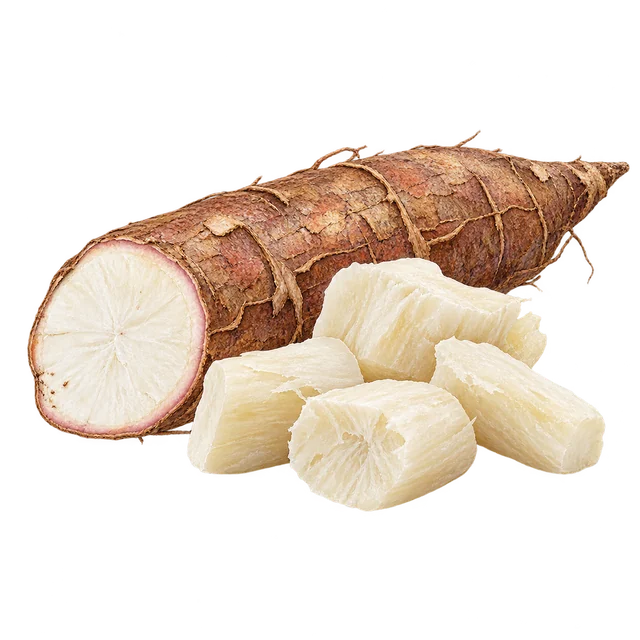
The cultivated root of Manihot esculenta, also called cassava, manioc or yuca. It is distinct from ornamental Yucca, cassava leaves, pure tapioca starch and processed fermented gari.
Ingredient details, preparation and research
Source plant or material
Manihot esculenta
Plant family / material: Euphorbiaceae
Forms and route
Commercially prepared roots and properly processed cooked root foods; cassava flours vary. Raw roots and uncontrolled home processing are not ready-to-eat forms.
Vitamins and minerals
Cassava is chiefly an energy staple, with limited protein. Accompany it with varied foods; pure starch and fortified flour have different nutrient profiles from cooked root.
Absorption and preparation
Processing changes starch and cyanogenic compounds, but no recipe pairing makes an unknown root safe. Composition is not evidence of detoxification or absorbed nutrients.
Practical preparation
Use commercially prepared or otherwise reliably processed food material. Follow its specific cooking directions and store cooked foods safely; no raw-root detoxification sequence is supplied.
Traditional and reported uses
- Cooked root dishes
- Processed flour foods
Contraindications and cautions
- Never eat raw cassava or use taste to determine cyanogenic safety. Peeling, brief soaking or ordinary boiling cannot be assumed sufficient for an unknown variety.
- Choose reputable, properly processed food products and follow their instructions. Do not drink raw root-processing liquid or improvise fermentation to make unsafe material edible.
Safety is cultivar- and process-dependent
IITA identifies cyanogenic compounds, while FAO explains distinct processing systems. These sources support caution and preparation specificity rather than a universal time-temperature instruction for all roots.
Evidence limits
Prepared food-root scope only; no raw tasting, processing-liquid use, leaf preparation or home cyanide-removal protocol.
Entry sources
- IITA: Cassava crop profile
- Belize Agriculture: Agricultural market prices, February 2020
- UWI: Faculty of Food and Agriculture Handbook 2022–2023
- UWI conference: National Agricultural Diversification Programme selected crops
- INIA: Los cultivos nativos en las comunidades del Perú
- Embrapa: Tucupi publications, fermentation, cooking and cyanide
- University of Hawaiʻi CTAHR: Pacific Crops
- University of Hawaiʻi: Pacific Food Guide, Food Preferences
- FAO: Roots, tubers, plantains and bananas in human nutrition; cooking and processing
- FAO: Traditional processing and utilization of cassava in Africa
Reference entry 335 · Recorded content review: 2026-10-09 · Review scope and dates