


Key cautions
- Heavy, new or unusual bleeding needs evaluation rather than self-treatment. EMA does not recommend use in pregnancy or lactation; fertility data are absent.
- Heavy, worsening or unusual bleeding must not be covered up with a herbal product.
- Seek urgent care for heavy bleeding with faintness, severe pain or possible pregnancy.
What’s inside
No clinically validated active marker or standard nutrient value is assigned here.
Uses in brief

- Traditional menstrual-bleeding use only after serious causes are medically excluded.
- Leaf and flowering-shoot food tradition (food or household practice; distinct from medicinal extracts).
History, folklore and reported uses
History, folklore and traditional uses
EMA recognizes a long-standing European medicinal record for menstrual bleeding in women with otherwise regular cycles. Its traditional registration specifically requires that serious causes be excluded by a physician first.
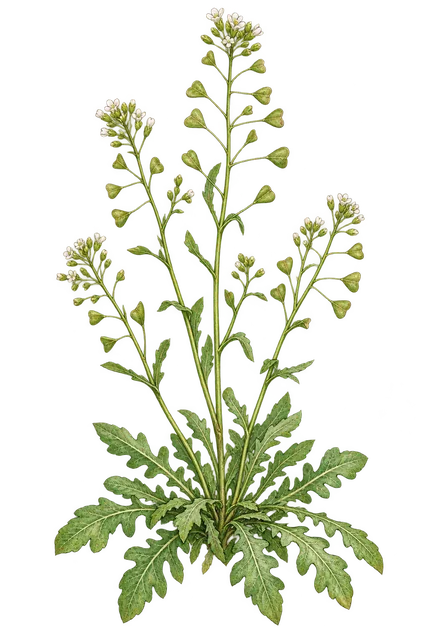
NC State describes shepherd’s purse as an annual mustard-family weed with heart-shaped pods and small white flowers, occurring widely in disturbed ground.
Traditional, historical and reported uses
- menstruation
Traditional accountWhy this label?
The available study was insufficiently characterized to support firm conclusions. Traditional registration is not proof of effectiveness.
Traditional use for heavy menstrual bleeding after medical evaluation. The available study was insufficiently characterized to support firm conclusions. Traditional registration is not proof of effectiveness.
- Leaf and flowering-shoot food tradition
Food or household practiceWhy this label?
Institutional account explicitly documents the same aerial plant parts as food; this is a distinct food exposure, not evidence of medicinal efficacy or supplement safety.
NC State Extension documents food use of shepherd’s-purse leaves and flowering shoots, including leaves in Chinese cuisine. This is an aerial-part food tradition, distinct from medicinal herb tea or liquid extract. It does not establish a treatment for bleeding or medicinal safety during pregnancy or breastfeeding.
Coverage reflects verified sources, without a minimum use quota.
Women’s Health: traditions, evidence and cautions
Historical use does not establish benefit or safety. Pregnancy, breastfeeding and fertility care require particular caution: food, tea, essential oil and concentrated extract are not interchangeable. These records are not treatment, dosing or pregnancy-management instructions. Discuss supplements with a qualified clinician or pharmacist; do not delay evaluation of persistent symptoms.
Shepherd’s purse
Capsella bursa-pastoris
- Plant part / material
- aerial parts
- Preparation studied or reported
- dried herb tea or specified liquid extract
Capsella bursa-pastoris; aerial parts.
menstruation
traditional use; insufficient clinical evidence
Reported or traditional useTraditional use for heavy menstrual bleeding after medical evaluation.
What the evidence supportsThe available study was insufficiently characterized to support firm conclusions. Traditional registration is not proof of effectiveness.
Heavy, new or unusual bleeding needs evaluation rather than self-treatment. EMA does not recommend use in pregnancy or lactation; fertility data are absent.
Leaf and flowering-shoot food tradition
food or household practice
Reported or traditional useNC State Extension documents food use of shepherd’s-purse leaves and flowering shoots, including leaves in Chinese cuisine. This is an aerial-part food tradition, distinct from medicinal herb tea or liquid extract. It does not establish a treatment for bleeding or medicinal safety during pregnancy or breastfeeding.
What the evidence supportsDocumented food context for these aerial parts. No medicinal benefit or concentrated-product safety follows from food use.
Food history does not establish medicinal pregnancy or breastfeeding safety. Do not use this decorative card for plant identification.
One exact-material card. dried herb tea or specified liquid extract. Keep preparations distinct; do not transfer findings from a named extract to every tea or powder.
- Heavy, new or unusual bleeding needs evaluation rather than self-treatment. EMA does not recommend use in pregnancy or lactation; fertility data are absent.
- Heavy, worsening or unusual bleeding must not be covered up with a herbal product.
- Seek urgent care for heavy bleeding with faintness, severe pain or possible pregnancy.
Read the complete historical reference and its material distinctions
Identity & detailed reference
Identity
Capsella bursa-pastoris; aerial parts.
Ingredient details, preparation and research
Also known as: Capsella bursa-pastoris; shepherd’s pouch
Source plant or material
Capsella bursa-pastoris — aerial parts
Plant family / material: Brassicaceae (mustard family)
Forms and route
dried herb tea or specified liquid extract
Vitamins and minerals
No nutrient quantities or daily-value claims are assigned to this medicinal material. Do not borrow the food nutrient profile of another plant part or use an extract as a dietary substitute.
Absorption and preparation
Preparation and route matter. A tea, whole powder, alcohol extract and isolated constituent can give different exposures. No food pairing or absorption-enhancement technique is established by the sources reviewed.
Traditional and reported uses
- Traditional use for heavy menstrual bleeding after medical evaluation. The available study was insufficiently characterized to support firm conclusions. Traditional registration is not proof of effectiveness.
- Leaf and flowering-shoot food tradition: NC State Extension documents food use of shepherd’s-purse leaves and flowering shoots, including leaves in Chinese cuisine. This is an aerial-part food tradition, distinct from medicinal herb tea or liquid extract. It does not establish a treatment for bleeding or medicinal safety during pregnancy or breastfeeding.
Contraindications and cautions
- Heavy, new or unusual bleeding needs evaluation rather than self-treatment. EMA does not recommend use in pregnancy or lactation; fertility data are absent.
- Heavy, worsening or unusual bleeding must not be covered up with a herbal product.
- Seek urgent care for heavy bleeding with faintness, severe pain or possible pregnancy.
Similar items and how they compare
- Yarrow herb
A European menstrual-use tradition
Yarrow’s cited indication is minor spasm, not the same bleeding claim.
- Other mustard greens
Family resemblance
Family membership does not justify eating or medicinally substituting an unidentified plant.
Identity and composition
Capsella bursa-pastoris; aerial parts. No clinically validated active marker or standard nutrient value is assigned here.
menstruation: what evidence can say
The available study was insufficiently characterized to support firm conclusions. Traditional registration is not proof of effectiveness. Heavy, new or unusual bleeding needs evaluation rather than self-treatment. EMA does not recommend use in pregnancy or lactation; fertility data are absent.
Exact material and preparation boundaries
One exact-material card. dried herb tea or specified liquid extract. Keep preparations distinct; do not transfer findings from a named extract to every tea or powder.
Medicines, pregnancy and breastfeeding
The EMA monograph reports no interactions but has limited clinical data. It does not recommend use during pregnancy or breastfeeding; fertility data are absent. Lack of reported adverse effects at assessment is not proof of safety.
Source-supported safety summary
Heavy, new or unusual bleeding needs evaluation rather than self-treatment. EMA does not recommend use in pregnancy or lactation; fertility data are absent. Heavy, worsening or unusual bleeding must not be covered up with a herbal product. Seek urgent care for heavy bleeding with faintness, severe pain or possible pregnancy.
Evidence limits
- This is a focused educational source review, not a systematic review or a treatment plan.
- Traditional use documents a practice; it does not establish clinical benefit. Laboratory findings and multi-ingredient trials cannot establish a single ingredient’s effects.
- No verified regional food or craft use was added. A broad entry can be accurate without inventing additional uses.
Entry sources
- EMA: shepherd’s purse
- EMA: Capsella monograph
- NC State Extension Plant Toolbox: capsella bursa pastoris
Reference entry 523 · Recorded content review: 2026-10-11 · Review scope and dates