


Key cautions
- Do not use OLE or PMD products on children younger than three years, following CDC guidance.
What’s inside
PMD is the relevant repellent component in processed OLE. Raw lemon-eucalyptus essential oil is generally citronellal-rich and chemically different.
Uses in brief

- Mosquito-bite prevention: EPA-registered OLE or PMD products are among the options recommended by CDC when used according to their labels.
- Registered-product mosquito and tick repellency, according to the product label
History, folklore and reported uses
History, folklore and traditional uses
Processed oil of lemon eucalyptus belongs to a modern repellent story. Research histories trace PMD’s development to Chinese plant-screening programs beginning in the 1960s and to attention paid to the material left after lemon-eucalyptus oil distillation. This does not make a homemade distillate equivalent to a standardized repellent.
The source plant has a separate fragrance trade: its citronellal-rich essential oil scents soaps and perfumes, according to FAO. That raw fragrance oil, processed OLE and isolated or synthetic PMD are different materials. The cosmetic uses belong to the raw oil and should not be listed as uses of this processed repellent.
Traditional, historical and reported uses
- Mosquito repellency in the documented preparation
Human researchWhy this label?
The claim invokes human field and laboratory testing of formulated PMD repellents, alongside official product guidance; laboratory testing with people remains human research and does not validate every oil.
Mosquito-bite prevention: EPA-registered OLE or PMD products are among the options recommended by CDC when used according to their labels. Human field and laboratory research supports formulated PMD repellents; an individual product’s performance cannot be inferred from the plant name alone. No blanket claim that all eucalyptus oils prevent bites or mosquito-borne disease. PMD and OLE are related but not interchangeable regulatory ingredient names; no universal protection duration is assigned. Registered OLE or PMD products also appear in CDC tick-bite prevention guidance; use a product whose label includes ticks.
This preparation-specific entry groups mosquito and tick protection under one repellent purpose. Raw-oil fragrance traditions are separate source-material history.
Historical-use additions reviewed 2026-10-08
Story sources
- CDC: Preventing Mosquito Bites
- CDC Yellow Book: Mosquitoes, Ticks, and Other Arthropods
- EPA: Skin-Applied Repellent Ingredients
- Carroll & Loye (2006): PMD, a registered botanical mosquito repellent with deet-like efficacy
- Kew: Corymbia citriodora
- Maia & Moore (2011): Plant-based insect repellents, PMD development history
- FAO: Eucalyptus oils, Chapter 4
- CDC: Preventing Tick Bites
Health topics: evidence and cautions
These notes describe a specific research context and preparation. A topic link is not a treatment recommendation.
Viruses: prevention, symptoms and research · Risk reduction
Form and route: EPA-registered labeled skin repellent · skin
Registered OLE or PMD repellents help prevent mosquito bites.
Evidence: public-health prevention guidance
CDC recommends registered repellents to reduce bite exposure.
Limits
The outcome is bite prevention, not direct antiviral action or a measured guarantee against infection. Pure essential oil is not equivalent.
Cautions
- Follow the exact registered product label; generally avoid OLE/PMD under age three.
- Keep away from eyes, mouth and damaged skin.
Read the full Viruses: prevention, symptoms and research topic record
Identity & detailed reference
Identity
Processed oil of lemon eucalyptus (OLE), containing para-menthane-3,8-diol (PMD), is a repellent ingredient. OLE and PMD are separately regulated active ingredients. Neither name means an ordinary bottle of lemon-eucalyptus essential oil; cineole-rich eucalyptus and lemon peel oil are also different.
Ingredient details, preparation and research
Source plant or material
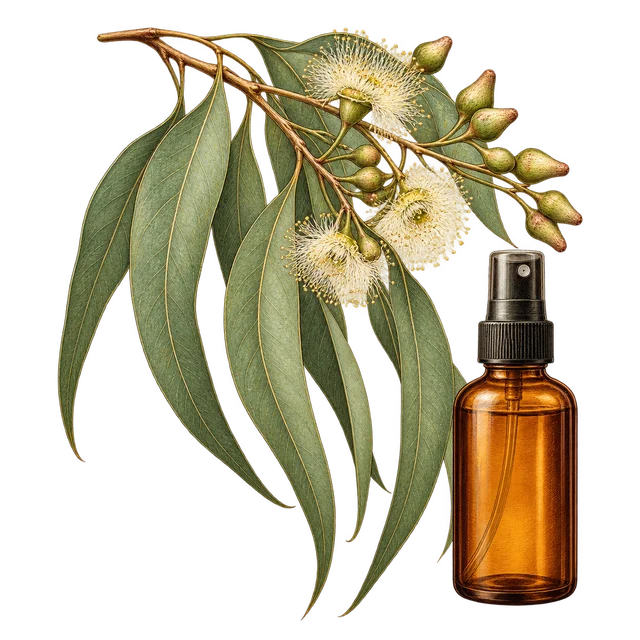
Lemon-scented gum leaves are the botanical source of processed OLE; PMD may also be manufactured synthetically.
Plant family / material: Myrtaceae (myrtle family)
Forms and route
Registered, labeled skin-applied repellent sprays or lotions containing OLE or PMD. The finished label governs protection claims and reapplication.
Absorption and preparation
Repellency concerns exposure at the skin surface or an explicitly tested spatial formulation. It is not an oral absorption goal; food pairing, teas and supplements are not established substitutes.
Traditional and reported uses
- Mosquito-bite prevention: EPA-registered OLE or PMD products are among the options recommended by CDC when used according to their labels.
- Human field and laboratory research supports formulated PMD repellents; an individual product’s performance cannot be inferred from the plant name alone.
- Registered OLE or PMD products also appear in CDC tick-bite prevention guidance; use a product whose label includes ticks.
Contraindications and cautions
- Do not use OLE or PMD products on children younger than three years, following CDC guidance.
- Do not substitute pure lemon-eucalyptus essential oil or a homemade leaf preparation for a registered repellent.
- Use only a finished product labeled for its intended site and age; concentrated oil and experimental study preparations are not home-use instructions.
Similar items and how they compare
- Eucalyptus essential oil
Similar common name
The existing card concerns cineole-rich oils, not processed OLE/PMD repellents.
- Citronella essential oil
Another plant-derived repellent ingredient
A different grass-derived oil, chemistry and evidence base.
Mosquito repellency and evidence
Human topical field and laboratory studies; CDC/EPA guidance. A botanical-derived option supported for practical bite prevention when the exact registered product is used as labeled. No blanket claim that all eucalyptus oils prevent bites or mosquito-borne disease. PMD and OLE are related but not interchangeable regulatory ingredient names; no universal protection duration is assigned.
Evidence limits
No blanket claim that all eucalyptus oils prevent bites or mosquito-borne disease. PMD and OLE are related but not interchangeable regulatory ingredient names; no universal protection duration is assigned.
Entry sources
- CDC: Preventing Mosquito Bites
- CDC Yellow Book: Mosquitoes, Ticks, and Other Arthropods
- EPA: Skin-Applied Repellent Ingredients
- Carroll & Loye (2006): PMD, a registered botanical mosquito repellent with deet-like efficacy
- Kew: Corymbia citriodora
- Maia & Moore (2011): Plant-based insect repellents, PMD development history
- FAO: Eucalyptus oils, Chapter 4
- CDC: Preventing Tick Bites
Reference entry 203 · Recorded content review: 2026-10-08 · Review scope and dates