


Key cautions
- Buy hygienically prepared material and follow the manufacturer’s cooking and storage directions. Sourness is not a reliable safety test.
- Do not use visibly moldy grain or try to rescue it by fermentation. Research showing changes in certain toxins does not establish a household detox method.
- Plain thin cereal pap is not a complete infant diet or a substitute for breast milk, formula or professional nutrition advice.
What’s inside
Primarily starch, with protein, fat, fiber and minerals dependent on milling and sieving. Organic acids and microbial metabolites contribute sour flavor.
Uses in brief

- Cooked pap
- Firm cereal gel
History, folklore and reported uses
History, folklore and traditional uses
Traditional processing: West Africa, particularly Nigeria.
A closer look at its history
One fermented cereal base, several foods
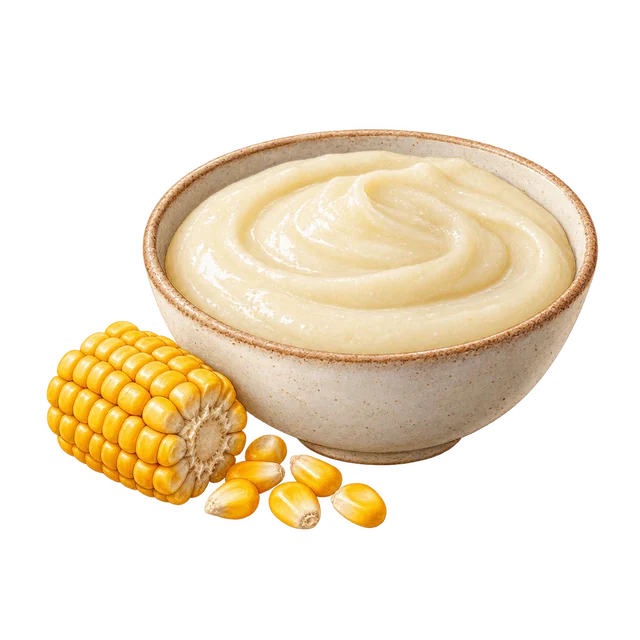
FAO’s account of African cereal fermentation describes ogi made from maize, sorghum or millet, particularly in Nigeria and Benin. Wet milling and sieving separate a starchy liquid from much of the bran and germ; fermentation and settling produce the sour material sold as a wet cake. Leaf wrapping and, later, transparent plastic packaging belong to the market history described in the report. Dilution and cooking then create a soft pap, while a firmer cooked form is known as agidi or eko. The name therefore covers a food-making tradition with several grains and textures.
A household food enters twentieth-century food science
Ogi became a subject of Nigerian food-science work because its familiar processing also removed nutrient-rich grain fractions. FAO records work by the Federal Institute of Industrial Research at Oshodi, Lagos, on a soy-enriched version reported in 1970, followed by research on drying and improving storage. That is an important historical development: researchers were adapting an existing regional food rather than inventing fermented cereal porridge. Ogi’s recorded role in infant feeding explains some of that attention, but the historical practice does not establish plain ogi as a nutritionally complete infant food.
Additional history reviewed 2026-10-09
Traditional, historical and reported uses
- Cooked pap
Food or household practiceWhy this label?
The source supports the named food, cosmetic or material practice; no treatment effect is inferred and the card’s form and safety limits remain attached.
FAO records ogi diluted and cooked as porridge. Use a safely produced food base; a traditional association with infant feeding does not replace individualized age-appropriate feeding advice.
- Firm cereal gel
Food or household practiceWhy this label?
The source supports the named food, cosmetic or material practice; no treatment effect is inferred and the card’s form and safety limits remain attached.
FAO describes a more firmly cooked gel called agidi or eko. This is a texture variation of the cereal preparation, with different water content from dry grain or thin porridge.
2 sourced featured uses; cultural or material records are not clinical efficacy evidence.
Historical-use additions reviewed 2026-10-09
Regional reading paths
These sourced notes describe cultivation, trade, food traditions or material history. A regional connection does not claim exclusive origin.
Africa
Traditional processing: West Africa, particularly Nigeria.
Sour fermented cereal base subsequently cooked into porridge or a stiff gel.
Identity & detailed reference
Identity
A fermented cereal preparation made from maize, sorghum or millet and subsequently cooked. Ogi/akamu identifies a food process and product, not one grain species or a live-culture supplement.
Ingredient details, preparation and research
Also known as: Ogi; akamu
Source plant or material
Fermented Zea mays, Sorghum bicolor or millet grain
Plant family / material: Poaceae cereal substrates; mixed fermentation microbiota
Forms and route
Wet fermented starch-rich base, dried commercial products and cooked pap; more firmly cooked forms include eko/agidi. Grain choice and processing determine the final food.
Vitamins and minerals
Sieving can remove germ and bran along with protein, fat and micronutrients. Composition depends on the cereal and dilution; nutrient claims for whole grain cannot be copied to thin ogi.
Absorption and preparation
Fermentation can change phytate and starch properties, but its effects vary. Pigeon-pea-enriched experimental ogi cannot establish nutrient absorption from plain maize ogi.
Practical preparation
Cook a prepared commercial ogi base as labeled using safe water. Refrigerate cooked leftovers promptly and reheat safely; this card gives no raw-grain fermentation timetable.
Traditional and reported uses
- Cooked pap
- Firm cereal gel
Contraindications and cautions
- Buy hygienically prepared material and follow the manufacturer’s cooking and storage directions. Sourness is not a reliable safety test.
- Do not use visibly moldy grain or try to rescue it by fermentation. Research showing changes in certain toxins does not establish a household detox method.
- Plain thin cereal pap is not a complete infant diet or a substitute for breast milk, formula or professional nutrition advice.
Processing studies have narrow scope
Original work examined bacterial succession and mycotoxin changes, while another study used maize with pigeon pea. These experiments do not guarantee food safety, a probiotic effect or equivalent composition across all ogi recipes.
Evidence limits
Prepared food profile, without infant-feeding prescription, DIY fermentation or a claim that fermentation neutralizes contaminated grain.
Entry sources
- FAO: Cereal fermentations in African countries
- Bacterial diversity and mycotoxin reduction during ogi fermentation
- Microbiological assessment of maize ogi cofermented with pigeon pea
Reference entry 315 · Recorded content review: 2026-10-09 · Review scope and dates