


Key cautions
- Use young tender pods and wash them before cutting.
- Use a tested recipe for shelf-stable pickles.
What’s inside
Water, fiber and mucilaginous polysaccharides; food references also list vitamin C, vitamin K, folate and minerals. Preparation changes the finished food.
Uses in brief

- Barbadian cou-cou
- Louisiana gumbo thickener
- Jamaican steamed-fish accompaniment
History, folklore and reported uses
History, folklore and traditional uses
Okra has a long cultivation history across Africa and Asia. Modern institutional references differ on its native origin: UF/IFAS describes likely African origins, while NParks lists Bangladesh, India and Myanmar. This card therefore does not assert one settled domestication place or date.
Its Caribbean uses are specific food traditions: Barbados combines okra with cornmeal in cou-cou, and Jamaica serves it with steamed fish. Louisiana cooks also value the pods as a gumbo thickener.
A closer look at its history
Kitchen gardens as cultural continuity
The Smithsonian’s Gardens of Resilience project places okra among crops through which African American communities preserved foodways and horticultural knowledge. The story emphasizes gardeners and cooks, rather than treating a crop’s movement as only a European shipping achievement. This source documents diaspora meaning, not an exact domestication site or first Caribbean landing.
The harvest stage explains the kitchen role
Okra is picked as an immature pod: extension gardeners repeatedly harvest tender fruits and remove missed woody ones. This makes it a crop of repeated small harvests rather than a once-a-season grain. Variety and harvest stage help explain why an overgrown pod is a poor substitute for the young vegetable.
Additional history reviewed 2026-10-10
Traditional, historical and reported uses
- Barbadian cou-cou
Food or household practiceWhy this label?
The claim records a named culinary preparation or food practice, preserving the regional and exact-form limits; it makes no clinical-efficacy claim.
Visit Barbados describes cornmeal stirred with fresh okra to make cou-cou, traditionally served with flying fish. The okra contributes to the characteristic texture of this national dish.
- Louisiana gumbo thickener
Food or household practiceWhy this label?
The claim records a named culinary preparation or food practice, preserving the regional and exact-form limits; it makes no clinical-efficacy claim.
LSU AgCenter identifies the pod mucilage as a thickening ingredient in Louisiana gumbo. This is a culinary property of the edible pods, not evidence for a medical use.
- Jamaican steamed-fish accompaniment
Food or household practiceWhy this label?
The claim records a named culinary preparation or food practice, preserving the regional and exact-form limits; it makes no clinical-efficacy claim.
Visit Jamaica specifically lists steamed fish with okra and bammy as a local meal. It documents a regional way of serving okra without implying that every Jamaican fish dish uses it.
- Roasted or sautéed vegetable
Food or household practiceWhy this label?
The claim records a named culinary preparation or food practice, preserving the regional and exact-form limits; it makes no clinical-efficacy claim.
UMass Extension lists roasting and sautéing among ways to serve okra. These preparations offer alternatives to a stew when a less sauce-like texture is wanted; the added oil remains part of the meal.
- Dilled whole-pod pickles
Food or household practiceWhy this label?
The claim records a named culinary preparation or food practice, preserving the regional and exact-form limits; it makes no clinical-efficacy claim.
The National Center for Home Food Preservation provides a tested recipe for small whole okra pods with dill, garlic and hot pepper. Its acid and heat-processing requirements are part of the method, not optional flavor suggestions.
Featured uses reflect distinct documented practices, up to seven where warranted. Food traditions and historical symbolism do not establish treatment benefits.
Historical-use additions reviewed 2026-10-09
Story sources
- Singapore NParks: Abelmoschus esculentus
- UF/IFAS: Okra, nutritional value and production practices in South Florida
- Visit Barbados: Local cuisine, cou-cou and flying fish
- LSU AgCenter: Okra in the garden
- Visit Jamaica: Jamaican food
- UMass Extension: Produce spotlight, okra
- National Center for Home Food Preservation: Pickled dilled okra
- FDA: Selecting and serving produce safely
Growing notes
Abelmoschus esculentus culinary pod cultivars.
- Season and size
- Sow after the last frost once soil is warm, commonly 2–3 weeks later; Maryland guidance uses 65°F soil. Choose compact varieties where space is limited: tall types can reach 6–10 feet. [1]
- Sun, soil and water
- Use full sun and well-drained soil. Irrigate in hot dry weather; mulch limits moisture loss. Let a soil test guide nutrients rather than applying a blanket fertilizer recipe. [2]
- Harvest and pruning
- Harvest young tender pods frequently, before woodiness develops; wear gloves for irritating spines. Remove missed old pods to sustain production. Tip pruning at about 24 inches can encourage branching. [1]
Growing sources and regional guidance
Growing notes reviewed 2026-10-10
Regional reading paths
These sourced notes describe cultivation, trade, food traditions or material history. A regional connection does not claim exclusive origin.
Africa
Long cultivated: West, Central and North African food systems; origins debated.
Immature pods cooked as vegetables and soup thickeners.
Identity & detailed reference
Identity
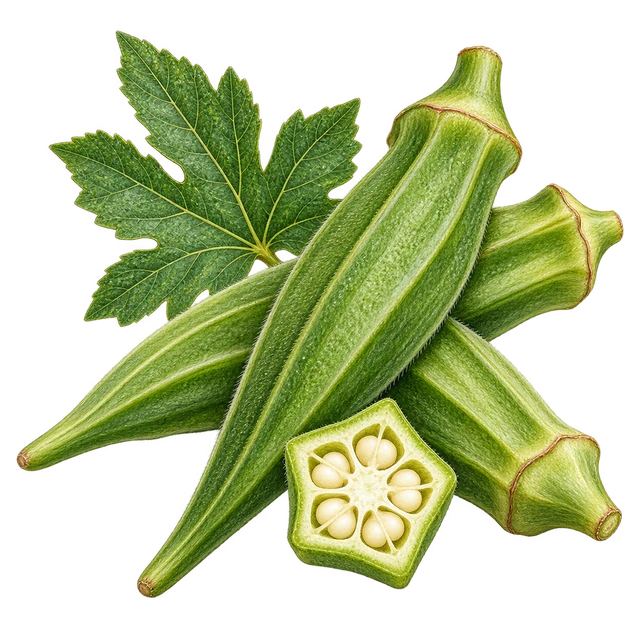
Young tender okra fruits, commonly called pods, with their soft edible seeds. This card covers market okra, not another Abelmoschus species or a seed-oil, root or leaf remedy.
Ingredient details, preparation and research
Also known as: Okra pods; Okras; Lady’s fingers; Ladies’ fingers; Ochro; Ochros; Bendi; Gumbo (okra plant)
Source plant or material
Abelmoschus esculentus (L.) Moench
Plant family / material: Malvaceae (mallow family)
Forms and route
Fresh or frozen young pods, cooked vegetables, soups and stews; properly prepared pickled pods. Mature woody pods, isolated mucilage and extracts are different materials.
Vitamins and minerals
UF/IFAS presents separate raw and boiled/drained okra profiles, including fiber, vitamin C, vitamin K and folate. These are not figures for fried okra, pickles, okra water or seed oil; this card makes no numerical serving claim.
Absorption and preparation
No special pairing is needed for an ordinary okra dish. Mucilage supplies culinary texture; that texture does not establish a glucose-lowering treatment or a medicine-absorption strategy.
Practical preparation
Choose tender, undamaged pods rather than tough mature ones. Rinse, trim the stalk end and cook whole or sliced for the intended dish. For pickles, follow the linked tested method in full.
Combination notes
Cornmeal in cou-cou and rice with gumbo are documented meal contexts. Breading, frying oil, salty sauces and pickle brine change the finished dish.
Traditional and reported uses
- Barbadian cou-cou
- Louisiana gumbo thickener
- Jamaican steamed-fish accompaniment
Contraindications and cautions
- Wash fresh pods under running water and keep them separate from raw meat or seafood during preparation. Cooking a mixed dish must also safely cook its other ingredients.
- Leaves and stems can have irritating hairs; use gloves when harvesting if your skin reacts.
- For shelf-stable pickled okra, follow a tested recipe with its specified vinegar, quantities, jar size and processing. Do not improvise from a flavor description.
- Okra water, powders and extracts are not equivalent to cooked pods and are not established substitutes for prescribed treatment.
Similar items and how they compare
- Other Abelmoschus species
Related plants can share the common name okra in some settings.
This card is limited to Abelmoschus esculentus market pods; it is not a wild-plant identification guide.
Young fruit and other plant parts
NParks distinguishes the soft green young fruit from mature fibrous pods. Its broader list of plant-part uses is not a reason to treat roots, oils or medicinal preparations as interchangeable with these vegetables.
Nutrition and disease claims
The UF/IFAS food table distinguishes raw from cooked okra. The card uses that preparation boundary, without adopting generalized disease-treatment claims or applying pod composition to okra water.
Preservation is a separate safety question
An acidic taste or a hot pepper does not establish a safe canned product. Follow the complete tested pickled-okra recipe and altitude-appropriate process.
Evidence limits
The precise origin is presented as uncertain because institutional accounts differ. Culinary texture and food composition are not clinical evidence. This review does not establish a medicinal dose or benefit for okra water, seed products or extracts.
Entry sources
- Singapore NParks: Abelmoschus esculentus
- UF/IFAS: Okra, nutritional value and production practices in South Florida
- Visit Barbados: Local cuisine, cou-cou and flying fish
- LSU AgCenter: Okra in the garden
- Visit Jamaica: Jamaican food
- UMass Extension: Produce spotlight, okra
- National Center for Home Food Preservation: Pickled dilled okra
- FDA: Selecting and serving produce safely
Reference entry 262 · Recorded content review: 2026-10-09 · Review scope and dates