


Key cautions
- Do not infer that an ornamental morning-glory root is edible from this food card.
- Use tested pressure-canning directions for preserved chunks; improvised shelf-stable mash is not covered here.
What’s inside
Sweet-potato roots supply starch, sugars and fiber. Orange-fleshed varieties contain beta-carotene, a pigment the body can convert into vitamin A. Cultivar, flesh color and cooking method affect composition, so one analysis cannot describe every pale, orange or purple root.
Utah State University: Fruit and Vegetable Guide, Sweet Potatoes · NIH ODS: Vitamin A and Carotenoids · USDA FoodData Central: SR Legacy April 2018 dataset
A cup of baked flesh
USDA record 168483 describes sweet potato baked in its skin, with the flesh alone measured and no added salt. One cup (200 g) supplies about 180 kcal, 41.4 g carbohydrate, 6.6 g fiber, 4.0 g protein, 0.3 g fat, 950 mg potassium and 39.2 mg vitamin C. Its vitamin A value is 1,922 micrograms RAE (retinol activity equivalents), a unit accounting for conversion of plant carotenoids into active vitamin A. The skin is not included in these figures.
USDA FoodData Central: SR Legacy April 2018 dataset · NIH ODS: Vitamin A and Carotenoids
Boiled is a different reference food
For skinless boiled sweet potato, USDA record 168484 gives a medium portion of 151 g: about 115 kcal, 26.8 g carbohydrate, 3.8 g fiber, 2.1 g protein, 347 mg potassium and 19.3 mg vitamin C. These are separate food records, not a controlled experiment proving how much one root loses during cooking. Added milk, butter, salt or sweeteners change a finished mash.
USDA FoodData Central: SR Legacy April 2018 dataset · Purdue Extension FoodLink: sweet potato
Uses in brief

- Baked whole root
- Mashed side dish
- Soup and stew
History, folklore and reported uses
Root, potato and yam
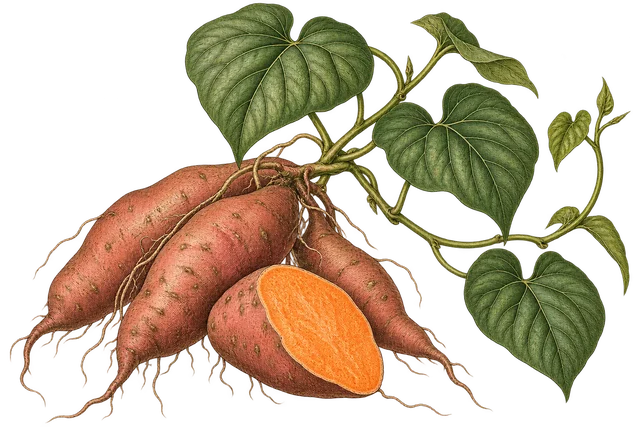
Sweet potato belongs to the morning-glory family and stores food in enlarged roots. Ordinary potatoes are stem tubers; true yams belong to Dioscorea, a different plant group. The retail habit of calling moist orange sweet potatoes “yams” does not change that identity.
A warm-climate American crop
Utah State University traces sweet potato to Central and South America. The plant needs a long, frost-free growing season to develop useful roots. Its many cultivars bring different flesh colors and cooked textures to the table.
Utah State University: Fruit and Vegetable Guide, Sweet Potatoes
From simple sides to filled meals
Bake whole roots or boil pieces for mash. Purdue’s recipes include sweet-potato pumpkin soup, black-bean stew and sweet-potato squash pancakes. Utah State adds sweet-potato and black-bean quesadillas, where the root becomes a tortilla filling. Cinnamon and allspice suit sweeter dishes; cilantro, onion and lime complement savory ones.
Purdue Extension FoodLink: sweet potato · Utah State University: Fruit and Vegetable Guide, Sweet Potatoes
Korean starch noodles
Dangmyeon are noodles made from sweet-potato starch. Korean cookbook author Maangchi describes their nearly transparent appearance after cooking and their use in japchae, a noodle-and-vegetable dish. They are processed starch, rather than whole root, and differ from similar-looking mung-bean noodles.
Leaves and shoots also have a food role
The International Potato Center records edible leaves and shoots as well as roots. That practice concerns identified food plants of Ipomoea batatas; it does not establish the edibility of ordinary potato leaves or unfamiliar ornamental morning glories.
Using the carotenoids in a meal
The body converts beta-carotene to vitamin A with variable efficiency. Preparation and the rest of the meal influence availability; some dietary fat helps the body take up carotenoids.
NIH ODS: Vitamin A and Carotenoids · Utah State University: Fruit and Vegetable Guide, Sweet Potatoes · Oregon State University, Linus Pauling Institute: Carotenoids
Food-based vitamin A research
Low and colleagues followed 741 young children and their households over two agricultural cycles in rural Mozambique. Their 2007 report described improved vitamin A intake and blood retinol, a marker of vitamin A status, after a program introducing orange-fleshed sweet potato alongside agriculture and nutrition support. This was a community intervention with comparison households, not a test of sweet potato alone or of every cultivar.
Low and colleagues, 2007: Orange-fleshed sweet potato intervention in Mozambique · Low et al. (2007): primary bibliographic record and abstract
Preparing and storing roots
Scrub sound roots under running water, remove damaged portions and cook until tender. Pierce whole roots before baking or microwaving. Keep uncooked roots in a cool, dry, dark place rather than the refrigerator, whose low temperature can harden the center and impair flavor.
Utah State University: Fruit and Vegetable Guide, Sweet Potatoes · Purdue Extension FoodLink: sweet potato
Growing notes
Ipomoea batatas selected for edible storage roots; not true yams (Dioscorea), potatoes, or an assurance that ornamental cultivars are food crops.
- Climate and planting
- Treat as a very tender warm-season crop in temperate gardens. Plant healthy slips after the last spring frost and when soil reaches about 65°F. This is a frost-free-season decision, not simply a USDA hardiness-zone match. [1]
- Sun, soil and spacing
- Choose full sun and loose, well-drained soil; ridges help drainage and root expansion. Maryland recommends about 12 inches between slips and 40 inches between rows. Allow sprawling vines room rather than crowding adjacent plants. [1]
- Water and fertility
- Keep moisture even, especially during the first 50–60 days. Water deeply in dry weather without saturating the soil. Use soil-test guidance: more nitrogen is not automatically more root yield. [1]
- Harvest and lifecycle
- Many cultivars take about 85–120 days from planting. Check a sample root at about 80–85 days and harvest before frost. Lift gently because skins bruise readily; curing and storage are separate steps, not permission to leave damaged roots warm and wet. [1]
Growing sources and regional guidance
Growing notes reviewed 2026-10-12
Regional reading paths
These sourced notes describe cultivation, trade, food traditions or material history. A regional connection does not claim exclusive origin.
North America
Cultivated: Mexico and Caribbean, including Trinidad and Tobago.
Cooked storage roots used as a staple.
South America
cultivated native American crop; Peru
Cooked storage root.
Australia & Oceania
cultivated; New Zealand, Hawaiʻi and Papua New Guinea
Cooked storage roots.
Identity & detailed reference
Identity
The edible storage root of sweet potato, a morning-glory relative; it is neither true yam nor ordinary potato.
Ingredient details, preparation and research
Also known as: sweet potatoes
Source plant or material
Ipomoea batatas (L.) Lam.; The edible storage root of sweet potato, a morning-glory relative; it is neither true yam nor ordinary potato.
Plant family / material: Convolvulaceae
Combination context
A meal containing some fat can support carotenoid uptake. Pair with beans or other foods for a mixed meal; no special spice or juice is necessary.
Traditional and reported uses
- Purdue describes baking the whole root as a vegetable side.
- Cooked roots can be mashed; additions determine the final dish.
- Purdue documents sweet-potato pumpkin soup and a black-bean stew.
- Purdue lists sweet-potato squash pancakes as a distinct batter-based use.
- Utah State provides a sweet-potato and black-bean quesadilla preparation.
Contraindications and cautions
- Do not infer that an ornamental morning-glory root is edible from this food card.
- Use tested pressure-canning directions for preserved chunks; improvised shelf-stable mash is not covered here.
Similar items and how they compare
- True yam
Both are starchy underground foods.
Dioscorea yams belong to a different family.
- Potato
Both are cooked staple vegetables.
Potato is a Solanum stem tuber; sweet potato is an Ipomoea storage root.
Entry sources
- Purdue Extension FoodLink: sweet potato
- Utah State University: Fruit and Vegetable Guide, Sweet Potatoes
- Utah State University: Sweet Potatoes in the Garden
- NIH ODS: Vitamin A and Carotenoids
- FDA: Selecting and Serving Produce Safely
- International Potato Center: Sweetpotato
- Maangchi: Starch noodles (dangmyeon)
Reference entry 163 · Recorded content review: 2026-10-07 · Review scope and dates