


Key cautions
- Never substitute Artemisia tea, capsules or extracts for prescribed malaria prevention or treatment.
- Avoid self-directed medicinal use in pregnancy or with liver disease; herbal tea-associated liver injury has been reported.
What’s inside
Artemisinin, a sesquiterpene lactone, plus other variable plant constituents; content depends on cultivar, harvest and preparation.
Uses in brief

- Historical Chinese fever remedy and botanical source of artemisinin; the plant is not recommended for preventing or treating malaria.
History, folklore and reported uses
History, folklore and traditional uses
Chinese qinghao fever remedies helped guide Tu Youyou’s twentieth-century research. In her Nobel biography she describes returning to Ge Hong’s text, then testing extraction methods and identifying artemisinin. The historical lead mattered, but purification, pharmacology and clinical development were crucial steps.
Traditional, historical and reported uses
- Fever traditions
Traditional accountWhy this label?
Kew attributes Chinese fever use over a long period; no particular archival passage or research result is identified in this claim.
Kew records more than two millennia of Chinese fever use; this describes historical practice rather than current malaria advice.
- Other traditional complaints
Traditional accountWhy this label?
Kew records traditional multi-herb indications rather than efficacy established by clinical studies.
Kew also records multi-herb use for jaundice, headache, dizziness and nosebleeds. These should not be read as validated indications.
- Aromatic ornamental wreaths
Food or household practiceWhy this label?
The claim documents aromatic ornamental wreaths as a culinary, craft, gardening, or practical material use; it reports neither a treatment outcome nor measured nutrient content.
Montana State University’s crop-research account identifies Artemisia annua, also called Sweet Annie, and records aromatic wreaths made from its foliage. This is a craft use separate from medicinal fever traditions.
- Historical beverage flavoring
Food or household practiceWhy this label?
The claim documents historical beverage flavoring as a culinary, craft, gardening, or practical material use; it reports neither a treatment outcome nor measured nutrient content.
The same university account describes Artemisia annua as historically used to flavor beverages. It supplies no regional chronology or recipe, so this remains a general flavoring-history record rather than an ancient-drink reconstruction or recommendation to consume wormwood.
Only specifically supported historical or culinary uses are included; tradition is not evidence of effectiveness.
Historical-use additions reviewed 2026-10-08
Identity & detailed reference
Identity
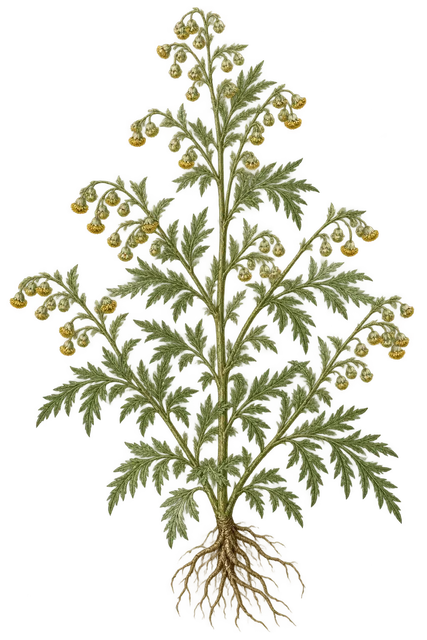
Artemisia annua aerial parts, especially leaves/flowering stems; distinct from A. absinthium (wormwood) and A. vulgaris (mugwort).
Ingredient details, preparation and research
Also known as: Sweet Annie; Qinghao
Source plant or material
Artemisia annua aerial parts, especially leaves/flowering stems; distinct from A. absinthium (wormwood) and A. vulgaris (mugwort).
Plant family / material: Asteraceae
Forms and route
Dried herb, teas and supplements are separate from purified artemisinin derivatives and prescribed combination medicines.
Vitamins and minerals
No dietary nutrient serving is assigned to this medicinal aerial-part preparation.
Absorption and preparation
Variable artemisinin content and extraction make tea exposure unreliable. Improving home extraction cannot substitute for a regulated combination medicine.
Traditional and reported uses
- Historical Chinese fever remedy and botanical source of artemisinin; the plant is not recommended for preventing or treating malaria.
Contraindications and cautions
- Never substitute Artemisia tea, capsules or extracts for prescribed malaria prevention or treatment.
- Avoid self-directed medicinal use in pregnancy or with liver disease; herbal tea-associated liver injury has been reported.
Similar items and how they compare
- Wormwood
A shared common-name family.
Artemisia absinthium is a different species; its preparations and safety literature cannot stand in for A. annua.
Plant versus medicine
WHO does not support Artemisia plant material in any form for malaria prevention or treatment. Variable constituents, inadequate dosing and treatment failure are concerns; a plant supplement is not an artemisinin-based combination therapy.
Historical interpretation
Tu’s first-person account connects textual clues with experimental drug discovery. It does not validate reproducing an ancient preparation at home.
Safety evidence
A published tea-associated hepatitis case is a safety signal, not an incidence estimate. Stop and seek care for jaundice or other signs of liver injury.
Evidence limits
- No home malaria regimen or medicinal dose is provided.
Entry sources
- Kew: Artemisia annua species profile
- WHO: Non-pharmaceutical forms of Artemisia
- Tu Youyou: Nobel biographical account
- Case of cholestatic hepatitis after Artemisia annua tea
- Montana State University Western Agricultural Research Center: Annual Wormwood
Reference entry 197 · Recorded content review: 2026-10-07 · Review scope and dates