


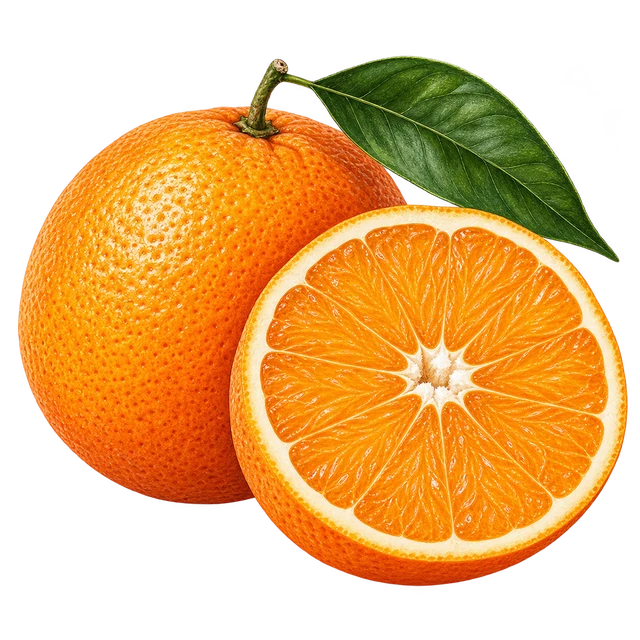
Key cautions
- Orange juice can interfere with some medicines.
- Use treated juice when foodborne risk matters.
- Sweet fruit, bitter-orange supplements and essential oil differ.
What’s inside
Fruit vitamin C and carbohydrate; the whole edible fruit also contains fiber. Peel is an aromatic food ingredient, not a whole-fruit nutrient serving.
Uses in brief

- Fresh segments
- Orange juice
- Culinary zest
- Candied peel
History, folklore and reported uses
History, folklore and traditional uses
Sweet orange is a cultivated citrus hybrid with Asian ancestry. University of Arizona guidance describes the mandarin and pummelo ancestry shared by sweet and sour oranges, while distinguishing their food uses.
Its growing and food traditions spread far beyond Asia. University of California’s historical account follows sweet oranges through Mediterranean trade to California and the development of the navel-orange industry.
Traditional, historical and reported uses
- Fresh segments
Food or household practiceWhy this label?
Describes eating sweet-orange fruit, with horticultural identity retained.
University of Arizona guidance distinguishes sweet eating oranges from bitter types and describes navel fruit as a fresh-food choice. Peeled segments are a fruit serving; the name orange covers cultivars with different taste and texture.
- Juice
Food or household practiceWhy this label?
Records juicing of the specified sweet-orange food type.
Valencia and other sweet-orange cultivars are grown for juice. Fresh fruit and juice are distinct food forms, and a juice’s concentration, treatment and added ingredients matter.
- Fragrant zest in cooking
Food or household practiceWhy this label?
Records culinary use of peel, not essential-oil therapy.
The Arizona guide specifically suggests zesting orange peel for culinary use. Use the colored outer peel from food fruit; an essential-oil bottle is not an equivalent recipe ingredient.
- Candied sweet-orange peel
Food or household practiceWhy this label?
Describes a confection made from peel, with a distinct composition.
University of California Riverside’s fruit account records candied peel as a sweet-orange use. This is a sugar-preserved confection and should not inherit the fresh fruit’s nutrient panel.
Featured uses are distinct documented practices, not a quota. Cultural and medicinal accounts preserve their named place and material; they do not establish clinical benefit.
Historical-use additions reviewed 2026-10-09
Story sources
- Kew POWO: Citrus × sinensis, synonym of Citrus × aurantium f. aurantium
- University of California Agriculture and Natural Resources: California Citrus and the Mother Orange Tree
- University of Arizona Cooperative Extension: Oranges for Southern Arizona
- University of California Riverside: Tropical and subtropical fruits, sweet-orange uses
Identity & detailed reference
Identity
The familiar sweet-orange fruit, including navel, Valencia and blood-orange cultivars. Kew currently places the name Citrus × sinensis under Citrus × aurantium f. aurantium; this broader taxonomy does not make the food interchangeable with bitter/Seville orange, grapefruit or stimulant supplements.
Ingredient details, preparation and research
Also known as: Orange; Sweet orange; Naranja dulce; Citrus sinensis; Citrus × sinensis; Navel orange; Valencia orange; Blood orange
Source plant or material
Citrus × sinensis (L.) Osbeck (sweet-orange horticultural name; Kew synonym of Citrus × aurantium f. aurantium)
Plant family / material: Rutaceae
Forms and route
Fresh segments, juice and food-grade peel or zest. Distilled essential oil, bitter-orange extracts and synephrine supplements are separate products.
Vitamins and minerals
NIH ODS gives approximately 70 mg vitamin C for 1 medium orange and 93 mg for ¾ cup of orange juice. These are separate reference portions, not an equal-volume comparison or a reason to prefer juice. Fortified beverages, concentrated juice, marmalade and zest need their own labels or food-composition entries.
Absorption and preparation
Vitamin C improves absorption of nonheme iron from a meal. Heating and storage can reduce it; the food’s vitamin content is not proof that it prevents colds or treats an illness.
Practical preparation
Wash oranges before peeling, cutting or zesting. Use clean utensils, refrigerate cut fruit and follow juice storage directions. Follow food-grade product instructions for dried peel or zest.
Combination context
Enjoy alongside beans, grains or other foods as a vitamin-C-containing part of a meal; no special medicinal mixture is established.
Combination notes
Use segments or zest in ordinary dishes according to taste. Added sugar and other recipe ingredients have their own nutritional effects.
Traditional and reported uses
- Fresh segments
- Orange juice
- Culinary zest
- Candied peel
Contraindications and cautions
- Follow medicine labels about fruit juice. FDA notes that orange juice can reduce absorption of fexofenadine; use the liquid directed on the medicine label and ask a pharmacist about your medicines.
- Choose pasteurized or otherwise treated juice, especially for people at increased risk of foodborne illness. Fresh-squeezed juice is not automatically free of pathogens.
- Bitter-orange and synephrine supplements are not sweet-orange fruit. Do not transfer their advertised weight-loss effects or safety assumptions to this food.
- Use only food-grade peel or products intended for eating. This card does not authorize swallowing essential oil or other concentrated orange products.
Similar items and how they compare
- Bitter / Seville orange
Shares citrus ancestry and overlapping botanical names in some classifications.
A different horticultural food type, with separate medicinal-extract and supplement exposures.
- Grapefruit
Another citrus fruit that can appear in broad hybrid taxonomic treatments.
Its interaction profile and nutrient data must not be copied to sweet orange; medicine advice is product-specific.
- Orange essential oil
Obtained from aromatic citrus material.
A concentrated oil is not equivalent to zest, fruit or juice and should not be treated as an ordinary food serving.
Current taxonomy needs a culinary qualifier
On the review date, Kew treated Citrus × sinensis as a synonym of Citrus × aurantium f. aurantium. The familiar horticultural name is retained with that qualification so the reader can identify sweet orange without importing claims from other citrus grouped under broad botanical treatments.
Bitter-orange supplement evidence is a different question
NCCIH reports uncertain benefit and safety concerns around some bitter-orange supplements, often multi-ingredient products. Those studies do not test eating a sweet orange, and the common overlap in botanical naming does not erase the preparation difference.
Juice interactions are medicine-specific
FDA explicitly includes orange and apple juice in its warning that fexofenadine may be absorbed less well. This is not the same mechanism or a blanket claim that every sweet orange has grapefruit-like effects.
Evidence limits
This is a sweet-orange food overview, not an essential-oil, bitter-orange or weight-loss-supplement monograph. Taxonomic conventions differ among sources. No fruit or juice treatment claim is made.
Entry sources
- Kew POWO: Citrus × sinensis, synonym of Citrus × aurantium f. aurantium
- University of California Agriculture and Natural Resources: California Citrus and the Mother Orange Tree
- Kew POWO: Citrus × aurantium f. aurantium, accepted treatment
- University of Arizona Cooperative Extension: Oranges for Southern Arizona
- University of California Riverside: Tropical and subtropical fruits, sweet-orange uses
- NIH NCCIH: Bitter Orange, evidence and safety
- NIH ODS: Vitamin C, food reference servings and absorption
- FDA: Grapefruit Juice and Some Drugs Don’t Mix, including orange juice and fexofenadine
- FDA: What You Need to Know About Juice Safety
- FDA: Selecting and Serving Produce Safely
Reference entry 280 · Recorded content review: 2026-10-09 · Review scope and dates