


Key cautions
- Do not assume raw use is appropriate; seek individualized advice if advised to restrict oxalate.
- Use authenticated produce from clean food-growing conditions.
What’s inside
Leaf solids include fibre and oxalates; oxalate content can vary with plant age and growing conditions.
Uses in brief

- Cooked leafy vegetable
- Horticultural food crop
History, folklore and reported uses
History, folklore and traditional uses
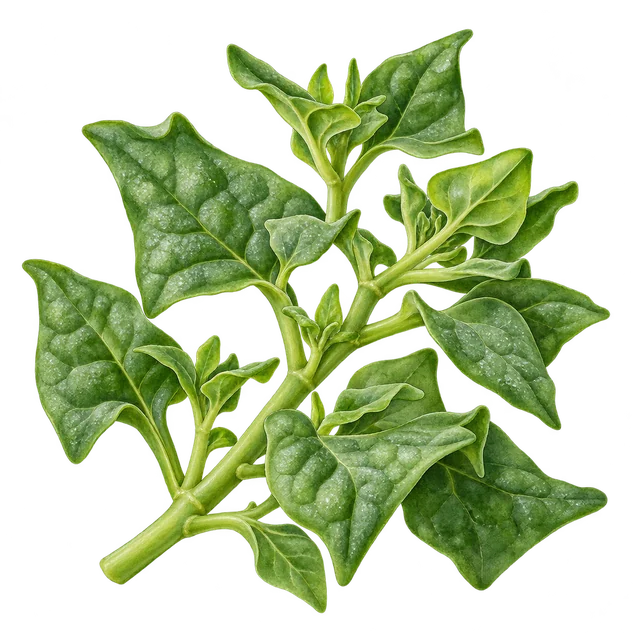
Warrigal greens are part of Australian native-food cultivation and are also associated with New Zealand. Their common English name describes their vegetable role, while their family and species distinguish them from ordinary spinach.
Traditional, historical and reported uses
- Cooked leafy vegetable
Food or household practiceWhy this label?
Sources document this named food or material use; no therapeutic outcome is claimed.
NSW Parks presents warrigal greens as an ingredient in cooked native-green dishes. The food scope is prepared leaves, not ornamental seed or unidentified coastal vegetation.
- Horticultural food crop
Food or household practiceWhy this label?
Sources document this named food or material use; no therapeutic outcome is claimed.
Southern Cross University and primary cultivation research investigate the plant as a vegetable crop, supporting cultivated food supply rather than dependence on casual foraging.
2 narrowly supported uses; no clinical efficacy or universal preparation is inferred.
Historical-use additions reviewed 2026-10-09
Regional reading paths
These sourced notes describe cultivation, trade, food traditions or material history. A regional connection does not claim exclusive origin.
Australia & Oceania
native; Australia and New Zealand
Prepared leafy vegetable.
Identity & detailed reference
Identity
Tetragonia tetragonioides; warrigal greens or New Zealand spinach, not Spinacia oleracea.
Ingredient details, preparation and research
Source plant or material
Tetragonia tetragonioides; warrigal greens or New Zealand spinach, not Spinacia oleracea.
Plant family / material: Aizoaceae
Forms and route
Food-grade leaves and tender shoots prepared as a leafy vegetable.
Vitamins and minerals
No universal nutrient value or oxalate reduction percentage is supplied. Raw, blanched and drained leaves are different analytical foods.
Absorption and preparation
Cooking and discarding water can alter soluble constituents. That is not a guarantee that every preparation is suitable for a person with an oxalate-related dietary restriction.
Practical preparation
Prefer cultivated, identified produce. Follow established food preparation guidance for blanching/cooking; do not substitute a raw salad instruction for the specific greens. Do not use this card to rescue unknown plants.
Traditional and reported uses
- NSW Parks presents warrigal greens as an ingredient in cooked native-green dishes. The food scope is prepared leaves, not ornamental seed or unidentified coastal vegetation.
- Southern Cross University and primary cultivation research investigate the plant as a vegetable crop, supporting cultivated food supply rather than dependence on casual foraging.
Contraindications and cautions
- Do not assume raw use is appropriate; seek individualized advice if advised to restrict oxalate.
- Use authenticated produce from clean food-growing conditions.
Oxalates require preparation-specific context
Ahmed and Johnson studied plant growth and oxalate variation under controlled nutrient treatments. The experiment supports the existence of variation; it does not provide a universal home treatment that makes any amount appropriate for everyone.
Research is not a nutrient ranking
Cultivation research can improve crop quality and production. It should not be rewritten as proof that native spinach treats illness or is nutritionally superior to every other leafy vegetable.
Evidence limits
This is a food/material reference, not evidence of disease treatment. Geographic and customary-use records do not establish a medicinal dose. Nutrient quantities are omitted unless a matching food form and serving have been verified.
Entry sources
- NSW National Parks: Bush tucker on the menu
- Ahmed and Johnson: Growing Australian native edible plants using hydroponic techniques
- Southern Cross University: Native spinach research
Reference entry 488 · Recorded content review: 2026-10-09 · Review scope and dates