


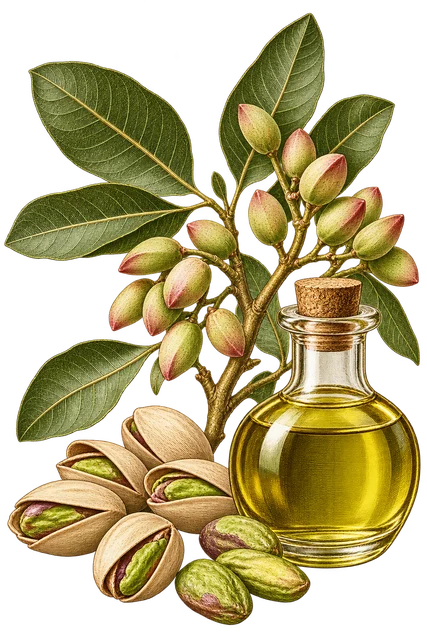
Key cautions
- Pistachio allergy applies to oils too; refining is no blanket safety guarantee
- Keep cosmetic bottles out of food.
What’s inside
This is concentrated seed fat, mainly triglycerides carrying oleic and linoleic fatty acids. Smaller fractions include tocopherols, plant sterols and pigments. The composition of whole pistachios or press-cake flour must not be assigned to the separated oil.
Martínez et al. (2016): Argentinian pistachio oil and flour, oil composition table
Fatty acids in a measured pressed oil
In a study of Argentinian Kerman pistachios, screw-pressed oils contained 53.5–55.3% oleic acid and 29.0–31.4% linoleic acid, expressed as relative shares of fatty acids. Oleic is monounsaturated; linoleic is an omega-6 polyunsaturated fat. These sample values are not grams per 100 g of whole kernels or a guarantee for other cultivars.
Martínez et al. (2016): Argentinian pistachio oil and flour, oil composition table
Composition and a practical nutrient calculation
The Argentinian oil study measured alpha-tocopherol at 31–33 micrograms/g. For a weighed 10 g portion: 31–33 × 10 ÷ 1,000 = 0.31–0.33 mg, or about 2.1–2.2% of the 15 mg Daily Value. Gamma-tocopherol was much higher. These are sample-specific values, not a guaranteed bottle specification; the study’s flour nutrient findings belong to the flour.
Martínez et al. (2016): Argentinian pistachio oil and flour, oil composition table · NIH ODS: Vitamin E, alpha-tocopherol requirements and absorption
Pigments and minor constituents
Carotenoids and chlorophylls contribute to the appearance of virgin oil, alongside variable tocopherols and plant sterols. These analytical findings describe the oil; antioxidant tests do not demonstrate disease prevention in people.
Martínez et al. (2016): Argentinian pistachio oil and flour, oil composition table · Cassiday, INFORM (June 2018): Unconventional oils, pistachio sensory profile and gourmet use; PDF hosted by FAO
Uses in brief

- Food-grade dressing/finishing oil; cosmetic skin and hair conditioning
- A small trial studied a 10% knee ointment, with replication still needed
In the King James Bible
Possible source-plant connection: pistachio nuts
Probable botanical identification
Genesis includes “nuts” among Jacob’s gifts from the land. Pistachios, Pistacia vera, are a commonly proposed identification of these nuts, although the KJV does not name the species. Pistachio oil is a different preparation from the gift nuts described.
And their father Israel said unto them, If it must be so now, do this; take of the best fruits in the land in your vessels, and carry down the man a present, a little balm, and a little honey, spices, and myrrh, nuts, and almonds:
Genesis 43:11 (KJV)
Scripture and identification sources
Words & their stories
WORDS & THEIR STORIES
The name behind the KJV
Biblical Hebrew · Genesis 43:11 (KJV)
בָּטְנִיםboṭnīm
The “nuts” in Jacob’s gift list, usually understood as pistachios.
Dictionary form: בָּטְנִים · boṭnīm
Brown–Driver–Briggs lists the attested plural as its headword. It records more than one Pistacia identification. The first qamats has the short o reading in boṭnīm.
What the language reveals
Two different nuts in one list
Boṭnīm is followed by šəqēdīm, almonds. The Hebrew therefore distinguishes these gift nuts from the almonds.
Keep the species claim modest
The lexicon records both P. vera and a terebinth identification. Pistachio is a strong interpretation, not a modern botanical label supplied by the verse.
Pistacia vera is the customary connection for this card. The text mentions gift nuts rather than pistachio oil.
History, folklore and reported uses
Botanical identity and plant part
The source is the kernel of Pistacia vera in Anacardiaceae, the cashew family. The oil is the nonvolatile seed-fat fraction. Seed oil, skin/pericarp extracts and resins have different compositions; sharing a genus name does not make them interchangeable. Check the botanical name and the actual part on the label.
Kew Plants of the World Online: Pistacia vera L., accepted name and family · COSMILE Europe: Pistacia vera seed oil, skin-conditioning function
From Central Asian groves to orchards
Pistachio oil begins with a tree whose edible kernels travelled far from their Central Asian home. A 2022 study drawing together archaeological, genetic and linguistic evidence places the crop’s domestication within a broad region covering southern Central Asia, northern Iran and northern Afghanistan. The tree grows on dry foothills and has separate male and female plants: farmers moving it into new orchards needed suitable land and pollinating neighbours. Iranian medical traditions also gave the kernel a place among strengthening foods, describing it in the language of tonics for organs such as the stomach and heart.
Mir-Makhamad et al. (2022): Pistachio domestication and dispersal out of Central Asia · Bozorgi et al. (2013): Traditional uses distinguished across five Pistacia species
From kernels to a specialty pressed oil
The pressed oil now sold as a specialty culinary or cosmetic ingredient is a more specific material. Modern work on virgin pistachio oils examines how cultivars and processing shape that product and its remaining press cake. Its heritage can therefore connect orchard, food and pressing craft without claiming that every old use of pistachio was an oil treatment. Wild Pistacia fruit oils, mastic-like resins and commercial edible-pistachio kernel oil also need separate names; they come from different materials, and sometimes different species.
Ojeda-Amador et al. (2018): Composition and properties of virgin pistachio oils and their by-products · Martínez et al. (2016): Argentinian pistachio oil and flour, oil composition table · COSMILE Europe: Pistacia vera seed oil, skin-conditioning function
A specialty food oil
Pressed Pistacia vera kernel oil is a modern specialty food ingredient, studied alongside the flour left after pressing. This is the concentrated edible fat of pistachio kernels.
Martínez et al. (2016): Argentinian pistachio oil and flour, oil composition table
A facial cleansing oil in Jordan
Bozorgi and colleagues’ ethnobotanical table specifically records Pistacia vera oil as a facial skin cleanser in Jordan. The record identifies the species and oil, although it does not describe the extraction method.
Bozorgi et al. (2013): Traditional uses distinguished across five Pistacia species
Skin conditioning
COSMILE records Pistacia vera seed oil as a skin-conditioning cosmetic ingredient. Its modern beauty use concerns the softer feel left by the kernel oil.
COSMILE Europe: Pistacia vera seed oil, skin-conditioning function
A modern joint-care ointment
Iranian researchers at Rafsanjan investigated cold-pressed Pistacia vera oil compounded into an ointment for painful osteoarthritic knees. This is a modern clinical investigation of a specifically prepared natural-medicine product.
Related food tradition: the strengthening kernel
The traditional-medicine history summarized by Bozorgi and colleagues describes Pistacia vera kernels as strengthening foods and tonics for organs including the stomach and heart. This use belongs to the kernel, and is retained as comparison rather than attributed to isolated oil.
Bozorgi et al. (2013): Traditional uses distinguished across five Pistacia species
Identity & detailed reference
Identity
Pistacia vera L. kernel/seed fixed oil. It is distinct from pistachio nut paste, pericarp extracts, mastic resin and essential oils or fruit oils of other Pistacia species.
Ingredient details, preparation and research
Source plant or material
Pistacia vera L.; fixed oil from the edible seed or kernel.
Plant family / material: Anacardiaceae (cashew family).
Forms and route
Food-grade virgin/cold-pressed, roasted-kernel or refined culinary oils; separate cosmetic carrier oils and finished skin/hair products. A 10% research ointment is a specific preparation, not equivalent to a culinary bottle.
Food sources
Only a labeled food-grade pistachio oil belongs in meals. A measured small drizzle can flavor vegetables, grain salads or a dressing; whole pistachios remain a different food.
Vitamins and minerals
A measured 10 g portion of the oils in one Argentinian study provides approximately 0.31–0.33 mg alpha-tocopherol, about 2% of the 15 mg U.S. Daily Value. The much larger total-tocopherol figure is mostly gamma-tocopherol. Do not transfer whole-pistachio potassium, copper, vitamin B6, protein or fibre claims to the oil.
Absorption and preparation
Food-grade oil is digested as fat. Dietary fat can support uptake of fat-soluble nutrients, but no extra oil or special pairing is required. Skin slip or a dry finish does not measure penetration, and the ointment researchers identified absorption as an unresolved question.
Practical preparation
Choose unroasted or roasted-kernel oil for the desired aroma, and check the label for heat use and storage. Keep tightly closed, cool and protected from light; use the stated expiry rather than an invented universal shelf life. For cosmetics, follow the finished formula’s site and frequency directions.
Combination notes
Vegetables with an edible oil are a practical meal combination; no pistachio-specific absorption synergy is established. Mixing a cosmetic with essential oils or prescribed topicals changes the formula and is not justified by the ointment trial.
Traditional and reported uses
- Food use: a specialty nut-flavoured dressing or finishing fat, using an edible labeled product.
- Cosmetic use: skin conditioning and oily lubrication of dry-feeling hair lengths.
- Preliminary human research: one small three-month knee-osteoarthritis trial of a 10% ointment; no established claim for pure oil to regrow hair or cure skin disease.
Contraindications and cautions
- Avoid pistachio oil with known pistachio allergy unless an allergy clinician specifically clears the product; cold pressing does not remove the allergy concern.
- Refining may substantially reduce residual protein but is not a promise that every bottle is safe. Do not challenge a known allergy with a home skin test.
- Use only the intended food or cosmetic route. Stop a skin product that causes itching, swelling or persistent redness; the trial does not establish safety in pregnancy or on broken skin.
Similar items and how they compare
- Sweet almond oil
Both are oleic-containing kernel oils used in culinary or cosmetic products, with lubrication as their shared skin and hair role.
Pistachio often has more pigments and a different balance of oleic and linoleic acids.
- Hazelnut oil
Both are nut-derived liquid oils with oleic acid as a major component, suitable for comparing fatty-acid profiles and cosmetic roles.
Hazelnut is usually more oleic-dominant; both require their own nut-allergy assessment.
Culinary and cosmetic context
Pistachio nuts have a long food history, while this card concerns the extracted specialty oil. COSMILE records skin conditioning as its cosmetic function. A lubricated, softer-feeling hair fibre or smoother skin surface is a plausible cosmetic goal, but is not evidence of new hair growth, sebum normalization, acne treatment or systemic nourishment through the skin.
What processing changes
Pressing, roasting kernels and refining are separate steps. A 2024 food experiment found that roasting method and storage changed oxidation measures. That is useful quality-control evidence, not a home heating prescription or proof that all roasted oils are healthier. Aroma, pigments and minor compounds vary among oils; the label’s intended heat use takes priority over a generic smoke-point chart.
Human evidence: a specific knee ointment
A 2023 paper reported 89 patients assigned to 10% cold-pressed Pistacia vera oil ointment, 0.5% piroxicam gel or ointment base for three months. Pain/function scores favored the oil preparation over base. It was a small, single-clinic trial with multiple outcomes and limited formulation/absorption characterization. Absence of a significant difference on some measures does not prove equivalence to piroxicam. It does not establish a kitchen-oil dose or a replacement for arthritis care.
A newer Pistacia study is not the same ingredient
The 2025 knee trial concerns Pistacia atlantica fruit oil. It cannot be treated as replication of a Pistacia vera kernel-oil result. Likewise, a pistachio pericarp ointment tests a different plant part. Botanical and preparation matching matters more than finding the word pistachio in a headline.
Absorption is route-specific
In digestion, pancreatic enzymes and bile help process dietary fats and fat-soluble vitamins. This does not mean more oil continually improves absorption. No validated percentage of pistachio oil penetrating human skin was established in the reviewed trial. Dietary intake, local skin conditioning and drug delivery are separate questions.
Allergy, skin tolerance and interactions
Unrefined tree-nut oils can retain allergenic proteins. Highly refined oils generally contain less, but suitability with a diagnosed allergy needs product-specific clinical advice. A home tolerance check cannot rule out food allergy. No specific clinically established medication interaction for ordinary culinary pistachio oil was identified in the reviewed evidence; that is not a guarantee for concentrated extracts or mixed cosmetics.
Related oils and sensible combinations
Hazelnut oil is another oleic-rich kernel oil; walnut oil typically supplies more polyunsaturated fat, including ALA. These comparisons concern composition, flavor and use, not interchangeable allergy safety. An edible drizzle over a vegetable dish is a serving suggestion, not a clinically proven synergistic remedy. Store and use cosmetic formulations separately.
Entry sources
- Kew Plants of the World Online: Pistacia vera L., accepted name and family
- COSMILE Europe: Pistacia vera seed oil, skin-conditioning function
- Shakerardekani and Rahdari (2024): Roasting method and storage effects on pistachio-oil oxidation
- Abbasifard et al. (2023): Randomized three-arm trial of 10% pistachio seed-oil ointment in knee osteoarthritis
- Azizi et al. (2025): Pistacia atlantica fruit-oil knee-osteoarthritis trial, a different species
- Martínez et al. (2016): Argentinian pistachio oil and flour, oil composition table
- NIH ODS: Vitamin E, alpha-tocopherol requirements and absorption
- NIDDK: Your digestive system and how it works
- Allergy UK: Tree nut allergy, refined and unrefined oils and cosmetics
- American Academy of Dermatology: How to test skin care products
- Maguire et al. (2004): Nut fatty acids, tocopherols, squalene and phytosterols
Reference entry 71 · Recorded content review: 2026-10-05 · Review scope and dates