


Key cautions
- Do not assume every plant called mint is edible or that every Mentha oil has the same safety. Avoid substituting pennyroyal or an unidentified wild mint.
- Peppermint leaf preparations can worsen reflux or heartburn; people with gallstones or bile-related problems should seek advice before medicinal use.
- The small hormone studies do not establish long-term reproductive safety or treatment effectiveness. If considering regular medicinal use for hormonal symptoms, especially during pregnancy, while trying to conceive or alongside hormonal treatment, ask for product-specific clinical advice. The studies do not demonstrate a clinically important hormone effect from ordinary food portions.
- Specific spearmint studies reported occasional symptoms such as heartburn, headache or bowel changes, and one knee-trial participant withdrew with mint sensitivity. Stop a preparation that causes irritation or an allergic reaction. Small short trials cannot establish safety for everyone or for every mint extract.
What’s inside
The nutrient example is fresh spearmint leaf eaten as food. Strained tea leaves most fiber behind, and distilled oil does not contain a whole-leaf vitamin or mineral serving. Plant species, cultivar and extraction method also change the aromatic and phenolic mixture.
USDA FoodData Central: primary SR Legacy food, nutrient and portion data · Tisserat, Berhow and Vaughn (2009): Spearmint plantlet culture and secondary metabolism
Nutrients in fresh spearmint
USDA’s reference portion is 2 tablespoons of fresh spearmint weighing 11.4 g (0.40 oz). Its separate two-leaf portion weighs only 0.3 g, so a garnish contributes much less. These are modern spearmint values, not measurements of biblical mint or every garden variety.
- Energy: about 5 kcal
- Carbohydrate: 0.96 g, including about 0.78 g fiber
- Protein: 0.38 g; total dietary fat: 0.08 g
- Calcium: 22.7 mg; iron: 1.35 mg
- Magnesium: 7.2 mg; potassium: 52 mg
- Folate: 12 micrograms; vitamin A: 23 micrograms RAE, the unit used for vitamin A activity
USDA FoodData Central: primary SR Legacy food, nutrient and portion data
Carvone and mint aromas
Spearmint contains carvone, an important volatile aroma compound. Peppermint, Mentha × piperita, is a different mint hybrid whose oil is commonly menthol-rich. Closely related species and cultivated chemical types can differ substantially, so an oil profile or selected plant line cannot describe all culinary mints.
Tisserat, Berhow and Vaughn (2009): Spearmint plantlet culture and secondary metabolism · NCCIH: Peppermint Oil, usefulness and safety
Rosmarinic acid and selected extracts
Spearmint contains rosmarinic acid, a nonvolatile phenolic compound. Selectively bred plants and concentrated extracts may contain much more than ordinary garden mint. The memory trial used a dried water extract of aerial parts, the above-ground plant, from selected material.
Tisserat, Berhow and Vaughn (2009): Spearmint plantlet culture and secondary metabolism · Herrlinger et al. (2018): Spearmint-extract trial in adults with age-associated memory complaints · Connelly et al. (2014): High-rosmarinic-acid spearmint tea in knee osteoarthritis
Uses in brief

- Flavor salads, sauces, vegetable dishes and drinks with a known culinary mint.
- Traditional digestive, nausea and mouth-care uses are well documented, with species-specific differences.
- Modern evidence for certain peppermint preparations should be read under the separate peppermint leaf or oil cards.
In the King James Bible
In the King James Bible
Named material
Matthew 23:23 and Luke 11:42 explicitly name mint among tithed herbs, in teaching about judgment, mercy, faith and the love of God. The text does not specify a Mentha species. Mentha longifolia is a regional botanical proposal; peppermint, spearmint and a modern mint oil should not be treated as explicitly named by the verses.
Woe unto you, scribes and Pharisees, hypocrites! for ye pay tithe of mint and anise and cummin, and have omitted the weightier matters of the law, judgment, mercy, and faith: these ought ye to have done, and not to leave the other undone.
Matthew 23:23 (KJV)
But woe unto you, Pharisees! for ye tithe mint and rue and all manner of herbs, and pass over judgment and the love of God: these ought ye to have done, and not to leave the other undone.
Luke 11:42 (KJV)
Scripture and identification sources
Words & their stories
WORDS & THEIR STORIES
The name behind the KJV
Koine Greek · Matthew 23:23; Luke 11:42 (KJV)
ἡδύοσμονhēdýosmon
Mint, an aromatic garden herb counted among tithed produce.
Dictionary form: ἡδύοσμον · hēdýosmon
Both verses have the same neuter accusative form, checked in Scrivener’s Greek.
What the language reveals
A name with fragrance in it
The word is related to “sweet” and “smell,” a fitting name for mint. Its ordinary lexical meaning here is mint, not every pleasant-smelling herb.
Two lists, the same criticism
Matthew pairs mint with dill and cumin; Luke pairs it with rue and other herbs. Both lists accompany criticism of neglected moral obligations.
The Greek names mint without fixing a Mentha species or hybrid. It does not specifically identify peppermint or peppermint essential oil.
History, folklore and reported uses
Mints in the kitchen
Pliny praised mint’s flavor in sauces in ancient Rome. Culinary mints remain familiar in Middle Eastern meals, while named garden species and hybrids have developed distinct commercial uses. Modern spearmint and peppermint should keep their own identities rather than being treated as one interchangeable ingredient.
Pliny: Natural History, Book XX, chapter 53, Bostock and Riley translation · Lytton John Musselman, Old Dominion University: Mint · NCCIH: Peppermint Oil, usefulness and safety
Mint in Moroccan daily tea
A 2019 conference abstract from researchers at Sidi Mohamed Ben Abdellah University in Fez, Morocco, describes mint tea as part of the country’s daily food culture. The account discusses Mentha as a genus: it does not identify biblical mint or mean that all Moroccan mint tea is peppermint.
Pliny’s digestive and local remedies
In Book XX, chapter 53 of Natural History, Pliny describes mint’s aroma and preparations intended for nausea, vomiting and hiccups. He also records applying mint at the temples for headache. His mint is not securely identified as a modern species, and these are historical reports rather than evidence that a household mint preparation treats those symptoms.
Pliny: Natural History, Book XX, chapter 53, Bostock and Riley translation
Medieval digestion and mouth care
A 2020 historical review traces Hildegard von Bingen’s twelfth-century use of spearmint and watermint for digestion. It also records mint-containing washes and gargles in the fourteenth-century surgeon Guy de Chauliac’s mouth-care practice. Later writers continued digestive and local pain-relief traditions, using several mints.
A Descriptive Overview of the Medical Uses Given to Mentha Aromatic Herbs throughout History (2020)
The story of Minthe
The same review links the name Mentha with ancient stories about the nymph Minthe, whose destruction was followed by the appearance of mint. Ancient authors give different versions of the story. This is folklore about mints, not evidence identifying one modern spearmint species.
A Descriptive Overview of the Medical Uses Given to Mentha Aromatic Herbs throughout History (2020)
Short spearmint-tea hormone studies
A five-day study in 21 women with hirsutism, excess coarse hair, found lower free testosterone but not a significant change in total testosterone. A later randomized 30-day trial enrolled 42 women with polycystic ovarian syndrome and compared spearmint tea with another herbal tea. It reported lower free and total testosterone and better self-rated symptoms, but no significant improvement in the objective excess-hair score. Short-term hormone measurements do not establish lasting hair reduction, fertility effects or a treatment for the syndrome.
Akdogan et al. (2007): Five-day spearmint-tea hormone study in women with hirsutism · Grant (2010): Randomized 30-day spearmint-tea trial in polycystic ovarian syndrome
A selected extract and memory
A 90-day blinded, placebo-controlled trial enrolled 90 adults aged 50–70 with age-associated memory complaints. At the higher of two tested doses, a proprietary, high-rosmarinic-acid spearmint water extract improved selected working-memory measures. Working memory means holding and using information briefly. Other cognitive measures did not improve, and the analysis did not adjust for testing many outcomes, increasing the chance of chance-positive findings. The manufacturer funded the trial and employed several authors. The findings are preliminary, not evidence for dementia treatment or an equivalent effect from mint in meals or ordinary tea.
Herrlinger et al. (2018): Spearmint-extract trial in adults with age-associated memory complaints
A specially bred tea and knee symptoms
A 16-week blinded trial randomized 62 people with knee osteoarthritis to high-rosmarinic-acid spearmint tea or commercial spearmint tea; 46 had data included in the analysis. Some symptom scores improved within each group, but pain, stiffness and physical-function scores did not differ significantly between groups. The study therefore did not establish that the specially bred tea worked better, or that either tea should replace arthritis treatment.
Connelly et al. (2014): High-rosmarinic-acid spearmint tea in knee osteoarthritis
Regional reading paths
These sourced notes describe cultivation, trade, food traditions or material history. A regional connection does not claim exclusive origin.
Antarctica
Controlled Antarctic greenhouse research.
Cultivated food crop; not native Antarctic flora.
Identity & detailed reference
Identity
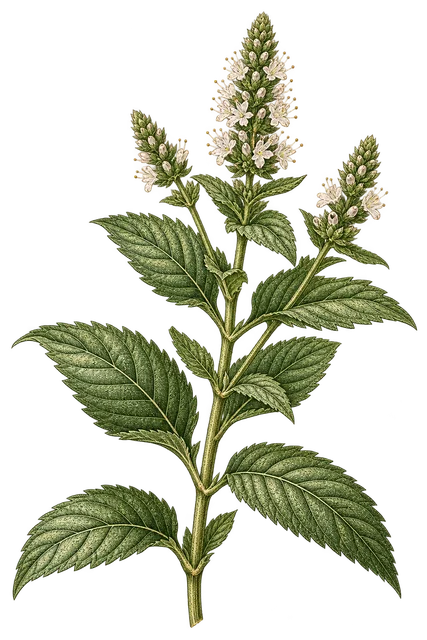
Mentha species, aromatic herbs of the mint family. The biblical species is not specified; Mentha longifolia is a regional candidate. Modern spearmint, Mentha spicata L., is a common culinary example. Peppermint, Mentha × piperita, is a distinct hybrid.
Ingredient details, preparation and research
Also known as: Mint; Spearmint (modern culinary example); Biblical mint (species unspecified)
Source plant or material
Mentha species, aromatic herbs of the mint family. The biblical species is not specified; Mentha longifolia is a regional candidate. Modern spearmint, Mentha spicata L., is a common culinary example. Peppermint, Mentha × piperita, is a distinct hybrid. Parts used: Fresh or dried leaves and tender flowering tops from positively identified culinary mint. Essential oil is a separately distilled material.
Plant family / material: Lamiaceae (mint family)
Forms and route
Fresh leaf, dried herb and food or tea infusions; culinary sauces and flavorings. Spearmint extract, peppermint leaf medicines and peppermint essential oil require their own species and preparation labels.
Absorption and preparation
A leaf serving, strained tea, standardized extract and enteric-coated peppermint-oil capsule deliver different materials to different sites. Enteric coating is relevant to a specific medicine’s release, not to a general rule for mint tea. No required food pairing or universal absorption enhancer is established for culinary mint.
Practical preparation
Use positively identified food-grade mint. Wash leaves and add to food or a normal food infusion. Label dried garden mint by species when known. Do not extract an essential oil at home for internal use or substitute a fragrance product for a food ingredient.
Combination notes
Mint with yogurt, peas, vegetables or lemon is a culinary choice. Peppermint-and-caraway products have been studied as specific combinations; that does not validate an improvised mixture of unspecified mint with another herb.
Traditional and reported uses
- Flavor salads, sauces, vegetable dishes and drinks with a known culinary mint.
- Traditional digestive, nausea and mouth-care uses are well documented, with species-specific differences.
- Modern evidence for certain peppermint preparations should be read under the separate peppermint leaf or oil cards.
Contraindications and cautions
- Do not assume every plant called mint is edible or that every Mentha oil has the same safety. Avoid substituting pennyroyal or an unidentified wild mint.
- Peppermint leaf preparations can worsen reflux or heartburn; people with gallstones or bile-related problems should seek advice before medicinal use.
- Do not swallow a generic essential oil or apply concentrated menthol-rich oil near an infant’s face. Culinary leaf and distilled oil are different exposures.
- Avoid a mint that causes allergy or irritation; medicinal extracts during pregnancy, breastfeeding or childhood require product-specific guidance.
- The small hormone studies do not establish long-term reproductive safety or treatment effectiveness. If considering regular medicinal use for hormonal symptoms, especially during pregnancy, while trying to conceive or alongside hormonal treatment, ask for product-specific clinical advice. The studies do not demonstrate a clinically important hormone effect from ordinary food portions.
- Specific spearmint studies reported occasional symptoms such as heartburn, headache or bowel changes, and one knee-trial participant withdrew with mint sensitivity. Stop a preparation that causes irritation or an allergic reaction. Small short trials cannot establish safety for everyone or for every mint extract.
Similar items and how they compare
- Peppermint leaf
A named Mentha hybrid with a documented traditional digestive use.
Peppermint is one particular modern mint; it cannot be asserted as the species in Matthew or Luke.
- Peppermint essential oil
A concentrated aromatic preparation from peppermint.
Oil trials, enteric coatings and oil cautions do not describe every culinary mint leaf.
- Spearmint
A familiar culinary mint used for this card’s nutrition example.
Its usual carvone-rich aroma differs from menthol-rich peppermint, and it is not a proven biblical species.
What the Bible identifies
Matthew 23:23 and Luke 11:42 name mint among tithed herbs without identifying its species. Botanical commentary proposes regional Mentha longifolia as a candidate. Neither passage establishes that the mint was peppermint or that a modern essential oil was being tithed.
Traditional leaf use and modern oil research
EMA recognizes specified peppermint leaf preparations for traditional relief of indigestion and flatulence. NCCIH describes evidence for some peppermint-oil products in IBS. These are distinct from a generic mint tea, and neither determines the identity of biblical mint.
Practical safety
Peppermint can aggravate reflux. Medicinal leaf use warrants caution with gallstones or bile disorders. Menthol-rich oils should not be used around an infant’s face. Identity matters because pennyroyal and other differently composed mints cannot be assumed to share the safety of culinary spearmint.
Entry sources
- Kew Plants of the World Online: Mentha spicata subsp. spicata
- Lytton John Musselman, Old Dominion University: Mint
- Pliny the Elder: Natural History, Book XX; Bostock and Riley translation (1856), public-domain primary historical text
- A Descriptive Overview of the Medical Uses Given to Mentha Aromatic Herbs throughout History (2020)
- Tisserat, Berhow and Vaughn. Spearmint plantlet culture and secondary metabolism, USDA Agricultural Research Service (2009)
- EMA: Peppermint leaf, traditional digestive use and cautions
- NCCIH: Peppermint Oil, usefulness and safety
- USDA FoodData Central, SR Legacy: Spearmint, fresh (FDC 173475)
- King James Bible, public-domain complete text, Project Gutenberg eBook 10
- King James Bible: Matthew 23:23
- King James Bible: Luke 11:42
- El Hassani and colleagues: Moroccan research about plants of the genus Mentha, Fez conference
Reference entry 128 · Recorded content review: 2026-10-06 · Review scope and dates