


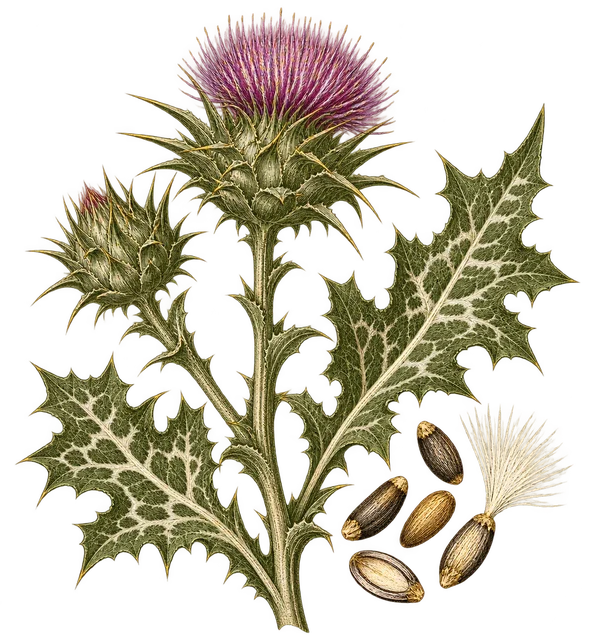
Key cautions
- Allergy and digestive upset are possible; concentrated products need review with diabetes and other medicines.
- Do not delay assessment of yellowing skin or eyes (jaundice), or dark urine. Medicinal pregnancy, breastfeeding and under-18 safety is inadequately established.
What’s inside
Fruit contains the silymarin flavonolignan mixture, including silybin/silibinin A and B, isosilybin, silychristin and silydianin, with taxifolin and fatty oil. A standardized extract concentrates selected constituents; its milligrams cannot be read as milligrams of whole fruit.
Uses in brief

- Traditional use: digestive fullness and indigestion after serious illness has been excluded.
- Research: specific silymarin extracts, with uncertain overall benefit for liver disease.
History, folklore and reported uses
Liver and biliary complaints
European herbal practice used milk-thistle fruits, commonly called seeds, for jaundice and related biliary complaints. Grieve records this as a popular German use, while the wider liver-remedy history is also noted by NCCIH.
Maud Grieve: A Modern Herbal (1931), Milk Thistle · NCCIH: Milk Thistle
Digestion and bitter tonics
Italian herbal bitters and tonic aperitifs have used milk thistle for its bitter, digestive character. The University of Molise also records the older food tradition of roots, tender leaves, stems and unopened flower heads.
Breast-milk production
Milk thistle had a reputation for increasing breast-milk production in European folk medicine. Grieve quotes John Evelyn’s description of the cooked, de-spined plant as food for nursing women; NCCIH separately records the historical attempt to increase milk supply.
Maud Grieve: A Modern Herbal (1931), Milk Thistle · NCCIH: Milk Thistle
Chest catarrh
Grieve’s 1931 milk-thistle entry describes the plant as a demulcent for chest catarrh and pleurisy, meaning a remedy intended to soothe irritated tissues. Her historical account places this use alongside the medicinal seed tradition.
Carried roots and melancholy lore
Grieve quotes Gerard crediting a milk-thistle root carried as a protective charm with dispelling melancholy; this was a belief about the carried plant, not a drink or food. A separate Christian legend says drops of Mary’s milk marked the leaves while she nursed the infant Jesus, explaining names such as Mary’s thistle and the epithet marianum. The University of Molise presents the white-leaf story as legend, not botany.
Maud Grieve: A Modern Herbal (1931), Milk Thistle · University of Molise botanical garden: Silybum marianum
Women’s Health: traditions, evidence and cautions
Historical use does not establish benefit or safety. Pregnancy, breastfeeding and fertility care require particular caution: food, tea, essential oil and concentrated extract are not interchangeable. These records are not treatment, dosing or pregnancy-management instructions. Discuss supplements with a qualified clinician or pharmacist; do not delay evaluation of persistent symptoms.
Milk thistle fruit
Silybum marianum (L.) Gaertn.
- Plant part / material
- Ripe fruit, commonly called seed
- Preparation studied or reported
- Whole fruit products versus standardized silymarin extracts.
LactMed records its galactagogue reputation and proprietary-product use without assigning a securely documented regional origin.
Lactation / milk-supply tradition
Extract-specific signal; whole-herb evidence insufficient
Reported or traditional usePromoted and traditionally used to increase breast milk.
What the evidence supportsNo valid trials establish whole-herb efficacy. Positive findings for purified or specially formulated silymarin cannot be generalized to all milk-thistle products.
Available milk measurements suggest low infant exposure to studied silymarin. Maternal gastrointestinal effects, drug interactions and serious Asteraceae-family allergy remain relevant.
- The cited lactation evidence does not establish medicinal-use safety during pregnancy; postpartum traditions must not be extrapolated to pregnancy.
Health topics: evidence and cautions
These notes describe a specific research context and preparation. A topic link is not a treatment recommendation.
Diabetes and prediabetes · Support during care
Form and route: Characterized oral silymarin-containing extract · oral
Some small type 2 diabetes studies suggest glucose effects.
Evidence: limited_human_evidence
NCCIH finds too little high-quality evidence for firm conclusions.
Limits
Most studies were from Middle Eastern settings; results do not establish a whole-fruit tea effect.
Cautions
- Digestive upset and daisy-family allergy are possible; quality and medicine interactions need review.
Identity & detailed reference
Identity
Silybum marianum (L.) Gaertn. (syn. Carduus marianus); ripe fruit, commonly called seed, in Asteraceae. Standardized silymarin is an extracted mixture, not another name for whole fruit.
Ingredient details, preparation and research
Source plant or material
Silybum marianum (L.) Gaertn.; ripe fruit, commonly called seed.
Plant family / material: Asteraceae (daisy family).
Forms and route
Oral crushed-fruit tea, powder, tinctures and characterized dry extracts. Capsules may contain whole-fruit powder or standardized silymarin; these are not equivalent. Phospholipid and other enhanced-bioavailability formulations are product-specific. Medical intravenous silibinin is a separate preparation and route.
Vitamins and minerals
No reliable micronutrient amount per usual fruit-tea, tincture or silymarin-extract serving was established. Silymarin is not a vitamin or mineral. Fruit fatty-oil content does not make a capsule or strained infusion nutritionally equivalent to a serving of seeds or nuts.
Absorption and preparation
Silymarin is poorly water-soluble, so fruit tea and standardized extracts deliver different mixtures. A 23-person crossover study found higher silybin exposure from one phosphatidylcholine soft-gel formulation than from conventional tablets; this is not proof of greater clinical benefit, or evidence that adding oil to tea reproduces the result. No universal with-fat or fasting rule follows.
Practical preparation
Check whether the label names fruit powder, tincture or standardized extract, and use that preparation's instructions. For a fruit tea, use identified food/medicinal-grade material and a weight-based or labeled tea-bag recipe; do not convert a spoonful of fruit into a silymarin dose. No universal fresh-to-dried substitution was established.
Combination notes
Combining milk thistle with dandelion or burdock does not establish a detoxifying effect. Review every ingredient and its actual extract rather than assuming a shared traditional purpose makes the blend safer or more effective.
Traditional and reported uses
- EMA records traditional European use for fullness and indigestion, and traditional liver-function support after serious conditions have been excluded.
- Standardized silymarin has been studied for liver diseases and glucose control, with inconclusive or conflicting overall evidence.
- Historical use to encourage milk production is documented; reliable effectiveness and breastfeeding safety are not established.
Contraindications and cautions
- Avoid with milk-thistle or Asteraceae allergy. Digestive upset and allergic reactions can occur.
- Silymarin extracts have lowered glucose in small trials; review concentrated products with diabetes medicines and an appropriate monitoring plan. This does not establish a glucose-lowering effect of every fruit tea.
- The EMA monograph reports no interactions, while laboratory enzyme effects and incompletely studied formulations justify a medicine review, especially for critical-dose medicines. Milk thistle does not make alcohol or hepatotoxic medicines safe.
- Medicinal use under 18 and in pregnancy or breastfeeding is not recommended by EMA because evidence is insufficient.
- Yellowing skin or eyes (jaundice), or a new change in urine or stool colour needs prompt medical assessment. Product identity and contaminant testing matter.
Similar items and how they compare
- Dandelion
Both occur in European traditions for digestive fullness and liver-associated complaints, with preparation identity essential when comparing products.
Milk thistle uses silymarin-containing fruit; dandelion root supplies bitter constituents and inulin.
- Turmeric
Both have digestive traditions and are marketed in concentrated extracts, making whole-herb versus selected-constituent labeling particularly relevant.
Turmeric uses curcuminoid-containing rhizomes; milk thistle uses fruit with silymarin flavonolignans.
Plant and preparation identity
Silybum marianum (L.) Gaertn. (syn. Carduus marianus); ripe fruit, commonly called seed, in Asteraceae. Standardized silymarin is an extracted mixture, not another name for whole fruit. Fruit contains the silymarin flavonolignan mixture, including silybin/silibinin A and B, isosilybin, silychristin and silydianin, with taxifolin and fatty oil. A standardized extract concentrates selected constituents; its milligrams cannot be read as milligrams of whole fruit.
Traditions, with their limits
European medicinal tradition includes digestive fullness, indigestion and liver-related support. EMA classifies these indications by long-standing use, after a clinician has excluded serious disease. This is not a guarantee of toxin removal or regeneration. Historical lactation use is a separate, unproven claim.
What human liver trials actually tested
A 154-person randomized trial tested higher-than-customary oral silymarin doses for 24 weeks in chronic hepatitis C after unsuccessful interferon treatment. The extract did not significantly improve liver-enzyme ALT levels, viral load or quality of life compared with placebo. A separate randomized trial in nonalcoholic steatohepatitis (NASH), a form of fatty liver disease with inflammation, also failed to establish benefit on its primary outcome. These disease-specific extract studies cannot validate fruit tea or a general liver-cleanse claim.
Glucose and laboratory findings
A four-month placebo-controlled trial in 51 people with type 2 diabetes reported improved glycaemic measures with silymarin alongside conventional treatment. It was small and preparation-specific. Cell and animal findings involving antioxidant, inflammatory and fibrosis pathways are mechanistic leads, not evidence that an ordinary tea reverses human liver injury.
Absorption and food timing
Silymarin is poorly water-soluble, so fruit tea and standardized extracts deliver different mixtures. A 23-person crossover study found higher silybin exposure from one phosphatidylcholine soft-gel formulation than from conventional tablets; this is not proof of greater clinical benefit, or evidence that adding oil to tea reproduces the result. No universal with-fat or fasting rule follows.
Forms, routes and preparation
Oral crushed-fruit tea, powder, tinctures and characterized dry extracts. Capsules may contain whole-fruit powder or standardized silymarin; these are not equivalent. Phospholipid and other enhanced-bioavailability formulations are product-specific. Medical intravenous silibinin is a separate preparation and route. Check whether the label names fruit powder, tincture or standardized extract, and use that preparation's instructions. For a fruit tea, use identified food/medicinal-grade material and a weight-based or labeled tea-bag recipe; do not convert a spoonful of fruit into a silymarin dose. No universal fresh-to-dried substitution was established.
Nutrition and comparisons
No reliable micronutrient amount per usual fruit-tea, tincture or silymarin-extract serving was established. Silymarin is not a vitamin or mineral. Fruit fatty-oil content does not make a capsule or strained infusion nutritionally equivalent to a serving of seeds or nuts. Compare characterized extracts by their documented composition and formulation, not by a vitamin-rich-food claim.
Cautions and interactions
Oral use commonly causes digestive symptoms; serious allergy is possible. EMA reports no established interactions for its listed preparations, but this is not a guarantee for every supplement. The glucose finding supports individualized review with diabetes treatment. Pregnancy, breastfeeding and medicinal under-18 use lack adequate safety evidence. Contaminated or mislabeled supplements are a separate risk.
When traditional self-care is insufficient
New jaundice, dark urine or pale stools require medical assessment. Treating liver disease, poisoning or medicine injury with household milk-thistle preparations is not supported by the reviewed trials.
Entry sources
- EMA: Milk-thistle fruit assessment report
- EMA: Final European Union milk-thistle fruit monograph
- NCCIH: Milk Thistle, updated February 2025
- Fried et al. (2012): Randomized silymarin trial in chronic hepatitis C
- Navarro et al. (2019): Randomized silymarin trial in non-cirrhotic NASH
- Huseini et al. (2006): Randomized silymarin trial in type 2 diabetes
- Mendez-Sanchez et al. (2019): Human crossover comparison of two silybin formulations
Reference entry 10 · Recorded content review: 2026-10-05 · Review scope and dates