


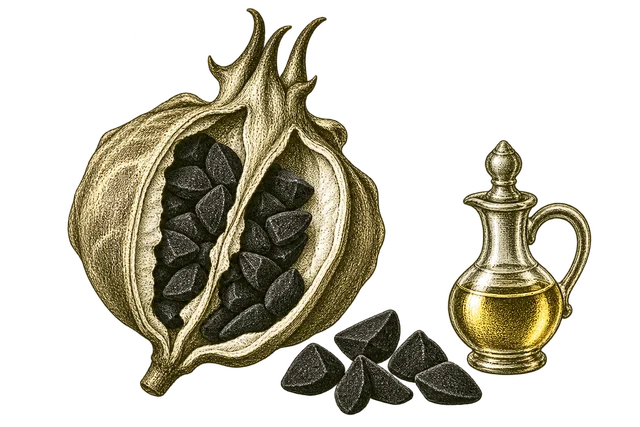
Key cautions
- Buy seed explicitly labeled Nigella sativa for food; ornamental Nigella seed, onion seed, cumin and sesame are not interchangeable.
- Black seed products can cause stomach upset, diarrhea, rash or hypersensitivity. Stop if a reaction develops.
What’s inside
Seeds contain fixed oil with linoleic and oleic acids, protein and fiber, plus a smaller volatile fraction containing thymoquinone and other terpenes. Whole-seed composition varies by crop; a thymoquinone percentage stated for an oil cannot be assigned to all seed.
Uses in brief

- Use food-grade seed to season breads, vegetables, pulses and pickles.
- Traditional digestive, respiratory and skin uses are documented across several medical cultures.
- Seed powder and extracts have been studied clinically, with preparation-specific and uncertain benefits.
In the King James Bible
In the King James Bible
Probable botanical identification
Isaiah’s KJV fitches is widely identified as Nigella sativa, a small aromatic seed crop, but this is a botanical interpretation rather than a modern species name in the verse. The fitches in Ezekiel 4:9 refers to a different grain context and must not be conflated. Isaiah names no pressed black seed oil.
When he hath made plain the face thereof, doth he not cast abroad the fitches, and scatter the cummin, and cast in the principal wheat and the appointed barley and the rie in their place?
Isaiah 28:25 (KJV)
For the fitches are not threshed with a threshing instrument, neither is a cart wheel turned about upon the cummin; but the fitches are beaten out with a staff, and the cummin with a rod.
Isaiah 28:27 (KJV)
Scripture and identification sources
Words & their stories
WORDS & THEIR STORIES
The name behind the KJV
Biblical Hebrew · Isaiah 28:25, 27 (KJV)
קֶצַחqeṣaḥ
The small-seeded crop rendered “fitches,” commonly identified as black cumin.
Dictionary form: קֶצַח · qeṣaḥ
The verse-form matches the dictionary form; cumin itself has a different name, kammōn.
What the language reveals
Sowing and threshing
The same crop is scattered in verse 25 and beaten with a staff in verse 27. This makes it part of an agricultural illustration rather than a remedy.
Two neighboring crops
Qeṣaḥ and kammōn are explicitly distinguished in the Hebrew. Modern common names containing “cumin” should not erase that distinction.
Nigella sativa is a leading conventional identification of qeṣaḥ. The verses do not describe black-seed oil or establish a medicinal use.
Language and identification bibliography
History, folklore and reported uses
History, folklore and traditional uses
A scattering of black seed across a loaf is one of Nigella’s most durable uses. Kew’s botanical account records its ancient cultivation for bread flavoring; Pliny’s gith or melanthion likewise appears as a prized bread seasoning amid a much larger catalogue of remedies. The probable connection with Isaiah is agricultural: small fitches are beaten out with a staff, illustrating the need to handle different crops in different ways.
Beyond the bakery, seed and preparations made from it entered household medicine across the Middle East and South Asia. Accounts describe digestive, respiratory, skin and nursing uses. Modern research has taken particular interest in thymoquinone and in pressed seed oil, but those are later, preparation-specific questions. Keeping those preparations distinct preserves the seed’s long culinary and household history.
Traditional, historical and reported uses
- Flavoring bread
Food or household practiceWhy this label?
Aromatic seed used to flavour bread.
Kew records ancient cultivation of Nigella for aromatic bread seasoning; Pliny describes gith seed as a valued flavoring for bread.
- Digestive complaints
Traditional accountWhy this label?
Regional traditional digestive-remedy preparations.
Traditional uses include dyspepsia, intestinal discomfort and diarrhea, recorded for seed and its preparations across several regions.
- Cough and breathing complaints
Traditional accountWhy this label?
Historical household respiratory-remedy practice, without an experimental claim.
Historical household medicine used black seed for cough, bronchitis and asthma-related complaints. These are reported uses, not a first-aid protocol.
- Skin and local remedies
Mixed/contextual sourcesWhy this label?
Combines classical written applications with broader traditional skin-use accounts.
Traditional accounts include skin disease and wounds. Pliny’s gith chapter also records local applications; these historical uses do not specify a modern standardized product.
- Nursing and milk supply
Traditional accountWhy this label?
Regional galactagogue traditions with an explicit species caveat.
LactMed records black seed as a galactagogue in India, Türkiye and the Middle East; some records involve a related Nigella species and must not be silently merged.
Story sources
- Kew Plants of the World Online: Nigella sativa L., including Flora of Somalia uses
- Pliny the Elder: Natural History, Book XX; Bostock and Riley translation (1856), public-domain primary historical text
- NIH LiverTox: Black Cumin Seed (2023)
- NIH LactMed: Black Seed, revised July 15, 2025
- Lytton John Musselman, Old Dominion University: Nigella
- King James Bible, public-domain complete text, Project Gutenberg eBook 10
Women’s Health: traditions, evidence and cautions
Historical use does not establish benefit or safety. Pregnancy, breastfeeding and fertility care require particular caution: food, tea, essential oil and concentrated extract are not interchangeable. These records are not treatment, dosing or pregnancy-management instructions. Discuss supplements with a qualified clinician or pharmacist; do not delay evaluation of persistent symptoms.
Black seed / nigella
Nigella sativa L.
- Plant part / material
- Seed
- Preparation studied or reported
- Culinary seed, seed powder; expressed fixed oil and essential oil are separate.
LactMed reports oral galactagogue traditions in India, Türkiye and the Middle East, sometimes including the distinct Nigella arvensis.
Lactation / milk-supply tradition
Insufficient human efficacy evidence
Reported or traditional useSeeds are used with the intention of increasing milk production.
What the evidence supportsConvincing clinical support is absent. A small trial found a prolactin signal without improved infant growth; prolactin alone is not proof of adequate milk transfer.
Milk-transfer and nursing-infant safety data are absent. Black-seed oil can cause allergic contact dermatitis; seed evidence should not be transferred to oil products.
- The cited lactation evidence does not establish medicinal-use safety during pregnancy; postpartum traditions must not be extrapolated to pregnancy.
Health topics: evidence and cautions
These notes describe a specific research context and preparation. A topic link is not a treatment recommendation.
Cancer by type · Traditional reports
Form and route: Seeds within a traditional multi-ingredient food mixture · oral
Qatar herbalists reported black seeds among remedies used by breast-cancer patients.
Evidence: Ethnobotanical survey only
Reported use only; not a clinical trial.
Limits
The mixture cannot establish the effect of black seed alone.
Cautions
- Do not replace oncology care.
Male fertility & sperm health · Support during care
Form and route: Seed-powder capsules; separate traditional-use context · oral
Condition and setting: Male infertility and reproductive-hormone research
A weak study reported semen and hormone changes. These findings do not establish a testosterone booster or an infertility treatment.
Evidence: Very low-certainty clinical evidence
Reported 2 g/day for three months; 55 enrolled, 40 completed. A separate traditional database records an ejaculation-related use.
Limits
Placebo allocation/sample sizes and analysis are unclear. A separate obesity study found no significant free-testosterone advantage; traditional terms do not establish modern diagnoses.
Cautions
- Medicinal supplementation differs from a culinary serving. No proven pregnancy/live-birth benefit; do not postpone evaluation.
Regional reading paths
These sourced notes describe cultivation, trade, food traditions or material history. A regional connection does not claim exclusive origin.
Africa
Introduced and cultivated: Kew’s Flora of Somalia account records the plant near Hargeysa and describes its aromatic seed and bread-flavouring use; its native range is elsewhere.
Food-grade ripe nigella seeds as a seasoning, distinct from cumin, caraway and concentrated black-seed oil.
Asia
Native and cultivated: Kew places the native range from southeastern Europe into western and southwestern Iran; ICAR documents cultivation in India and use in breads, pickles and curries.
Food-grade ripe seeds used sparingly as a culinary seasoning; black-seed oil and extracts are separate preparations.
Identity & detailed reference
Identity
Nigella sativa L., an annual in Ranunculaceae. Food-grade ripe black seeds are called nigella, kalonji or black seed. This is a probable identification of Isaiah’s fitches, not a proven identity for every KJV use of that English word.
Ingredient details, preparation and research
Also known as: Black seed; Kalonji; Nigella seed; KJV fitches in Isaiah (candidate identity); Black cumin; Black cumin seed
Source plant or material
Nigella sativa L., an annual in Ranunculaceae. Food-grade ripe black seeds are called nigella, kalonji or black seed. This is a probable identification of Isaiah’s fitches, not a proven identity for every KJV use of that English word. Parts used: Ripe dried seeds. Pressed fixed seed oil, distilled volatile oil and isolated thymoquinone are different materials.
Plant family / material: Ranunculaceae (buttercup family)
Forms and route
Whole or ground culinary seed; food seasoning and traditional infusions; seed powder capsules and extracts. Black seed oil is a related but separate card and is not the form named in Isaiah.
Vitamins and minerals
Nigella seed contains fat, protein and fiber, but this review did not verify a suitable generic USDA household-serving record for Nigella sativa. No teaspoon nutrient totals or Daily Value claims are invented. Use the actual food product’s gram-weighted label for a serving. A scattered bread topping contributes far less than a 100 g laboratory analysis, and pressed oil does not carry the seed’s fiber and protein.
Absorption and preparation
Grinding changes exposure of seed contents, and pressing separates an oil fraction; neither establishes a predictable blood level of thymoquinone. The seed, fixed oil and standardized extracts have different compositions. No clinically established honey, pepper or other household absorption-enhancer recipe is identified for ordinary nigella seed.
Practical preparation
Use food-grade, positively identified seed. Whole seed can top bread or season cooked foods; light dry roasting is a culinary technique. Store airtight and discard rancid-smelling material. Do not turn historical respiratory or skin descriptions into inhalation, nasal or wound-treatment instructions.
Combination notes
Nigella accompanies bread, vegetables and pulses, and appears in Bengali panch phoron. These are traditional culinary combinations. No combination is presented as a cure-all or a means of making thymoquinone reliably more absorbable.
Traditional and reported uses
- Use food-grade seed to season breads, vegetables, pulses and pickles.
- Traditional digestive, respiratory and skin uses are documented across several medical cultures.
- Seed powder and extracts have been studied clinically, with preparation-specific and uncertain benefits.
Contraindications and cautions
- Buy seed explicitly labeled Nigella sativa for food; ornamental Nigella seed, onion seed, cumin and sesame are not interchangeable.
- Black seed products can cause stomach upset, diarrhea, rash or hypersensitivity. Stop if a reaction develops.
- Do not treat oil, seed powder, volatile oil and isolated thymoquinone as equivalent doses. Avoid improvised use of concentrated essential oil.
- Discuss medicinal use during pregnancy or breastfeeding and alongside regular medicines with a clinician. Infant-safety and breast-milk transfer data are lacking.
Similar items and how they compare
- Black seed oil
Pressed from the same Nigella sativa seeds.
Oil omits most seed protein and fiber; an oil study is not automatically a seed study or a biblical seed reference.
- Cumin (KJV cummin)
Another ancient seed spice, sometimes confused by the common name black cumin.
Cuminum cyminum is an Apiaceae plant with cuminaldehyde-rich aroma, not Nigella sativa.
- Sesame seed
Another seed used to finish breads.
Sesame is a different plant and allergen; its food-composition figures must not be assigned to nigella.
Which fitches?
Isaiah 28 describes small fitches handled differently from grain and pairs them with cummin. Nigella sativa is a leading botanical identification. The English fitches in Ezekiel 4:9 belongs to a separate grain-name problem and is not evidence for Nigella. Isaiah also does not mention pressed black seed oil.
Food and constituents
Kew records ancient cultivation and bread flavoring. The edible seed contains both fixed lipids and a smaller aromatic fraction. Thymoquinone draws much research interest, but amount, stability and extraction vary; listing it is not a claim that every culinary seed delivers a pharmacological dose.
Human evidence for seed preparations
A placebo-controlled trial of powdered seed enrolled 123 adults; 73 completed it. The reported changes were not statistically significant. LiverTox judges the overall clinical evidence for benefit unconvincing. Seed, extract and oil findings remain preparation-specific, without an established treatment claim for diabetes, high blood pressure or cancer.
Safety in context
Short-term studies generally report good tolerance; abdominal discomfort, diarrhea, headache and rare hypersensitivity can occur. LactMed notes missing infant-safety data and allergic contact dermatitis from oil. Ordinary culinary use, concentrated extract and direct skin application warrant different judgments.
Nutrition and practical limits
A composition study of a research seed sample cannot supply a universal teaspoon serving for a retail product. No verified generic portion table is used here. Label-based grams are the appropriate route when nutrition tracking matters; the seed’s small culinary portion is mainly a flavoring.
Evidence limits
- No reliable generic household-serving nutrient table was verified for Nigella sativa.
- The probable Isaiah identity does not apply to the separate grain term translated fitches in Ezekiel.
Entry sources
- Kew Plants of the World Online: Nigella sativa L., including Flora of Somalia uses
- Pliny the Elder: Natural History, Book XX; Bostock and Riley translation (1856), public-domain primary historical text
- Srinivasan. Cumin and black cumin seeds: traditional uses, chemical constituents and nutraceutical effects (2018)
- NIH LiverTox: Black Cumin Seed (2023)
- NIH LactMed: Black Seed, revised July 15, 2025
- Qidwai et al. Powdered Nigella sativa seed: randomized double-blind controlled trial (2009)
- Lytton John Musselman, Old Dominion University: Nigella
- King James Bible, public-domain complete text, Project Gutenberg eBook 10
- King James Bible: Isaiah 28:25
- King James Bible: Isaiah 28:27
- Qidwai et al. (2009): Powdered Nigella seed trial, author institution abstract
Reference entry 123 · Recorded content review: 2026-10-06 · Review scope and dates