


Key cautions
- Check medicines before supplementation; avoid medicinal use in pregnancy and stop for allergy.
What’s inside
Fixed oil mainly contains linoleic- and oleic-rich triglycerides with palmitic acid. Smaller fractions include phytosterols, variable tocopherols/tocotrienols and aromatic constituents such as thymoquinone, p-cymene and carvacrol. Seed powder, distilled essential oil and concentrated thymoquinone extracts have different profiles.
Effects of chemical composition on sensory quality and oxidative stability of cold-pressed black-cumin oils (2022) · Dąbrowski et al. (2024): Variation in the composition and quality of Nigella sativa seed oils
Uses in brief

- Traditional digestive, respiratory and skin uses; selected preparations have limited human trial evidence.
- Culinary fixed oil and whole seeds are distinct from concentrated extracts.
In the King James Bible
Possible source-plant connection: Isaiah’s fitches
Probable botanical identification
Isaiah describes the careful threshing of “fitches,” commonly identified as Nigella sativa, the source plant of black seed oil. The passage concerns seeds rather than pressed oil. This probable identification applies to Isaiah’s fitches; the same KJV word in Ezekiel refers to a grain crop.
For the fitches are not threshed with a threshing instrument, neither is a cart wheel turned about upon the cummin; but the fitches are beaten out with a staff, and the cummin with a rod.
Isaiah 28:27 (KJV)
Scripture and identification sources
Words & their stories
WORDS & THEIR STORIES
The name behind the KJV
Biblical Hebrew · Isaiah 28:27 (KJV)
קֶצַחqeṣaḥ
The seed crop called “fitches” in the KJV, commonly identified as black cumin or nigella.
Dictionary form: קֶצַח · qeṣaḥ
The verse uses the dictionary form twice, while naming ordinary cumin separately.
What the language reveals
Distinct crops, distinct handling
Isaiah contrasts the tools used to thresh this crop and cumin with heavier threshing equipment. It describes agricultural handling of seeds.
A specific Hebrew name
Brown–Driver–Briggs identifies qeṣaḥ as Nigella sativa. This does not make every occurrence of the English word “fitches” the same plant.
Nigella sativa is the usual identification here, but the verse concerns seeds rather than pressed black seed oil and makes no health claim.
Language and identification bibliography
History, folklore and reported uses
Inflamed-skin care and the older seed tradition
MSK records Nigella seed preparations traditionally used for inflammation and infections. In a specifically oil-based modern practice, AromaWeb describes topical black-seed oil for eczema, psoriasis and inflamed skin.
Memorial Sloan Kettering Cancer Center: Nigella sativa, traditional use and contemporary claims · AromaWeb: Black Cumin Seed Oil, practitioner account
Modern metabolic-support supplementation
Oral black-seed oil capsules have been investigated as a modern complementary approach to blood-sugar and lipid concerns in people with type 2 diabetes. This is a contemporary purpose for the fixed oil, not an ancient seed remedy.
Rubbing painful joints
An Iranian knee-osteoarthritis study documents topical black-seed oil massage as a modern complementary approach to painful joints. This concerns the fixed oil used externally.
Kooshki et al. (2016): Topical Nigella sativa oil in knee osteoarthritis
Respiratory support alongside usual treatment
Black-seed oil capsules have been investigated as an addition to usual asthma care. This modern supplementary purpose differs from the older, broader reputation of Nigella seed preparations.
Koshak et al. (2017): Nigella sativa oil as adjunctive asthma care
Persian digestive preparations with honey
Mohtashami and colleagues describe a honey-based Nigella preparation in Traditional Persian Medicine for upper-digestive symptoms. Their modern formulation combined seed oil and honey for functional dyspepsia, persistent upper-abdominal discomfort without an identified structural cause.
Mohtashami et al. (2015): Persian honey-based Nigella sativa seed-oil preparation for dyspepsia
A seed in food, faith and medicine
Nigella sativa seeds, also called kalonji or black cumin, have culinary and medicinal histories in India, Arabia and Europe. Sahih al-Bukhari, a collection of reports about the Prophet Muhammad, preserves Abu Huraira’s account of an expansive statement about the seed’s healing value. This religious reference remains important to many Muslims; it is about the seed, not proof that bottled oil cures every illness.
Sahih al-Bukhari 5688: Medicine, report narrated by Abu Huraira · Memorial Sloan Kettering Cancer Center: Nigella sativa, traditional use and contemporary claims
Health topics: evidence and cautions
These notes describe a specific research context and preparation. A topic link is not a treatment recommendation.
Male fertility & sperm health · Support during care
Form and route: Cold-pressed seed oil · oral
Condition and setting: Abnormal semen quality in men with infertility
One small placebo-controlled trial reported better sperm concentration, motility and morphology. Pregnancy and live-birth benefit was not established.
Evidence: Limited clinical evidence
Two months; 34 analyzed per arm; 2.5 mL twice daily versus liquid paraffin.
Limits
Short trial in selected infertile men; does not show healthy-testis protection or treatment of testicular disease. Essential oil and isolated thymoquinone are different.
Cautions
- Study exposure is not a personal dose recommendation. Severe dermatitis has followed topical oil use; the drug-metabolism signal came from oral seed in four volunteers, not a test of every oil product. Ask a pharmacist to review medicines.
Identity & detailed reference
Identity
Nigella sativa L.; expressed fixed seed oil. Confirm the botanical name because “black cumin” also names unrelated spices. Ethiopian, Egyptian and Syrian origin labels do not designate separate medicinal species.
Ingredient details, preparation and research
Source plant or material
Nigella sativa L.; seeds used whole as a spice or pressed for fixed oil. Ethiopian origin is geographic provenance within the same species.
Plant family / material: Ranunculaceae (buttercup family).
Forms and route
Food-grade fixed oil; oral supplement oils or capsules; topical formulations. Whole seed, seed powder, water/alcohol extracts, isolated thymoquinone and distilled essential oil are different materials and are not dose-equivalent.
Vitamins and minerals
A weighed 5 g culinary portion of unblended food-grade oil is mainly fat, roughly 45 kcal, not a medicinal serving. Vitamin E varies markedly: one study of 13 hexane-extracted seed oils found alpha-tocopherol absent/trace in most samples and a highest sample mean of about 20 mg/kg, equivalent to only about 0.1 mg in 5 g. These are research-sample values, not a guarantee for commercial pressed oil; whole-seed mineral claims do not transfer to the oil.
Absorption and preparation
Human thymoquinone exposure from ordinary oil remains incompletely characterized. A 2023 assay study did not detect it in sampled serum from two volunteers; instability, binding and assay limits prevent interpreting that as zero absorption. In a small 2026 pilot, thymoquinone and/or thymoquinol were qualitatively detected in urine after repeated oil intake, but this did not establish absorption percentage, blood levels or a clinical dosing regimen. No validated food pairing or universal uptake-enhancing recipe is established.
Practical preparation
Check Nigella sativa, intended route, ingredients and whether the contents are fixed oil or a concentrated extract. For food, use only an explicitly edible oil and the recipe/label quantity; strong flavor does not measure thymoquinone. Keep the bottle tightly closed and follow its light, heat and storage directions. Do not use a universal spoonful as a medicinal dose.
Combination notes
Honey, tea, yogurt or another food may make an edible oil easier to use in a recipe, but no specific pairing is proven to improve clinical effectiveness or absorption. A mixed-herb or multi-ingredient trial cannot identify the contribution of black seed alone. Combining glucose- or pressure-lowering supplements can complicate medicine monitoring.
Traditional and reported uses
- Culinary traditions: the seeds flavor foods in South Asian, Middle Eastern and Ethiopian cuisines; food-labeled pressed oil is a separate flavoring ingredient.
- Traditional medicine: preparations for digestive and respiratory complaints and inflammatory discomfort; Persian sources also describe topical acne use.
- Small human trials have studied selected oral oils or skin formulations. These do not establish a cure or a replacement for prescribed treatment.
Contraindications and cautions
- Oral use can cause gastrointestinal discomfort; topical or oral products can trigger allergy, sometimes severe. Stop for rash; extensive blistering or systemic symptoms need medical care.
- Avoid medicinal supplementation during pregnancy. Breastfeeding and pediatric use need professional guidance because safety data are inadequate.
- Review use with diabetes/blood-pressure medicines, anticoagulants and CYP2D6/CYP3A4-metabolized medicines, and before surgery. Interaction likelihood and size are not established for every oil.
- A four-person human seed study and laboratory work found metabolic interaction signals. Warfarin findings remain preclinical; do not present a proven direction or magnitude of bleeding risk.
- Do not ingest a cosmetic product or substitute concentrated essential oil or isolated thymoquinone for culinary fixed oil.
Similar items and how they compare
- Grapeseed oil
Both fixed seed oils can be rich in linoleic acid and occur in cosmetic formulations.
Grapeseed lacks black seed’s characteristic thymoquinone-containing aromatic fraction; shared fatty acids do not imply shared medicinal effects.
- Sesame oil
Both are seed-derived edible oils with distinctive culinary uses.
Sesame has its own lignans and important allergy considerations. It is not a substitute for a studied Nigella formulation, and neither origin nor flavor proves potency.
Identity, names and plant part
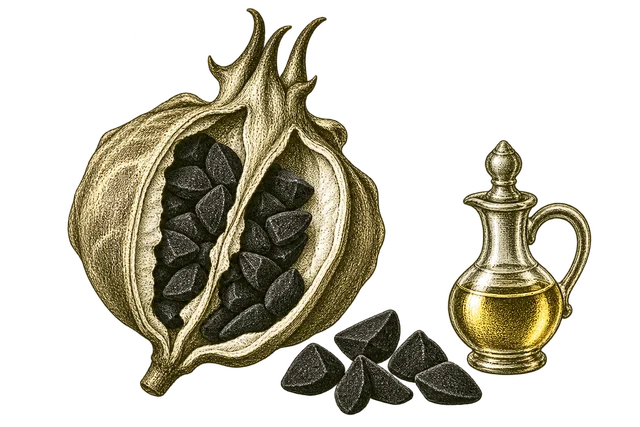
Nigella sativa is an annual in Ranunculaceae. The culinary seed and expressed fixed oil are distinct from cumin (Cuminum cyminum) and from other spices sold as black cumin. Ethiopian-grown N. sativa is the same species as N. sativa grown elsewhere. A Latin name and a clear part/preparation description are more informative than a common name alone.
Fixed oil, essential oil and minor compounds
Pressed oil is largely triglyceride fat, typically dominated by linoleic and oleic acids. It also carries smaller aromatic and unsaponifiable fractions, including thymoquinone and plant sterols. Distilled essential oil concentrates volatile compounds and is not the same product. Analyses show variation in oxidation, flavor and constituent content across commercial samples; the percentage of a marker requires both a unit and a stated analytical basis.
Traditional uses with attribution
MSK describes culinary and medicinal use in India, Arabia and Europe, while Ethiopian research records whole seeds in bread, sauces and berbere. Persian medical traditions described Nigella preparations for acne. Digestive, respiratory and inflammatory uses belong to these histories; they should be attributed without treating every historical preparation or modern bottled oil as equivalent.
Ethiopian origin: what the three-origin study shows
A 2024 study compared commercially supplied oils pressed from Ethiopian, Egyptian and Syrian seeds. The Ethiopian sample led several chemical and laboratory measures, but the work did not compare health outcomes in people or establish that all Ethiopian oils are superior. Its often-repeated 34.8% thymoquinone value is a relative GC-MS peak-area share in the volatile fraction. It is not 34.8% of the whole bottled fixed oil by mass or volume.
Within-country variation and batch quality
A separate study characterized essential oils from 64 Ethiopian genotypes and found considerable variation; thymoquinone ranged about 14.8–42.4% of the measured essential-oil composition. These figures also do not describe the concentration in pressed food oil. Together, the studies favor checking the actual batch, preparation and assay over assuming a universal nationality-based ranking. Greater marker concentration is not proof of greater clinical benefit.
Oral human evidence: asthma and diabetes
In an adjunctive four-week asthma trial, 80 people were enrolled and 60 completed follow-up. The tested oil improved an asthma-control score and eosinophil count versus placebo, but the difference in FEV1 was not statistically significant. A separate three-month open-label trial found black-seed-oil capsules inferior to metformin for glycemic control in newly diagnosed type 2 diabetes. Neither trial supports replacing inhalers, diabetes medication or urgent medical care.
Topical human evidence is formulation-specific
A randomized 60-person acne trial tested a thymoquinone-standardized Nigella hydrogel against its vehicle for 60 days. Acne severity and lesion counts improved more with the active gel. This is encouraging but small, short-term evidence for that formulation. It does not establish that undiluted household oil has the same efficacy, safety or suitability for every type of irritated skin.
Laboratory effects are not treatment claims
The three-origin experiment included bacterial/fungal and antioxidant assays. Such findings can guide product research but do not prove that swallowing oil treats infection or that topical use disinfects wounds. Laboratory and animal reports of anticancer or liver-protective effects likewise do not establish a cancer treatment or a liver-detoxification program in humans.
Medicine interactions: a small human signal exists
The CYP interaction evidence is not exclusively laboratory-based. In 2010, four healthy volunteers underwent a dextromethorphan probe test before and after seven days of black seed; urinary metabolite ratios changed, alongside inhibition in human liver microsomes. This suggests potential CYP2D6/CYP3A4 interactions, but the tiny seed-material study cannot quantify risk for every medicine, dose or commercial oil. A pharmacist should check the actual product and medicines.
Additional cautions and liver safety
Gastrointestinal upset and hypersensitivity are documented; severe contact dermatitis has occurred after topical oil. Pregnancy supplementation should be avoided, and LactMed reports inadequate data on passage into milk and infant safety. Review supplements before surgery or with glucose/pressure-lowering drugs or anticoagulants. LiverTox’s 2023 review found no published clinically apparent liver injury attributed to black-cumin products; this does not guarantee safety for adulterated products, high-strength extracts or every person.
Warfarin evidence needs careful wording
MSK notes preclinical thymoquinone–warfarin findings whose clinical significance is unknown. It would be inaccurate to turn this into a proven statement that every black-seed oil increases bleeding, or to predict a reliable direction of warfarin effect. The practical implication is a medication review and disclosure of the supplement, rather than a self-directed change to anticoagulant treatment.
Absorption and strength are not established by taste
A 2023 assay study measured widely differing thymoquinone concentrations in 19 oil products but failed to detect it in sampled serum from two volunteers after oral oil; instability and binding complicated analysis. A September 2026 randomized open-label pilot assigned eight healthy adults to oil or no supplement. In the four oil recipients, thymoquinone and/or thymoquinol were qualitatively detected in urine after repeated intake. This supports detectability, not a quantified absorption fraction, pharmacokinetic profile or proven clinical benefit. Neither study establishes an ideal dose or food pairing. Country, pungency and capsule count cannot replace a clearly specified product assay.
Realistic food nutrition
The 5 g figure here is a weighed culinary comparison, not a spoon-to-dose conversion. Pressed oil supplies energy and fatty acids, with no dependable mineral contribution from the original seed. In an analysis of 13 hexane-extracted seed oils, alpha-tocopherol was very low or undetected in most samples. Total tocopherols/tocotrienols and thymoquinone must not be relabeled as an equal quantity of nutritional vitamin E; alpha-tocopherol is the form used for human vitamin E requirements. Extraction and seed batch matter; these measurements are not a universal commercial pressed-oil label.
Entry sources
- Kew Plants of the World Online: Nigella sativa L., Ranunculaceae
- NIH LiverTox: Black Cumin Seed, updated April 27, 2023
- Memorial Sloan Kettering: Nigella sativa, clinical evidence and interaction cautions
- Cleveland Clinic: Black seed oil, pregnancy, medication and surgery cautions
- Abdel-Razek et al. (2024): Egyptian, Ethiopian and Syrian black-cumin oil composition and laboratory antimicrobial assays
- Degu et al. (2025): Essential-oil composition across 64 Ethiopian Nigella sativa genotypes
- Tekbaş et al. (2023): Thymoquinone measurement in 19 oils and exploratory human serum testing
- Al-Jenoobi et al. (2010): Black seed and CYP2D6/CYP3A4 probe metabolism in microsomes and four volunteers
- Effects of chemical composition on sensory quality and oxidative stability of cold-pressed black-cumin oils (2022)
- Koshak et al. (2017): Randomized placebo-controlled adjunctive black-seed-oil asthma trial
- Soleymani et al. (2020): Standardized Nigella sativa hydrogel in a 60-person acne trial
- Moustafa et al. (2019): Black-seed-oil capsules versus metformin in newly diagnosed type 2 diabetes
- Gaudin et al. (2018): Severe acute contact dermatitis associated with Nigella sativa oil
- NIH LactMed: Black Seed, revised July 15, 2025
- Dąbrowski et al. (2024): Variation in the composition and quality of Nigella sativa seed oils
- NIH Office of Dietary Supplements: Vitamin E, alpha-tocopherol and requirements
- FDA: How to understand and use the Nutrition Facts label
- El-Banna et al. (2026): Eight-person pilot of Nigella oil and urinary thymoquinone/metabolite detection
Reference entry 29 · Recorded content review: 2026-10-05 · Review scope and dates