


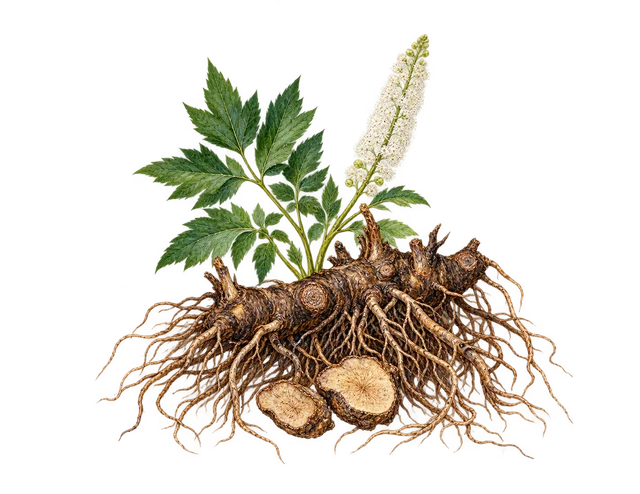
Key cautions
- May be unsafe in pregnancy or breastfeeding. Rare serious liver injury reports involve products labeled black cohosh; causation and adulteration are uncertain. Hormone-sensitive disease warrants specialist review.
- Avoid use with liver disease; stop and seek care for jaundice, dark urine or persistent abdominal pain.
- Do not confuse with blue cohosh, a different plant with serious toxicity concerns.
What’s inside
Root/rhizome extracts contain triterpene glycosides and phenolic acids; no single constituent has been shown to explain clinical effects.
Uses in brief

- Menopause extracts studied; evidence mixed and product-specific.
- Historical menstrual, pain and cough uses; not established treatments.
History, folklore and reported uses
History, folklore and traditional uses
NIH records Indigenous North American use for menstrual complaints, alongside musculoskeletal pain and respiratory illnesses. European settlers adopted it, and German medicinal use dates to the nineteenth century. These broad summaries do not identify a particular nation or justify attributing the practice to every Indigenous community.
The tall white flower spikes make a vertical accent in shade gardens. Dried seedheads can be used in flower arrangements. These are uses of the living plant or seedheads, not of the medicinal root.
Traditional, historical and reported uses
- menstruation; menopause
Mixed/contextual sourcesWhy this label?
Recent reviews suggest some defined extracts may improve hot flashes or overall symptoms. Older trials conflict; product and combination differences matter. Evidence does not establish general hormone balancing or fertility benefit.
Historical menstrual-cramp use; later use for menopause symptoms. Recent reviews suggest some defined extracts may improve hot flashes or overall symptoms. Older trials conflict; product and combination differences matter. Evidence does not establish general hormone balancing or fertility benefit.
- Broader medicinal history
Traditional accountWhy this label?
NIH describes historical North American uses for musculoskeletal pain, fever and cough as well as menstrual complaints. The summary does not identify individual Indigenous nations; it should not be treated as a universal Indigenous practice.
NIH describes historical North American uses for musculoskeletal pain, fever and cough as well as menstrual complaints. The summary does not identify individual Indigenous nations; it should not be treated as a universal Indigenous practice.
Coverage reflects verified sources, without a minimum use quota.
Women’s Health: traditions, evidence and cautions
Historical use does not establish benefit or safety. Pregnancy, breastfeeding and fertility care require particular caution: food, tea, essential oil and concentrated extract are not interchangeable. These records are not treatment, dosing or pregnancy-management instructions. Discuss supplements with a qualified clinician or pharmacist; do not delay evaluation of persistent symptoms.
Black cohosh
Actaea racemosa (syn. Cimicifuga racemosa)
- Plant part / material
- root and rhizome
- Preparation studied or reported
- defined extracts; powdered underground parts
Actaea racemosa (syn. Cimicifuga racemosa); root and rhizome. Not blue cohosh or Asian Actaea species.
menstruation; menopause
Mixed/contextual sources
Reported or traditional useHistorical menstrual-cramp use; later use for menopause symptoms. Recent reviews suggest some defined extracts may improve hot flashes or overall symptoms. Older trials conflict; product and combination differences matter. Evidence does not establish general hormone balancing or fertility benefit.
What the evidence supportsRecent reviews suggest some defined extracts may improve hot flashes or overall symptoms. Older trials conflict; product and combination differences matter. Evidence does not establish general hormone balancing or fertility benefit.
May be unsafe in pregnancy or breastfeeding. Rare serious liver injury reports involve products labeled black cohosh; causation and adulteration are uncertain. Hormone-sensitive disease warrants specialist review. Avoid use with liver disease; stop and seek care for jaundice, dark urine or persistent abdominal pain. Do not confuse with blue cohosh, a different plant with serious toxicity concerns.
Broader medicinal history
Traditional account
Reported or traditional useNIH describes historical North American uses for musculoskeletal pain, fever and cough as well as menstrual complaints. The summary does not identify individual Indigenous nations; it should not be treated as a universal Indigenous practice.
What the evidence supportsNIH describes historical North American uses for musculoskeletal pain, fever and cough as well as menstrual complaints. The summary does not identify individual Indigenous nations; it should not be treated as a universal Indigenous practice.
May be unsafe in pregnancy or breastfeeding. Rare serious liver injury reports involve products labeled black cohosh; causation and adulteration are uncertain. Hormone-sensitive disease warrants specialist review. Avoid use with liver disease; stop and seek care for jaundice, dark urine or persistent abdominal pain. Do not confuse with blue cohosh, a different plant with serious toxicity concerns.
One exact-material card. defined extracts; powdered underground parts. Keep preparations distinct; do not transfer findings from a named extract to every tea or powder.
- May be unsafe in pregnancy or breastfeeding. Rare serious liver injury reports involve products labeled black cohosh; causation and adulteration are uncertain. Hormone-sensitive disease warrants specialist review.
- Avoid use with liver disease; stop and seek care for jaundice, dark urine or persistent abdominal pain.
- Do not confuse with blue cohosh, a different plant with serious toxicity concerns.
Read the complete historical reference and its material distinctions
Identity & detailed reference
Identity
Actaea racemosa (syn. Cimicifuga racemosa); root and rhizome. Not blue cohosh or Asian Actaea species.
Ingredient details, preparation and research
Also known as: black snakeroot; bugbane; Cimicifuga racemosa
Source plant or material
Actaea racemosa (syn. Cimicifuga racemosa) — root and rhizome
Plant family / material: Ranunculaceae (buttercup family)
Forms and route
defined extracts; powdered underground parts
Vitamins and minerals
No nutrient quantities or daily-value claims are assigned to this medicinal material. Do not borrow the food nutrient profile of another plant part or use an extract as a dietary substitute.
Absorption and preparation
Preparation and route matter. A tea, whole powder, alcohol extract and isolated constituent can give different exposures. No food pairing or absorption-enhancement technique is established by the sources reviewed.
Traditional and reported uses
- Historical menstrual-cramp use; later use for menopause symptoms. Recent reviews suggest some defined extracts may improve hot flashes or overall symptoms. Older trials conflict; product and combination differences matter. Evidence does not establish general hormone balancing or fertility benefit.
- NIH describes historical North American uses for musculoskeletal pain, fever and cough as well as menstrual complaints. The summary does not identify individual Indigenous nations; it should not be treated as a universal Indigenous practice.
Contraindications and cautions
- May be unsafe in pregnancy or breastfeeding. Rare serious liver injury reports involve products labeled black cohosh; causation and adulteration are uncertain. Hormone-sensitive disease warrants specialist review.
- Avoid use with liver disease; stop and seek care for jaundice, dark urine or persistent abdominal pain.
- Do not confuse with blue cohosh, a different plant with serious toxicity concerns.
Similar items and how they compare
- Blue cohosh
Shared common-name element
Caulophyllum thalictroides is a separate species and a safety-only comparison.
- Red clover
Also studied for hot flashes
Red-clover isoflavones are not black-cohosh constituents.
Identity and composition
Actaea racemosa (syn. Cimicifuga racemosa); root and rhizome. Not blue cohosh or Asian Actaea species. Root/rhizome extracts contain triterpene glycosides and phenolic acids; no single constituent has been shown to explain clinical effects.
menstruation; menopause: what evidence can say
Recent reviews suggest some defined extracts may improve hot flashes or overall symptoms. Older trials conflict; product and combination differences matter. Evidence does not establish general hormone balancing or fertility benefit. May be unsafe in pregnancy or breastfeeding. Rare serious liver injury reports involve products labeled black cohosh; causation and adulteration are uncertain. Hormone-sensitive disease warrants specialist review.
Exact material and preparation boundaries
One exact-material card. defined extracts; powdered underground parts. Keep preparations distinct; do not transfer findings from a named extract to every tea or powder.
Medicines, pregnancy and breastfeeding
NIH ODS reports no known clinically relevant medicine interactions, while noting that interactions have not been systematically studied. That is not a guarantee of compatibility. NCCIH advises caution in pregnancy/breastfeeding and uncertainty for hormone-sensitive conditions.
Source-supported safety summary
May be unsafe in pregnancy or breastfeeding. Rare serious liver injury reports involve products labeled black cohosh; causation and adulteration are uncertain. Hormone-sensitive disease warrants specialist review. Avoid use with liver disease; stop and seek care for jaundice, dark urine or persistent abdominal pain. Do not confuse with blue cohosh, a different plant with serious toxicity concerns.
Evidence limits
- This is a focused educational source review, not a systematic review or a treatment plan.
- Traditional use documents a practice; it does not establish clinical benefit. Laboratory findings and multi-ingredient trials cannot establish a single ingredient’s effects.
Entry sources
Reference entry 520 · Recorded content review: 2026-10-11 · Review scope and dates