


Key cautions
- May sting, dry or sensitize skin. Drying toners can aggravate acne and eczema-prone skin.
- External products are not drinks or eye drops. Check age and pregnancy/breastfeeding directions; do not improvise a preserved spray.
- Stop using the cited hemorrhoid pads and ask a doctor if rectal bleeding occurs. Its label also directs consultation before use in children under 12; this age boundary belongs to that product, not to all witch-hazel preparations.
What’s inside
Plant part and processing determine which constituents reach the bottle. Tannin-containing leaf or bark extracts differ from steam-distilled water; the finished formula also determines alcohol content and skin feel.
EMA: Assessment of witch-hazel bark, leaf and distillate, 2009/2010 · DailyMed: Top Care Witch Hazel liquid, label updated 14 April 2025
Tannins belong to extracts, not ordinary distillates
The leaf and bark provide tannins such as proanthocyanidins and hamamelitannin; extraction solvent and plant part change the profile. These nonvolatile tannins are not carried over by normal steam distillation. Distilled witch-hazel water therefore contains little to essentially no tannin, unless a manufacturer blends in an extract. An extract’s tannin-based laboratory findings cannot be transferred to a distillate bottle.
EMA: Assessment of witch-hazel bark, leaf and distillate, 2009/2010 · Piazza et al.: Witch-hazel bark extract in human keratinocyte laboratory models, 2022
Alcohol, concentration and the label
The verified Top Care U.S. label lists witch hazel 86% and alcohol 14% by volume. The 86% is the labeled preparation, not 86% tannins. This example does not describe every toner. Alcohol-free products can contain differently made extracts, humectants and preservatives. Compare actual ingredient lists and intended use; percentage on the front alone is not a measure of clinical strength.
DailyMed: Top Care Witch Hazel liquid, label updated 14 April 2025 · EMA: Assessment of witch-hazel bark, leaf and distillate, 2009/2010
Uses in brief

- Traditional minor skin-inflammation and dryness support with specified medicinal preparations.
- Some labeled liquids relieve irritation from bites or small scrapes; certain finished shampoos have observational scalp-comfort experience.
History, folklore and reported uses
Botanical identity and plant parts
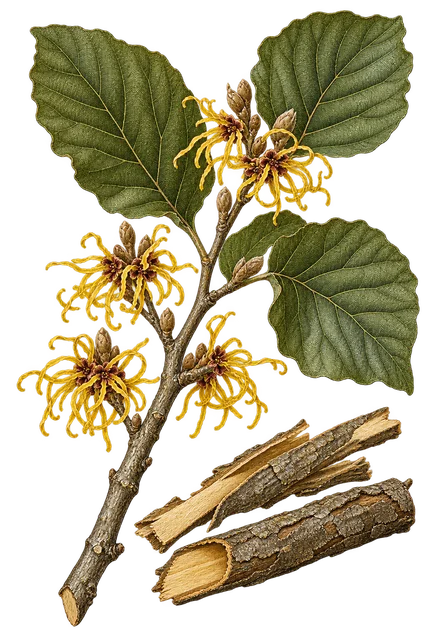
Kew accepts Hamamelis virginiana L., in Hamamelidaceae, native to parts of North America. Medicinal leaves, bark and twigs must be distinguished. It is not a hazelnut tree; resemblance or a shared common-name fragment does not establish botanical identity, equivalent preparations or allergy cross-reactivity.
Kew Plants of the World Online: Hamamelis virginiana L. · EMA: Assessment of witch-hazel bark, leaf and distillate, 2009/2010
Forest Potawatomi knowledge
Witch hazel is a woodland shrub with yellow ribbon-like flowers that appear as the year turns toward winter. Its medicinal story predates the familiar clear liquid on the bathroom shelf. In his ethnobotanical account, Huron H. Smith specifically recorded Forest Potawatomi use of witch-hazel twigs in steam baths for sore muscles. Naming that community matters: it preserves one documented practice instead of flattening many different Indigenous traditions into a single origin story.
Huron H. Smith: Ethnobotany of the Forest Potawatomi, witch-hazel entry · Sheila Connor, Arnoldia (1995): Mystical, Medicinal Witch Hazel
From woodland brush to a household bottle
The plant also entered a substantial New England manufacturing trade. Arnold Arboretum historian Sheila Connor describes Thomas Newton Dickinson’s Essex, Connecticut, distillery, established in 1866, supplied with locally cut witch-hazel brush. That passage from forest harvest to bottled household remedy helps explain the plant’s durable place in personal care. It also changed the material: distilled witch-hazel water differs from bark or leaf preparations rich in tannins. The old shrub, the traditional bath and the modern bottle are connected, but each belongs to its own preparation and setting.
Sheila Connor, Arnoldia (1995): Mystical, Medicinal Witch Hazel · EMA: Assessment of witch-hazel bark, leaf and distillate, 2009/2010
Sore-muscle steam baths
Huron H. Smith recorded Forest Potawatomi use of witch-hazel twigs in steam baths for sore muscles during his Wisconsin fieldwork. The remedy used twigs and steam, not the later bottled distillate.
Huron H. Smith: Ethnobotany of the Forest Potawatomi, witch-hazel entry
Skin irritation and small injuries
British and European pharmacy used witch-hazel water for minor skin irritation, soreness, insect bites and grazes. EMA’s assessment also records leaf-and-bark preparations, keeping these tannin-containing materials distinct from distillate.
EMA: Assessment of witch-hazel bark, leaf and distillate, 2009/2010
Haemorrhoidal discomfort
British pharmaceutical books and continental herbal practice used witch-hazel leaf or bark extracts in ointments and suppositories for haemorrhoidal complaints. This became one of the shrub’s enduring local medicinal uses.
EMA: Assessment of witch-hazel bark, leaf and distillate, 2009/2010
Mouth and throat rinses
European herbal traditions used leaf-and-bark infusions as gargles for sore mouth, throat and gums. EMA documents the astringent oral-care tradition alongside external skin uses.
EMA: Assessment of witch-hazel bark, leaf and distillate, 2009/2010
Astringent bowel tea
British and German herbal compendia recorded leaf-and-bark preparations, including teas, for diarrhoea and related bowel complaints. This historical internal use concerns medicinal herb preparations, never drinking cosmetic witch-hazel water.
EMA: Assessment of witch-hazel bark, leaf and distillate, 2009/2010
Modern external hemorrhoid pads
The verified Meijer pad label lists witch hazel 50% for temporary relief of external itching, burning and irritation associated with hemorrhoids. This identifies one finished medicine, not a tannin concentration or evidence that a toner can replace it. Unlike a suppository, this pad is for external application and must not be inserted into the rectum or vagina.
DailyMed: Meijer Hemorrhoidal Pads, witch hazel 50%, updated July 11, 2025
Health topics: evidence and cautions
These notes describe a specific research context and preparation. A topic link is not a treatment recommendation.
Body odor · Cosmetic formulation role
Form and route: Ingredient in a labeled cosmetic deodorant · topical
Condition and setting: Everyday deodorant formulation; not excessive-sweating treatment
Witch hazel appears in odor-targeting deodorant formulas.
Evidence: Cosmetic formulation reference
AAD lists it among ingredients targeting odor-forming bacteria.
Limits
An ingredient role is not a trial proving a homemade preparation works.
Cautions
- Choose a finished labeled product; discontinue if skin becomes irritated.
Regional reading paths
These sourced notes describe cultivation, trade, food traditions or material history. A regional connection does not claim exclusive origin.
North America
Native: eastern United States and Canada.
Extracts used in topical lotions and ointments.
Identity & detailed reference
Identity
Hamamelis virginiana L., a North American shrub in the Hamamelidaceae family. Its leaves, bark and twigs yield different preparations; leaf/bark extracts and distilled witch-hazel water are not chemically interchangeable.
Ingredient details, preparation and research
Source plant or material
Hamamelis virginiana L.; leaves, bark from stems/branches/twigs, or twigs used for distillation. Identify the actual plant part and preparation rather than inferring composition from the common name.
Plant family / material: Hamamelidaceae (witch-hazel family); distinct from edible hazelnuts in the genus Corylus.
Forms and route
Leaf or bark extracts, tinctures and topical creams; leaf/bark or twig distillates; formulated toners and prepared pads. Some U.S. astringent liquids contain 14% ethanol, while alcohol-free cosmetic formulas also exist. Read the plant part, extraction method, full formula, intended body area and route.
Food sources
Not an ordinary dietary ingredient or a recommended nutritional tea. Do not ingest topical witch-hazel products.
Vitamins and minerals
Witch-hazel topicals are not dietary vitamin or mineral sources. Tannins, hamamelitannin and aromatic compounds are phytochemicals, not a useful nutritional serving. There is no reason to drink an astringent to obtain nutrients.
Absorption and preparation
The preparation and vehicle matter, but no robust whole-product skin-absorption percentage or food pairing is established. Do not claim that all witch-hazel products stay entirely outside the body. Use the intended local route and do not add alcohol, acids, heat or essential oils to increase penetration.
Traditional and reported uses
- Traditional use: North American botanical practice and later European herbal medicine use witch-hazel preparations for minor skin irritation. EMA recognizes specified distillates in semisolid medicines for minor skin inflammation and dryness on long-standing-use evidence.
- Labeled modern use: particular U.S. astringent liquids temporarily relieve minor irritation from insect bites, small cuts and scrapes; this is a product-specific indication.
- Cosmetic and scalp context: included in toners and some gentle scalp products. Observational experience suggests comfort in selected sensitive scalps, but does not establish a standalone treatment for dandruff, hair loss or deep acne.
Contraindications and cautions
- Can cause contact allergy, stinging, redness or dryness. Ethanol-containing astringents can be a poor fit for dry, eczema-prone or already irritated skin; alcohol-free does not mean allergy-free.
- Avoid drying astringents on acne-prone skin. Witch hazel is not established treatment for a deep developing pimple or a substitute for appropriate acne care.
- Do not swallow an external-use bottle or put a cosmetic toner in the eyes. Eye, mouth or hemorrhoid medicines have their own formulations and labels; one route does not authorize another.
- Pregnancy/breastfeeding safety of medicinal distillate use has not been established. Ask a health professional and follow the label. EMA’s specified skin medicines are not recommended below age 6; this is not blanket approval for every cosmetic or child.
- Seek help for worsening symptoms, spreading painful redness, pus, fever or persistent unexplained scalp symptoms. The cited U.S. label advises review if symptoms last over 7 days.
- Do not use witch hazel as a universal preservative or essential-oil solubilizer. Altering a finished product with water, tea or essential oils changes its safety and stability.
- Stop using the cited hemorrhoid pads and ask a doctor if rectal bleeding occurs. Its label also directs consultation before use in children under 12; this age boundary belongs to that product, not to all witch-hazel preparations.
Similar items and how they compare
- Rosewater
Both are sold in botanical toner and mist formats.
Rosewater is a fragrant flower hydrosol; witch hazel may be an alcohol-containing distillate or a tannin-rich extract. Neither name guarantees a gentle finished formula.
- Calendula
Both have traditional topical minor-irritation uses.
Calendula uses flowers and often an emollient cream or infused oil; witch-hazel liquids may feel astringent and drying. Their allergy cautions also differ.
- Rosemary leaf
Both appear in some scalp-care products.
A multibotanical tonic does not establish synergy. Rosemary leaf extract or infusion is not rosemary essential oil, and none is interchangeable with a witch-hazel distillate.
Attributed traditional use and current regulatory review
Witch hazel has a recorded history in North American traditional practice and later European topical medicines. EMA’s distillate monograph recognizes minor skin inflammation and dryness on long-standing use, rather than well-established clinical efficacy. Its review adopted in January 2026 found no new distillate evidence that warranted revising that monograph. Traditional use remains useful context without treating every modern preparation as equivalent.
What the human skin studies show
A 72-patient randomized eczema trial found a tested distillate cream no better than its cream base, while low-dose hydrocortisone performed better. In a separate 40-volunteer UV-redness experiment, effects varied among lotions and vehicles, with limited added benefit for one distillate lotion. These findings show why the cream base and exact formula matter. They do not erase traditional minor-irritation use or establish an eczema replacement.
Laboratory anti-acne and antibacterial claims
Bark extracts have been studied in cultured human keratinocytes, and leaf extracts against bacteria in laboratory assays. Human cells in a dish are not a human clinical trial. Those findings do not prove that a drugstore distillate treats acne, sterilizes skin, cures infection or acts as an antibiotic. Tannin-rich extract and tannin-poor distillate evidence must remain separate.
Scalp comfort and the limits of the evidence
A 2014 retrospective report described a branded witch-hazel shampoo used in 1,373 patients, with reported improvement in irritation and favorable tolerance. It lacked randomized controls; the shampoo base, accompanying care and other tonic ingredients could contribute, and the author disclosed consultancy for the manufacturer. This is suggestive product-specific comfort experience, not proof of hair regrowth or dandruff treatment. Do not compound it into minoxidil or change prescribed scalp medicines at home.
Routes are formulation-specific
Skin medicines, cosmetic toners, prepared hemorrhoid products and dedicated ophthalmic medicines are different products. EMA’s eye indication concerns properly manufactured medicinal eye preparations, not household witch-hazel water. This card supplies no homemade eye-drop, mouth-rinse or internal-use recipe. Use only the route and site on the actual label; investigate persistent symptoms rather than increasing concentration.
Dry skin, acne, eczema and allergy
A tight or stripped feeling is not evidence that acne is improving. AAD advises avoiding drying astringents on acne-prone skin and avoiding alcohol/fragrance in overly dry skin. Stop a product that stings or worsens redness. For suspected allergy, follow the home tolerance-check and clinician patch-testing distinction described for rosewater; alcohol-free and botanical labels cannot rule out contact allergy.
Pregnancy, children and interactions
EMA has not established safety in pregnancy or lactation; the cited U.S. label advises consulting a health professional. EMA’s specified semisolid skin medicines are not recommended for children under 6 because data are inadequate. Its statement that no medicine interactions were reported is not a guarantee for all extracts or routes. Use age-appropriate labeled products and do not extrapolate adult topical experience to oral use or infants.
Absorption and nutrition
There is no validated whole-product absorption figure that applies to every witch-hazel preparation. Ingredient profile, vehicle and skin condition differ; local topical intent does not justify claiming zero systemic absorption. No food pairing is needed, and topical use offers no dietary vitamin/mineral serving. Choosing a tolerated product is more relevant than trying to drive plant chemicals deeper into the skin.
Storage and combination boundaries
Keep the original bottle clean and closed and follow its storage instructions. Do not assume a distillate’s original alcohol content preserves a new mixture after dilution. Water, botanical tea and added essential oils change the formulation. Neither refrigeration nor a normal smell confirms microbial safety. Use a finished product with an assessed preservation system rather than improvising a stored scalp spray.
A realistic combination concept
The observed commercial scalp regimen included a witch-hazel shampoo and a multibotanical tonic containing rosemary and other herbs. It is an example of an existing product concept, not evidence that a witch-hazel–rosemary pair is superior or that rosemary essential oil can be added safely. If considering such care, prefer an intact, labeled, tolerated product and introduce one change at a time; fewer ingredients can make a reaction easier to trace.
Entry sources
- EMA: Final monograph on witch-hazel leaf/bark or twig distillate
- DailyMed: Top Care Witch Hazel liquid, label updated 14 April 2025
- Korting et al.: Randomized comparison of witch-hazel distillate cream, vehicle and hydrocortisone in atopic eczema, 1995
- American Academy of Dermatology: Skin-care habits that can worsen acne
- EMA: Witch-hazel distillate review addendum, adopted 21 January 2026, published 11 May 2026
- Kew Plants of the World Online: Hamamelis virginiana L.
- EMA: Assessment of witch-hazel bark, leaf and distillate, 2009/2010
- Trüeb: Observational report on witch-hazel shampoo and tonic for sensitive scalp, 2014
- Piazza et al.: Witch-hazel bark extract in human keratinocyte laboratory models, 2022
- Cheesman et al.: Witch-hazel leaf extracts in bacterial culture assays, 2023
- Primary human study: Topical 10% witch-hazel distillate lotions in an experimental UV-redness test, 2002
- American Academy of Dermatology: Dermatologists’ tips for relieving dry skin
- American Academy of Dermatology: How to test skin care products
- FDA: Allergens in cosmetics
- FDA: Microbiological safety and cosmetics
- FDA: Shelf life and expiration dating of cosmetics
- EDQM: Guidance on essential oils in cosmetic products, second edition, 2024
Reference entry 101 · Recorded content review: 2026-10-05 · Review scope and dates