


Key cautions
- Check the full cream label: added progesterone is a separate hormone ingredient with its own precautions.
- Avoid self-directed medicinal use during pregnancy or breastfeeding. Review hormone-sensitive conditions, kidney disease, prolonged oral use and medicines with a clinician.
- Do not treat sudden severe abdominal pain or vomiting blood as ordinary colic: seek emergency medical care. Persistent or recurring pain, or vomiting that does not settle, also needs medical assessment.
What’s inside
Steroidal saponins are the main chemical focus of this medicinal material. Species, extraction and added ingredients determine what a preparation contains; food-yam nutrition figures do not describe it.
Manda et al.: Laboratory absorption and metabolism of diosgenin and dioscin · NC State Extension: Dioscorea villosa botany and lack of edible tubers
Plant, family and medicinal material
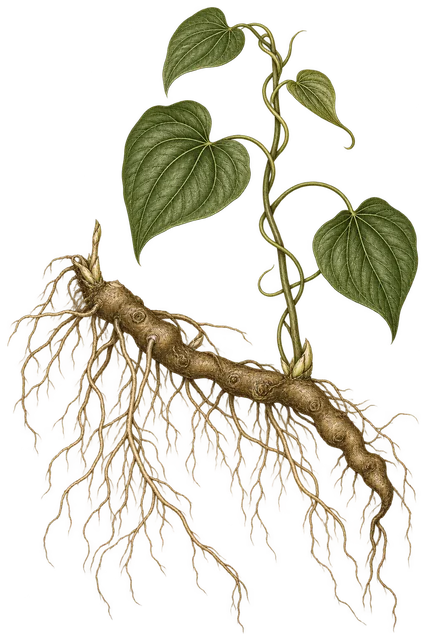
Dioscorea villosa L. is a North American climbing vine in Dioscoreaceae. Herbal preparations use its slender underground rhizome and attached roots. NC State distinguishes it from yams grown for edible tubers. Dioscorea alata and other cultivated food yams, and sweet potatoes sold as yams, are different materials; their nutrient panels and food studies should not be assigned to this medicinal herb.
Kew: Dioscorea villosa identity, family and range · NC State Extension: Dioscorea villosa botany and lack of edible tubers
Constituents and the progesterone distinction
Steroidal saponins include dioscin and related glycosides; diosgenin is a sapogenin associated with them. Industry can use diosgenin as a starting material in chemical manufacture of steroid medicines, but that laboratory process does not occur merely by eating the herb or applying its cream. The human body does not turn wild-yam diosgenin into progesterone. A cream listing progesterone contains a separately manufactured hormone, even when its label says it was derived from yam.
Manda et al.: Laboratory absorption and metabolism of diosgenin and dioscin · Memorial Sloan Kettering: Wild yam, traditional uses, hormone claims and precautions · DailyMed: Example of a wild-yam-branded cream with added progesterone; unapproved-drug labeling · Dietz et al. 2016: Botanicals and Their Bioactive Phytochemicals for Women’s Health
Dioscin, diosgenin and the older name dioscorein
Dioscin is a saponin with sugar units attached; diosgenin is the corresponding sugar-free steroidal framework. The older dispensatory name dioscorein referred to a dried extract rather than one purified chemical. Similar-sounding names therefore do not identify interchangeable ingredients.
Manda et al.: Laboratory absorption and metabolism of diosgenin and dioscin · Felter and Lloyd, King's American Dispensatory (1898): Dioscorea
Nutrients and similar products
Medicinal rhizome capsules, tinctures and creams are not meaningful food servings for vitamins or minerals. Edible cultivated yam is a separate starchy food, and progesterone cream is a separate hormone preparation. Neither is interchangeable with wild-yam-only extract. No home recipe, forage identification shortcut or nutritional serving is assigned to Dioscorea villosa.
NC State Extension: Dioscorea villosa botany and lack of edible tubers · DailyMed: Example of a wild-yam-branded cream with added progesterone; unapproved-drug labeling · Komesaroff et al.: Placebo-controlled trial of Dioscorea villosa cream in menopausal women
Uses in brief

- Attributed Western herbal use for digestive spasms and menstrual cramps; clinical benefit is not established.
- Promoted for menopause, but a small placebo-controlled cream trial found no significant symptom or progesterone benefit.
History, folklore and reported uses
Forms, routes and preparation differences
Dried rhizome/root can appear in traditional decoctions, powders, capsules and tinctures; commercial products also include extracts and topical creams. A hot-water preparation, an alcohol extract and a skin cream do not have the same composition or delivery route. Species identification, extraction ratio, concentration and other ingredients matter. There is no well-established clinical dose or defensible generic teaspoon-to-gram conversion for these diverse products.
Manda et al.: Laboratory absorption and metabolism of diosgenin and dioscin · Memorial Sloan Kettering: Wild yam, traditional uses, hormone claims and precautions · Drugs.com natural-products monograph: Pregnancy/lactation information and interaction limitations
Colic root in North American practice
Wild yam’s older names, colic root and rheumatism root, point toward a story of cramps and discomfort rather than hormones. North American herbal practice used the underground parts of Dioscorea villosa for digestive and menstrual complaints. Contemporary herbalist David Winston preserves that line of practice in his account of the plant, describing uses for gas pain, colic and menstrual cramps. His account is a named practitioner’s tradition, useful for understanding herbal practice even where the claimed effects remain unconfirmed.
David Winston: Attributed traditional digestive and menstrual-cramp uses · Felter and Lloyd, King's American Dispensatory (1898): Dioscorea
A separate history of steroid manufacture
A different chapter unfolded in twentieth-century chemistry. As the American Chemical Society documents, Russell Marker developed ways to manufacture progesterone from plant starting materials, with Mexican Dioscorea species becoming important industrial sources. That laboratory achievement helped attach a hormone story to products called “wild yam.” The bridge is chemical manufacturing, not a transformation performed by the body: eating wild yam or applying an ordinary yam cream does not turn its diosgenin into progesterone. Keeping the two histories separate lets the older colic-root tradition remain visible.
American Chemical Society: Russell Marker and the Mexican steroid hormone industry · Dietz et al. 2016: Botanicals and Their Bioactive Phytochemicals for Women’s Health
Reading the historical accounts
Eclectic physicians belonged to a nineteenth-century American medical movement that made extensive use of botanical remedies. Their materia medica recorded practitioners’ observations and preparations. The following uses preserve those accounts, rather than modern trial results or instructions for self-treatment.
Drugs.com natural-products monograph: Pregnancy/lactation information and interaction limitations · Felter and Lloyd, King's American Dispensatory (1898): Dioscorea
Colic-root digestive remedies
Nineteenth-century North American Eclectic physicians used wild-yam rhizome decoctions and extracts for intestinal cramps and the complaint they called bilious colic. King’s Dispensatory makes this the plant’s principal historical use.
Felter and Lloyd, King's American Dispensatory (1898): Dioscorea
Menstrual cramps
Ellingwood’s 1919 American materia medica records Dioscorea villosa tinctures for cramp-like menstrual pain. The tinctured underground part belonged to the Eclectic physician’s antispasmodic materia medica.
Nausea and vomiting
King’s Dispensatory also records rhizome preparations for persistent nausea and vomiting, including combination decoctions. The authors placed these remedies among the plant’s uses for an irritable stomach.
Felter and Lloyd, King's American Dispensatory (1898): Dioscorea
Rheumatism-root tradition
Madaus’s 1938 account preserves the American name rheumatism root and use for cramp-like rheumatic pain and neuralgia. His Dioscorea villosa entry identifies the rootstock as the medicinal part; related yam species have separate histories.
Spasmodic respiratory complaints
King’s Dispensatory records a narrower Eclectic use of wild-yam rhizome preparations for spasmodic asthma, including a case attributed to John King. The account is a named practitioner’s case report, a narrower record than the established colic-root tradition.
Felter and Lloyd, King's American Dispensatory (1898): Dioscorea
Breathing symptoms need modern care
The historical asthma account is not a rescue treatment. Follow your prescribed asthma action plan; severe or worsening breathing difficulty, or an attack not relieved by your reliever medicine, requires emergency help.
Historical use around childbirth
King’s Dispensatory also describes an oral combination decoction for pregnancy-related nausea, and Ellingwood records oral tincture for pains after childbirth. These accounts do not establish safety in pregnancy, breastfeeding or postpartum complications; they are not recommendations to reproduce the preparations.
Felter and Lloyd, King's American Dispensatory (1898): Dioscorea · Finley Ellingwood (1919): Dioscorea villosa · Drugs.com natural-products monograph: Pregnancy/lactation information and interaction limitations
Different yam histories
Madaus discusses several Dioscorea species within the same entry, including D. hispida and D. oppositifolia. Their food and medicinal accounts cannot simply be assigned to D. villosa. His D. villosa discussion includes the rootstock and homeopathic preparations, another reason to keep preparation and historical context attached to each claim.
Women’s Health: traditions, evidence and cautions
Historical use does not establish benefit or safety. Pregnancy, breastfeeding and fertility care require particular caution: food, tea, essential oil and concentrated extract are not interchangeable. These records are not treatment, dosing or pregnancy-management instructions. Discuss supplements with a qualified clinician or pharmacist; do not delay evaluation of persistent symptoms.
Wild yam
Dioscorea villosa
- Plant part / material
- root/rhizome extract
- Preparation studied or reported
- topical extract cream studied; oral preparations are different
Wild yam is traditionally associated with cramping and gastrointestinal complaints. Its diosgenin became significant in laboratory steroid chemistry, but a laboratory starting material is not a hormone treatment produced by the human body.
menopause
small negative clinical trial
Reported or traditional useTraditional antispasmodic reputation; later menopause-cream promotion.
What the evidence supportsA small placebo-controlled crossover trial of wild-yam cream found no meaningful menopause or hormone advantage. Findings from other Dioscorea species or mixtures cannot establish D. villosa efficacy.
No established pregnancy/lactation safety for medicinal preparations. Hormone-sensitive cancer requires clinician review. A cream containing added progesterone is a different product.
- No established pregnancy/lactation safety for medicinal preparations. Hormone-sensitive cancer requires clinician review. A cream containing added progesterone is a different product.
Identity & detailed reference
Identity
Dioscorea villosa L., a North American climbing vine also called colic root or rheumatism root. Herbal products generally use the rhizome and roots. This medicinal plant is distinct from cultivated edible yams and from sweet potatoes marketed as yams.
Ingredient details, preparation and research
Also known as: Colic root; Rheumatism root; Wild yam root
Source plant or material
Dioscorea villosa L.; primarily the slender underground rhizome and attached roots, not the large edible tubers of cultivated food yams.
Plant family / material: Dioscoreaceae (yam family).
Forms and route
Dried rhizome/root for traditional tea or decoction, powdered herb, capsules, tinctures or liquid extracts, and topical creams. Extract strength and ingredients vary. A cream containing only wild yam is different from one with added progesterone or other hormones; check the full ingredient and active-ingredient panels.
Food sources
Dioscorea villosa is a medicinal botanical, not a recommended food. Cultivated edible yams, such as Dioscorea alata, are separate foods.
Vitamins and minerals
Medicinal Dioscorea villosa preparations are not a meaningful dietary vitamin or mineral source. Nutrient values for cultivated edible yams do not apply to its capsules, tinctures or creams.
Absorption and preparation
Human whole-herb pharmacokinetic data are limited. Laboratory work found poor water solubility and transport-related limits for diosgenin, and partial conversion of dioscin to diosgenin in simulated digestive fluids. These findings do not show that any food pairing, oil, tincture or cream reliably improves clinical effects. There is no validated household absorption booster, and absorption cannot make diosgenin become progesterone in the body.
Combination context
No evidence-based wild-yam combination is established here. Adding oils, other herbs or hormone-oriented ingredients does not make wild-yam-only extract into progesterone. A blend containing added progesterone must be assessed as a hormone-containing product; each additional botanical has its own cautions.
Traditional and reported uses
- Attributed Western herbal practice: herbalist David Winston describes wild yam for colic, gas-related abdominal discomfort and menstrual cramps. These are traditional antispasmodic uses, rather than established clinical treatment recommendations.
- Other recorded traditional uses: Memorial Sloan Kettering describes use for digestive ailments, muscle spasms, asthma, joint pain and rheumatoid arthritis. Such historical practice can be documented without assuming that it treats the underlying disease.
- Contemporary reported use: menopausal symptoms and perceived hormone balance. NCCIH finds too little research for a conclusion. In a placebo-controlled crossover study of 23 women, a Dioscorea villosa cream did not significantly improve symptoms or raise serum or salivary progesterone. Results from other yam species or combination formulas cannot establish the effects of this herb.
- Diosgenin has served as an industrial starting material for manufacturing steroid medicines. The body does not convert wild-yam diosgenin into progesterone. Wild yam is not a demonstrated substitute for prescribed progesterone, contraception or fertility treatment.
Contraindications and cautions
- Avoid self-directed medicinal use during pregnancy or breastfeeding: reliable safety data are lacking. Historical use around menstruation or childbirth does not establish pregnancy safety. Medicinal use in children also lacks an established safety basis.
- Discuss use with the treating clinician if you have a hormone-sensitive condition, especially a hormone-sensitive cancer. Hormonal activity seen in some laboratory studies is inconsistent and does not demonstrate safe or effective hormone replacement in people.
- A repeated-dose rat study found kidney fibrosis and liver inflammation. This does not establish the incidence of harm in humans, but supports avoiding unsupervised prolonged oral use, particularly with kidney disease or medicines that can affect kidney function.
- Clinically confirmed interactions are poorly characterized. A laboratory study found CYP3A4 inhibition only at relatively high concentrations and considered substantial interactions unlikely; this is not proof of safety with every medicine. Request a pharmacist review with prescription hormones or cancer treatments, and assess every ingredient in combination products.
- Creams can irritate skin; stop if a rash develops. A wild-yam-branded cream may contain actual added progesterone with its own risks and interactions. DailyMed includes such a product explicitly labeled as an unapproved drug; listing there is not FDA approval.
- There is no well-established clinical dosing guideline. Do not forage or substitute an unidentified yam species, and do not assume a cosmetic extract assessment establishes oral-extract safety.
- Do not treat sudden severe abdominal pain or vomiting blood as ordinary colic: seek emergency medical care. Persistent or recurring pain, or vomiting that does not settle, also needs medical assessment.
Similar items and how they compare
- Edible yams (for example Dioscorea alata)
They share the Dioscorea genus and the common word yam.
Cultivated food yams have edible starchy tubers and a different composition; studies of eating these tubers do not validate Dioscorea villosa supplements.
- Progesterone-containing creams
Both may be sold with wild-yam-related language for menopausal concerns.
A cream listing progesterone contains a separately manufactured hormone. A wild-yam-only cream supplies plant extract and is not equivalent in effects, dosing or risks.
Attributed traditions and human evidence
Herbalist David Winston describes wild yam for colic, gas-associated discomfort and menstrual cramps. These are attributed practice claims, not established disease treatments. The directly relevant randomized crossover study involved 23 women using Dioscorea villosa cream and placebo for three months each. There was no significant advantage for menopausal symptoms and no rise in serum or salivary progesterone. Studies of edible yam species or multi-ingredient formulas cannot establish the effects of this preparation.
Laboratory findings and absorption
An in-vitro study examined diosgenin and dioscin in simulated digestive fluids, cell barriers and liver preparations. Diosgenin had poor water solubility and transport-related limitations; some dioscin converted to diosgenin during simulated digestion. These are laboratory observations, not proof that a tincture, meal with fat or topical oil improves outcomes in people. A human absorption advantage has not been established for a household preparation, and greater absorption would not turn diosgenin into progesterone.
Pregnancy, hormones and oral safety
Reliable pregnancy, breastfeeding and pediatric safety data are lacking, so avoid self-directed medicinal use in these situations. People with hormone-sensitive conditions, particularly cancers, should check with their treating clinician. A repeated-dose rat study found kidney fibrosis and liver inflammation after 28 days of oral extract exposure. This does not quantify human risk, but supports caution about prolonged unsupervised oral use, especially with kidney disease or medicines affecting the kidneys. Laboratory hormonal findings are not evidence of safe hormone replacement.
Medicines, skin products and combinations
Confirmed human interactions are poorly characterized. High-concentration CYP3A4 inhibition in one laboratory study is not a demonstrated interaction at ordinary human exposure and is not proof of universal safety. Seek a product-specific review with prescription hormones or cancer treatment. Cream ingredients can cause skin irritation. A current DailyMed example explicitly contains added progesterone and is labeled as an unapproved drug; the listing does not establish FDA approval. No best wild-yam blend is established, and added oils or herbs cannot supply the missing progesterone conversion.
Evidence limits
- The cream trial is small and preparation-specific; it cannot prove all formulations safe or ineffective for every purpose.
- Animal toxicity and cell-based hormonal or enzyme effects are labeled as such and do not supply a human incidence estimate.
- DailyMed is used to verify a label’s ingredients and unapproved-drug status, not its efficacy claims or inconsistent dosing statements.
- No validated medicinal dose, household conversion, absorption enhancer or best blend is established.
Entry sources
- Memorial Sloan Kettering: Wild yam, traditional uses, hormone claims and precautions
- Komesaroff et al.: Placebo-controlled trial of Dioscorea villosa cream in menopausal women
- NCCIH: Menopausal symptoms and complementary approaches
- DailyMed: Example of a wild-yam-branded cream with added progesterone; unapproved-drug labeling
- Kew: Dioscorea villosa identity, family and range
- NC State Extension: Dioscorea villosa botany and lack of edible tubers
- Manda et al.: Laboratory absorption and metabolism of diosgenin and dioscin
- Wojcikowski et al.: Kidney-fibrosis findings in rats given Dioscorea villosa extract
- David Winston: Attributed traditional digestive and menstrual-cramp uses
- Drugs.com natural-products monograph: Pregnancy/lactation information and interaction limitations
Reference entry 91 · Recorded content review: 2026-10-05 · Review scope and dates