


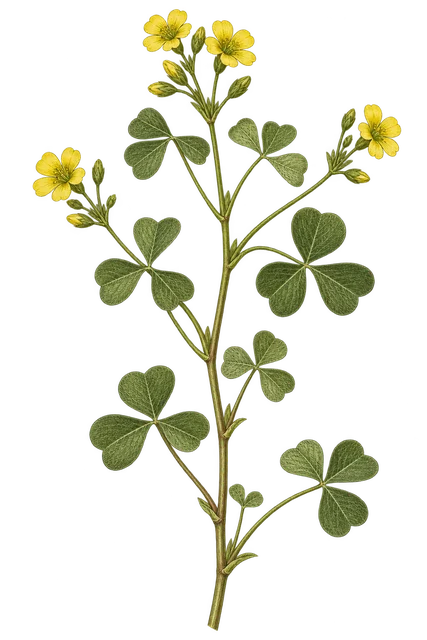
Key cautions
- Oxalic acid limits use; avoid large portions and concentrated preparations.
- If you have kidney disease, calcium-oxalate stones or a prescribed low-oxalate diet, choose another garnish pending clinical advice.
What’s inside
Oxalic acid/soluble oxalates contribute sourness and are the principal safety concern.
Uses in brief

- Small flavor accents from correctly identified, food-grown material.
History, folklore and reported uses
History, folklore and traditional uses
Missouri’s field guide places yellow wood sorrel between garden weed and wild food. Its sour flavor explains names such as sourgrass, while the small flowers give it an ornamental role. NC State’s account permits only sparing food use because of oxalates. The useful story is about a tart accent with limits, rather than a plentiful green to build a salad around.
Traditional, historical and reported uses
- Sour garnish
Food or household practiceWhy this label?
The claim documents sour garnish as a culinary, craft, gardening, or practical material use; it reports neither a treatment outcome nor measured nutrient content.
NC State records leaves, stems, flowers and seed pods as tangy foods used sparingly. This card limits practical suggestions to small leaf or flower accents.
- Cherokee appetite-remedy record
Traditional accountWhy this label?
A named Cherokee ethnobotanical compilation records an appetite remedy without a verified preparation or clinical outcome.
Hannah Dinkins’s Plants of the Cherokee compilation identifies yellow wood sorrel as Oxalis stricta and records a remedy for a condition translated as spoiled appetite. The entry does not identify a plant part or establish a safe preparation; this is cultural documentation.
Only specifically supported uses are included; historical or culinary use is not clinical proof.
Historical-use additions reviewed 2026-10-08
Identity & detailed reference
Identity
Yellow wood sorrel, Oxalis stricta; sour leaves and flowers have limited culinary use. It is not Rumex sorrel or roselle.
Ingredient details, preparation and research
Source plant or material
Oxalis stricta L.; Yellow wood sorrel, Oxalis stricta; sour leaves and flowers have limited culinary use. It is not Rumex sorrel or roselle.
Plant family / material: Oxalidaceae
Forms and route
Fresh leaves or flowers as a small sour accent; no concentrated juice, tincture or medicinal-tea regimen.
Vitamins and minerals
A few leaves or flowers are a flavoring, not a reliable serving of vitamins or minerals; no numerical nutrient credit is assigned.
Absorption and preparation
This review found no human absorption study supporting special pairings. Sourness is not evidence of a vitamin-C dose.
Practical preparation
Use only verified O. stricta grown for food, sparingly. This card does not endorse all Oxalis species or root use.
Traditional and reported uses
- Small flavor accents from correctly identified, food-grown material.
Contraindications and cautions
- Oxalic acid limits use; avoid large portions and concentrated preparations.
- If you have kidney disease, calcium-oxalate stones or a prescribed low-oxalate diet, choose another garnish pending clinical advice.
Similar items and how they compare
- Curly dock
Also sour and oxalate-containing.
Rumex crispus belongs to Polygonaceae.
- Hibiscus / roselle
Sometimes also called sorrel.
Roselle drinks use Hibiscus sabdariffa calyces.
Identity matters
O. stricta is in Oxalidaceae. The similar everyday names clover and sorrel do not identify interchangeable ingredients.
Evidence limit
The reviewed botanical references support a limited food use, not a medicinal dose or a method that makes large quantities safe.
Individual oxalate advice
Stone-prevention diets depend on stone type and individual findings. Do not restrict dietary calcium on your own or treat this plant card as an individualized kidney diet.
Entry sources
- NC State Extension: Oxalis stricta
- Missouri Department of Conservation: Yellow wood sorrel
- National Kidney Foundation: Kidney stone diet plan and prevention
- Hannah Dinkins: Plants of the Cherokee and their uses, yellow wood sorrel
Reference entry 177 · Recorded content review: 2026-10-07 · Review scope and dates