


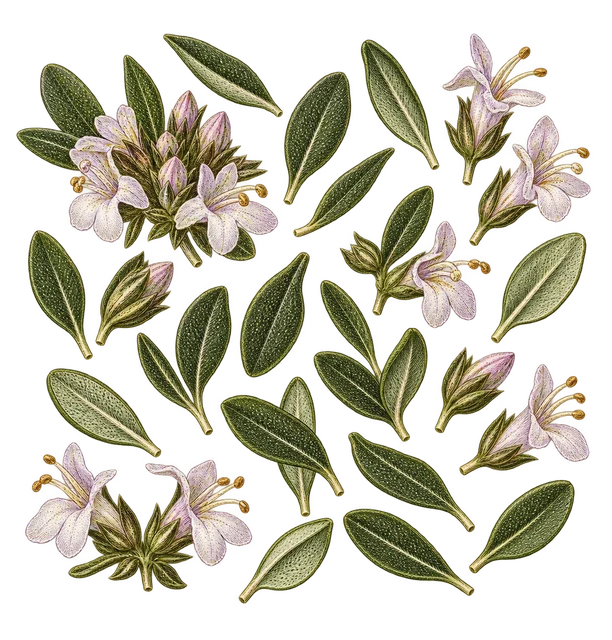
Key cautions
- Avoid thyme medicines with thyme/mint-family allergy; stomach upset can occur. Keep essential oil separate from tea and food.
- Seek care for breathing difficulty, fever, worsening cough or symptoms lasting over a week. Medicinal pregnancy/child use is preparation-specific.
What’s inside
Thyme leaf contains phenolic acids and flavonoids as well as a variable aromatic oil fraction. Species, cultivar, growing conditions and preparation all affect the resulting mixture.
EMA: Thyme-herb assessment report, species, constituents and preparations · Satyal et al. (2016): Thyme essential-oil characterization across geographical locations
Leaf compounds and aroma
The herb contains rosmarinic acid and flavonoids. Its volatile fraction may feature thymol, carvacrol, p-cymene and gamma-terpinene. These describe its chemistry without making every thyme preparation interchangeable.
EMA: Thyme-herb assessment report, species, constituents and preparations · Satyal et al. (2016): Thyme essential-oil characterization across geographical locations
Different chemical types
A chemotype is a form of the plant distinguished by its chemical profile. Some thyme oils are rich in linalool, geraniol or sabinene hydrate rather than thymol. EMA’s medicinal-herb specification emphasizes a thymol type; a different garden or aromatherapy type cannot automatically inherit its evidence.
EMA: Thyme-herb assessment report, species, constituents and preparations · Satyal et al. (2016): Thyme essential-oil characterization across geographical locations
A teaspoon of fresh leaves
In USDA’s 2015 reference data, a teaspoon of fresh thyme weighs 0.8 g and provides about 1 kcal, 1.3 mg vitamin C, 0.14 mg iron, 3 mg calcium and 0.1 g fibre. These are small contributions from the edible herb. Dried thyme has a different water content, and strained tea or essential oil cannot be assigned whole-leaf nutrient values.
Uses in brief

- Food seasoning in soups, stews, vegetables and savory dishes.
- Traditional use of specified thyme-herb preparations for productive cough associated with a cold; single-herb clinical evidence is limited.
- Hair-care form check: thyme essential oil appeared in a studied blend; culinary thyme and tea are different preparations.
History, folklore and reported uses
Wild and garden thymes in old herbals
The Met explains that ancient authors’ thymes often differed from today’s Thymus vulgaris. Dioscorides discussed Mediterranean thymes, while northern European texts also used creeping species. Hildegard of Bingen discussed more than one thyme in the twelfth century; their identities remain partly uncertain. Writers described thyme as warming and drying within humoral medicine, which understood health through the balance of bodily fluids and qualities such as heat and cold.
Cough and digestive traditions
European practice used thyme leaf and flowers in teas, syrups and extracts for chesty coughs with colds; EMA records this for T. vulgaris and T. zygis. Health Canada separately documents dried leaf and flowering-top infusions and tinctures for indigestion and gas-related abdominal cramps. EMA’s traditional-use conclusion rests on long use and plausibility, not strong clinical proof for every thyme product or evidence that it eradicates infection.
EMA: Thyme herb · Health Canada (2026): Thyme oral monograph, digestive and respiratory traditions
Gargles and external compresses
Health Canada records thyme leaf and flowering-top mouthwashes and gargles for minor mouth and throat inflammation. The Egyptian Drug Authority’s 2022 compendium records water-infused herb compresses for inflamed swellings and warts. These local preparations differ from oral remedies and distilled oil.
Health Canada (2025): Thyme buccal monograph · Egyptian Drug Authority (2022): Thymus vulgaris monograph
A nineteenth-century menstrual remedy
William Cook’s 1869 American dispensatory records warm garden-thyme infusion for painful or obstructed menstruation attributed to exposure to cold.
William Cook, The Physiomedical Dispensatory (1869): Thymus vulgaris
Thyme in the cooking pot
NC State records fresh or dried garden-thyme leaves in soups, stews, sauces, meat and fish, an everyday culinary use alongside the herb’s medicinal traditions. Garden thyme is native to southwestern Europe and southeastern Italy and grows well in sunny, dry, well-drained ground. Use the leaves in savoury foods and remove woody stems as appropriate. Follow the particular tea or extract label for medicinal preparations.
Leaves tucked into drawers
In the Ancona district of central Italy, an ethnobotanical survey recorded thyme leaves placed in drawers to protect their contents from moths. This household custom uses the leaf’s fragrance and is separate from the medicinal cough tradition.
Identity, family and monograph material
Thymus vulgaris L. belongs to Lamiaceae, the mint family. EMA’s herb assessment also covers T. zygis L.; the medicinal material is leaves and flowers separated from dried stems. Other ornamental or wild thymes should not be assumed equivalent from the common name alone.
Kew Plants of the World Online: Thymus vulgaris L. · EMA: Thyme-herb assessment report, species, constituents and preparations
Human cough evidence
EMA found the 60-person thyme-versus-bromhexine study too limited and poorly described for firm conclusions. A separate 361-adult randomized study found a larger reduction in coughing fits with a fixed thyme–ivy syrup than placebo over 11 days. That result concerns the combined extract, not thyme leaf alone, and does not justify replacing medical assessment when symptoms are concerning.
EMA: Thyme herb · Kemmerich et al. (2006): Fixed thyme–ivy extract syrup in 361 adults with acute bronchitis
Oil chemistry in laboratory tests
In a 2016 study, distilled thyme oils with different chemical profiles had different effects in laboratory antifungal tests. A sabinene-hydrate-rich oil performed differently from the linalool- and geraniol-rich oils tested. Water infusions, alcohol extracts and distilled oils contain different proportions of constituents; these experiments do not show that tea or oil treats infection in a person. An assay concentration or constituent percentage cannot be converted into a home oral-oil dose.
Satyal et al. (2016): Thyme essential-oil characterization across geographical locations · EMA: Thyme-herb assessment report, species, constituents and preparations · National Capital Poison Center: Essential oils, poisonous when misused
Safety, age and escalation
Avoid thyme medicines with thyme or related mint-family allergy; gastrointestinal symptoms can occur. Most EMA preparations are for adults/adolescents over 12, with some particular products for children over 4. Medicinal pregnancy/lactation safety is insufficiently established. Seek review if cough lasts over a week or worsens; breathing difficulty, fever or coughing up pus-containing mucus need assessment. These restrictions do not describe ordinary food seasoning.
EMA: Thyme herb · EMA: Thymus vulgaris and Thymus zygis herb monograph
Human absorption and metabolism
In a 12-person study of a particular thyme-containing tablet, thymol sulfate appeared in blood plasma, the liquid part of blood; unchanged thymol was not detected. Sulfate and glucuronide metabolites, forms made as the body processes thymol, appeared in urine. This describes processing of that formulation, not the amount delivered by leaf tea or an effective concentration in the lungs.
Kohlert et al. (2002): Thymol pharmacokinetics after a thyme-containing tablet in 12 volunteers
Health topics: evidence and cautions
These notes describe a specific research context and preparation. A topic link is not a treatment recommendation.
Respiratory health · Traditional reports
Form and route: tea or defined oral herb preparation · oral
Traditional thyme preparations are used for a chesty cough with a cold.
Evidence: documented traditional use; clinical evidence insufficient
EMA recognizes longstanding symptom use; this is not proof of a disease cure.
Limits
Culinary seasoning and essential oil are not equivalent cough medicines.
Cautions
- Avoid with thyme-family allergy; worsening symptoms need assessment.
- Most medicinal preparations are for ages 12 and older; some have different labels. Stomach upset can occur.
Regional reading paths
These sourced notes describe cultivation, trade, food traditions or material history. A regional connection does not claim exclusive origin.
Europe
Cultivated and traditional processing: Mediterranean thyme and UK herb gardens; European medicinal assessment.
Leaves and flowering herb provide culinary aroma.
Identity & detailed reference
Identity
Thymus vulgaris L.; leaves and flowers. The EMA thyme-herb monograph also covers Thymus zygis L.; other thyme species and named chemotypes should be identified rather than assumed equivalent.
Ingredient details, preparation and research
Source plant or material
Thymus vulgaris L.; leaves and flowers stripped from woody stems.
Plant family / material: Lamiaceae (mint family).
Forms and route
Fresh or dried culinary leaves, herb tea, labeled liquid extracts/tinctures and prepared oral cough products. Distilled thyme essential oil is a separate concentrate; combination cough products have their own ingredients and instructions.
Practical preparation
Use culinary leaves in food, removing woody stems as needed. A labeled thyme-herb infusion or oral extract should be prepared according to its leaflet. Do not turn an essential-oil chemical analysis into a drops-per-cup recipe or add aromatherapy oil to tea.
Combination notes
Thyme works with soups, roasted vegetables, mushrooms and other savory foods. Thyme–ivy clinical results belong to the tested product; they do not show that adding kitchen ivy or mixing arbitrary extracts improves a thyme tea. Culinary blending with oregano or marjoram is for taste.
Traditional and reported uses
- Culinary seasoning for soups, stews, vegetables, meat and herb blends.
- EMA traditional-use conclusion for specified T. vulgaris/T. zygis herb preparations: productive cough associated with a cold.
- Human cough studies often evaluate fixed combinations such as thyme–ivy or thyme–primrose. They do not establish equal effects of thyme alone or homemade tea.
- Linalool-, thymol-, geraniol- and other oil chemotypes are chemical categories, not interchangeable medicinal indications.
- Hair-care form check: thyme essential oil appeared in a studied blend; culinary thyme and tea are different preparations.
Contraindications and cautions
- Avoid thyme medicines with allergy to thyme or related mint-family plants. Stomach upset can occur.
- Seek medical advice if cough persists beyond a week or worsens, or if fever, breathing difficulty or coughing up pus-containing mucus develops; herbs should not delay needed assessment.
- Medicinal-use safety in pregnancy and breastfeeding is not established. Age limits depend on the preparation; this adult card is not a dosing guide for children.
- Do not swallow aromatherapy thyme oil or apply it undiluted. Its concentration and irritation risk are different from those of a culinary herb or labeled tea.
Similar items and how they compare
- Oregano
Both are mint-family seasoning herbs whose volatile fractions can contain thymol, carvacrol and linalool, with strong chemotype variation.
Thyme has an EMA traditional-use cough monograph for specified preparations; oregano is not an interchangeable cough medicine.
- Sweet basil
Both include linalool-rich chemotypes and contain phenolic acids as well as aroma compounds.
Basil has a different set of volatile profiles, sometimes rich in estragole; similar scent constituents do not make extracts equivalent.
Related herbs and combinations
Oregano and marjoram are useful flavor companions and share some aroma chemistry. A fixed thyme–ivy medicinal trial cannot establish the effect of kitchen combinations, nor show that two independently purchased extracts are synergistic.
Hair care: cosmetic role and evidence limits
The hair research concerns concentrated thyme essential oil, not the culinary herb, a thyme tea or a leaf rinse. Thyme oil was one component of a diluted blend studied for alopecia areata. The small seven-month study concerned alopecia areata, not all forms of hair loss. It compared a blend with carrier oils and could not isolate an individual essential oil. The authors later described alternating allocation, which weakens the original randomization claim. The study is not a home-mixing recipe. Dilution does not establish effectiveness or eliminate allergy risk. For any thyme-oil scalp cosmetic, choose a properly formulated diluted topical product and follow its label; avoid neat oil and irritated skin, and stop for burning or rash.
Entry sources
- Kew Plants of the World Online: Thymus vulgaris L.
- EMA: Thyme-herb assessment report, species, constituents and preparations
- Satyal et al. (2016): Thyme essential-oil characterization across geographical locations
- EMA: Thyme herb, traditional-use conclusions and limitations of clinical evidence
- EMA: Thymus vulgaris and Thymus zygis herb monograph
- Kemmerich et al. (2006): Fixed thyme–ivy extract syrup in 361 adults with acute bronchitis
- National Capital Poison Center: Essential oils, poisonous when misused
- Kohlert et al. (2002): Thymol pharmacokinetics after a thyme-containing tablet in 12 volunteers
- USDA FoodData Central: SR Legacy downloadable food and portion data
- University of Minnesota Extension: Herbs, preparation and culinary pairings
- De Martino et al. (2009): Three Origanum vulgare subsp. hirtum oil chemotypes
- Baâtour et al. (2012): Growing conditions and sweet-marjoram essential-oil composition
- FDA: Daily Value on the Nutrition and Supplement Facts labels
- NC State Extension: Thymus vulgaris
- Hay et al. (1998): Essential-oil blend trial in alopecia areata
- Hay and Ormerod (1999): Author reply clarifying alternating allocation
- EMA: Thyme oil (Thymi aetheroleum)
Reference entry 97 · Recorded content review: 2026-10-05 · Review scope and dates