


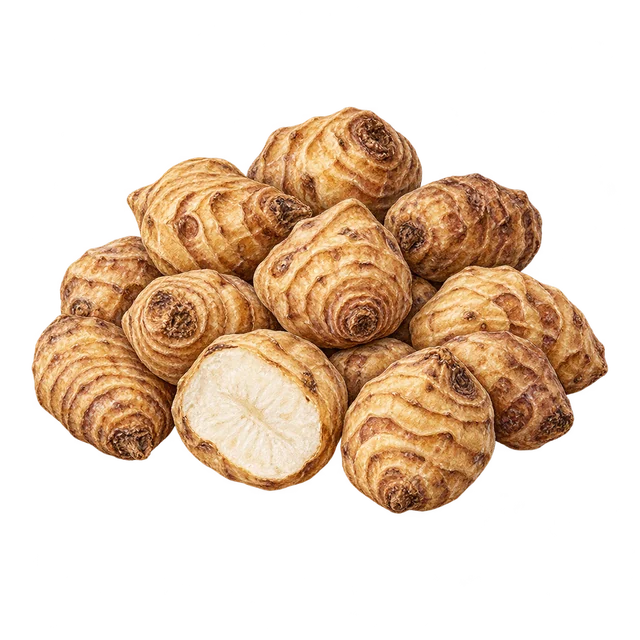
Key cautions
- Choose clean food-grade tubers, not unidentified weeds or planting material. Soil-associated contamination requires proper handling; soaking alone is not sterilization.
- Hard tubers can be a choking or chewing problem for young children and people with swallowing difficulties. Allergy remains possible despite the absence of botanical tree nuts.
- Do not use homemade tigernut drink as infant formula. Refrigerate prepared drinks and follow reliable food-safety guidance.
What’s inside
Starch, sugars, fiber and appreciable tuber oil, often with oleic acid prominent. Cultivated forms and processing vary, so different products should not share a single composition claim.
Uses in brief

- Snack tubers
- Flour and beverages
History, folklore and reported uses
History, folklore and traditional uses
Cultivated/traded: West African food traditions, including Nigeria.
A closer look at its history
An Egyptian food pictured in a tomb
Tigernuts are edible underground tubers of a sedge, not tree nuts. Hala Barakat’s cultural-history account connects them with ancient Egyptian food remains and with cake-making scenes in the tomb of Rekhmire at Thebes. The Metropolitan Museum preserves Nina de Garis Davies’s facsimile of the scene and dates its ancient original to about 1479–1396 BCE. The images give a valuable window onto preparation and presentation, but an image is not a fully measured recipe: modern reconstructions involve interpretation of ingredients, quantities and actions.
From Egyptian street snacks to distinct regional drinks
Barakat also describes Egyptian habb el-aziz sold as a soaked street snack, including an association with moulid celebrations. Elsewhere the same tuber enters drinks such as Nigerian kunnu aya and Spanish horchata de chufa, made from ground tubers and water, commonly with sweetening and straining. These examples show continuity of an ingredient alongside considerable change in texture and setting: snack, flour, cake and drink are separate preparations. Their coexistence does not establish a direct, unchanged recipe lineage from an Egyptian tomb to a modern beverage stall.
Additional history reviewed 2026-10-09
Traditional, historical and reported uses
- Snack tubers
Food or household practiceWhy this label?
The source supports the named food, cosmetic or material practice; no treatment effect is inferred and the card’s form and safety limits remain attached.
FAO records tigernut eaten as a snack, including roasted forms. Use cleaned food-grade tubers; hard dried pieces may require a preparation suitable for the person eating them.
- Flour and beverages
Food or household practiceWhy this label?
The source supports the named food, cosmetic or material practice; no treatment effect is inferred and the card’s form and safety limits remain attached.
FAO records milled products and drinks. Filtration can remove fiber, while sweetening changes sugar content; a drink is not automatically a complete replacement for dairy or infant formula.
2 sourced featured uses; cultural or material records are not clinical efficacy evidence.
Historical-use additions reviewed 2026-10-09
Women’s Health: traditions, evidence and cautions
Historical use does not establish benefit or safety. Pregnancy, breastfeeding and fertility care require particular caution: food, tea, essential oil and concentrated extract are not interchangeable. These records are not treatment, dosing or pregnancy-management instructions. Discuss supplements with a qualified clinician or pharmacist; do not delay evaluation of persistent symptoms.
Tigernut / chufa
Cyperus esculentus L.
- Plant part / material
- Edible tubers; the survey names tiger nuts without detailing processing
- Preparation studied or reported
- Food; processing not specified in the reproductive-use report
Ghanaian interviews recorded tiger nuts in lactation traditions.
lactation
original ethnobotanical food-use record; efficacy unproven
Reported or traditional useTiger nuts were named as a milk-supply food.
What the evidence supportsThe survey establishes reported practice, not clinical effectiveness.
No tigernut-specific medicinal pregnancy/lactation safety evidence was located. Keep ordinary food use separate from claims for extracts or medicinal regimens.
- Do not label the food a proven galactagogue.
Regional reading paths
These sourced notes describe cultivation, trade, food traditions or material history. A regional connection does not claim exclusive origin.
Africa
Cultivated/traded: West African food traditions, including Nigeria.
Edible tubers eaten as snacks or processed into drinks; not a tree nut.
Identity & detailed reference
Identity
The edible tubers of Cyperus esculentus, called tigernut, chufa or earth almond. They are underground sedge tubers, not tree nuts, peanuts or seeds.
Ingredient details, preparation and research
Source plant or material
Cyperus esculentus
Plant family / material: Cyperaceae
Forms and route
Clean fresh or dried food tubers, flour and formulated drinks. Extracted tuber oil and sweetened beverages differ from the whole tuber in fiber, fat and sugar content.
Vitamins and minerals
Whole tubers contribute carbohydrate, fat and fiber; strained beverages and pure oil omit or redistribute these fractions. No universal mineral or protein-serving claim is assigned.
Absorption and preparation
Grinding and cooking alter the matrix, but composition assays do not establish a specific glycemic benefit or enhanced absorption from every drink.
Practical preparation
Follow the purchased food product’s cleaning, preparation and storage instructions. Use safe water and clean equipment for drinks, keep them cold and discard spoiled material.
Traditional and reported uses
- Snack tubers
- Flour and beverages
Contraindications and cautions
- Choose clean food-grade tubers, not unidentified weeds or planting material. Soil-associated contamination requires proper handling; soaking alone is not sterilization.
- Hard tubers can be a choking or chewing problem for young children and people with swallowing difficulties. Allergy remains possible despite the absence of botanical tree nuts.
- Do not use homemade tigernut drink as infant formula. Refrigerate prepared drinks and follow reliable food-safety guidance.
Cultivated forms differ
A primary Burkina Faso study compared three tuber morphotypes and their oils, finding physicochemical variation. Its laboratory findings support form-specific characterization, not a disease-treatment or fertility claim.
Evidence limits
Food-tuber profile; no raw wild-plant identification, infant-feeding substitution or generalized medicinal claim.
Entry sources
- FAO: Compendium of forgotten foods, tigernut
- Original study: Composition of three Burkina Faso tigernut morphotypes
- FAO Ecocrop: Cyperus esculentus
Reference entry 338 · Recorded content review: 2026-10-09 · Review scope and dates