


Key cautions
- Check sodium, ingredients and storage directions. Use a validated fermentation method or a reputable prepared product; never taste a suspect batch.
- Avoid untreated raw juice during pregnancy or with increased infection risk. Kidney-stone, kidney-disease or low-blood-pressure concerns need product-specific advice.
What’s inside
Beet tissue, fermentation liquid and microbes contribute different things to the finished food. The useful starting point is the actual product: root pieces, strained drink, concentrated juice or powder.
Miszczak et al.: Beetroot fermentation, Polish culinary heritage and changing phytochemicals · NIH ODS: Probiotics, live cultures and limits of fermented-food claims
Plant, food part and what fermentation means
Garden beetroot is Beta vulgaris L., in Amaranthaceae; older classifications may say Chenopodiaceae. The edible swollen root/hypocotyl differs from beet greens. Lactic-acid fermentation transforms beet sugars and produces a sour food or liquid. Lacto-fermentation refers to lactic acid and does not inherently mean milk was added, although some recipes add whey. Root pieces and their liquid, often called beet kvass or leaven, are distinct servings.
Kew: Beta vulgaris identity, garden beet group and family · Miszczak et al.: Beetroot fermentation, Polish culinary heritage and changing phytochemicals · Weston A. Price Foundation: Example of contemporary digestive/liver-tonic advocacy, not clinical verification or food-safety guidance
Constituents and product variation
Beetroot supplies fiber, sugars, folate, potassium, betalain pigments, phenolic compounds, betaine and variable inorganic nitrate. Fermentation adds organic acids and changes sugars and plant compounds. Food analyses show that fermentation conditions and storage affect chemistry; analyses of commercial juices, including lacto-fermented examples, found nitrate and nitrite variation. A label that only says beet or fermented does not specify a nitrate dose, viable culture count or proven probiotic strain.
USDA SR28: Cooked beet nutrient baseline, NDB 11081, PDF pages 214–216 · Miszczak et al.: Beetroot fermentation, Polish culinary heritage and changing phytochemicals · Bescos et al.: Nitrate/nitrite variation in commercial and homemade juices and storage effects
Nutrients and realistic portions
Fermented-product nutrition depends on beet-to-liquid ratio, salt, any sugar and how much brine is consumed. For comparison only, USDA plain cooked beet slices at 1/2 cup (85 g) provide about 37 kcal, 1.7 g fiber, 68 micrograms folate, 259 mg potassium and 0.67 mg iron. Folate is the more meaningful vitamin/mineral contribution in this reference portion; these are not fermented-beet measurements. A manufacturer’s historical kvass label lists 0 g fiber and 20 mg sodium per 100 mL, illustrating why actual drink labels matter. Other brined products can be much saltier.
USDA SR28: Cooked beet nutrient baseline, NDB 11081, PDF pages 214–216 · Tymek manufacturer sheet: Product-specific kvass serving and nutrient label · FDA: Daily Values for interpreting nutrients per serving
Pigments and the fermentation liquid
Betalains are beet pigments: betacyanins contribute red-violet color and betaxanthins yellow-orange color. In a 2024 food-processing study, researchers measured the liquid around beet slices, not a clinical response in people. Pigments moved out of the tissue and also broke down over time, so a higher reading in the liquid did not mean fermentation had created more pigment in the whole food.
Miszczak et al.: Beetroot fermentation, Polish culinary heritage and changing phytochemicals
Uses in brief

- Tangy vegetable side or condiment; fermented beet liquid is a traditional drink and ingredient in soups such as borscht.
- Root pieces supply fiber. Live-culture and nutrient amounts depend on the actual product and processing.
History, folklore and reported uses
Prepared forms are not interchangeable
Forms include fermented slices or shreds, mixed vegetable ferments, strained kvass, commercially fermented juice and dried powders. Vinegar-pickled beets may be acidified without fermentation; cooked plain beetroot is neither of these. Pasteurization, cooking, drying, dilution and storage can change the composition and the number of living organisms. Read the processing and storage label rather than assuming every sour beet product contains live cultures.
University of Minnesota Extension: Vinegar pickles versus fermented pickles · NIH ODS: Probiotics, live cultures and limits of fermented-food claims · Miszczak et al.: Beetroot fermentation, Polish culinary heritage and changing phytochemicals
Food pairings and similar products
Prepared beet kvass is a documented sour ingredient in borscht with beets, carrots, potatoes, garlic and dill; sour cream is optional. These are flavor and meal-composition choices, not demonstrated absorption enhancers or therapeutic synergy. Cooking means the meal should not be counted on for living cultures. Vinegar pickles have a different preservation process; nitrate-standardized juice has a different measured exposure; sauerkraut starts with a different vegetable. None can be substituted dose-for-dose for fermented beet pieces or kvass.
Real Pickles: Using prepared beet kvass in cooked borscht, a culinary recipe · University of Minnesota Extension: Vinegar pickles versus fermented pickles · NIH ODS: Probiotics, live cultures and limits of fermented-food claims · Bescos et al.: Nitrate/nitrite variation in commercial and homemade juices and storage effects · Tymek manufacturer sheet: Product-specific kvass serving and nutrient label
Christmas Eve red barszcz
Fermented beets have a particularly vivid place at the Polish Christmas Eve table. The Adam Mickiewicz Institute's Culture.pl describes red barszcz made with a fermented beet sour, or zakwas, alongside vegetable and dried-mushroom broths. Small mushroom-filled dumplings called uszka often accompany it; regional versions use white beans instead. The sour liquid belongs to a meal shaped by fasting customs, family recipes and seasonal ingredients. Its significance is therefore richer than the idea of a bottled health drink: fermentation supplies a distinctive tartness and a recognizable taste of the holiday.
The changing meaning of barszcz
Even the soup's name carries a longer history of souring foods. Culture.pl's account, drawing on food historian Jarosław Dumanowski, explains that barszcz originally referred to a soup made from hogweed and later became a broader name for sour soups. Beetroot barszcz is one development within that changing culinary family, rather than proof that every ancient reference to barszcz describes beet kvass.
Adam Mickiewicz Institute / Culture.pl: Polish Food 101 – Żur, the changing meaning of barszcz
The modern tonic revival
Today's natural-food revival often calls fermented beet liquid a tonic. That language can be recorded alongside the older cooking tradition without making them identical.
Digestion and bowel regularity
Sally Fallon’s Nourishing Traditions, quoted by the Weston A. Price Foundation’s North Atlanta chapter, promotes fermented beet kvass for digestion and regularity. The sour drink’s place in the contemporary natural-food revival supplies this particular remedy tradition.
The “blood tonic” tradition
The same modern natural-food account calls beet kvass a blood tonic, placing it among restorative drinks used in hopes of building general vitality. “Blood tonic” is the source’s wellness language, not a diagnosis or a measured effect on blood.
Liver-cleansing claims
Fallon’s account also promotes beet kvass for cleansing the liver. This detoxification claim has circulated through the contemporary fermentation revival and is recorded here as that movement’s belief.
Kidney-stone remedy claims
The same source recommends kvass for kidney stones, but supplies no clinical verification. This is particularly unsuitable as a general promise: beet products can contribute oxalate, and stone-prevention advice depends on the person’s stone type and diet.
Weston A. Price Foundation, North Atlanta chapter (2024): Beet Kvass Recipe from Nourishing Traditions; modern advocacy source · National Kidney Foundation: Calcium kidney stones and individualized oxalate advice
Preserving food and souring holiday soup
Polish fermented beet sour, zakwas, supplies the characteristic tartness of Christmas Eve red barszcz. Culture.pl documents this food-preservation and ritual-meal tradition, which is separate from later tonic claims.
Regional reading paths
These sourced notes describe cultivation, trade, food traditions or material history. A regional connection does not claim exclusive origin.
Europe
Traditional processing: Poland, including zakwas z kiszonych buraków.
Fermented beet liquid/vegetable used as a sour food ingredient and beverage; not a proven probiotic treatment.
Identity & detailed reference
Identity
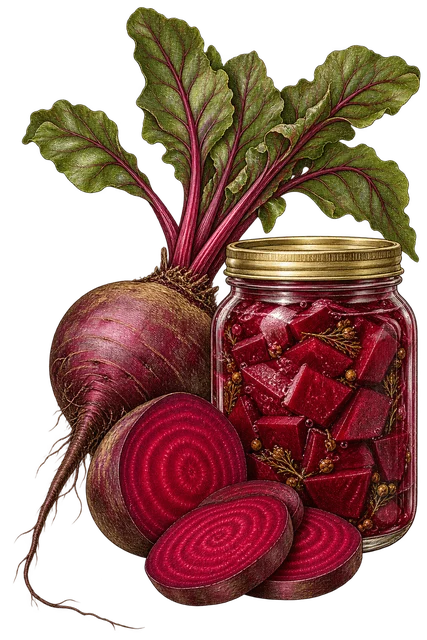
Garden beetroot, Beta vulgaris L., transformed by microbial fermentation. Lacto-fermented beet pieces and their fermented liquid (often called beet kvass or beetroot leaven) are related but nutritionally different foods. Lacto-fermentation describes lactic-acid production, not necessarily the addition of milk.
Ingredient details, preparation and research
Also known as: Lacto-fermented beetroot; Beet kvass (fermented liquid); Beetroot leaven; Zakwas buraczany (fermented liquid)
Source plant or material
Beta vulgaris L., garden beet group; the enlarged edible root/hypocotyl. Beet greens and sugar beets are distinct culinary forms and should not share an assumed nutrient panel.
Plant family / material: Amaranthaceae (amaranth/goosefoot family; older references may use Chenopodiaceae).
Forms and route
Refrigerated fermented slices, cubes or shreds; beet-containing vegetable ferments; fermented beet liquid/kvass; commercially fermented juice; and dried fermented powders. Vinegar-pickled beets can be acidified without fermentation. Ordinary fresh or pasteurized beet juice is not necessarily fermented. Heating or pasteurization after fermentation reduces or eliminates viable cultures.
Food sources
Fermented roots can be enjoyed as a small side or condiment, with the labeled portion and brine accounted for. For an explicitly nonfermented comparison, 1/2 cup (85 g) of plain cooked beet slices supplies about 37 kcal and 1.7 g fiber. A manufacturer’s 2018 Tymek kvass sheet lists 10 kcal, 3 g carbohydrate, 0 g fiber and 20 mg sodium per 100 mL; this illustrates one product, not a universal or guaranteed current label. Check the bottle being purchased.
Vitamins and minerals
There is no single nutrient panel for fermented beets or kvass. For comparison only, 1/2 cup (85 g) of plain cooked beet slices contains about 68 micrograms folate (17% Daily Value), 259 mg potassium (6%) and 0.67 mg iron (4%). These are not measured fermented-product values. Root pieces retain fiber that a strained drink may lack, while brine can add substantial sodium. Small beet portions are not an anemia treatment.
Absorption and preparation
Dietary nitrate is absorbed and partly returned to saliva, where oral bacteria help generate nitrite before further nitric-oxide formation. Fermentation is not required for this pathway and does not guarantee a fixed nitrate dose or stronger effect. A small human study detected betalain derivatives after fermented juice, but did not establish superiority over unfermented beets or a clinical health benefit. No best fat pairing or household absorption booster is established.
Combination context
Prepared kvass can add tartness to borscht with root vegetables, garlic and dill, or serve as a sour ingredient with a meal. This is a culinary use, not demonstrated medicinal synergy. Cooking changes or removes live-culture exposure. Choose the rest of the meal for balanced nutrition and do not alter fermentation salt or acidity to create a wellness blend.
Traditional and reported uses
- Traditional culinary use: fermented beetroot and its sour liquid are part of Polish food heritage. The roots are eaten as a vegetable or condiment; the liquid is used as a drink or a sour ingredient in dishes such as red borscht. Fermentation preserves food and changes its flavor.
- Attributed contemporary wellness use: the Weston A. Price Foundation promotes beet kvass as a digestive and liver tonic. This records a tradition-oriented practice claim; it does not establish liver detoxification, treatment of gallstones or kidney stones, or pregnancy safety.
- Nutrition and digestive interest: eating the root retains fiber, while a strained drink may contain little or none. Some unheated products contain living microbes, but NIH distinguishes these from a probiotic shown to benefit health at a defined strain and amount. Fermented beets are not automatically a clinically validated probiotic.
- Studied related use: nitrate-rich beet juice has been investigated for blood pressure and exercise performance, with variable results. One hypertension trial used 250 mL/day for four weeks; another treated-hypertension trial found no additional short-term pressure reduction. These results cannot be assigned to a spoonful of fermented roots, kvass or an unstandardized powder. A separate small fermented-juice study measured absorbed pigment compounds rather than clinical benefit.
Contraindications and cautions
- Sodium depends on the recipe and how much brine is consumed. Compare the actual serving label, especially with a sodium-restricted diet. Fermentation does not cancel sodium. Do not reduce the salt in a home fermentation recipe arbitrarily to make it lower sodium.
- Use reliable food-safety instructions or a reputable commercially prepared product. Safe fermentation requires appropriate salt, acidity, time, temperature, clean equipment and storage; bubbling, a sour taste or an appealing smell alone cannot establish safety. Refrigerate and follow the product’s storage directions. Do not taste a suspect or spoiled batch.
- Pregnant people, young children, older adults and those with weakened immunity should avoid untreated raw beet juice/kvass and choose products processed to destroy pathogens. Acidity alone does not reliably kill all harmful organisms. Ask the care team about live-culture products if seriously ill or immunocompromised.
- Beets contain oxalate. People with calcium-oxalate stones and high urine oxalate may need individualized portion limits; fermentation cannot be assumed to remove the oxalate. A strict low-oxalate diet is not necessary for everyone. Kidney disease may also require individualized sodium and potassium advice.
- Specific fermented-beet drug interactions are not well established. As a precaution, check concentrated nitrate-rich products with a clinician if taking blood-pressure-lowering medicines or prone to low blood pressure; ordinary food portions are different from concentrated daily shots. Do not stop prescribed treatment.
- Gas or digestive discomfort can occur with dietary changes. Beets can color urine or stool pink/red; unexplained, persistent or painful discoloration still warrants assessment. Check mixed products for added sugar and allergens, including milk-derived whey in some recipes.
Similar items and how they compare
- Vinegar-pickled beets
Both are sour preserved beet products often served with meals.
Vinegar can supply acidity without microbial fermentation. Sweet pickled products may add sugar, and heat-processed jars should not be assumed to contain living cultures.
- Beet juice or nitrate-standardized beet products
They share beet pigments and may provide dietary nitrate.
Juicing, dilution, fermentation, concentration and storage change composition. A trial’s measured nitrate dose cannot be inferred from the word beet or fermented on another product.
- Sauerkraut and other fermented vegetables
They can also be made by lactic-acid fermentation and eaten as small sides.
The starting vegetable, fiber, nutrients, salt and microbes differ. None automatically supplies a proven probiotic strain and effective dose.
Culinary tradition and wellness claims
Fermented beet roots and leaven are documented in Polish food traditions, and kvass is used in drinks and sour soups. The Weston A. Price Foundation promotes it as a digestive and liver tonic; this is an attributed contemporary practice claim. It does not establish detoxification, removal of stones or pregnancy safety. Enjoying fermented beets as food does not require accepting those medicinal claims.
- Miszczak et al.: Beetroot fermentation, Polish culinary heritage and changing phytochemicals
- Weston A. Price Foundation: Example of contemporary digestive/liver-tonic advocacy, not clinical verification or food-safety guidance
- FDA: Fruit, vegetable and juice safety for pregnancy and other vulnerable groups
What human studies do and do not show
Nitrate-rich beet juice has lowered blood pressure in some trials, including a four-week study of 68 people given 250 mL daily; a separate one-week trial in 27 treated hypertensive adults found no extra reduction. These were specific juices and nitrate exposures, not trials of a spoonful of fermented beetroot. In a different study, 24 healthy volunteers consumed fermented beet juice for six weeks and betalain derivatives were detected in plasma and urine. That supports absorption of some compounds, not disease treatment or better absorption than all unfermented preparations.
Living microbes and probiotic limits
Some unheated fermented products contain living microbes. A probiotic claim requires evidence of a health benefit at an adequate amount for the relevant organisms; fermentation alone does not supply that evidence. Heating can remove live-culture exposure while leaving a useful food ingredient. People who are seriously ill or immunocompromised should ask their care team about live-culture products rather than assuming natural microbes are risk-free.
Food safety and vulnerable groups
Use a research-tested method specifically suited to the food or a reputable commercially prepared product. Salt, acidity, time, temperature, cleanliness and storage all matter; sourness and bubbling are not safety tests. Do not improvise reduced-salt fermentation or taste suspect food. Follow storage instructions, including refrigeration when required. During pregnancy and for other groups vulnerable to foodborne illness, avoid untreated raw beet juice/kvass and choose juice treated to destroy pathogens. This juice precaution should not be broadened into a blanket ban on all fermented vegetables.
Kidneys, medicines and tolerance
Check sodium when managing blood pressure or fluid balance. Beets contain oxalate, so calcium-oxalate stone formers with high urinary oxalate may need individualized portions; fermentation cannot be presumed to remove it. Kidney disease can require personalized sodium and potassium limits. Specific fermented-beet drug interactions are not well established. Review concentrated nitrate products if prone to low pressure or taking pressure-lowering medicines; do not replace prescribed treatment. Dietary changes can cause gas. Beet pigments can color urine or stool, but persistent, painful or unexplained red discoloration needs assessment.
- National Kidney Foundation: Calcium kidney stones and individualized oxalate advice
- NIH ODS: Probiotics, live cultures and limits of fermented-food claims
- Kapil et al.: Nitrate-rich beetroot juice trial in hypertension, not a fermented-beet trial
- Bondonno et al.: No additional short-term blood-pressure effect in a treated-hypertension beet-juice trial
Evidence limits
- The numeric cooked-beet panel is an explicitly labeled comparator; it is not assigned to fermented beets or kvass.
- The manufacturer sheet is dated 2018. It supports only a product-specific historical example; the current bottle label controls.
- The fermented-juice absorption study did not establish a clinical benefit or superiority to unfermented preparations.
- No universal probiotic strain, nitrate dose, oxalate reduction, medicinal blend or safe home-fermentation formula is assumed.
Entry sources
- NIH ODS: Probiotics, live cultures and limits of fermented-food claims
- University of Minnesota Extension: Fermentation and food-safety controls
- FDA: Fruit, vegetable and juice safety for pregnancy and other vulnerable groups
- National Kidney Foundation: Calcium kidney stones and individualized oxalate advice
- Kew: Beta vulgaris identity, garden beet group and family
- Miszczak et al.: Beetroot fermentation, Polish culinary heritage and changing phytochemicals
- USDA SR28: Cooked beet nutrient baseline, NDB 11081, PDF pages 214–216
- Tymek manufacturer sheet: Product-specific kvass serving and nutrient label
- Kapil et al.: Nitrate-rich beetroot juice trial in hypertension, not a fermented-beet trial
- Bondonno et al.: No additional short-term blood-pressure effect in a treated-hypertension beet-juice trial
- NIH ODS: Beetroot/nitrate exercise research and product variability
- Bescos et al.: Nitrate/nitrite variation in commercial and homemade juices and storage effects
- Weston A. Price Foundation: Example of contemporary digestive/liver-tonic advocacy, not clinical verification or food-safety guidance
- USDA/NCHFP: Fermented-food and pickled-vegetable safety guidance
- University of Minnesota Extension: Vinegar pickles versus fermented pickles
- Sawicki et al. (2018): Betalain compounds in plasma and urine after fermented red beet juice
- Real Pickles: Using prepared beet kvass in cooked borscht, a culinary recipe
- FDA: Daily Values for interpreting nutrients per serving
Reference entry 92 · Recorded content review: 2026-10-05 · Review scope and dates