


Key cautions
- Avoid medicinal amounts during pregnancy; medicinal breastfeeding use needs review. Relevant peanut, soy or other legume allergy can also matter.
- Supplement amounts can lower blood sugar or cause digestive upset. Check diabetes medicines and warfarin; keep vitamin-K-rich leafy foods consistent if taking warfarin.
- EMA’s medicinal-seed assessment also advises against use when pregnancy is planned and in women of childbearing potential not using contraception, citing reproductive-toxicity findings in animals and limited human data. This extends the medicinal-product caution; it is not evidence that customary food portions cause infertility.
- Allergy is not limited to swallowing fenugreek. EMA describes serious reactions after inhaling seed powder and after applying a seed paste to the scalp. Avoid breathing powder dust, and do not assume a hair mask or skin poultice is safe because it is external.
What’s inside
Seed fiber, aromatic compounds and extract chemistry belong to different questions from the nutrition of fresh leaves. A strained tea or capsule is not a nutritional substitute for either food.
EMA: Fenugreek seed assessment report, revision 1
Constituents and what they imply
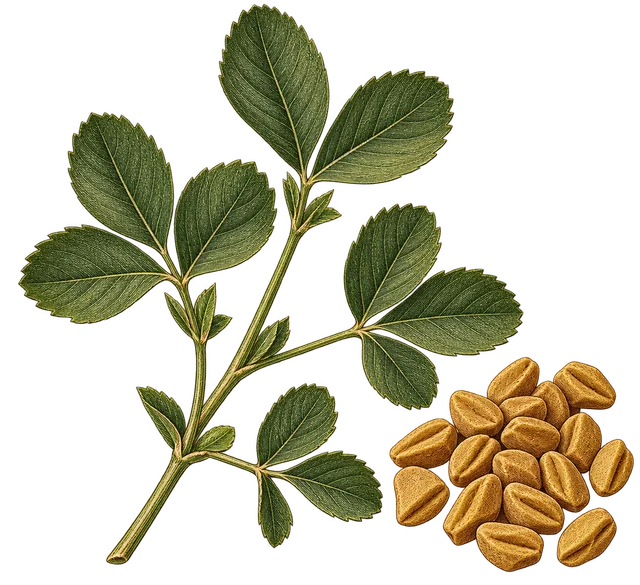
Seeds contain water-binding galactomannan mucilage, other fiber and protein, trigonelline, steroidal saponins, flavonoids and 4-hydroxyisoleucine. Sotolon contributes the characteristic aroma. These chemical findings help explain why water extracts, whole seeds and concentrated extracts differ; they do not establish that an ordinary seasoning portion produces the effects reported for isolated compounds in laboratory work.
EMA: Fenugreek seed assessment report, revision 1 · NIH LactMed: Fenugreek and breastfeeding
Nutrients at useful serving sizes
USDA lists one teaspoon of seed as 3.7 g: about 1.24 mg iron (7% of the 18 mg Daily Value) and 0.9 g fiber. A weighed 50 g fresh-leaf portion, calculated from IFCT C020, contains about 214 micrograms vitamin K1 and 29 mg vitamin C before cooking, roughly 178% and 32% of their Daily Values. It also contains about 2.8 mg iron. These are compositional reference values, not measured absorption or a recommendation to eat raw leaves. Cooked portions, dried seasoning, tea and extracts differ.
USDA SR28: Fenugreek seed, NDB 02019, composition and household measures (PDF pages 81–82) · ICMR–National Institute of Nutrition: Indian Food Composition Tables 2017, C020 fenugreek leaves; vitamin C PDF page 74, vitamin K PDF page 104 · FDA: Daily Values for interpreting nutrients per serving
Saponins are not a hormone prescription
Diosgenin is associated with fenugreek’s steroidal saponins. The word steroid describes a chemical structure, not proof that eating the seed raises human testosterone. Trials of selected extracts must be judged separately from the chemistry of a spice.
EMA: Fenugreek seed assessment report, revision 1 · Isenmann et al. (2023): The Anabolic Effect of Fenugreek, systematic review and meta-analysis
Uses in brief

- Culinary seeds and fresh or dried methi leaves; these are different ingredients.
- Traditional seed use for temporary appetite loss and minor skin inflammation; evidence for milk supply and diabetes remains uncertain.
History, folklore and reported uses
Plant, family and parts
Trigonella foenum-graecum L. is a Fabaceae legume. The mature seed is the material covered by the EMA medicinal monograph. Fresh methi leaves and dried leaves are separate culinary ingredients, not interchangeable with seed powder or a seed extract. Check the plant part on a supplement label.
Kew: Trigonella foenum-graecum identity and family · EMA: Fenugreek seed medicinal-use overview · Ontario Ministry of Agriculture: Fenugreek culinary seed and leaf uses
Forms and preparation differences
Food forms include whole or ground seed, fresh leaves and dried leaves. Medicinal forms include seed infusions, powders and solvent extracts; traditional external preparations are applied to the skin. Grinding opens up the hard seed, while soaking or gentle roasting changes its texture and bitter taste. A strained infusion contains a different mixture from swallowed seed powder. An extract selects constituents according to its solvent and manufacturing process, so equal capsule weights need not mean equal preparations. No single household dose covers all forms.
EMA: Fenugreek seed medicinal-use overview · McCormick Science Institute: Fenugreek culinary preparation · EMA: Fenugreek seed assessment report, revision 1
Absorption and combinations
Seed mucilage takes up water and can act within the digestive tract without entering the bloodstream. Human whole-preparation pharmacokinetics are incomplete, and no special fat pairing or best extract is established. Fenugreek plus ginger is a documented culinary pairing in a McCormick spice blend; its value here is flavor. Vitamin-C-containing foods such as peppers or citrus can improve absorption of a meal’s plant iron in general. Neither fact proves medicinal synergy or that a fenugreek–ginger supplement improves milk supply.
EMA: Fenugreek seed assessment report, revision 1 · McCormick Kitchens: Culinary blend containing fenugreek and ginger · NIH ODS: Plant iron and vitamin C in the same meal · NIH LactMed: Fenugreek and breastfeeding
From kitchen to household remedy
Fenugreek moves easily between the spice jar, the vegetable garden and the household medicine chest. Known as methi in South Asian cooking, it offers both leafy greens and strongly scented seeds. The EMA’s historical survey describes a broad geographic story: fenugreek in Egyptian bread-making, a condiment and lactation herb in India, and a seed tonic in Chinese medical tradition. These are distinct uses carried by different communities, rather than evidence of one universal ancient remedy.
EMA: Fenugreek seed assessment report, revision 1 · Kew Plants of the World Online: Trigonella foenum-graecum · NIH LactMed: Fenugreek and breastfeeding · ICAR-IISR: Fenugreek, Trigonella foenum-graecum · Singh et al. (2021): Extra-early fenugreek accession, International Journal of Seed Spices
Appetite books and external traditions
The seed’s reputation for nourishment and appetite also entered formal herbal books. EMA traces appetite-stimulating use to the 1908 Indian Materia Medica and later European compendia, while softened seed preparations had an external tradition for irritated skin. Reports of hair and scalp use belong to the wider folk record too. The continuing interest in fenugreek for milk production shows how a family remedy can move into modern supplements; the history is meaningful, while individual breastfeeding needs and the safety of concentrated preparations remain separate questions.
EMA: Fenugreek seed assessment report, revision 1 · Kew Plants of the World Online: Trigonella foenum-graecum · NIH LactMed: Fenugreek and breastfeeding · ICAR-IISR: Fenugreek, Trigonella foenum-graecum · Singh et al. (2021): Extra-early fenugreek accession, International Journal of Seed Spices
Appetite and indigestion
The 1908 Indian Materia Medica recorded powdered fenugreek seed for appetite; later European books used cut-seed macerates and seed powders. EMA also preserves the broader folk use for indigestion.
Milk-production traditions
In India, seed preparations have long been used as lactation remedies. LactMed documents the continuation of this galactagogue tradition in teas, capsules and mixed herbal products.
EMA: Fenugreek seed assessment report, revision 1 · NIH LactMed: Fenugreek and breastfeeding
Softening skin poultices
European herbal practice applied softened or powdered fenugreek seeds as moist poultices for boils and irritated skin. EMA records this external emollient tradition in several countries, including Polish preparations documented since 1962.
Hair and scalp folklore
EMA’s historical review retains fenugreek’s folk reputation for baldness. The seed’s place in hair and scalp folklore is recorded without a hair-specific formula.
Chinese seed tonics
Traditional Chinese medicine used fenugreek seeds as a tonic for weakness and swelling of the legs, according to EMA’s historical survey. The report identifies the seed but not one universal preparation for that tradition.
Bitter seeds in spice blends and pickles
India’s spice-research institute records Trigonella foenum-graecum seeds in Indian spice blends, pickles and curries. The seed’s bitter aromatic seasoning role is separate from medicinal seed preparations.
Methi as a leafy vegetable
Indian agricultural researchers describe fenugreek leaves as a popular green vegetable. This food role uses Trigonella foenum-graecum foliage, a different plant part and preparation from the dried seed spice.
Singh et al. (2021): Extra-early fenugreek accession, International Journal of Seed Spices
Testosterone and sports supplements
A 2023 meta-analysis pooled seven studies with 449 participants overall. It reported a small total-testosterone effect in male athletes, but the confidence intervals for free testosterone, lean mass and leg-press performance included no effect. These findings concern studied supplemental preparations, not a serving of seeds or leaves, and do not establish treatment for testosterone deficiency or benefits for women.
Isenmann et al. (2023): The Anabolic Effect of Fenugreek, systematic review and meta-analysis
Women’s Health: traditions, evidence and cautions
Historical use does not establish benefit or safety. Pregnancy, breastfeeding and fertility care require particular caution: food, tea, essential oil and concentrated extract are not interchangeable. These records are not treatment, dosing or pregnancy-management instructions. Discuss supplements with a qualified clinician or pharmacist; do not delay evaluation of persistent symptoms.
Fenugreek seed
Trigonella foenum-graecum L.
- Plant part / material
- Mature seed
- Preparation studied or reported
- Culinary seed foods; seed teas, powders and supplements are separate forms.
Warli women in Dahanu, Maharashtra, were documented using fenugreek seed foods for nursing; LactMed also reports international use.
Lactation / milk-supply tradition
Mixed, low-certainty human evidence
Reported or traditional useSeed foods and herbal products are taken with the intention of increasing breast milk.
What the evidence supportsSmall studies and meta-analyses disagree; mixed products and weak designs limit attribution. A reliable individual benefit is not established.
Gastrointestinal effects, allergy and hypoglycemia are possible. NCCIH advises against amounts above food use during pregnancy; breastfeeding supplement safety remains inadequately known.
- Avoid medicinal quantities in pregnancy. Food familiarity does not establish safety of milk-supply supplements.
Health topics: evidence and cautions
These notes describe a specific research context and preparation. A topic link is not a treatment recommendation.
Diabetes and prediabetes · Support during care
Form and route: Seed powder or characterized seed supplement · oral
Blood-sugar research is promising but too weak for a treatment claim.
Evidence: limited_low_quality_human_evidence
NCCIH notes that studies suggesting benefit are often low quality.
Limits
Leaves and extracts differ from whole seeds; long-term clinical outcomes are not established.
Cautions
- May cause low glucose, digestive upset or allergy. Avoid medicinal amounts during pregnancy.
Regional reading paths
These sourced notes describe cultivation, trade, food traditions or material history. A regional connection does not claim exclusive origin.
Asia
Cultivated and traded: Indian spice crop and South Asian ingredient.
Seeds used in spice mixtures; distinguish culinary leaf forms.
Identity & detailed reference
Identity
Trigonella foenum-graecum L.; mature seeds and fresh or dried leaves, also called methi. Most medicinal monographs and trials concern the seed, not culinary leaves.
Ingredient details, preparation and research
Also known as: Methi; Fenugreek seed; Fresh methi leaves; Kasuri methi (dried leaves)
Source plant or material
Trigonella foenum-graecum L.; an annual legume whose mature seeds and leaves are used separately.
Plant family / material: Fabaceae (legume/pea family).
Forms and route
Whole or ground seed, seed tea, commercial seed extracts/capsules, and fresh or dried culinary leaves. Traditional external seed preparations also exist. Leaves, whole seed powder and concentrated extracts are not interchangeable.
Food sources
Whole or ground seed is a spice; fresh leaves can be a leafy vegetable, and dried leaves a seasoning. The USDA seed teaspoon is a food-specific reference measure, not a universal herb-spoon weight or a medicinal dose. For fresh leaves, use a weighed portion rather than an unsupported cup conversion.
Vitamins and minerals
A USDA reference teaspoon of fenugreek seed (3.7 g) supplies about 1.24 mg iron (7% Daily Value) and 0.9 g fiber. A weighed 50 g portion of fresh leaves, calculated from the Indian Food Composition Tables, provides about 214 micrograms vitamin K1, 29 mg vitamin C and 2.8 mg iron before cooking. These leaf values do not apply to a dried-leaf sprinkle, seed tea or extract; cooking and serving weight change the result.
Absorption and preparation
Grinding, soaking and gentle pan-roasting are culinary techniques that alter texture or bitterness; they are not established medicinal absorption boosters. Water hydrates seed mucilage, which can act locally in the gut. A strained tea differs from eating the seed and from a selective extract. For dietary nonheme iron, vitamin-C-containing foods in the same meal can improve absorption in general; no fenugreek-specific increase or superior extract is established.
Combination context
Fenugreek and ginger occur together in culinary spice blends; use them for flavor rather than an assumed therapeutic synergy. Adding vitamin-C-rich foods to a meal can aid absorption of plant iron generally. Combination lactation trials cannot show that fenugreek alone works or that a homemade fenugreek–ginger blend is effective.
Traditional and reported uses
- Food use: seeds provide a bitter, maple-like character in curries, chutneys, pickles and spice blends; fresh or dried leaves flavor cooked vegetables, sauces and other dishes.
- European traditional medicinal use: temporary loss of appetite, and externally for minor skin inflammation. EMA attributes these indications to long-standing use rather than demonstrated clinical efficacy.
- Traditional/reported use: digestive complaints, as a tonic or laxative, for menstrual discomfort and to encourage breast-milk production. Milk-supply studies have mixed results, and evidence for menstrual-cramp benefit is uncertain.
- Studied/promoted use: blood-sugar and cholesterol management. Some studies suggest glucose lowering, but inconsistent preparations and weak study quality prevent treating fenugreek as a dependable substitute for diabetes care.
Contraindications and cautions
- Food quantities are generally considered safe for most people, but fenugreek can cause serious allergy. EMA advises against medicinal seed products in people allergic to fenugreek, peanut, soy or other legumes; food use also warrants caution when there is a relevant allergy.
- May cause gas, diarrhea or nausea. Larger amounts can lower blood sugar, especially alongside diabetes medicines; glucose monitoring and medication review may be needed.
- Avoid amounts above ordinary food use during pregnancy. Breastfeeding safety data are limited, and EMA does not recommend medicinal use while breastfeeding or in people under 18. A milk-supply concern is better assessed with appropriate lactation support than treated automatically with fenugreek.
- Check with a pharmacist if taking warfarin or other blood thinners. LactMed cautions about a possible bleeding interaction; EMA found the fenugreek-specific reports sparse and confounded by other herbs. Separately, fresh methi leaves contain vitamin K, so keep leafy-food intake consistent with warfarin rather than abruptly avoiding or adding large amounts.
- Fenugreek can give sweat or urine a maple-like smell. Do not use smell alone to explain an infant's symptoms or to make a diagnosis. Persistent appetite loss or worsening skin symptoms need assessment.
- EMA’s medicinal-seed assessment also advises against use when pregnancy is planned and in women of childbearing potential not using contraception, citing reproductive-toxicity findings in animals and limited human data. This extends the medicinal-product caution; it is not evidence that customary food portions cause infertility.
- Allergy is not limited to swallowing fenugreek. EMA describes serious reactions after inhaling seed powder and after applying a seed paste to the scalp. Avoid breathing powder dust, and do not assume a hair mask or skin poultice is safe because it is external.
Similar items and how they compare
- Marshmallow root
Both contain water-loving mucilage polysaccharides associated with viscous preparations and traditional soothing uses.
Fenugreek is a legume seed with distinctive food uses, allergy cautions and possible glucose lowering; marshmallow uses a different plant's root and a different mucilage profile.
- Sweet fennel
Both are culinary spice ingredients with traditional digestive uses and are sometimes encountered in breastfeeding-oriented herbal products.
Fenugreek is a Fabaceae seed with bitter maple-like flavor and galactomannan; fennel is an Apiaceae fruit with anise-like volatile oils. Similar traditional use does not establish milk-supply benefit or equivalent safety.
Traditional uses and human evidence
EMA recognizes long-standing seed use for temporary appetite loss and externally for minor skin inflammation; this recognition rests on traditional use rather than adequate clinical efficacy trials. Other documented traditions include digestive, menstrual and milk-supply uses. NCCIH finds the human evidence for diabetes and menstrual cramps insufficiently reliable. Blood-sugar signals from some studies do not make fenugreek a substitute for diabetes treatment, and products and study quality vary.
Breastfeeding evidence and pregnancy
Milk-supply findings are mixed, and some positive studies tested multi-ingredient products. LactMed emphasizes assessing latch, feeding and other modifiable causes of low supply rather than relying on a galactagogue. NCCIH advises against pregnancy amounts above food use; EMA does not recommend medicinal seed use during pregnancy, breastfeeding or under age 18. These medicinal restrictions should not be presented as a ban on customary food quantities. Safety information for nursing parents and infants remains limited.
Allergy, medicines and other cautions
Fenugreek can cause gas, nausea, diarrhea and serious allergy. Legume cross-reactivity is possible, including peanut and chickpea; EMA also names soy and other Fabaceae allergy. Supplemental amounts can lower glucose, so diabetes treatment may need monitoring. Warfarin warrants a pharmacist check: LactMed cautions about bleeding, while EMA judges the specific interaction reports sparse and confounded by other herbs. Fresh leaves also supply vitamin K, making consistent leafy-vegetable intake important with warfarin. Maple-like body odor can occur and is not a diagnostic test.
Similar items and when to seek advice
Marshmallow root offers a comparison for water-binding mucilage, while fennel is another culinary ingredient with traditional digestive uses. They are different plants and preparations, with different safety considerations; none should be assumed to replace the others. Persistent appetite loss needs assessment. EMA advises medical review if oral symptoms continue beyond two weeks or if external skin symptoms worsen or last more than a week.
Evidence limits
- This is a source-based reference, not an individualized medicinal dose or an endorsement of a supplement brand.
- The 3.7 g teaspoon is specific to USDA fenugreek seed. No generic gram-per-spoon conversion or fresh-leaf cup equivalence is assigned.
- Fresh-leaf nutrition is calculated from raw-food reference means; cooking losses, regional variation and iron bioavailability are not quantified.
- Traditional, single-herb, isolated-compound and multi-ingredient findings are kept separate.
Entry sources
- NCCIH: Fenugreek, evidence and safety
- EMA: Fenugreek seed medicinal-use overview
- EMA: Fenugreek seed assessment report, revision 1
- NIH LactMed: Fenugreek and breastfeeding
- Kew: Trigonella foenum-graecum identity and family
- Ontario Ministry of Agriculture: Fenugreek culinary seed and leaf uses
- McCormick Science Institute: Fenugreek culinary preparation
- ICMR–National Institute of Nutrition: Indian Food Composition Tables 2017, C020 fenugreek leaves
- FDA: Daily Values and interpreting nutrient amounts per serving
- USDA SR28: Fenugreek seed, NDB 02019, composition and household measures (PDF pages 81–82)
- ICMR–National Institute of Nutrition: Indian Food Composition Tables 2017, C020 fenugreek leaves; vitamin C PDF page 74, vitamin K PDF page 104
- McCormick Kitchens: Culinary blend containing fenugreek and ginger
- NIH ODS: Plant iron and vitamin C in the same meal
- NIH ODS: Vitamin K and consistent intake with warfarin
- EMA: Marshmallow root, mucilage and traditional preparations
- EMA: Fennel fruit assessment, traditional digestive uses
- ICAR-IISR: Fenugreek, Trigonella foenum-graecum
- Singh et al. (2021): Extra-early fenugreek accession, International Journal of Seed Spices
Reference entry 90 · Recorded content review: 2026-10-05 · Review scope and dates