


Key cautions
- Keep culinary basil separate from concentrated oils/extracts; estragole and methyleugenol content varies by chemotype.
- Wash food leaves; avoid unformulated oils on skin and keep vitamin-K intake consistent with warfarin.
- Refrigerate homemade pesto promptly and use it within 3 days, following the National Center for Home Food Preservation, or freeze it for longer storage. Fresh herbs in oil can support botulism bacteria: oil alone does not make them shelf-stable. Do not improvise room-temperature storage or substitute a splash of acid for a tested preservation process. Do not home-can pesto; a safe canning process has not been established.
What’s inside
A whole fresh leaf, a strained infusion, an extract and distilled essential oil have different compositions. Cultivar and growing conditions also influence the chemical profile.
Lee and Scagel (2009), USDA research: Chicoric acid and other phenolics in basil leaves · Zheljazkov et al. (2008): Oil composition of 38 sweet-basil accessions
Constituents and chemotypes
Leaf analyses identify rosmarinic, chicoric and caffeic-acid derivatives. Studies of many accessions show diverse volatile profiles, including linalool, estragole (methyl chavicol), eugenol/methyleugenol, geraniol and citral-related compounds. An oil profile is a chemical description; it does not quantify a garnish or prove a calming benefit.
Lee and Scagel (2009), USDA research: Chicoric acid and other phenolics in basil leaves · Zheljazkov et al. (2008): Oil composition of 38 sweet-basil accessions · Costa et al. (2015): Chemical diversity in basil germplasm
Food portion, vitamin K and absorption
USDA fresh basil: 2 tablespoons chopped (5.3 g) supplies about 1 kcal, 22 micrograms vitamin K (about 18% Daily Value) and 1 mg vitamin C. Protein and fiber are small at this portion. Pesto also contains the calories and nutrients of oil, nuts and cheese; tea and essential oil do not inherit leaf nutrient values. Fat in an ordinary meal can support vitamin-K absorption. Maintain stable vitamin-K intake with warfarin rather than abruptly changing large herb portions. This is nutrient guidance, not proof of improved medicinal-extract absorption.
USDA FoodData Central: SR Legacy downloadable food and portion data · FDA: Daily Value on the Nutrition and Supplement Facts labels · NIH ODS: Vitamin K, absorption and vitamin-K antagonists · USDA SR28: Basil, fresh, report 02044 (archived copy)
Purple pigments and leaf analysis
The Purple Petra cultivar examined by Lee and Scagel contained anthocyanins, pigments associated with purple foliage. Their fresh-leaf analysis also identified caftaric acid, another caffeic-acid derivative. Laboratory extraction and chromatography, which separates compounds for measurement, characterize sampled leaves rather than an established therapeutic dose in basil tea.
Lee and Scagel (2009), USDA research: Chicoric acid and other phenolics in basil leaves
Uses in brief

- Culinary leaves in tomato dishes, pesto, salads and other foods.
- Specific oral extracts have preliminary human research; this does not establish medicinal effects from food, tea or raw leaf juice.
History, folklore and reported uses
Identity, family and plant part
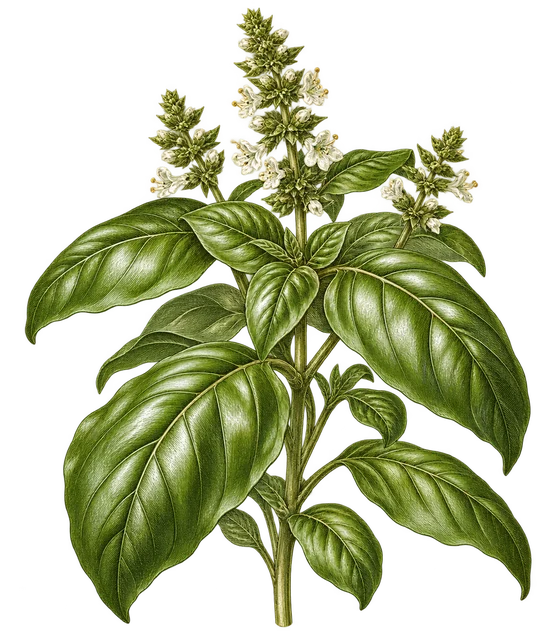
Ocimum basilicum L. is a Lamiaceae herb whose leaves and flowers are edible. Genovese, Thai and purple culinary types vary. Holy basil/tulsi is O. tenuiflorum; tree/clove basil is O. gratissimum. This entry concerns sweet-basil leaf, not seeds or a generic “basil” supplement.
NC State Extension: Ocimum basilicum · Royal Botanic Gardens, Kew: Brilliant basil
Food preparation and culinary combinations
Wash fresh leaves under running water and use clean hands and utensils. Add fresh basil near the end of cooking or just before serving to retain its aroma. Use identified food-grade dried leaf for an infusion and follow its label; medicinal extract or oil studies are not kitchen recipes. Tomato, rice, eggs and vegetables are straightforward pairings. No medicinal synergy is established by combining basil with garlic, oil or aloe.
University of Minnesota Extension: Herbs, preparation and culinary pairings · FDA: Fresh-herb microbiological sampling and safe handling · Orafidiya et al. (2004): Preliminary acne trial of formulated Ocimum gratissimum oil and aloe
Culinary flowers and exact edible part
Food-grown Ocimum basilicum flowers can be used as seasoning along with the leaves. This culinary use does not turn a flowering top into an essential-oil or standardized-extract dose. Specify sweet basil and the cultivar where known; holy basil/tulsi remains a different species. Wash gently and add as a flavoring rather than using an undefined mass as a medicinal regimen.
University of Minnesota Extension: Edible flowers · University of Minnesota Extension: Edible flowers and late-summer herbs
Growing for fresh leaves
Plant sweet basil after frost in sun and moist, well-drained soil. Pinching growing tips and flower buds encourages branching. Leaving flowers for culinary use and harvesting leafy shoots are different choices for the same food-grown plant.
Folklore, mourning and engagement
Basil’s history is much stranger than a bowl of pesto suggests. Oxford’s botanical account recalls Nicholas Culpeper’s 1652 discussion of contradictory beliefs about the herb, including an extraordinary tale that smelling it could breed a scorpion in the brain. That is folklore, not biology, but it shows how strongly aromatic plants could attract both affection and suspicion. The same account describes basil’s associations with mourning in some places and engagement in Romania: one familiar leaf could carry very different meanings.
University of Oxford Plants 400: Ocimum basilicum, folklore and uses
Aromatic traditions and distinct species
Herbal traditions also assigned basil uses for headaches, low spirits and difficult breathing, while its most enduring everyday role remained culinary. Modern garden varieties extend that sensory history through different leaf colors and scents. Sweet basil, Ocimum basilicum, should keep this identity of its own. The Hindu sacred associations and Ayurvedic history of tulsi belong to its relative Ocimum tenuiflorum; Kew explicitly distinguishes the two. Respecting that distinction makes room for both plants’ cultural richness without transferring one species’ sacred status or medicinal claims to the other.
Gerhard Madaus (1938): Basilicum, Ocimum basilicum · Royal Botanic Gardens, Kew: Brilliant basil
Wind and nervous indigestion
Madaus’s 1938 account records sweet-basil herb infusions for gas, stomach cramps and nervous indigestion, including Italian practice and the French herbal physician Henri Leclerc. The source identifies Ocimum basilicum, not tulsi.
Calming nervous states
Madaus cites Ernst Meyer’s 1935 use of basil-herb infusions to calm nervous states. Earlier European herbals also associated the herb and distilled basil water with low spirits and nervous weakness.
Cough and chest complaints
Danish folk reports collected by Madaus describe the herb taken internally as an expectorant for chest complaints. His historical survey also records cough and difficult-breathing uses in early European herbals.
Leaf dressings for sores
Madaus preserves a German practitioner’s use of basil leaves in spirit-based compresses for injuries and poorly healing wounds. The leaves were used as dressings in this external branch of European herbal practice.
Mouth and throat gargles
The same 1938 materia medica records sweet-basil herb preparations used as gargles for irritated mucous membranes. Gargling gave the aromatic herb a local mouth-and-throat application.
Basil in Genoese pesto
The Genoese Basil DOP consortium identifies Ocimum basilicum with Liguria’s pesto tradition. It describes locally grown fresh basil becoming a substantial ingredient in the pounded sauce, a culinary role distinct from sweet basil’s medicinal-herb history.
An Italian association, a wider origin
Kew places basil’s roots in tropical Africa and Asia and its arrival in Britain in the sixteenth century. Its strong association with Italian cooking developed through regional culinary traditions.
From fresh leaves to a Ligurian crop
Genoese pesto was codified in nineteenth-century cookbooks. Liguria, the coastal region around Genoa in northwest Italy, developed a distinctive basil-growing tradition. Basil-growing districts in the Bisagno valley and hills of Pra’ supplied Genoa with fresh leaves. The local consortium dates early greenhouses to the beginning of the twentieth century and Basilico Genovese’s protected designation of origin to 2005.
Metropolitan City of Genoa, Parco del Basilico: La storia del pesto · Consortium for the Protection of Genoese Basil DOP: History
Keeping a harvest
Freezing small portions offers a practical way to keep prepared pesto beyond a few days. Use freezer-safe containers, label the batch and leave expansion space. Oil-covered leaves and pesto require safe storage even when their smell and appearance seem normal.
National Center for Home Food Preservation: Freezing pesto · Oregon State University Extension: Herbs and vegetables in oil
Growing notes
Ocimum basilicum L., culinary sweet-basil cultivars; excludes tulsi and sterile interspecific ornamental basils.
- Climate, season and habit
- Grow as a frost-tender annual in temperate gardens; winter-hardiness zones are less useful than frost dates. Start indoors 6–8 weeks before planting out after frost. Genovese commonly reaches about 2 feet; dwarf cultivars stay smaller. [1] [2]
- Sun, soil and nutrition
- Give 6–8 hours of sun, well-drained soil and roughly pH 6.0–7.5. Test garden soil before adding nutrients. Feed according to the test and container-product directions rather than automatically applying a high-nitrogen schedule. [1] [3]
- Water and spacing
- Keep roots evenly moist without waterlogging; adjust irrigation to rainfall, heat and pot size. Space approximately 12–18 inches for airflow, allowing for cultivar size. Water at soil level where possible. [4] [3]
- First harvest and pruning
- Begin light harvesting once plants have 6–8 leaves; timing varies with warmth and starting size. Cut above a leaf pair, leaving foliage to regrow. Pinch growing tips and flower buds for a branching leaf crop; harvest repeatedly through summer. [3] [1] [2]
Growing sources and regional guidance
- University of Minnesota Extension: Growing basil in home gardens
- NC State Extension Plant Toolbox: Ocimum basilicum
- Utah State University Extension: How to Grow Basil in Your Garden
- Penn State Extension: Herb Garden Plants: Basil
- University of Minnesota Extension: Companion planting in home gardens
- Metropolitan City of Genoa, Parco del Basilico: La storia del pesto
- Consortium for the Protection of Genoese Basil DOP: History and origins of Genoese Basil
- Royal Botanic Gardens, Kew: Brilliant basil
Growing notes reviewed 2026-10-09
Regional reading paths
These sourced notes describe cultivation, trade, food traditions or material history. A regional connection does not claim exclusive origin.
Antarctica
Controlled Antarctic greenhouse research.
Cultivated food crop; not native Antarctic flora.
Identity & detailed reference
Identity
Ocimum basilicum L.; fresh or dried leaves and flowering tops. Holy basil/tulsi (Ocimum tenuiflorum, syn. O. sanctum) is a different species. Sweet, Thai and purple basil cultivars can differ markedly in aroma chemistry.
Ingredient details, preparation and research
Source plant or material
Ocimum basilicum L.; leaves and flowering tops, especially culinary leaf.
Plant family / material: Lamiaceae (mint family).
Forms and route
Fresh leaves and flowers, dried culinary herb, leaf infusions and labeled extracts. Basil essential oil is a distinct concentrate, and basil seeds are a different food part from this leaf-focused entry.
Vitamins and minerals
USDA fresh basil: 2 tablespoons chopped (5.3 g) supplies about 1 kcal, 22 micrograms vitamin K (about 18% Daily Value) and 1 mg vitamin C. Protein and fiber are small at this portion. Pesto also contains the calories and nutrients of oil, nuts and cheese; tea and essential oil do not inherit leaf nutrient values.
Absorption and preparation
The food leaves supply vitamin K; consuming green vegetables with some dietary fat improves vitamin-K absorption, so a normal mixed meal is reasonable. This nutrient principle does not establish improved linalool or rosmarinic-acid treatment effects. Tea, hydroalcoholic extract and distilled oil deliver different mixtures, and no generic basil-remedy absorption protocol is established.
Practical preparation
Wash fresh leaves under running water and use clean hands and utensils. Add fresh basil near the end of cooking or just before serving to retain its aroma. Use identified food-grade dried leaf for an infusion and follow its label; medicinal extract or oil studies are not kitchen recipes.
Food notes
Food-grown Ocimum basilicum flowers can be used as seasoning along with the leaves. This culinary use does not turn a flowering top into an essential-oil or standardized-extract dose. Specify sweet basil and the cultivar where known; holy basil/tulsi remains a different species. Wash gently and add as a flavoring rather than using an undefined mass as a medicinal regimen.
Combination notes
Tomato, garlic, olive oil, rice, eggs and vegetables are useful flavor partners. Pesto is a food preparation, not a demonstrated medicinal synergy, and a raw-leaf/aloe mixture is not the formulated product from an acne trial.
Traditional and reported uses
- Fresh or dried leaf flavoring for tomatoes, salads, pesto, rice, eggs and cooked dishes; leaves/flowers are also used in aromatic infusions.
- Preliminary human research has tested particular O. basilicum leaf-extract capsules and syrups. Results need confirmation and cannot be applied to culinary leaves, essential oil or another basil species.
- Laboratory antibacterial and antioxidant tests characterize particular preparations; they do not establish treatment of a human infection.
- A preliminary acne study used a formulated O. gratissimum essential-oil lotion with aloe, not raw O. basilicum leaf juice.
- Sweet-basil flowers as a culinary seasoning alongside the leaves.
Contraindications and cautions
- Use correctly identified culinary basil and avoid it with a known allergy. A medicinal extract or essential oil is a different exposure from ordinary food portions.
- Some chemotypes contain estragole and/or methyleugenol. Toxicological concerns support limiting unnecessary concentrated exposure; do not assume every basil oil is linalool-rich or suitable to swallow.
- Safety of concentrated medicinal products is not adequately established in pregnancy, breastfeeding or children. Ordinary culinary use neither establishes safety for those products nor requires avoiding a normal garnish.
- Fresh basil contains vitamin K. With warfarin or a similar vitamin-K antagonist, maintain consistent dietary intake and discuss large changes such as adding a substantial daily pesto portion.
- Raw juice is unstandardized and not sterile, and food tolerance does not predict skin tolerance. Do not put it into open lesions, the nose or eyes. Stop a skin product for irritation.
- Do not self-add basil extracts to antidepressant or other prescription treatment on the strength of a small trial; medication interactions and product composition need professional review.
- Refrigerate homemade pesto promptly and use it within 3 days, following the National Center for Home Food Preservation, or freeze it for longer storage. Fresh herbs in oil can support botulism bacteria: oil alone does not make them shelf-stable. Do not improvise room-temperature storage or substitute a splash of acid for a tested preservation process. Do not home-can pesto; a safe canning process has not been established.
Similar items and how they compare
- Lemon balm
Both are aromatic mint-family leaves with rosmarinic acid and can be prepared as infusions.
Lemon balm has documented traditional stress/sleep indications; those indications are not established for sweet basil by chemical similarity.
- Thyme
Both have chemically distinct types within a species, including linalool-rich types, and are familiar culinary herbs.
Many thyme products emphasize thymol or carvacrol; basil may instead contain substantial estragole or eugenol.
Culinary tradition and research context
Extension sources document food flavoring and aromatic leaf/flower infusions. Modern Iranian trials cite traditional Persian medicine as motivation for studying particular basil preparations. The existence of this research does not transfer tulsi’s Ayurvedic uses to sweet basil or establish an ancient universal recipe.
Preliminary human oral-extract evidence
A 2024 trial in 60 menopausal women reported improved symptom scores after one month of a specific leaf-extract capsule. A 2025 single-blind trial randomized 60 adults with depression and anxiety to extract syrup or placebo alongside prescribed sertraline; 57 completed, and scores improved more with basil. Short follow-up, small samples and formulation/reporting limitations require caution; these are not evidence for replacing treatment or recreating a dose from leaves.
Acne and laboratory findings are different questions
The preliminary 84-person acne investigation used formulated O. gratissimum essential oil, with or without aloe gel. It did not test raw O. basilicum juice. Separately, sweet-basil oils grown under different light conditions showed variable laboratory antibacterial activity. Neither finding validates a homemade acne mixture or treatment of an infection.
Concentrates and safety
EMA identifies genotoxic/carcinogenic concerns for estragole and calls for medicinal-product exposure to be as low as practically achievable. Methyleugenol also needs toxicological attention. Species, chemotype, concentration, route and duration matter; these hazard findings do not establish that ordinary culinary basil causes cancer. Pregnancy, breastfeeding and child safety cannot be inferred for concentrated preparations.
Related leaves
Lemon balm and thyme are other aromatic mint-family leaves; some constituents overlap. A shared linalool or rosmarinic-acid component cannot transfer the traditional indications or clinical findings of one herb to another.
Entry sources
- NC State Extension: Ocimum basilicum, identity and edible parts
- Kew: Brilliant basil, culinary varieties, tulsi and tree basil
- Lee and Scagel (2009), USDA research: Chicoric acid and other phenolics in basil leaves
- Zheljazkov et al. (2008): Oil composition of 38 sweet-basil accessions
- Costa et al. (2015): Chemical diversity in basil germplasm
- Talaei et al. (2025): Basil extract syrup as an adjunct to sertraline, single-blind trial
- Karimi et al. (2024): Sweet-basil leaf-extract capsules and menopausal symptoms
- Orafidiya et al. (2004): Preliminary acne trial of formulated Ocimum gratissimum oil and aloe
- Primary study (2022): Light conditions, sweet-basil oil chemistry and laboratory antibacterial tests
- EMA: Estragole-containing herbal medicinal products, revised public statement
- EMA: Methyleugenol-containing herbal medicinal products
- National Capital Poison Center: Essential oils, poisonous when misused
- USDA FoodData Central: SR Legacy downloadable food and portion data
- FDA: Daily Value on the Nutrition and Supplement Facts labels
- NIH ODS: Vitamin K, absorption and vitamin-K antagonists
- University of Minnesota Extension: Herbs, preparation and culinary pairings
- FDA: Fresh-herb microbiological sampling and safe handling
- Satyal et al. (2016): Thyme essential-oil characterization across geographical locations
- University of Minnesota Extension: Edible flowers
- University of Minnesota Extension: Edible flowers and late-summer herbs
- Consortium for the Protection of Genoese Basil DOP: History
Reference entry 96 · Recorded content review: 2026-10-07 · Review scope and dates