


Key cautions
- Never swallow household oil or improvise pediatric use
- Keep off broken skin and away from eyes; fragrance can worsen breathing symptoms
What’s inside
1,8-Cineole (eucalyptol) dominates the medicinal oil types, with alpha-pinene, limonene and other terpenes. Species, processing and rectification alter proportions. Citronellal-rich lemon-eucalyptus oil and PMD-containing repellents have different compositions and purposes.
EMA (2025): Eucalyptus oil assessment report, revision 1 · CDC: Repellents and distinction between registered oil-of-lemon-eucalyptus products and pure essential oil
Uses in brief

- Traditional cold-cough comfort in labelled inhaled or topical medicines
- Traditional topical relief of localized minor muscle pain
History, folklore and reported uses
Cold-associated cough
The European Medicines Agency records cineole-rich eucalyptus-oil medicines for cough accompanying a cold. Inhaled medicines and formulated topical preparations belong to this long-standing sickroom tradition.
European Medicines Agency: Eucalypti aetheroleum · EMA (published February 2025): Eucalyptus oil monograph, revision 1, adopted November 2024 · National Capital Poison Center: Eucalyptus oil safety
Localized muscular aches
Eucalyptus oil also has a traditional medicinal role in preparations for localized muscle pain. The use is associated with rubbing products and appropriate bath preparations.
Antiseptic skin ointments
In A Modern Herbal, published in 1931, Maud Grieve records eucalyptus oil in compounded ointments for sores, chafed skin and other minor skin complaints. The account documents historical pharmacy practice.
Maud Grieve, A Modern Herbal (1931): Eucalyptus, medicinal oils and ointments · EMA (published February 2025): Eucalyptus oil monograph, revision 1, adopted November 2024 · National Capital Poison Center: Eucalyptus oil safety
Headache associated with sinus discomfort
AromaWeb describes Eucalyptus globulus and E. radiata oils in aromatherapy for minor headaches, especially those associated with sinus congestion. This is a distinct practitioner use of the aromatic oil.
AromaWeb: Aromatherapy and essential oils for headaches, eucalyptus section
Cleaning, laundry and household freshening
Bosisto’s records the continuing Australian use of eucalyptus-oil products for sticky labels, greasy surfaces, laundry stains and stale-smelling fabrics. These practices give the aromatic bottle a place in everyday washing and surface care.
Bosisto’s: What is eucalyptus essential oil good for?, household practices
Bush stills and the oil industry
A photograph in the Australian Museum’s 1967 account shows a eucalyptus distillery near Braidwood, New South Wales, with cut foliage, a heavy-lidded still, firewood and cooling water for the condenser. The account recalls oil distilled from Eucalyptus piperita in the early colonial period and Joseph Bosisto’s experiments in Melbourne in the middle of the 1800s, encouraged by botanist Ferdinand von Mueller. These are milestones in the commercial oil industry, not the beginning of human knowledge of eucalyptus.
H. H. G. McKern: Volatile Plant Oils in Australia, Australian Natural History 15(11), 1967
From export oil to household bottles
Bosisto’s company history follows eucalyptus oil from export trade into branded sprays and domestic cleaners. Several eucalyptus species supplied earlier oils, so an old household bottle need not have matched the chemistry of today’s cineole-rich medicinal preparations.
Bosisto’s: Our Story, company account of the eucalyptus-oil trade · European Medicines Agency: Eucalypti aetheroleum
Health topics: evidence and cautions
These notes describe a specific research context and preparation. A topic link is not a treatment recommendation.
Respiratory health · Safety reference
Form and route: labeled formulated cough product · topical or inhalation only as labeled
Traditional cough use does not make eucalyptus oil an asthma treatment.
Evidence: traditional use with important route-specific safety limits
EMA distinguishes whole oil from isolated cineole used in trials.
Limits
Asthma trial findings for cineole cannot be assigned to household oil.
Cautions
- Do not swallow household oil or put it into a nebulizer.
- Fragrances and oils may irritate lungs or worsen asthma; avoid if triggered.
- Children need strict product age limits; laryngeal spasm and seizures are concerns.
Regional reading paths
These sourced notes describe cultivation, trade, food traditions or material history. A regional connection does not claim exclusive origin.
Australia & Oceania
native and cultivated; Australia
Distilled aromatic product ingredient.
Identity & detailed reference
Identity
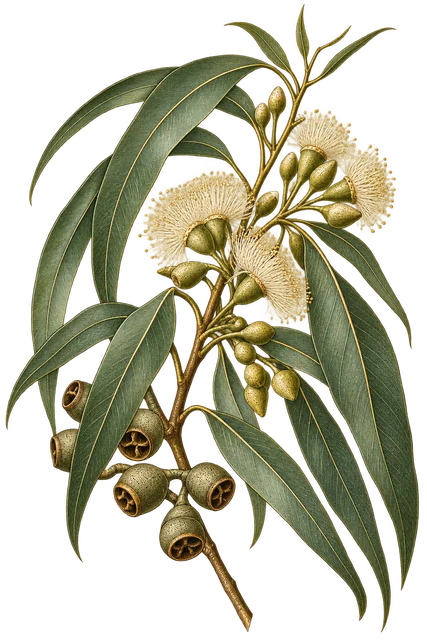
Cineole-rich essential oil distilled from fresh leaves/terminal branches, principally Eucalyptus globulus Labill., E. polybractea R.T.Baker or E. smithii R.T.Baker (Myrtaceae). Other species and lemon-eucalyptus materials cannot be substituted on name alone.
Ingredient details, preparation and research
Source plant or material
Eucalyptus globulus, E. polybractea or E. smithii; fresh leaves and terminal branchlets yield the medicinal cineole-rich volatile oil.
Plant family / material: Myrtaceae (myrtle family).
Forms and route
Labelled chest rubs, inhalation preparations and topical/bath medicines. Eucalyptus leaf tea, isolated cineole capsules and regulated oral eucalyptus medicines are separate preparations; do not swallow a household essential-oil bottle.
Food sources
Not applicable to this external essential-oil entry. Leaf teas and regulated oral medicines must be evaluated separately; neither authorizes swallowing the household oil.
Vitamins and minerals
Topical or inhaled eucalyptus oil supplies no dietary vitamin, mineral or essential-fat serving. Medicinal terpene content is not a nutrient label.
Absorption and preparation
Isolated 1,8-cineole reaches the blood after inhalation, but a laboratory exposure study does not quantify what a room diffuser or chest rub delivers. Whole-oil pharmacokinetic data are limited. Large-area covered skin applications can also produce harmful exposure; stronger delivery is not an objective.
Practical preparation
Use only a labelled finished preparation for the intended route and age, and follow its exposure and duration instructions. Do not formulate an oral dose, guess a drops-to-millilitre conversion or add oil to a nebulizer, oxygen system or ventilator. Keep it away from eyes and open flames; avoid home steam practices with scalding water.
Combination notes
Chest rubs often contain menthol, camphor and additional ingredients. A positive trial of that mixture cannot isolate eucalyptus, and each component adds its own precautions. Adding more oils to a medicine can change both dose and tolerability.
Traditional and reported uses
- European traditional medicinal use: relief of cough associated with an ordinary cold using an appropriate finished product.
- European traditional medicinal use: symptomatic relief of localized muscle pain with topical or formulated bath preparations.
- Aroma/cosmetic use: a penetrating, fresh medicinal scent in toiletries and rubs. Perceived freshness is not evidence that airways have opened or an infection has been treated.
- Small human studies of inhalation or mixed vapor rubs are suggestive for particular symptoms but do not establish eucalyptus alone as an asthma, pneumonia, blood-pressure or chronic-pain treatment.
Contraindications and cautions
- Never swallow concentrated household eucalyptus oil. Poisoning may cause vomiting, loss of coordination, seizures or coma. Keep all oil-containing products and vaporizer liquids inaccessible to children.
- The current EMA monograph contraindicates use under 24 months and in children with a seizure history; it does not recommend topical/inhalation/bath use from 2 to under 3 years. These boundaries do not override a stricter finished-product label.
- Avoid eyes, the face/nose of small children, and broken or irritated skin. Skin allergy and respiratory irritation are possible. Stop exposure for wheezing, coughing or breathlessness; urgent symptoms need medical care.
- EMA does not recommend medicinal use in pregnancy or breastfeeding because adequate data are lacking. Adults with epilepsy or fragrance-triggered respiratory disease should get individual advice.
- No medicinal interactions were reported in the revised EMA monograph; this does not demonstrate compatibility with every drug or preparation. Do not use boiling-water bowls or improvise oil delivery through medical respiratory equipment.
Similar items and how they compare
- Rosemary essential oil
Cineole-rich rosemary shares 1,8-cineole with eucalyptus, explaining part of their overlapping penetrating, fresh aromatic character in formulated products.
Rosemary can also contain substantial camphor or verbenone; check the actual chemotype.
- Peppermint essential oil
Both are used for a strong, fresh aroma in properly formulated inhalation or topical preparations and require careful route-specific handling.
Peppermint’s dominant menthol and menthone give a different cooling character and safety profile.
- Oil-of-lemon-eucalyptus / PMD repellent
A related-sounding product encountered in insect-bite prevention.
A registered repellent has a different active profile and intended use; neither cineole-rich oil nor pure lemon-eucalyptus EO is an automatic substitute.
Species and preparation boundary
The EMA medicinal definition concerns selected cineole-rich leaf/branch oils. E. globulus is Tasmanian blue gum in Myrtaceae. A botanical leaf preparation, distilled oil, purified cineole medicine and scented multi-ingredient rub are four different materials. A species name without a characterized preparation is not enough to transfer trial results.
Traditional evidence is the basis of the monograph
The European assessment accepts long-standing use for common-cold cough and localized muscle pain. It does not classify these indications as clinically well-established efficacy. The public overview specifically distinguishes studies of isolated 1,8-cineole from studies of eucalyptus oil; capsule findings cannot establish the benefit of room fragrance or home steam.
A combination vapor rub trial
In a one-night trial with 138 children completing, parents generally rated a combination vapor rub better than no treatment, and several symptoms better than petrolatum. Irritant effects were more common. The product contained multiple active ingredients; partial blinding and subjective parent ratings limit inference. This is not evidence for eucalyptus oil alone, nor a pediatric DIY recipe.
Small postoperative inhalation trial and its correction
Jun et al. studied 52 completers after knee replacement, alongside usual postoperative care. Three days of eucalyptus inhalation were associated with lower pain ratings; inflammatory markers did not differ significantly. A correction published 30 May 2026 replaced incorrectly entered baseline Table 3 data and corrected white-cell-count units. The publisher says conclusions were unchanged. The small, brief study does not establish chronic-pain, anti-inflammatory or antihypertensive treatment.
Age guidance: use the revised document
The final revision adopted in November 2024 and published in February 2025 is the current monograph. Its under-24-month contraindication and under-3-year topical/inhalation limitations differ from the older public overview’s under-30-month/from-4-years wording. Product labels and national authorizations can be stricter. Do not treat the youngest age mentioned in any trial as a general permission.
Absorption: an isolated constituent, not a diffuser dose
Jäger et al. detected 1,8-cineole in blood during controlled inhalation, with a peak around 18 minutes. This establishes that inhalation can produce systemic exposure. It does not establish an equivalent therapeutic dose from every eucalyptus product or prove clinical benefit. The EMA assessment notes the lack of clinical pharmacokinetic data for the whole oil across routes.
Poisoning and topical exposure
Poison Control describes both ingestion poisoning and a child who developed neurologic toxicity after repeated, extensive oil-containing covered dressings. Avoid neat oil, large-area occlusion and inaccessible-to-review homemade mixtures. Prompt poison advice is appropriate after accidental ingestion; do not wait for a presumed safe period because symptoms can be delayed.
Lemon eucalyptus is a separate issue
Registered repellents containing oil of lemon eucalyptus or PMD should not be confused with cineole-rich eucalyptus oil, lemon peel oil or an unformulated lemon-eucalyptus essential oil. CDC does not recommend pure lemon-eucalyptus essential oil as a repellent because the requisite safety/efficacy testing is absent. Use the registered repellent’s own label.
Practical limits and when to seek care
A fragrance can feel soothing while failing to treat the cause of illness. Worsening cough, fever with chest symptoms, breathlessness, or a red/swollen painful area need assessment. The monograph calls for review of prolonged symptoms and records allergic reactions/contact eczema; no reported interaction is not a guarantee of no interaction.
Review and publication-status check
Reviewed 5 October 2026 using the current EMA monograph, primary human trials and poison-center material. The 2026 correction to the knee-replacement study was found and incorporated; it is an erratum, not a retraction. Targeted searches did not locate a retraction for the selected vapor-rub or knee-replacement trial. This review does not establish universal efficacy or safety for all eucalyptus species.
- Jun et al. (2013): Eucalyptus inhalation after knee replacement
- Publisher correction (30 May 2026): Eucalyptus knee-replacement trial, baseline table and WBC units
- Paul et al. (2010): Combination vapor rub, petrolatum and no treatment for nighttime cold symptoms
- EMA (published February 2025): Eucalyptus oil monograph, revision 1, adopted November 2024
Entry sources
- EMA (published February 2025): Eucalyptus oil monograph, revision 1, adopted November 2024
- EMA: Eucalypti aetheroleum overview and current document inventory
- National Capital Poison Center: Eucalyptus oil safety
- Jun et al. (2013): Eucalyptus inhalation after knee replacement
- Publisher correction (30 May 2026): Eucalyptus knee-replacement trial, baseline table and WBC units
- Paul et al. (2010): Combination vapor rub, petrolatum and no treatment for nighttime cold symptoms
- EMA (2025): Eucalyptus oil assessment report, revision 1
- Australian National Botanic Gardens: Eucalyptus globulus, Tasmanian blue gum, Myrtaceae
- Jäger et al. (1996): Human inhalation pharmacokinetics of isolated 1,8-cineole
- CDC: Repellents and distinction between registered oil-of-lemon-eucalyptus products and pure essential oil
- National Cancer Institute: Aromatherapy with essential oils, professional PDQ
Reference entry 34 · Recorded content review: 2026-10-05 · Review scope and dates