


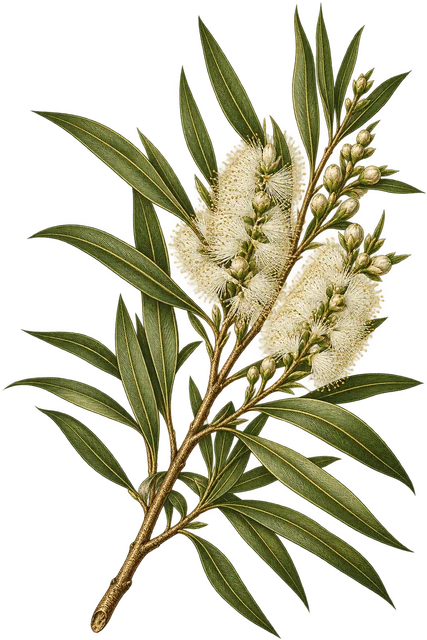
Key cautions
- Never swallow or improvise an eye treatment
- Can irritate or cause allergy; older trial percentages are not home-mixing instructions
What’s inside
Commercial terpinen-4-ol-type oil contains terpinen-4-ol, gamma-terpinene, alpha-terpinene, terpinolene and alpha-terpineol, with smaller/variable 1,8-cineole and other terpenes. Species, chemotype and oxidation affect the composition; a list of constituents cannot certify a bottle’s purity or stability.
European Commission SCCS (final October 2025): Tea tree oil cosmetic safety opinion SCCS/1681/25 · Cosmetic Ingredient Review: Safety assessment of Melaleuca alternifolia-derived ingredients
Uses in brief

- Formulated acne and dandruff products have small human trials
- Traditional skin use; antifungal results are preparation-specific
History, folklore and reported uses
Small superficial wounds
The European Medicines Agency records a long-standing use of specified tea-tree oil medicines for small superficial wounds, continuing the distilled oil’s Australian antiseptic-cupboard history.
European Medicines Agency: Melaleucae aetheroleum · National Capital Poison Center: Tea tree oil, remedy and poison
Insect bites
Tea-tree oil preparations also have a traditional-use record for minor insect bites. This is a separate household first-aid purpose from using the oil as a general cleaner.
Small boils and mild acne
The European Medicines Agency includes small boils, also called furuncles, and mild acne among the skin complaints in the traditional medicinal record. These uses concern formulated topical tea-tree medicines.
European Medicines Agency: Melaleucae aetheroleum · National Capital Poison Center: Tea tree oil, remedy and poison
Itchy, irritated athlete’s foot
The monograph records relief of itching and irritation associated with mild athlete’s foot. This is the oil’s traditional foot-care role.
Minor inflammation inside the mouth
EMA also records specially formulated tea-tree preparations applied to the mouth lining for minor inflammation. This is a medicinal mouth product, not a reason to swallow essential oil.
European Medicines Agency: Melaleucae aetheroleum · National Capital Poison Center: Tea tree oil, remedy and poison
From Australian river country to plantations
Melaleuca alternifolia grows in the damp coastal country of northeastern New South Wales, around the Clarence and Richmond rivers. Arthur Penfold’s investigations in the 1920s brought its distilled oil to wider attention as an antiseptic. Harvesting leaves from natural stands supplied the early trade; later plantations expanded production. Earlier uses of plant material and the concentrated-oil industry are distinct histories.
Carson, Hammer and Riley: Melaleuca alternifolia oil, historical and commercial background
A household product falls and rises
Researchers writing in Australian Infection Control describe tea-tree oil losing popularity as penicillin became prominent, then returning during the natural-products revival of the late 1970s and 1980s. Its sharp scent became associated with household cleanliness and minor skin care.
Health topics: evidence and cautions
These notes describe a specific research context and preparation. A topic link is not a treatment recommendation.
Body odor · Cosmetic formulation role
Form and route: Ingredient in a finished topical deodorant · topical
Condition and setting: Everyday deodorant formulation; not excessive-sweating treatment
Tea tree oil appears in some odor-targeting cosmetic products.
Evidence: Cosmetic formulation reference
Its cosmetic role does not establish reliable clinical odor control.
Limits
An ingredient role is not a trial proving a homemade preparation works.
Cautions
- Do not swallow tea tree oil.
- Topical oil products can cause redness or irritation.
Regional reading paths
These sourced notes describe cultivation, trade, food traditions or material history. A regional connection does not claim exclusive origin.
Australia & Oceania
native and cultivated; Australia, New South Wales and Queensland
Distilled ingredient in formulated skin and household products.
Identity & detailed reference
Identity
Melaleuca alternifolia (Maiden & Betche) Cheel, Myrtaceae; concentrated steam-distilled leaf and terminal-branch oil, usually the terpinen-4-ol type. Tea-tree leaf preparations and Camellia sinensis drinking tea are different materials.
Ingredient details, preparation and research
Source plant or material
Melaleuca alternifolia, native to eastern Australia; leaves and terminal branchlets supply the distilled volatile oil. EMA also recognizes specified other Melaleuca sources for pharmacopoeial tea-tree oil; check the actual label.
Plant family / material: Myrtaceae (myrtle family).
Forms and route
Finished skin gels, washes and shampoos; some registered herbal medicines have specific cutaneous or mouth-lining indications. Their formulation, contact time and age directions matter. A neat essential-oil bottle is neither an oral remedy nor an eye preparation.
Food sources
Not a food. Use ordinary foods for nutrients and Camellia sinensis products if the intended beverage is tea.
Vitamins and minerals
No dietary vitamin, mineral or essential-fat serving is supplied by external tea-tree oil. “Essential” refers to the plant’s volatile essence, not a dietary requirement. It must not be swallowed for nutrition.
Absorption and preparation
In an excised-human-epidermis experiment, only a small fraction of applied constituents entered or crossed the tissue, with terpinen-4-ol the main penetrant; covering the application increased penetration. This is laboratory exposure evidence, not a safe-use dose or proof of bloodstream treatment. Do not use occlusion, heat or penetration enhancers to intensify a home application.
Practical preparation
Choose a finished product labelled for the intended site, age and purpose. Follow contact-time and rinse-off directions. Keep closed, away from heat/light, and within its storage/expiry guidance. Do not convert trial percentages to a universal drops recipe or add concentrated oil to an existing shampoo or acne medicine.
Combination notes
A carrier changes delivery but does not cancel sensitization. Avoid casually layering it with irritating acne actives. Results from multi-ingredient lice, oral-care or acne products cannot isolate tea tree or prove synergy.
Traditional and reported uses
- Attributed tradition: Aboriginal Australian communities used tea-tree leaves for wounds, burns and bites. This describes leaf practices, not concentrated oil on damaged skin.
- Human evidence: small trials of finished acne gel and dandruff shampoo show benefit; evidence does not establish neat oil as an equivalent treatment.
- Traditional European medicinal indications include selected minor skin complaints and athlete’s-foot irritation; these registrations rely on long use rather than strong clinical proof.
- Cosmetic role: a distinctive medicinal/herbal scent and an ingredient in specific cleansing and scalp-care formulations. Claims to regrow hair, cure nail fungus or eradicate lice remain inadequately established for oil alone.
Contraindications and cautions
- Do not swallow tea-tree oil. Accidental ingestion needs prompt poison-center advice; severe neurologic symptoms can occur. Store the original closed bottle securely away from children and pets.
- Avoid eyes and improvised eyelid, mouth, vaginal or other mucosal applications. An expressly labelled mouth product must be used only as directed and never swallowed.
- Burning, redness and allergic contact dermatitis are possible. A small-area tolerance trial does not guarantee absence of delayed allergy. Stop if a reaction develops.
- Keep within the finished product’s route and age instructions. The 2025 SCCS cosmetic assessment applies to specified adult products, not every mixture, children or aerosol/spray delivery.
- Drug-interaction and long-term special-population data are limited. Pregnancy, breastfeeding, pediatric use and application alongside prescription skin treatments require product-specific advice; avoid application where an infant could ingest it.
Similar items and how they compare
- Eucalyptus essential oil
Both are leaf-derived Myrtaceae oils containing volatile monoterpenes and used in carefully formulated aromatic or topical products.
Eucalyptus is cineole-dominant; tea tree is usually terpinen-4-ol-dominant, with different uses.
- Rosemary essential oil
Both are concentrated aromatic ingredients found in formulated scalp products, sharing some monoterpenes but requiring their own product-specific assessment.
Rosemary often emphasizes cineole or camphor; it does not reproduce tea tree’s profile.
- Camellia sinensis tea
The common name tea tree can cause confusion.
Drinking tea comes from a different family and plant; tea-tree essential oil is poisonous to swallow.
Botanical material and chemical identity
The entry concerns distilled volatile oil, chiefly from M. alternifolia. Its terpinen-4-ol-dominant profile differs from the predominantly cineole-rich medicinal eucalyptus oils. Leaf, hydrosol, extract and concentrated oil have different exposure and chemical profiles; botanical identity alone cannot establish equivalence.
History and traditional registration
NCCIH attributes wound, burn and insect-bite uses to Aboriginal Australian leaf traditions. EMA recognizes selected minor skin and mouth-lining uses on a traditional-use basis. Neither source turns household neat oil into a modern wound-care recommendation, and a plant’s historical use does not demonstrate clinical efficacy.
Acne: a formulated 5% gel trial
Enshaieh and colleagues randomized 60 people with mild-to-moderate acne to 5% tea-tree gel or vehicle for 45 days. Lesion counts and an acne-severity index improved more with active gel. This was a small, short study of a specific preparation, not a comparison against all current acne treatments. Its concentration is reported to identify the study, not to prescribe a DIY or indefinite leave-on product.
Dandruff: shampoo rather than neat scalp oil
A four-week randomized, single-blind trial assigned 126 participants to 5% tea-tree shampoo or placebo shampoo. The scalp severity score improved approximately 41% versus 11%. The short duration, limited blinding and specific rinse-off vehicle restrict generalization. This is not evidence of hair regrowth or a reason to add a guessed number of drops to shampoo.
Athlete’s foot and other infection claims
A 158-person trial of two concentrated tea-tree solutions versus placebo reported improved symptoms and some fungal-culture outcomes, but four oil-treated participants developed moderate-to-severe dermatitis. This safety trade-off matters; the study is not a home recipe. NCCIH considers the overall athlete’s-foot evidence small and possibly weaker than standard treatments. Nail-fungus, Demodex, lice and mouth-rinse evidence remains insufficient or mixture-dependent.
Current cosmetic safety opinion is application-specific
SCCS’s final opinion adopted 30 October 2025 assessed specified adult products: up to 2% shampoo, 1% shower gel, 1% face wash and 0.1% face cream. It excludes aerosol/spray exposure, requires composition/stability control, and identifies tea-tree oil as a moderate skin sensitizer. These assessed categories are not universal safe dilutions or automatic bans/permissions for other uses. Older 5% therapeutic trials answer a different question from current cosmetic risk assessment.
Absorption and formulation
Cross et al. tested human epidermal membranes from three donors. Approximately 1.1–1.9% of applied constituents from an ethanol solution and 2–4% from pure oil entered or crossed epidermis under the test conditions; partial covering increased terpinen-4-ol penetration. Evaporation also removed much of the oil. These ex vivo results cannot establish exposure in diseased skin, children, large-area use or a different carrier.
Safety and evidence limits
Poison Control documents serious poisoning and eye injury; cosmetic dilution does not make an oil drinkable or suitable for the cornea. Published efficacy is generally short-term and product-dependent. No established clinical drug-interaction list makes all topical combinations safe, and lack of observed harm in a small trial cannot exclude uncommon or delayed reactions.
Review and publication-status check
Reviewed 5 October 2026. PubMed/publisher records and targeted title/author retraction searches were checked for the acne, dandruff and athlete’s-foot trials used here; no retraction notice was located in those checks. This is a bounded check rather than a guarantee. The newer SCCS opinion was included without extrapolating its adult cosmetic conclusions to medicinal, pediatric or inhaled use.
- Enshaieh et al. (2007): Randomized placebo-controlled trial of formulated 5% tea-tree gel in acne
- Satchell et al. (2002): Randomized trial of a 5% tea-tree shampoo for dandruff
- Satchell et al. (2002): Tea-tree solutions for interdigital tinea pedis
- European Commission SCCS (final October 2025): Tea tree oil cosmetic safety opinion SCCS/1681/25
Entry sources
- NCCIH (April 2025): Tea tree oil, evidence and safety
- National Capital Poison Center: Tea tree oil, remedy and poison
- EMA: Melaleucae aetheroleum, traditional medicinal uses and current document inventory
- Enshaieh et al. (2007): Randomized placebo-controlled trial of formulated 5% tea-tree gel in acne
- Satchell et al. (2002): Randomized trial of a 5% tea-tree shampoo for dandruff
- European Commission SCCS (final October 2025): Tea tree oil cosmetic safety opinion SCCS/1681/25
- Australian National Botanic Gardens: Melaleuca alternifolia
- Cosmetic Ingredient Review: Safety assessment of Melaleuca alternifolia-derived ingredients
- Satchell et al. (2002): Tea-tree solutions for interdigital tinea pedis
- Cross et al. (2008): Tea-tree constituents through excised human epidermis
- National Cancer Institute: Aromatherapy with essential oils, professional PDQ
Reference entry 33 · Recorded content review: 2026-10-05 · Review scope and dates