


Key cautions
- Cook grain and flour before eating. Flour is not a ready-to-eat ingredient, and fermentation alone does not make uncooked batter safe.
- For coeliac disease or strict gluten avoidance, verify a labeled gluten-free supply chain and other ingredients; a teff-containing mix may also contain wheat or barley.
What’s inside
Starch, protein, fiber and minerals, with phytate influencing mineral availability. Grain color, soil contamination, milling and fortification can affect reported iron measurements.
Uses in brief

- Flour for injera
- Cooked cereal food
History, folklore and reported uses
History, folklore and traditional uses
Native/domesticated and cultivated: Ethiopia and Eritrea.
A closer look at its history
The grain behind injera, and the straw behind the house
Teff’s place in Ethiopian farming extends beyond its tiny edible grains. The National Research Council’s 1996 account describes flour for injera, gruel and other breads, while the straw fed working livestock and served as a preferred binding material in clay walls, bricks and household containers. Farmers valued both outputs. This helps explain why judging the crop only by grain yield misses part of its history: a harvest could contribute to meals, animal power and construction, all within the same household economy.
An Ethiopian grain becomes southern African hay
Kew obtained teff seed from Abyssinia in 1886 and distributed it to gardens and other institutions; its 1887 bulletin encouraged trials in suitable regions. The National Research Council traces a particularly successful introduction to the Transvaal, where the fast-growing, soft-stemmed grass became valuable hay. It later helped feed horses and oxen during the Boer War. Teff consequently traveled under two different identities: a cherished grain for Ethiopian food and a forage crop elsewhere. Its international story did not begin with recent gluten-free marketing, nor did every country first grow it to make injera.
Additional history reviewed 2026-10-09
Traditional, historical and reported uses
- Flour for injera
Food or household practiceWhy this label?
The source supports the named food, cosmetic or material practice; no treatment effect is inferred and the card’s form and safety limits remain attached.
The National Research Council documents teff’s central bread-making role. Fermentation and cooking create a separate food matrix, and a blended injera should not be described as pure teff.
- Cooked cereal food
Food or household practiceWhy this label?
The source supports the named food, cosmetic or material practice; no treatment effect is inferred and the card’s form and safety limits remain attached.
The same crop chapter records uses beyond the grain’s botanical identity, including porridge-type preparations. Cooked grain provides a staple base that can be combined with varied foods.
2 sourced featured uses; cultural or material records are not clinical efficacy evidence.
Historical-use additions reviewed 2026-10-09
Regional reading paths
These sourced notes describe cultivation, trade, food traditions or material history. A regional connection does not claim exclusive origin.
Africa
Native/domesticated and cultivated: Ethiopia and Eritrea.
Small cereal grain milled for breads and porridge.
Identity & detailed reference
Identity
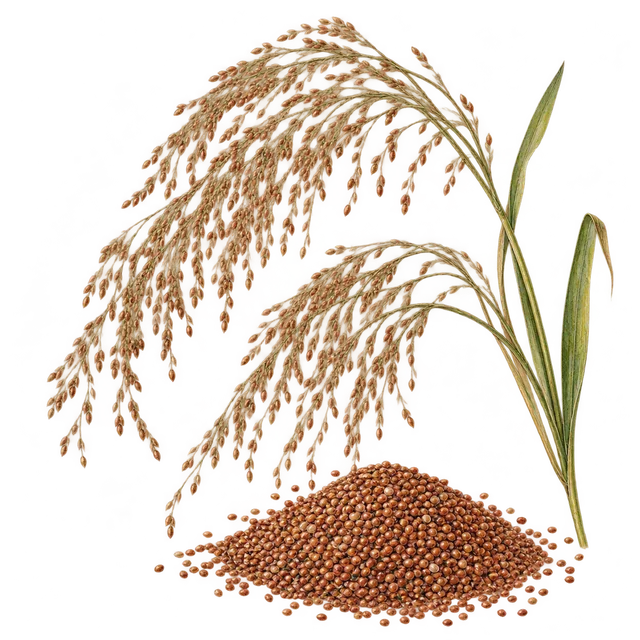
The cereal grain of Eragrostis tef, commonly spelled teff. It is a tiny grass seed, not wheat; cooked teff grain, flour and fermented injera are different food forms.
Ingredient details, preparation and research
Source plant or material
Eragrostis tef
Plant family / material: Poaceae
Forms and route
Clean whole grain, flour and cooked porridges or breads. Flour blends may contain wheat or other cereals even when teff is emphasized on the package.
Vitamins and minerals
Teff provides carbohydrate with protein, fiber and minerals. Dry flour cannot be compared gram-for-gram with hydrated porridge or bread, and a universal high-iron serving is not assigned.
Absorption and preparation
Phytate and processing affect mineral availability. A specific fortified-injera study improved iron absorption using formulation changes, but it cannot predict absorption from every teff porridge or bread.
Practical preparation
Follow package cooking directions using safe water. Store grain and flour dry and protected from pests; cool and refrigerate cooked food appropriately.
Traditional and reported uses
- Flour for injera
- Cooked cereal food
Contraindications and cautions
- Cook grain and flour before eating. Flour is not a ready-to-eat ingredient, and fermentation alone does not make uncooked batter safe.
- For coeliac disease or strict gluten avoidance, verify a labeled gluten-free supply chain and other ingredients; a teff-containing mix may also contain wheat or barley.
Evidence is food-form specific
The human iron study used fortified teff injera and controlled changes involving phytase, including added wheat. It does not show that unfortified teff alone treats anemia or that all teff preparations have the same bioavailability.
Evidence limits
Whole-grain and flour profile; no anemia-treatment claim, universal glycemic index or gluten-free guarantee for mixed products.
Entry sources
- National Research Council, Lost Crops of Africa: Tef
- FAO: Sorghum and millets in human nutrition; fermented foods
- Human study: Whole-wheat addition during injera fermentation and iron absorption from fortified tef
Reference entry 319 · Recorded content review: 2026-10-09 · Review scope and dates