


Key cautions
- Separate from other medicines as a precaution; follow product timing and ask a pharmacist about essential prescriptions.
- Use fresh water macerates immediately. Age limits vary by product; medicinal pregnancy/breastfeeding use is not recommended.
What’s inside
Mucilage polysaccharides, including rhamnogalacturonan-related material, plus pectins and starch; smaller amounts of flavonoids and phenolic acids. Solvent, root quality and processing affect the finished mixture.
Uses in brief

- Traditional local soothing for mouth/throat irritation with dry cough.
- Traditional relief of mild stomach and intestinal discomfort.
History, folklore and reported uses
Dry cough, mouth and throat irritation
European marshmallow-root drinks made by soaking the root, along with syrups, were used for dry cough and irritated mouth or throat tissues.
EMA: Marshmallow root overview and current monograph status · Maud Grieve: A Modern Herbal (1931), Marsh Mallow
Digestive irritation
European herbal texts record marshmallow-root drinks for irritated stomach and intestinal tissues. The British Herbal Compendium also included ulcers of the stomach and duodenum, the first part of the small intestine.
Poultices for inflamed skin
European herbals used powdered or softened root in poultices, ointments and creams for boils, eczema and dermatitis. The 1949 British Pharmaceutical Codex also recorded fomentations, warm moist applications, for inflamed tissues.
Urinary discomfort
British herbal references summarized by EMA record marshmallow root for cystitis, inflammation of the bladder; urethritis, inflammation of the urine passage; and urinary stones. Grieve also describes simmered-root drinks for painful urinary complaints.
EMA: Marshmallow root assessment, historical topical uses · Maud Grieve: A Modern Herbal (1931), Marsh Mallow
Teething roots
Sorø Museum’s pharmacy-garden history in Denmark records marshmallow root used as a teething ring for small children.
Museum West Zealand, Sorø Pharmacy Garden: Althaea officinalis
From pharmacy sweet to confectionery
French pharmacists used marshmallow root in pâte de guimauve, a sweet preparation associated with chest complaints. Later confectionery replaced the root with other ingredients, leaving its name attached to sweets that usually no longer contain the plant.
A plant of damp ground
Althaea officinalis is a tall mallow of damp places, with pale flowers and soft-looking leaves. Cambridge University Botanic Garden records its place both in food and in the apothecary’s store of medicinal plants.
Health topics: evidence and cautions
These notes describe a specific research context and preparation. A topic link is not a treatment recommendation.
Respiratory health · Traditional reports
Form and route: water preparation or labeled oral root medicine · oral or oromucosal as labeled
Traditional root preparations soothe mouth or throat irritation with dry cough.
Evidence: documented traditional use; clinical evidence insufficient
EMA recognizes longstanding symptom use; this is not proof of a disease cure.
Limits
This is symptom support, not evidence of clearing an infection.
Cautions
- Follow product age limits; ethanol extracts have separate restrictions.
- Seek advice if symptoms last over a week.
Regional reading paths
These sourced notes describe cultivation, trade, food traditions or material history. A regional connection does not claim exclusive origin.
Europe
Native and historical: a Eurasian plant including the United Kingdom, recorded by Cambridge’s botanic garden as an apothecary plant whose root also entered confectionery.
Mucilaginous root in traditional herbal preparations and the history of marshmallow sweets; modern confectionery need not contain the plant.
Identity & detailed reference
Identity
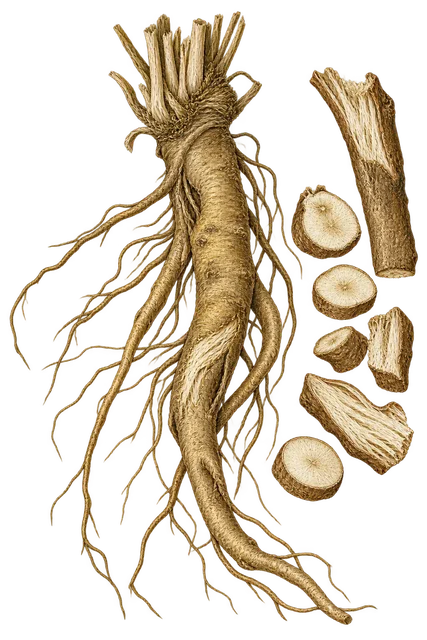
Althaea officinalis L.; peeled or unpeeled dried root, called Althaeae radix. Leaf preparations and modern marshmallow candy are different materials.
Ingredient details, preparation and research
Source plant or material
Althaea officinalis L.; dried root (Althaeae radix).
Plant family / material: Malvaceae (mallow family).
Forms and route
Water macerates/teas, syrups, lozenges and defined dry or liquid extracts for oral or mouth use. Some monographed liquid extracts use 25% ethanol; they are not interchangeable with a mucilage-rich water preparation.
Vitamins and minerals
No reliable micronutrient quantity was established for an ordinary root tea/macerate or labeled syrup serving. Mucilage is a polysaccharide, not a vitamin or mineral. Modern candy is separate: one manufacturer’s four-piece (29 g) marshmallow serving contains 100 kcal and 17 g added sugar, with no marshmallow root in its ingredient list.
Absorption and preparation
The mucilage rationale is chiefly local surface contact, rather than achieving high blood concentrations. Human pharmacokinetic data are inadequate. EMA says no human or animal tests had been performed to confirm the proposed delay in medicine absorption; its 30–60-minute separation advice is precautionary. Medicine-specific instructions can require a different interval.
Practical preparation
Choose identified cut root or a labeled root product. For a water macerate, follow its specified root weight, potable-water volume and soaking instructions, then strain and use immediately with clean utensils. Do not leave it at room temperature overnight or invent a shelf life. A concentrated tincture is not a drop-for-drop substitute for a water macerate or mouth preparation.
Food notes
Root preparations are used as demulcents or flavorings rather than dependable nutrient foods. Syrup sugar and confectionery calories belong to the finished-product label; eating marshmallow sweets does not reproduce the root preparation.
Combination notes
Mullein shares the traditional soothing-throat role, but a combination needs its own preparation instructions and evidence. Licorice-containing blends require separate blood-pressure, potassium and medicine review. Neither a similar use nor two mucilage-containing plants establishes synergy.
Traditional and reported uses
- European traditional use: local soothing of irritated mouth or throat and associated dry cough.
- European traditional use: relief of mild stomach/gut discomfort.
- Observational product studies report cough relief, but robust preparation-specific efficacy evidence remains limited. Laboratory cell effects do not prove tissue healing in people.
Contraindications and cautions
- Avoid known allergy. Pregnancy/breastfeeding medicinal safety is unestablished and EMA does not recommend use.
- Bloating or abdominal discomfort occurred in a few uncontrolled syrup reports. Stop for suspected allergy; limited reporting does not establish that every product is side-effect-free.
- Mucilage could delay uptake of medicines: EMA advises a 30–60-minute gap before or after other medicines as a precaution, not as a clinically demonstrated interaction. Ask a pharmacist about medicines with their own timing requirements.
- Age limits depend on indication and preparation: some throat products are for ages 3+, stomach/gut use generally 12+, and the monographed ethanol extract is adult-only. Do not extrapolate a child’s dose from adult tea.
- Prepare water macerates hygienically and use immediately. Check syrups and lozenges for sugar, alcohol and other active ingredients.
- Seek assessment if cough/throat symptoms last over one week or gut discomfort over two weeks, or sooner for worsening symptoms, breathing/swallowing difficulty, fever or purulent sputum.
Similar items and how they compare
- Mullein
Both have traditional local throat and dry-cough uses in water-based preparations.
Marshmallow uses root; EMA mullein uses flowers of three species, and mullein teas require careful removal of hairs.
- Licorice root
Both roots appear in traditional throat and digestive products.
Marshmallow centers on mucilage contact; glycyrrhizin-containing licorice has important systemic blood-pressure and electrolyte risks.
Root identity and forms
Althaea officinalis belongs to Malvaceae. The relevant medicinal material is dried root, peeled or unpeeled. Tea/macerate, syrup, lozenge and solvent-defined extract are different formulations; the EMA monograph includes a particular low-strength ethanol extract as well as water preparations. Neither leaf nor confectionery should be substituted by name alone.
Traditional local soothing
The European tradition covers mouth/throat irritation with dry cough and mild stomach/gut discomfort. “Demulcent” describes a soothing preparation contacting irritated surfaces. These are traditional indications, not proof of healing ulcers, treating reflux disease or correcting an infection. EMA’s 2025 periodic review did not identify evidence requiring a changed monograph.
What human studies actually show
Two uncontrolled syrup studies in roughly 900 children reported improvement, but lacked comparison groups. An adult placebo-controlled study involved 63 people with ACE-inhibitor-related cough; the extract was inadequately described. In 2018, two pharmacy-based surveys enrolled 822 users of a named aqueous extract in syrup or lozenges and recorded perceived benefit. Such surveys are vulnerable to natural recovery and expectation effects; they do not establish the effect of homemade tea.
Mucilage and laboratory evidence
Root contains mucilage polysaccharides, pectin and starch. A cell study found that aqueous extract/polysaccharides affected epithelial-cell activity and formed bioadhesive layers in laboratory systems. This is mechanistic support for local contact, not a human tissue-healing trial or proof of whole-body absorption. More concentrated or more alcoholic is not automatically more suitable for soothing.
Medicine absorption: precaution, not demonstrated interaction
EMA’s assessment states that no animal or human tests had been performed to confirm the suggested slowing of other medicines’ absorption. It nevertheless recommends avoiding intake within 30–60 minutes before or after another medicine as a precaution. Follow the relevant product and prescription instructions, and ask a pharmacist about time-critical medicines; do not change a prescribed dose or assume this generic gap overrides a longer drug-specific interval.
Fresh preparation and route limits
A macerate is a water-soaked root preparation. Follow a specified product’s root weight, water quantity and soaking method, use clean utensils and potable water, strain, and use immediately. EMA calls for immediate use; this is not permission to keep an unpreserved jar for days. Follow the label for oral versus mouth contact. Do not improvise a mouth rinse from a concentrated alcohol tincture.
Food portion and candy distinction
No dependable per-serving vitamin/mineral claim was verified for strained root preparations. Mucilage does not make a syrup a micronutrient supplement. As a separate food example, the reviewed Jet-Puffed label lists four sweets (29 g) as 100 kcal and 17 g added sugar, with gelatin and sugars but no Althaea root. This example describes that candy only, not every confectionery formula.
Age, pregnancy and symptom review
Product-specific limits matter: throat preparations may allow ages 3 and older, gut-discomfort use generally begins at 12, and the monographed ethanol extract is adult-only. Pregnancy/breastfeeding use is not recommended because evidence is inadequate. Cough lasting over one week, gut symptoms over two weeks, or earlier worsening requires assessment. Licorice in a blend introduces separate risks; adding mullein is not proven to amplify benefit. The 2025 review noted a few digestive complaints in syrup users and uncertain non-serious case reports; these did not establish a new safety signal.
Entry sources
- EMA: Marshmallow root overview and current monograph status
- EMA: Marshmallow root traditional-use monograph (2016)
- Kew: Althaea officinalis, accepted name and Malvaceae family
- EMA: Marshmallow root assessment report (2016), including precautionary absorption warning
- EMA: Marshmallow root periodic review addendum (2025)
- Fink et al. (2018): Two non-interventional surveys of marshmallow-root products in 822 users
- Deters et al. (2010): Marshmallow polysaccharides and epithelial cells in vitro
- EMA: Mullein flower traditional-use monograph (2018)
- NCCIH: Licorice root, usefulness and safety
- Kraft Heinz: Jet-Puffed Marshmallows, ingredient and nutrition label
Reference entry 23 · Recorded content review: 2026-10-05 · Review scope and dates