


Key cautions
- Thujone can be neurotoxic at excessive exposure. Avoid self-dosing common-sage essential oil; a seizure history warrants particular caution with concentrates.
- Medicinal use is not recommended during pregnancy/breastfeeding or under 18 in the EMA monograph. Normal food seasoning is a separate exposure.
- If you take warfarin, keep dietary vitamin K intake consistent and discuss substantial changes in sage or supplement intake with your clinician. Ordinary seasoning is distinct from a concentrated medicinal product.
- Do not replace prescribed treatment for cholesterol, diabetes or memory problems with sage. A trial’s specific preparation and short follow-up do not establish a safe long-term homemade dose.
What’s inside
The whole leaf contains nutrients and nonvolatile plant compounds alongside an aromatic fraction. Food sage, a strained infusion, an alcohol extract and distilled essential oil are not compositionally equivalent. The quantities and compounds below refer to the identified form.
USDA FoodData Central: primary SR Legacy food, nutrient and portion data · Walch et al. (2012): NMR analysis of sage teas and tinctures · EMA: Final assessment report on Salvia officinalis leaf and essential oil, revision 1; historical leaf uses
Nutrients in a teaspoon of ground sage
USDA SR Legacy lists a teaspoon of ground sage as 0.7 g. Smaller sprinkles supply less; these reference values describe the leaf eaten, not a strained tea, tincture or essential oil.
- Energy: about 2 kcal
- Carbohydrate: 0.43 g, including about 0.28 g fiber
- Protein: 0.07 g; total dietary fat: 0.09 g
- Calcium: 12 mg; iron: 0.20 mg
- Magnesium: 3.0 mg; potassium: 7.5 mg
- Vitamin K: 12 micrograms, about 10% of the Daily Value
USDA FoodData Central: primary SR Legacy food, nutrient and portion data · FDA: Daily Values for nutrition labels
Phenolic compounds
Sage leaf contains rosmarinic acid and flavonoids related to luteolin and apigenin. Many occur as glycosides, compounds attached to sugar units. Its diterpenes, another group of plant compounds, include carnosic acid and carnosol. Detecting these substances is a composition finding, not proof of a treatment effect.
EMA: Final assessment report on Salvia officinalis leaf and essential oil, revision 1; historical leaf uses · Walch et al. (2012): NMR analysis of sage teas and tinctures
Aromatic compounds and thujone
Sage’s volatile fraction can contain alpha- and beta-thujone, camphor and 1,8-cineole. Their proportions depend on the plant’s chemical profile and preparation. A survey of commercial sage teas and tinctures found substantial variation, with more thujone and camphor on average in alcohol tinctures than water infusions. A product name alone does not specify exposure.
Walch et al. (2012): NMR analysis of sage teas and tinctures · EMA: Public statement on thujone-containing herbal medicinal products, revision 1
Uses in brief

- Food seasoning; traditional leaf preparations for mild digestive symptoms and sweating.
- Separate mouth/throat and skin preparations have traditional local uses; small extract trials remain preliminary.
History, folklore and reported uses
Four traditional uses, different preparations
The European Medicines Agency records oral leaf preparations for mild indigestion, including bloating and heartburn, and excessive sweating. Local infusions and liquids were used for mouth or throat inflammation and minor skin inflammation. These conclusions rest on longstanding use, not proof of all four uses in high-quality clinical trials.
EMA: Salvia officinalis leaf monograph, revision 1 (adopted 2016, published 2017) · EMA: Final assessment report on Salvia officinalis leaf and essential oil, revision 1; historical leaf uses
A prized plant in medieval gardens
The Met describes sage in Walahfrid Strabo’s ninth-century garden poem and the useful-plant list associated with Charlemagne’s estates. Common sage became established in northern European gardens, but classical and medieval accounts sometimes blend it with three-lobed Greek sage, Salvia fruticosa. Those species should not be treated as one plant.
Long life and dark hair
A health poem associated with Salerno, Italy, wondered how someone with sage in the garden could die; an English saying linked eating it in May with long life. The Met notes that the Salerno proverb may originally have concerned Greek sage. Later medieval herbals repeated an older belief that sage preparations darkened hair. These are historical beliefs, not demonstrated benefits.
Cooking and the linen cupboard
An ethnobotanical survey in Ancona, in Italy’s Marche region, recorded sage leaves used to flavor meat, eaten fried and dried to scent linen. Elsewhere, poultry, stuffing, soups and vegetables are familiar culinary partners. Such combinations are chosen for flavor, not proven medicinal synergy.
Lucchetti et al. (2019): Ethnobotanical uses in the Ancona district, Table 1 · University of Minnesota Extension: Herbs, preparation and culinary pairings
Sore-throat spray research
A randomized, blinded trial enrolled 286 patients across two stages and tested a sage fluid-extract spray for acute viral sore throat. A 15% preparation reduced throat-pain scores more than placebo during the first two hours after use; mild burning or dryness occurred. The result concerns a specific alcohol-extracted leaf spray, not a homemade gargle, tea or essential oil, and does not show eradication of infection.
Hubbert et al. (2006): Sage fluid-extract spray for acute pharyngitis · EMA: Final assessment report on Salvia officinalis leaf and essential oil, revision 1; historical leaf uses
Memory and attention research
A blinded crossover study tested a standardized common-sage extract in 20 healthy adults over 65, with each participant receiving extract and placebo on separate visits. One of four tested doses improved selected memory and attention measures over several hours. This small, short-term study does not establish dementia treatment or an equivalent effect from cooking with sage.
Scholey et al. (2008): Acute common-sage extract study in 20 older volunteers · NCCIH: Sage, usefulness and safety, updated April 2025
Blood-lipid research
A two-month randomized, blinded study in 67 people with raised blood lipids compared sage-leaf extract capsules with placebo and reported improved cholesterol and triglyceride measurements. This is a small extract trial, not evidence that seasoning prevents heart attacks or replaces lipid-lowering treatment. NCCIH considers the wider evidence limited and finds insufficient evidence for a blood-glucose benefit.
Kianbakht et al. (2011): Common-sage leaf extract and blood lipids, randomized trial · NCCIH: Sage, usefulness and safety, updated April 2025
Women’s Health: traditions, evidence and cautions
Historical use does not establish benefit or safety. Pregnancy, breastfeeding and fertility care require particular caution: food, tea, essential oil and concentrated extract are not interchangeable. These records are not treatment, dosing or pregnancy-management instructions. Discuss supplements with a qualified clinician or pharmacist; do not delay evaluation of persistent symptoms.
Common sage leaf
Salvia officinalis L.
- Plant part / material
- Leaf
- Preparation studied or reported
- Culinary leaf and herbal preparations; essential oil is not equivalent.
LactMed records sage use for weaning/oversupply. Reports involving S. fruticosa or S. nemorosa belong to separate species and are not automatically common-sage evidence.
Weaning / oversupply tradition
Traditional use without clinical efficacy evidence
Reported or traditional useUsed with the intention of reducing an abundant milk supply or supporting weaning.
What the evidence supportsNo human studies evaluating a milk-supply effect were located by LactMed; efficacy remains unproven.
Nursing safety data are absent. Thujone and camphor are neurotoxic at high exposure; avoid presenting concentrated sage oil as a home lactation intervention.
- The cited lactation evidence does not establish medicinal-use safety during pregnancy; postpartum traditions must not be extrapolated to pregnancy.
Health topics: evidence and cautions
These notes describe a specific research context and preparation. A topic link is not a treatment recommendation.
Body odor · Traditional reports
Form and route: Specified oral leaf preparations recognized by EMA for traditional use · oral
Condition and setting: Excessive sweating; traditional-use context
Specified sage leaf preparations have a traditional European use for excessive sweating.
Evidence: Traditional use; not established odor treatment
EMA bases this indication on long-standing use. Sweating and odor are different outcomes.
Limits
This does not establish odor control or equivalence of sage essential oil.
Cautions
- Concentrated thujone-containing products require caution; avoid substituting sage oil.
- Medicinal pregnancy/lactation and under 18 use are not recommended in the monograph.
Regional reading paths
These sourced notes describe cultivation, trade, food traditions or material history. A regional connection does not claim exclusive origin.
Europe
Cultivated and traditional processing: Mediterranean herb grown in UK gardens.
Culinary leaves and labelled herbal preparations; avoid treating essential oil as a food substitute.
Identity & detailed reference
Identity
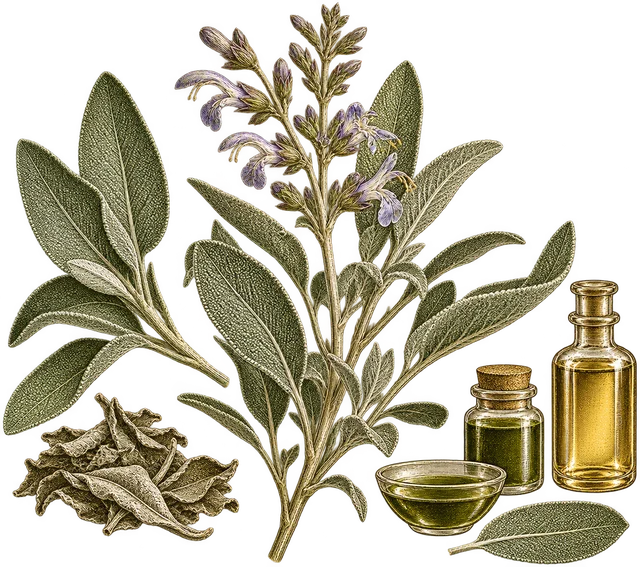
Salvia officinalis L., common or garden sage; leaf. Clary sage (Salvia sclarea), Spanish sage and other Salvia taxa must not be substituted as though their chemistry and evidence were identical.
Ingredient details, preparation and research
Source plant or material
Salvia officinalis L.; fresh/dried leaf and specified leaf extracts. Common-sage essential oil is a separate concentrated material.
Plant family / material: Lamiaceae (mint family).
Forms and route
Fresh/dried culinary leaf; labeled leaf tea; specified water or ethanol extracts, tablets and tinctures; separately formulated mouth rinses, gargles, gels or skin products. Distilled common-sage oil and clary-sage oil are different materials.
Practical preparation
Use identified food sage for cooking. For a medicinal leaf product, check its extraction type, strength, intended route and thujone specification, and follow its leaflet. A gargle, oral tea and skin preparation are not interchangeable recipes.
Combination notes
Sage pairs with poultry, stuffing, soups and cooked vegetables; use a restrained amount because its flavor is strong. Rosemary or thyme can join a savory dish, but combining their extracts has no established clinical synergy.
Traditional and reported uses
- Culinary seasoning, including poultry, stuffing, soups and savory vegetable dishes.
- EMA traditional-use indications: mild indigestion including bloating, excessive sweating, mouth/throat inflammation and minor skin inflammation, using the specified route and preparation.
- Small human studies of particular sage extracts suggest possible effects on menopausal symptoms or cognitive-test performance; they do not establish benefits from culinary leaves or prove prevention/treatment of dementia.
Contraindications and cautions
- High or prolonged exposure to thujone-containing sage products can be unsafe; an essential oil is not a substitute for culinary leaf or labeled tea. People with seizure disorders should have concentrated products reviewed before use.
- Medicinal-use pregnancy/lactation safety has not been established; EMA does not recommend these medicinal preparations in pregnancy, breastfeeding or people under 18. This is not a blanket ban on ordinary food seasoning.
- Avoid with known sage allergy. Keep products intended for gargling or external use to their labeled route, and do not swallow a rinse.
- Have persistent or unexplained sweating evaluated. Seek advice for worsening symptoms, digestive symptoms lasting more than two weeks, or mouth/throat symptoms lasting more than one week.
- EMA reports no established interactions for its specified preparations, but this is not a guarantee for all supplements. Check concurrent medicines, ethanol-containing products and substantial dietary vitamin-K changes.
- If you take warfarin, keep dietary vitamin K intake consistent and discuss substantial changes in sage or supplement intake with your clinician. Ordinary seasoning is distinct from a concentrated medicinal product.
- Do not replace prescribed treatment for cholesterol, diabetes or memory problems with sage. A trial’s specific preparation and short follow-up do not establish a safe long-term homemade dose.
Similar items and how they compare
- Rosemary leaf
Both are aromatic mint-family leaves with digestive traditions and rosmarinic-acid-containing extracts, distinct from their concentrated essential oils.
Common sage emphasizes sweating and mouth-rinse traditions; rosemary also features in bath preparations.
- Clary sage essential oil
Both come from Salvia species and appear in aromatic products, so checking the complete botanical name prevents confusion.
Clary sage is Salvia sclarea flower/leaf oil, chemically different from common sage leaf.
Botanical identity and forms
Salvia officinalis L., common or garden sage; leaf. Clary sage (Salvia sclarea), Spanish sage and other Salvia taxa must not be substituted as though their chemistry and evidence were identical. The mint-family leaf is used in foods and in several water/ethanol preparations. A shared common name does not make clary-sage oil equivalent to common-sage leaf.
Menopause extract study
An 80-woman, four-week randomized placebo-controlled trial tested a proprietary thujone-free ethanolic extract of freshly harvested sage in tablets. It reported lower menopausal symptom and hot-flush scores. The manufacturer sponsored the study and employed one author; its short duration does not establish long-term safety or equivalence to ordinary tea or oil. NCCIH considers the overall hot-flash evidence limited.
Thujone, route and vulnerable groups
EMA asks that thujone be specified in medicinal products and favors lower-thujone chemotypes. High exposure can affect the nervous system. Medicinal use is not recommended in pregnancy, breastfeeding or under 18 because adequate data are lacking. Ordinary culinary amounts have a different safety context; a clinician should review concentrates with a seizure history or regular medicines.
Duration and symptom review
Use the actual leaflet. EMA advises review when digestive or minor-skin symptoms persist beyond two weeks and mouth/throat symptoms beyond one week, or if symptoms worsen. Sweating that remains unexplained deserves assessment; it should not be indefinitely masked by escalating a home tea or oil.
Absorption evidence
A seven-volunteer study detected thujone metabolites after a particular sage infusion, demonstrating uptake and metabolism rather than a health benefit. It does not set a universally safe tea recipe. No need to add oil or another “absorption enhancer” is established; increasing thujone exposure is not a goal.
Current assessment and related herbs
The EMA page lists an ongoing periodic review, but the adopted leaf monograph remains revision 1. Rosemary shares mint-family culinary use; clary sage shares a genus name. Neither relationship transfers common-sage evidence or its product specifications automatically.
Entry sources
- Kew Plants of the World Online: Salvia officinalis L.
- NCCIH: Sage, usefulness and safety (April 2025)
- EMA: Salvia officinalis leaf monograph, revision 1 (adopted 2016, published 2017)
- Walch et al. (2012): NMR analysis of sage teas and tinctures
- EMA: Public statement on thujone-containing herbal medicinal products, revision 1
- Dimpfel et al. (2021): Placebo-controlled study of a specific fresh-sage extract in menopause
- Thamm et al. (2018): Thujone and metabolites after sage infusion in seven volunteers
- USDA FoodData Central: SR Legacy downloadable food and portion data
- FDA: Daily Value on the Nutrition and Supplement Facts labels
- University of Minnesota Extension: Herbs, preparation and culinary pairings
- EMA: Sage-leaf assessment page and pending revision-2 review
- NIH ODS: Vitamin K, absorption and vitamin-K antagonists
- Lucchetti et al. (2019): Ethnobotanical uses in the Ancona district, Table 1
Reference entry 15 · Recorded content review: 2026-10-05 · Review scope and dates