


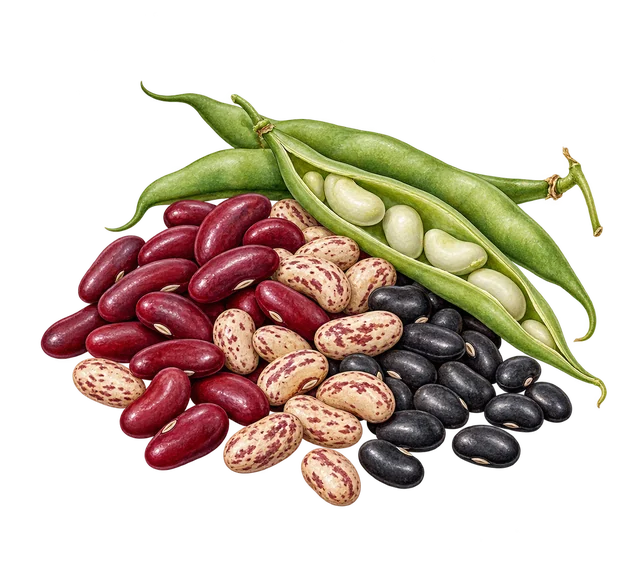
Key cautions
- Never eat raw or undercooked kidney beans; lectin poisoning can cause substantial gastrointestinal illness.
- A low-temperature slow cooker alone is not a reliable method for raw kidney beans
- Beans may cause gas; individual tolerance varies
What’s inside
Cooked mature beans supply starch, protein, fiber and minerals; raw beans also contain lectins and other components reduced by appropriate processing.
Uses in brief

- Cooked beans and stews
- Bean sauces and fillings
History, folklore and reported uses
History, folklore and traditional uses
CONABIO documents diverse Phaseolus beans in Mexican agriculture and cuisine. This card is limited to common bean; it does not replace the inventory’s separate fava-bean record or assume that all bean species have identical preparation needs.
Traditional, historical and reported uses
- Cooked beans and stews
Food or household practiceWhy this label?
Label describes the stated practice or evidence, not an efficacy grade. Exact form and cautions remain attached.
Common beans form substantial cooked dishes and accompaniments in Mexican and other regional cuisines. Safe preparation is part of the food’s identity.
- Bean sauces and fillings
Food or household practiceWhy this label?
Label describes the stated practice or evidence, not an efficacy grade. Exact form and cautions remain attached.
CONABIO records beans in enfrijoladas, tlacoyos and other foods, showing their use as ground sauces or fillings as well as whole seeds.
2 supported uses; records describe the named form and are not treatment recommendations.
Historical-use additions reviewed 2026-10-09
Health topics: evidence and cautions
These notes describe a specific research context and preparation. A topic link is not a treatment recommendation.
Diabetes and prediabetes · Support during care
Form and route: Thoroughly cooked beans · oral
Beans fit the legume-rich meal pattern tested in type 2 diabetes.
Evidence: randomized_diet_pattern_evidence
The legume-diet trial improved HbA1c and blood pressure modestly.
Limits
The trial tested a dietary pattern, not a bean extract or a cure.
Cautions
- Never eat raw or undercooked kidney beans; use proper cooking.
Regional reading paths
These sourced notes describe cultivation, trade, food traditions or material history. A regional connection does not claim exclusive origin.
North America
Domesticated/cultivated: Mexico/Mesoamerica; regional food crop in Belize.
Properly cooked dry beans and edible immature pods.
Identity & detailed reference
Identity
Phaseolus vulgaris seeds and edible immature pods. Vicia faba (broad bean), chickpea, lentil and tepary bean are different species.
Ingredient details, preparation and research
Also known as: Pinto beans; Black beans; Kidney beans; Navy beans
Source plant or material
Phaseolus vulgaris
Plant family / material: Fabaceae
Forms and route
Dried mature beans, cooked/canned beans and immature green pods. Raw bean flour and concentrated bean extracts are not equivalent to cooked food.
Vitamins and minerals
Dry-bean and cooked-bean weights differ because of absorbed water. Canned products may contain added salt; immature green pods do not have the same composition as mature seeds.
Absorption and preparation
Cooking improves usability of this food, while phytate and meal composition influence mineral availability. Pairing with varied foods supports a balanced diet without requiring a medicinal combination.
Practical preparation
For dried beans, follow authoritative species-appropriate soaking and boiling guidance rather than taste alone. Canned beans are already cooked; drain/rinse as desired and handle opened cans safely.
Traditional and reported uses
- Cooked beans and stews
- Bean sauces and fillings
Contraindications and cautions
- Never eat raw or undercooked kidney beans; lectin poisoning can cause substantial gastrointestinal illness.
- A low-temperature slow cooker alone is not a reliable method for raw kidney beans. Use commercially canned beans or a validated boiling procedure.
- Beans may cause gas; individual tolerance varies. Avoid products if allergic.
Lectin risk is preparation-specific
FDA documents outbreaks involving inadequately cooked beans, including slow-cooker preparations. This does not make properly cooked beans inherently unsafe; it explains why raw and cooked forms must remain separate.
Evidence limits
Regional history and food/material practice do not establish treatment efficacy. Composition depends on the named species, part and preparation; no medicinal dose or universal nutrient ranking is inferred.
Entry sources
- CONABIO: Frijoles, ayocotes, téparis, ibes
- FDA: Bad Bug Book, phytohaemagglutinin
- CFIA: List of Grains and Field Crops
- Belize Agriculture: Agricultural market prices, February 2020
Reference entry 404 · Recorded content review: 2026-10-09 · Review scope and dates