


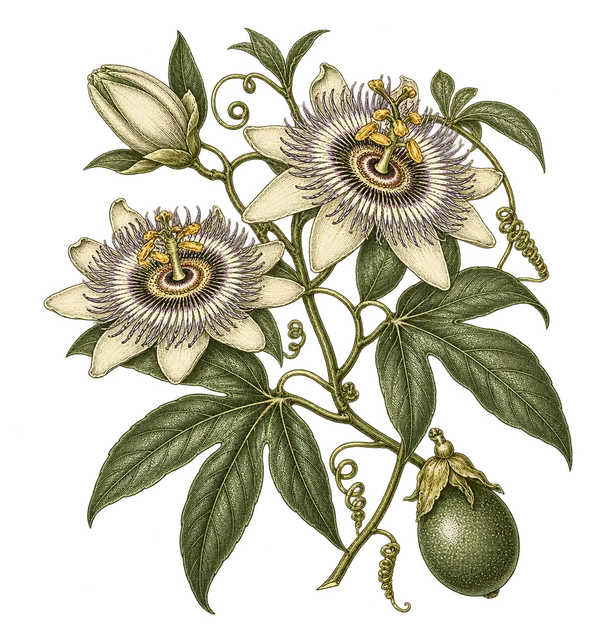
Key cautions
- May cause drowsiness, dizziness or confusion. Avoid driving if affected; check sedating medicines, alcohol and anesthetics.
- Do not use in pregnancy. Under-12 medicinal use and breastfeeding use lack adequate support. Tell a surgical team about recent use.
What’s inside
Flavonoid C-glycosides, including isovitexin and isoorientin and related apigenin/luteolin derivatives. Composition varies; beta-carboline alkaloids may be trace or undetectable in commercial material. It should not be described as a predictably strong MAO inhibitor.
EMA: Passiflora incarnata aerial-herb assessment report (2014)
Uses in brief

- Traditional: mild mental stress and helping sleep.
- Limited human research: subjective sleep quality and total sleep time; not a dependable treatment for every insomnia or anxiety disorder.
History, folklore and reported uses
Anxiety and unsettled sleep
European herbal practice uses dried P. incarnata above-ground parts, including leaves and stems, in teas and extracts for mild mental stress and sleeping difficulties. Kew also records the plant’s familiar anxiety-and-sleep remedy role.
EMA: Passionflower traditional-use conclusions and current monograph status · Kew: Purple passionflower
Headache and nerve pain
King’s American Dispensatory (1898) describes passionflower for nervous headache and facial or other nerve pain. Practitioners in the American Eclectic school of medicine, which emphasized plant remedies, used preparations of roots and stem bases as well as leaf tinctures, a broader plant-part history than today’s aerial-herb monograph.
Felter and Lloyd: King's American Dispensatory (1898), Passiflora
Menstrual cramps
The same nineteenth-century American dispensatory records passionflower for painful, spasmodic menstruation. It belongs to the Eclectic antispasmodic tradition, which used the plant for pain accompanied by cramping.
Felter and Lloyd: King's American Dispensatory (1898), Passiflora
Burns and local soreness
King’s Dispensatory also records water-based passionflower extracts applied externally to recent burns, scalds and painful ulcers. This lesser-known topical tradition should be read as a historical use, separate from the modern oral herb.
Felter and Lloyd: King's American Dispensatory (1898), Passiflora
Maypop as a cultivated food
John Smith’s early-seventeenth-century Virginia account describes Powhatan cultivation of maypop fruit, calling it maracocks. Plant Humanities Lab identifies it as P. incarnata. Other American Passiflora species have their own food and medicinal histories; those records should not all be assigned to this vine.
Plant Humanities Lab: Passionflower—Christian Curiosity, Exotic Vine, Tropical Fruit
A flower read as a religious emblem
European missionaries interpreted passionflowers through the Passion of Christ, seeing the corona, a ring of threadlike structures in the flower, as a crown of thorns and other structures as instruments of the Crucifixion. This devotional reading spread through European images and gardens, where P. incarnata grew by the early seventeenth century. The name concerns Christian symbolism, not an aphrodisiac claim. The medicinal aerial herb is also distinct from maypop fruit or supermarket passionfruit juice.
Plant Humanities Lab: Passionflower—Christian Curiosity, Exotic Vine, Tropical Fruit
Health topics: evidence and cautions
These notes describe a specific research context and preparation. A topic link is not a treatment recommendation.
Stress · Traditional reports
Form and route: Oral tea, powder or specified extracts covered by EMA’s herbal assessment; no DIY recipe · oral
Condition and setting: Traditional relief of mild mental stress
EMA recognizes specified passionflower preparations for mild mental stress on the basis of traditional use. Clinical evidence is insufficient to establish effectiveness for stress.
Evidence: Documented traditional use; insufficient clinical evidence
EMA’s assessment covers dried aerial herb and specified oral preparations. NCCIH distinguishes small anxiety and insomnia studies from the lack of adequate stress evidence.
Limits
Traditional-use registration is not proof from modern trials. Anxiety before a procedure, insomnia and everyday stress are different settings; passionfruit foods and other Passiflora species do not inherit these claims.
Cautions
- Can cause drowsiness, dizziness or confusion and interact with anesthesia. Avoid during pregnancy; breastfeeding safety is uncertain. Do not combine sedating products without professional advice or drive if drowsy.
Regional reading paths
These sourced notes describe cultivation, trade, food traditions or material history. A regional connection does not claim exclusive origin.
North America
Native to the southeastern and south-central United States; use this species-specific connection rather than treating every passionflower as interchangeable.
Historical herbal aerial-part preparations; evidence and sedation, pregnancy and medicine cautions remain on the existing card.
Identity & detailed reference
Identity
Passiflora incarnata L.; dried above-ground herb in Passifloraceae, sometimes containing flowers or fruit. Medicinal aerial herb is not interchangeable with passionfruit juice or every ornamental Passiflora species.
Ingredient details, preparation and research
Source plant or material
Passiflora incarnata L.; aerial herb (Passiflorae herba).
Plant family / material: Passifloraceae (passionflower family).
Forms and route
Cut dried aerial herb for oral infusion; powdered herb and manufactured liquid/dry extracts. Tinctures may contain alcohol. Skin preparations have different and inadequately established safety.
Vitamins and minerals
Usual medicinal tea, tincture and extract servings have no established dependable vitamin/mineral contribution in these sources. Nutrition facts for edible passionfruit cannot be transferred to Passiflora incarnata aerial herb.
Absorption and preparation
Human pharmacokinetics of the whole herb and major constituents remain poorly characterized in the EMA assessment. Equal tincture volumes do not mean equal exposure. No validated food, fat or herb pairing was identified to improve absorption.
Practical preparation
Use correctly identified, food/medicinal-grade P. incarnata aerial herb or a labeled tea bag; follow its infusion directions and strain. Do not brew an unidentified ornamental vine. Do not convert extract capsules or tincture droppers into a homemade tea dose.
Combination notes
Passionflower occurs with valerian or lemon balm in traditional bedtime blends. Added drowsiness is possible and proof of synergy is lacking. Check the complete blend, medications and alcohol exposure rather than treating each ingredient as harmless because it is herbal.
Traditional and reported uses
- Documented traditional oral use for mild mental stress and helping sleep.
- A small tea trial found improved self-rated sleep quality; a short extract trial found a modest total-sleep-time signal.
- Small studies have examined anxiety, including around procedures; this does not justify self-dosing before surgery or dental sedation.
Contraindications and cautions
- Drowsiness, dizziness and confusion can occur; avoid driving or hazardous tasks if affected.
- Do not combine casually with alcohol, sleeping tablets or other sedating products. Anesthesia and medicines used around surgery may excessively slow the nervous system.
- Do not use during pregnancy because of concern about uterine contractions. Breastfeeding safety is unknown.
- EMA medicinal use is for adults/adolescents over 12; it is not a home sleep remedy for younger children.
- Tell the surgical team if taken within two weeks of a procedure. Topical safety is unknown. Seek assessment for persistent/worsening symptoms rather than layering more bedtime herbs.
Similar items and how they compare
- Lemon balm
Both have traditional use for mild stress and sleep support and are prepared as oral teas or liquid extracts.
Passionflower uses aerial vine material; lemon balm is an aromatic, rosmarinic-acid-containing leaf.
- Valerian
Both are used in bedtime herbal preparations and may cause drowsiness, making sedative combinations a practical comparison point.
Valerian uses underground parts with valerenic acids; passionflower primarily supplies flavonoid-containing aerial herb.
Plant, family and parts
Passiflora incarnata L.; dried above-ground herb in Passifloraceae, sometimes containing flowers or fruit. Medicinal aerial herb is not interchangeable with passionfruit juice or every ornamental Passiflora species. Aerial-herb tea and fruit foods are distinct materials.
Traditional role
EMA recognizes long-standing oral use for mild stress and sleep support. Clinical evidence was insufficient for a well-established-use conclusion. Its current page lists a later periodic-review call; a call for evidence is not a new approval or new efficacy finding.
Human tea and extract studies
The 2011 crossover tea trial enrolled 41 healthy adults and used week-long treatment periods; it found improved self-rated sleep quality, with a much smaller sleep-laboratory subgroup. A separate 110-adult insomnia trial lasted two weeks: total sleep time increased by about 23 minutes versus essentially no change with placebo, while the proportion of time in bed spent asleep and the time spent awake after first falling asleep did not improve more than with placebo. Neither trial establishes sustained benefit or equivalent effects from all tinctures.
Constituents and laboratory evidence
C-glycosyl flavonoids dominate the characterized profile. Laboratory and animal studies suggest GABA-system effects, but the active mixture and human mechanism remain uncertain. Older claims about a particular benzoflavone were questioned when later investigators could not consistently reproduce its isolation. Trace/absent beta-carbolines do not justify labeling ordinary passionflower a clinically established MAO inhibitor.
Forms, preparation and nutrition
Use correctly identified, food/medicinal-grade P. incarnata aerial herb or a labeled tea bag; follow its infusion directions and strain. Do not brew an unidentified ornamental vine. Do not convert extract capsules or tincture droppers into a homemade tea dose. The reviewed trials measured sleep outcomes, not nutrient delivery; a medicinal infusion should not be counted as a vitamin/mineral serving. Food passionfruit tables do not describe this herb.
Absorption and combinations
Human pharmacokinetics of the whole herb and major constituents remain poorly characterized in the EMA assessment. Equal tincture volumes do not mean equal exposure. No validated food, fat or herb pairing was identified to improve absorption. Valerian and lemon balm share the traditional bedtime context, although their parts and chemicals differ. A traditional blend is not evidence that larger combinations are better.
Safety, pregnancy and procedures
Possible adverse effects include drowsiness, dizziness and confusion. Avoid use in pregnancy; breastfeeding data are inadequate. Tell the anesthetist about use within two weeks of surgery and do not self-treat procedure anxiety with it. Sedative medicines and alcohol deserve review; do not drive if impaired. Skin-use safety remains unknown.
Children and when to seek care
The EMA traditional-use context excludes children under 12 and advises review if symptoms persist beyond two weeks or worsen. This age boundary is not a recommendation to sedate an adolescent without first understanding the sleep problem.
Entry sources
- NCCIH: Passionflower, usefulness and safety (April 2025)
- EMA: Passionflower traditional-use conclusions and current monograph status
- EMA: Passiflora incarnata aerial-herb assessment report (2014)
- Kew: Passiflora incarnata L., accepted name and Passifloraceae family
- Ngan and Conduit (2011): Placebo-controlled passionflower-tea sleep trial
- Lee et al. (2020): Passionflower extract and polysomnographic sleep, randomized trial
- EMA: Final assessment of traditional sedative herbal-tea combinations, Species sedativae
Reference entry 12 · Recorded content review: 2026-10-05 · Review scope and dates