


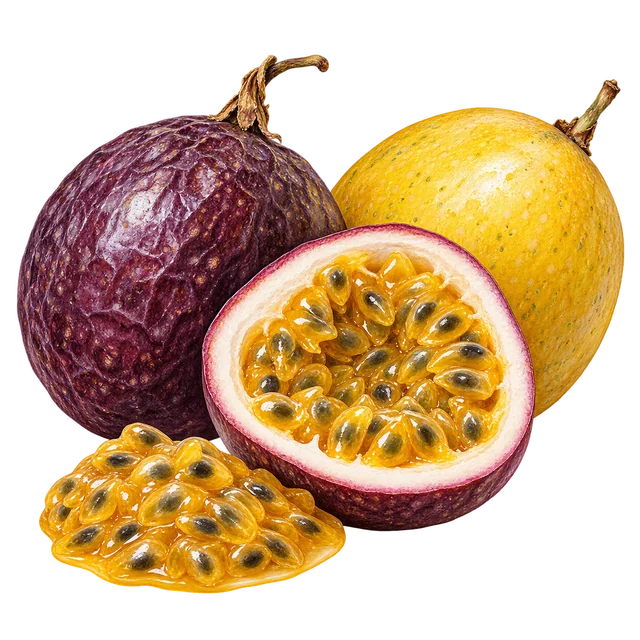
Key cautions
- Do not assume passion-fruit juice has the same actions or interactions as medicinal passionflower products.
- Do not grind rind or use leaf extracts in food based on this card; check allergies and added sugars in prepared products.
What’s inside
Fruit acids, sugars, aroma compounds and pigments; fiber differs between pulp with seeds and strained juice.
Uses in brief

- Pulp and juice
- Clarified beverage processing
History, folklore and reported uses
History, folklore and traditional uses
Brazilian fruit research gives a clear regional cultivation and processing connection for maracujá. Other Passiflora fruits have their own food histories, and the genus name does not make them chemically or medically interchangeable.
A closer look at its history
The English name carries a missionary interpretation
UF’s historical account connects the passionflower name with a Christian reading of flower structure and its use by missionaries in Brazil. That is an attributed European religious interpretation, not the origin of Indigenous cultivation or a claim that the plant appears in biblical text. The same account cautions that an early European “granadilla” report may have concerned P. ligularis rather than P. edulis.
Additional history reviewed 2026-10-12
Traditional, historical and reported uses
- Pulp and juice
Food or household practiceWhy this label?
Source documents this specific material, culinary use or attributed practice; no clinical efficacy is inferred.
Embrapa documents P. edulis as a major fruit for fresh consumption and juice preparation in Brazil. Strained juice and seed-containing pulp are different food forms.
- Clarified beverage processing
Food or household practiceWhy this label?
Source documents this specific material, culinary use or attributed practice; no clinical efficacy is inferred.
A primary study evaluated microfiltration and sensory acceptance of organic passion-fruit juice grown in Rio de Janeiro. This records a modern beverage application, not a home preservation guarantee.
2 bounded uses; regional records do not establish treatment effects.
Historical-use additions reviewed 2026-10-09
Growing notes
Passiflora edulis purple, yellow and named hybrid fruit cultivars; not medicinal P. incarnata or arbitrary ornamental passionflowers.
- Climate and lifecycle
- UF suggests zones 9b and warmer for this short-lived vine; freeze damage remains possible. Plant after frost risk. Yellow lowland types and purple upland types differ in climate suitability. [1]
- Sun, soil and support
- Provide full sun, freely draining soil and a strong trellis. Avoid waterlogging and prolonged drought. [1] [2]
- Water and planting material
- Keep shallow roots moist without saturation. Use healthy, virus-free plants; seedlings vary. Cuttings retain selected traits but may carry parental disease. [1]
- Pollination
- Carpenter bees are especially effective. Some purple selections, including Possum Purple, are self-compatible; yellow types generally need compatible cross-pollen, and hybrids vary. Ask specifically about the cultivar’s pollination needs before buying one isolated vine. [1]
- First crop, pruning and pests
- Suitable sites may yield fruit within a year; productive vines typically last three to four years. Train and thin growth. Viruses, root disease and pests can limit production. [1]
Growing sources and regional guidance
Growing notes reviewed 2026-10-12
Regional reading paths
These sourced notes describe cultivation, trade, food traditions or material history. A regional connection does not claim exclusive origin.
South America
cultivated; Brazil
Fruit pulp and juice.
Australia & Oceania
Introduced crop from South America, cultivated in Hawaiʻi and Australia; lilikoʻi is a documented Hawaiian food name.
Ripe aromatic pulp and edible seeds flavor juices and desserts.
Identity & detailed reference
Identity
Passiflora edulis; edible fruit pulp and associated edible seeds of Passiflora edulis; distinct from medicinal Passiflora incarnata aerial parts.
Ingredient details, preparation and research
Also known as: Passiflora edulis
Source plant or material
Passiflora edulis
Plant family / material: Passifloraceae
Forms and route
Fresh pulp, frozen pulp, strained juice and prepared desserts; purple and yellow fruit forms are commonly marketed.
Vitamins and minerals
Sweetened drinks and concentrates have their own composition. No sedative nutrient, universal vitamin amount or disease-prevention claim follows from the word passionfruit.
Absorption and preparation
A peel-extract experiment cannot describe absorption from juice. Straining changes the food, and mixing it with milk or oil has no established medicinal purpose.
Practical preparation
Wash before opening, scoop the edible interior and use or refrigerate promptly. Follow thawing and storage instructions for commercial pulp.
Traditional and reported uses
- Pulp and juice
- Clarified beverage processing
Contraindications and cautions
- Do not assume passion-fruit juice has the same actions or interactions as medicinal passionflower products.
- Do not grind rind or use leaf extracts in food based on this card; check allergies and added sugars in prepared products.
Fruit parts and experiments differ
Research on flavonoids in developing peels concerns a different material from the edible juice. It cannot establish a calming effect, medical dose or clinical antioxidant benefit from a serving of fruit.
Evidence limits
This is a food-form review, not a treatment recommendation. Composition and laboratory findings apply to the material actually studied; no medicinal dose, universal nutrient ranking or preservation guarantee is inferred.
Entry sources
- Embrapa: Suco de maracujá orgânico processado por microfiltração
- Embrapa: Colheita e pós-colheita de passifloras
- Flavonoid accumulation in passion-fruit peels
Reference entry 468 · Recorded content review: 2026-10-09 · Review scope and dates