


Key cautions
- May reduce alertness. Review sedating medicines, alcohol and multi-herb bedtime products; do not drive if affected.
- Medicinal use is not recommended under age 12 or during pregnancy/breastfeeding without professional advice. Keep homemade leaf preparations off broken skin.
What’s inside
Lemon-balm leaf contains aromatic compounds and a separate mixture of less volatile plant constituents. The composition of a leaf infusion differs from a concentrated extract or distilled essential oil.
EMA: Melissa leaf historical assessment
Phenolic acids and other leaf compounds
Rosmarinic acid occurs alongside other hydroxycinnamic acids, including caffeic and chlorogenic acids. The leaf also contains flavonoids and triterpenes. An extract standardized to one marker still contains a mixture, and the marker level does not establish its clinical effect.
The lemon-scented fraction
The small, variable volatile-oil fraction includes citral-related compounds and citronellal. Water and alcohol extract different mixtures; distilled oil leaves most nonvolatile leaf constituents behind. A bottle of essential oil is therefore not a concentrated version of every component of leaf tea.
Food and nutrient portions
No reliable vitamin/mineral amount per usual tea or tincture serving was established in the sources reviewed. A few flavoring leaves and an extract standardized to rosmarinic acid should not be counted as a dependable dietary micronutrient serving.
Uses in brief

- Traditional oral use: mild stress, helping sleep, and bloating or flatulence.
- Traditional external use: crushed fresh leaves for insect bites; this is a recorded practice, not a proven bite treatment.
History, folklore and reported uses
Joy, long life and the honeybee
The name Melissa is linked to the Greek word for honeybee. The University of Molise recalls Avicenna’s association of the plant with cheerfulness and Paracelsus’s association with long life. Grieve’s 1931 herbal quotes Gerard’s practice of rubbing beehives with balm leaves to gather and retain bees.
University of Molise botanical garden: Melissa officinalis · Maud Grieve: A Modern Herbal (1931), Balm
Calming drinks and compound spirits
European herbalists used leaf teas and extracts for mild stress, sleep, bloating and wind. Older accounts described balm wine for melancholy. Carmelite melissa spirit combined balm with other aromatics and was used for anxiety and nausea; Grieve names lemon peel, nutmeg and angelica root among the ingredients and records the compound preparation for nervous headache and nerve pain. EMA retains a traditional-use designation for the leaf: clinical evidence remains insufficient to establish these effects. No reviewed evidence establishes that lemon balm digests lactose or replaces lactase.
University of Molise botanical garden: Melissa officinalis · EMA: Melissa leaf historical assessment · Maud Grieve: A Modern Herbal (1931), Balm · EMA: Melissa leaf public summary
Feverish colds and external remedies
Grieve describes balm tea, alone or in blends, as a cooling, perspiration-promoting drink for feverish colds and influenza. Quoting Gerard, she records balm juice on wounds, and also recounts older applications for sores and painful gout. These are historical practices.
Leaves and flowers at the table
People interviewed in Italy’s Ancona district used lemon-balm leaves and flowers in salads and as meat seasoning, giving the fragrant plant a culinary role alongside its household-remedy history. The University of Molise also describes fresh leaves used to flavour vinegars, fruit salads, omelettes and desserts.
Lucchetti et al. (2019): Ethnobotanical uses in the Ancona district, Table 1 · University of Molise botanical garden: Melissa officinalis
A fragrant drawer herb
The Ancona survey also records dried lemon-balm leaves placed in drawers to keep moths away, and leaves and flowers steeped in water as a skin tonic. These are distinct household and grooming customs recorded in central Italy.
Lucchetti et al. (2019): Ethnobotanical uses in the Ancona district, Table 1
Plant, family and preparation
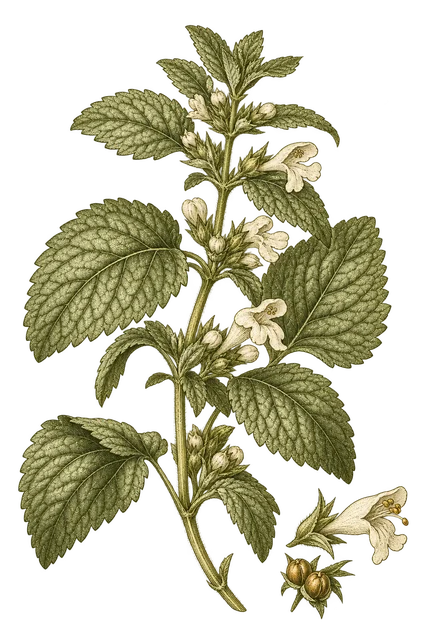
Melissa officinalis L. belongs to Lamiaceae, the mint family. Melissa and lemon balm are the same herb; lemon verbena and lemongrass are different plants. The medicinal material is the leaf. Fresh flavoring leaves, water infusions, alcohol extracts, creams and essential oil are different preparations.
Kew: Melissa officinalis L., accepted name and Lamiaceae family · EMA: Melissa leaf historical assessment
Human calming research
In a randomized crossover experiment, 18 healthy volunteers received a standardized extract or placebo before a laboratory stress task. One tested condition increased self-rated calmness while reducing alertness. This short experiment does not establish long-term sleep benefit, treatment of diagnosed anxiety, or the effect of homemade tea.
Kennedy et al. (2004): Randomized crossover study of lemon balm and laboratory-induced stress
Skin tradition and separate cream research
A 2004 survey in the Marches region of Italy recorded crushed fresh-leaf compresses for insect bites. Separately, a randomized trial in 66 people with recurrent cold sores tested a standardized leaf-extract cream called Lo-701. The primary combined symptom score was better than placebo on the second day. That finding belongs to the manufactured cream; it does not establish that fresh leaves, essential oil or oral tincture treat herpes or infected bites.
Pieroni et al. (2004): Original Marches ethnobotanical survey, lemon-balm leaf compresses for insect bites · Koytchev et al. (1999): Standardized Melissa leaf-extract cream in recurrent herpes labialis
Laboratory thyroid findings
Laboratory and animal findings concerning thyroid-stimulating hormone have uncertain relevance to people. They support discussing lemon-balm use with a clinician when managing thyroid disease or taking thyroid medicines, rather than claiming that lemon balm causes hypothyroidism.
Human absorption study
A small human extract study measured rosmarinic acid and metabolites, compounds formed as the body processes it. Food delayed peak exposure, but only four participants contributed to the food comparison and estimates were imprecise. Because it tested a concentrated extract, the study does not establish how a cup of leaf tea is absorbed.
Noguchi-Shinohara et al. (2015): lemon-balm extract pharmacokinetics
Women’s Health: traditions, evidence and cautions
Historical use does not establish benefit or safety. Pregnancy, breastfeeding and fertility care require particular caution: food, tea, essential oil and concentrated extract are not interchangeable. These records are not treatment, dosing or pregnancy-management instructions. Discuss supplements with a qualified clinician or pharmacist; do not delay evaluation of persistent symptoms.
Lemon balm leaf
Melissa officinalis L.
- Plant part / material
- Leaf
- Preparation studied or reported
- Herbal teas; studied barley-malt/lemon-balm combination differs from leaf alone.
LactMed records a galactagogue reputation and modern combination use. The reviewed evidence does not securely identify an ancient regional lactation tradition.
Lactation / milk-supply tradition
Weak combination-product evidence
Reported or traditional useIncluded in herbal milk-support products.
What the evidence supportsSignals arise chiefly from mixtures, including a Polish barley-malt product studied in preterm-infant mothers. Lemon balm’s independent contribution is unknown.
Milk-transfer data and safety/efficacy studies of lemon balm alone in nursing mothers or infants are absent. Do not infer that an essential oil is interchangeable with leaf tea.
- The cited lactation evidence does not establish medicinal-use safety during pregnancy; postpartum traditions must not be extrapolated to pregnancy.
Health topics: evidence and cautions
These notes describe a specific research context and preparation. A topic link is not a treatment recommendation.
Stress · Symptom support
Form and route: Oral leaf preparations; the laboratory trial used a standardized extract, not essential oil · oral
Condition and setting: Acute laboratory stress; traditional mild mental stress
An 18-person experiment found greater calmness after one tested dose, alongside reduced alertness. EMA recognizes leaf preparations for mild stress on traditional-use grounds, not established clinical efficacy.
Evidence: Limited acute clinical evidence; separately documented traditional use
A randomized crossover experiment compared 300 mg and 600 mg extract with placebo. At 600 mg, calmness increased and alertness fell during a laboratory stress task.
Limits
A single-dose laboratory result does not establish sustained benefit for everyday stress. EMA’s traditional-use assessment is a separate evidence category, not proof from this trial.
Cautions
- Reduced alertness matters for driving and machinery. Discuss sedating medicines and persistent symptoms with a clinician; essential oil is not an oral substitute.
Regional reading paths
These sourced notes describe cultivation, trade, food traditions or material history. A regional connection does not claim exclusive origin.
Europe
Traditional processing/use: European herbal preparations; Italian field research documents regional household use.
Aromatic leaf infusions and extracts; leaf and essential oil are distinct.
Identity & detailed reference
Identity
Melissa officinalis L.; medicinal leaf, in the Lamiaceae family. Melissa and lemon balm are the same herb. Lemon verbena and lemongrass are different plants.
Ingredient details, preparation and research
Source plant or material
Melissa officinalis L.; fresh culinary leaves or dried medicinal leaf (Melissae folium).
Plant family / material: Lamiaceae (mint family).
Forms and route
Fresh leaves for flavor; dried-leaf infusion, powder, liquid extracts and tinctures. Standardized topical creams and distilled essential oil are separate products with different composition and routes.
Practical preparation
For tea, use identified dried leaf or a labeled tea bag and follow its leaf quantity, water volume and infusion instructions. Do not substitute drops of essential oil for leaf tea. For fresh flavoring leaves, wash them first; medicinal extract equivalence cannot be calculated from a handful of leaves.
Combination notes
Melissa occurs in traditional sleep-tea combinations with valerian or passionflower. Their inclusion together does not prove synergy; use a labeled blend rather than adding full separate product amounts. Culinary ginger can change flavor but is not classified here as a sedative.
Traditional and reported uses
- EMA documents traditional use for mild mental stress, helping sleep, and mild bloating/flatulence.
- Small human studies of particular extracts suggest calming effects; these do not establish treatment of an anxiety disorder or chronic insomnia.
- A 2004 Italian field survey records crushed fresh-leaf compresses for insect bites. A separate small trial studied manufactured cream for cold sores.
- Melissa does not supply established lactase activity or correct lactose malabsorption; digestive tradition is a different claim.
Contraindications and cautions
- Avoid with known allergy. Reduced alertness is possible; do not drive or operate machinery if affected.
- Added drowsiness with alcohol, sleeping medicines, sedating antihistamines or other calming herbs is a precaution, not a quantified interaction established for every tea.
- Laboratory/animal thyroid-stimulating-hormone findings have uncertain clinical relevance. Ask for an individual review if using thyroid medication or managing thyroid disease.
- Medicinal pregnancy/breastfeeding safety is inadequately studied; medicinal use under age 12 is not recommended. Alcohol tinctures need separate consideration.
- Seek assessment if stress, sleep or digestive symptoms worsen or last beyond two weeks. Stop topical use if it irritates; fresh plants are not sterile.
Similar items and how they compare
- German chamomile
Both are aromatic infusion herbs traditionally used for relaxation, sleep routines and bloating, with nonvolatile flavonoids in their preparations.
Lemon balm uses rosmarinic-acid-containing leaves; chamomile uses flowers with bisabolol-related volatiles.
- Passionflower
Both have documented traditional oral use for mild stress and sleep support and occur in tea or tincture blends.
Lemon balm also has a digestive tradition; passionflower uses a chemically different aerial herb.
Simple preparation and household limits
For tea, use identified dried leaf or a labeled tea bag and follow its leaf quantity, water volume and infusion instructions. Do not substitute drops of essential oil for leaf tea. For fresh flavoring leaves, wash them first; medicinal extract equivalence cannot be calculated from a handful of leaves. If choosing the fresh-leaf bite tradition, use clean, correctly identified material on a small area of intact skin only, discard after use, and stop for irritation. This is hygiene-oriented harm reduction, not a validated recipe. Washing and a wrapped cold pack are simpler bite-care measures; infection or allergic warning signs need care.
Medicinal safety and related herbs
Avoid known allergy. Pregnancy, breastfeeding and under-12 medicinal use lack adequate support; persistent or worsening symptoms need assessment. A lemon-balm/valerian or lemon-balm/passionflower tea has a documented tradition, but extra sedation and formulation differences matter. No evidence reviewed establishes that stacking separate extracts improves benefit.
Entry sources
- EMA: Melissa leaf monograph (2013)
- EMA: Melissa officinalis leaf assessment report (2013)
- Pieroni et al. (2004): Original Marches ethnobotanical survey, lemon-balm leaf compresses for insect bites
- Kew: Melissa officinalis L., accepted name and Lamiaceae family
- Kennedy et al. (2004): Randomized crossover study of lemon balm and laboratory-induced stress
- Koytchev et al. (1999): Standardized Melissa leaf-extract cream in recurrent herpes labialis
- Noguchi-Shinohara et al. (2015): Human lemon-balm extract pharmacokinetics and food-effect trial
- EMA: Final assessment of traditional sedative herbal-tea combinations, Species sedativae
- FDA: Microbiological safety and cosmetics
- NHS: Insect bites and stings, home care and warning signs
- Maud Grieve: A Modern Herbal (1931), Balm
- Lucchetti et al. (2019): Ethnobotanical uses in the Ancona district, Table 1
Reference entry 08 · Recorded content review: 2026-10-05 · Review scope and dates