


Key cautions
- Cold-pressed and distilled oils have different phototoxicity profiles
- Oxidized fragrance can trigger allergy; do not drink an aromatherapy oil
What’s inside
Limonene usually predominates, accompanied by beta-pinene, gamma-terpinene, alpha-pinene, sabinene and the citral components geranial/neral. Expressed oil may contain phototoxic furanocoumarins including bergapten and oxypeucedanin; amounts vary. Vitamin C is not a meaningful constituent of the volatile oil.
EFSA (2021): Expressed lemon oil and fractions, compositional assessment · Naganuma et al. (1985): Phototoxic constituents and variability of lemon oils · NIH Office of Dietary Supplements: Vitamin C fact sheet
Uses in brief

- Fragrance in cosmetics, household products and optional aroma routines
- Small studies of immediate mood or nausea; benefits remain context-specific
History, folklore and reported uses
Alertness and focused energy
Aromatherapist Kelly Holland Azzaro’s 2008 National Association for Holistic Aromatherapy journal account associates lemon aroma with alertness, clearer thinking and focused energy. This is a modern practitioner use of peel essence.
Kelly Holland Azzaro: NAHA Aromatherapy E-Journal 2008.3, pages 4–5, practitioner account
Freshening stale-smelling rooms
AromaWeb describes diffusing lemon oil to improve a room’s smell, including stale tobacco odors. Its bright peel fragrance has a household deodorizing role.
Oily or blemish-prone skin
AromaWeb, citing Julia Lawless, records lemon oil in natural-care preparations for oily skin and spots.
AromaWeb: Lemon essential oil, practitioner applications · Naganuma et al. (1985): Phototoxic constituents and variability of lemon oils · CIR (2019): Safety assessment of citrus-derived peel oils in cosmetics
Cold-season aromatherapy
AromaWeb reproduces Julia Lawless’s inclusion of colds and flu among lemon oil’s aromatherapy uses. This records a symptomatic-care purpose, not evidence that lemon scent treats an infection.
AromaWeb: Lemon essential oil, practitioner applications · Naganuma et al. (1985): Phototoxic constituents and variability of lemon oils · CIR (2019): Safety assessment of citrus-derived peel oils in cosmetics
Traditional foot and localized skin care
AromaWeb also records lemon oil for athlete’s foot, corns and warts in the practitioner literature. These localized skin-care purposes concern concentrated peel oil, not the vitamin-C or acidity of lemon juice.
AromaWeb: Lemon essential oil, practitioner applications · Naganuma et al. (1985): Phototoxic constituents and variability of lemon oils · CIR (2019): Safety assessment of citrus-derived peel oils in cosmetics
Flavouring medicines and refreshing drinks
Felter and Lloyd’s 1898 dispensatory records expressed lemon-peel oil as a medicine flavouring and in a sweetened summer drink.
Felter and Lloyd: King’s American Dispensatory (1898), Oleum Limonis · Naganuma et al. (1985): Phototoxic constituents and variability of lemon oils · CIR (2019): Safety assessment of citrus-derived peel oils in cosmetics
Sicilian and Calabrian sponge work
In his 1926–27 Field Museum study Citrus Products, James B. McNair described workers in Sicily and Calabria, Italy, pressing lemon peel against sponges to collect oil from its glands. Juice entered a separate stream of production. McNair contrasted expressed oil with distilled lemon oil used to scent soaps: one fruit could supply several commodities with different aromas and uses.
James B. McNair: Citrus Products, Field Museum of Natural History, 1926–27, lemon-oil manufacture · Biodiversity Heritage Library: Citrus Products bibliographic record
Identity & detailed reference
Identity
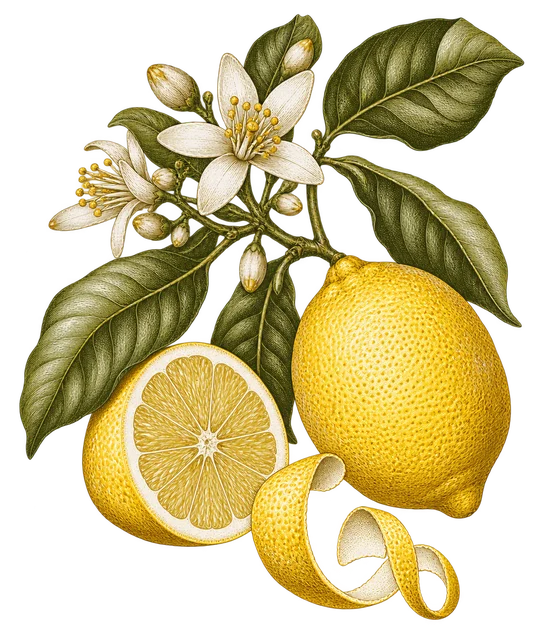
Citrus × limon (L.) Osbeck, Rutaceae; oil from the fruit peel. Cold-expression and distillation produce materially different phototoxic-constituent profiles. This is not juice, zest as food, lemon leaf extract or lemon-eucalyptus oil.
Ingredient details, preparation and research
Source plant or material
Citrus × limon (L.) Osbeck; aromatic fruit-peel glands are the source. Mechanical expression carries a nonvolatile peel fraction that is greatly reduced by distillation.
Plant family / material: Rutaceae (citrus/rue family).
Forms and route
Expressed/cold-pressed peel oil, distilled volatile peel oil, and characterized furanocoumarin-reduced fractions; used in fragrance, cosmetic and household formulations. A culinary flavouring made to food specifications is a separate product from an aromatherapy bottle.
Food sources
For vitamin C, choose edible fruit and vegetables, including citrus fruit. Food zest or juice is not interchangeable with a concentrated aromatic oil.
Vitamins and minerals
Lemon essential oil is not a vitamin-C supplement, source of fibre or useful mineral serving. Vitamin C is water-soluble and is obtained from food or suitable supplements, not by smelling or applying peel oil.
Absorption and preparation
Inhalation involves both scent perception and variable exposure to volatile molecules; topical delivery depends on formulation and skin condition. Phototoxicity is a local skin-plus-UVA problem, not a desired absorption effect. No validated household method turns aroma exposure into a dietary or therapeutic dose.
Practical preparation
Check botanical identity, extraction type, intended route and finished-product sun warnings. If cold-pressed versus distilled status is unknown, avoid guessing a skin dilution. Do not add oil to drinking water, use an arbitrary drop conversion, or turn an experimental aroma protocol into a home medicine.
Combination notes
Several phototoxic ingredients in a blend can add to the final product’s exposure; a low concentration of each is not automatically safe. Mixing lemon oil with a carrier does not reliably disperse it in water or cancel allergy. Similar fragrance notes do not imply equivalent medical effects.
Traditional and reported uses
- Contemporary aromatherapy practice: a refreshing scent during a break, work or relaxation; personal preference and setting influence the experience.
- Cosmetic/household role: a citrus perfume note in finished cleansers, toiletries and room fragrances. Scent does not establish disinfection or removal of toxins.
- Human evidence: short studies have assessed positive mood, pregnancy nausea and postoperative symptoms; they do not prove treatment of depression, dementia, infection or impaired immunity.
- Historical citrus-food uses should remain attached to fruit/juice. Evidence about eating lemons or vitamin C cannot be transferred to distilled peel oil.
Contraindications and cautions
- Cold-expressed lemon contains variable phototoxic compounds. Skin exposure followed by sufficient UVA can cause a burn or discoloration; use a finished product with extraction-specific safety information and sun directions.
- Distillation greatly reduces phototoxic constituents, but “distilled” does not eliminate irritation or allergy. Furanocoumarin-reduced claims should be supported by supplier/product specifications.
- Limonene oxidizes on air exposure into sensitizing products. Keep tightly closed, cool and away from light; discontinue for itching, redness, swelling or rash.
- Avoid eyes, mucosa and application to damaged skin. Stop aroma exposure if it causes headache, cough, nausea or breathing discomfort. Do not put oil into respiratory medical equipment.
- Do not swallow aromatherapy oil. Pregnancy nausea needs clinical advice if persistent or severe; small aroma trials do not establish safety of ingestion or all pregnancy exposures. Clinically important medication interactions for this exact external oil are not well characterized.
Similar items and how they compare
- Frankincense essential oil
Some frankincense oils share limonene and pinene with lemon, producing a partial overlap in bright, resinous-citrus aromatic notes.
Frankincense varies strongly by species; expressed lemon carries a distinct phototoxicity concern.
- Eucalyptus essential oil
Both contain volatile monoterpenes and are chosen for fresh aromatic impressions in professionally formulated fragrance or household products.
Eucalyptus is cineole-rich and camphoraceous; lemon is limonene-rich and distinctly citrus-scented.
- Lemon fruit or juice
Shares the source fruit and familiar citrus association.
Edible fruit/juice provides water-soluble nutrients; concentrated peel aroma oil is neither a vitamin-C serving nor a juice replacement.
Identity and extraction change the material
Kew accepts Citrus × limon in Rutaceae. EFSA’s compositional analysis separates cold-expressed oil, the heavier residual fraction and the distilled volatile fraction. The distillate had markedly reduced nonvolatile coumarins. This feed-additive assessment is useful for chemistry only; animal-feed authorizations are not human dosing or cosmetic-safety advice.
A bright scent and cosmetic role
The oil’s citrus character explains its use in perfumery and fragranced cleansers. Cosmetic citrus-oil assessments concern the finished product, phototoxic constituents and sensitization. A pleasant smell is a reasonable sensory goal; “detox,” immune boosting and antimicrobial cleaning claims require evidence about the actual product and use conditions. A 2008 NAHA practitioner account associates lemon aroma with alertness and clear thought; this is retained as an attributed practice claim rather than proven cognitive enhancement.
Mood experiment: short-term positive affect
Fifty-six healthy adults experienced lemon, lavender and water on separate randomized visits. Lemon improved positive-mood measures, but physiological outcomes including cortisol, blood pressure, immune markers, pain and barrier repair did not show a consistent beneficial pattern. This supports a modest sensory/mood possibility in that setting, not treatment of clinical depression or systemic healing.
A published correction to extraction method
The authors’ 2008 reply to a methodological letter states that the lemon oil was mechanically expressed, correcting the original report’s description as steam distilled. Their reply is not a retraction. The correction matters because it prevents this odor study being mistakenly cited as evidence for a distilled product’s specific composition or skin safety.
Pregnancy nausea: preliminary four-day evidence
A randomized study of 100 pregnant women compared lemon aroma with placebo over four days. Between-group symptom differences were reported on days two and four. The short follow-up, sensory blinding challenge and limited safety scope preclude claims that every lemon-oil preparation is safe in pregnancy. It is not evidence for ingesting the oil or replacing evaluation of dehydration or hyperemesis.
Newer postoperative research needs replication
A 2026 single-centre trial randomized 104 coronary-bypass patients and analyzed 103, reporting improved postoperative symptoms and selected inflammatory measures with supervised lemon inhalation. Its specific hospital protocol, multiple outcomes, baseline-imbalance discussion and scent-blinding challenges constrain generalization. This is preliminary adjunctive evidence, not an instruction to modify oxygen tubing, ventilation or standard perioperative care.
Phototoxicity: expressed versus distilled
Naganuma et al. identified bergapten and oxypeucedanin as phototoxic contributors, with more than twenty-fold variation in their amounts across lemon-oil origins. A later extraction comparison also showed much lower concentrations of selected nonvolatile compounds after hydrodistillation. Distillation reduces this hazard substantially; it does not establish that every labelled oil or every final formulation is nonirritating or safe in sunlight.
Oxidation and contact allergy
A multicentre study patch-tested 2,900 dermatitis patients with an oxidized-limonene preparation; 5.2% reacted positively. That is a selected clinic population and a diagnostic test, not the allergy rate among all lemon-oil users. It nevertheless directly supports the relevance of limonene oxidation products and careful storage. Formal allergy testing is different from a home spot trial.
Absorption, interactions and nutrition limits
The product’s route, dose and vehicle are essential to interpreting any experiment. No human therapeutic blood concentration or drug-interaction clearance is established for an arbitrary lemon-oil bottle. Citrus juice drug interactions should not be automatically assigned to aroma exposure; conversely, absence of interaction studies does not prove safety. The oil cannot replace food vitamin C.
Review and publication-status check
Reviewed 5 October 2026. Targeted publication/retraction searches were performed for the cited mood, nausea, phototoxicity, extraction and newer bypass studies; no retraction of those selected articles was located. The mood study’s extraction correction is explicitly retained. Laboratory antioxidant findings from mice were used only to distinguish materials, not as a human anti-aging benefit.
- Kiecolt-Glaser et al. (2008): Randomized crossover lemon/lavender/water odor experiment
- Kiecolt-Glaser et al. (2008): Author reply correcting lemon extraction to mechanical compression
- Yavari Kia et al. (2014): Lemon inhalation and pregnancy nausea, randomized trial
- Naganuma et al. (1985): Phototoxic constituents and variability of lemon oils
- Li et al. (2021): Cold-pressed versus hydrodistilled lemon composition and mouse oxidative-stress experiment
- Sangi et al. (2026): Lemon inhalation in 104 randomized coronary-bypass patients
Entry sources
- Kew Plants of the World Online: Citrus × limon, accepted hybrid, Rutaceae
- EFSA (2021): Expressed lemon oil and fractions, compositional assessment
- Naganuma et al. (1985): Phototoxic constituents and variability of lemon oils
- CIR (2019): Safety assessment of citrus-derived peel oils in cosmetics
- Kiecolt-Glaser et al. (2008): Randomized crossover lemon/lavender/water odor experiment
- Kiecolt-Glaser et al. (2008): Author reply correcting lemon extraction to mechanical compression
- Yavari Kia et al. (2014): Lemon inhalation and pregnancy nausea, randomized trial
- Bråred Christensson et al. (2013): Multicentre patch testing of oxidized limonene
- Li et al. (2021): Cold-pressed versus hydrodistilled lemon composition and mouse oxidative-stress experiment
- Sangi et al. (2026): Lemon inhalation in 104 randomized coronary-bypass patients
- NIH Office of Dietary Supplements: Vitamin C fact sheet
- NAHA Journal (2008.3): Kelly Holland Azzaro, practitioner account of frankincense and lemon aroma uses, pp. 4–5
- Felter and Lloyd: King’s American Dispensatory (1898), Oleum Limonis
Reference entry 37 · Recorded content review: 2026-10-05 · Review scope and dates