


Key cautions
- Can worsen heartburn. Check supplements with blood-thinning medicines; bleeding evidence is mixed.
- Ask the maternity team before medicinal use in pregnancy. Child-use limits depend on the exact preparation and purpose.
- Joint pain accompanied by swelling, redness or fever needs medical assessment rather than continued treatment with a ginger preparation.
- Most EMA ginger-medicine uses are adult-only. One specified traditional motion-sickness powder has a separate framework for ages six and older; that is a product-specific rule, not permission to adapt an adult dose at home.
What’s inside
Fresh rhizome, dried ground ginger, strained tea, distilled oil and concentrated extracts deliver different mixtures. Ginger’s pungent compounds and aromatic oil are described separately below.
EMA: Ginger rhizome, final assessment report revision 1, 2025
Pungent compounds
Gingerols contribute the characteristic pungency; 6-gingerol is prominent, with smaller amounts of 8- and 10-gingerol. Drying and storage convert some gingerols into shogaols, with further changes possible during processing. A dried spice and a fresh slice therefore need not have the same chemical balance.
EMA: Ginger rhizome, final assessment report revision 1, 2025
Aromatic oil
The dried medicinal rhizome assessment describes an aromatic oil containing compounds such as zingiberene, beta-sesquiphellandrene and beta-bisabolene, with smaller amounts of other terpenes. Origin and processing change the oil profile. Distillation concentrates this fraction rather than reproducing whole ginger.
EMA: Ginger rhizome, final assessment report revision 1, 2025
Food material and nutrients
The rhizome also contains starch, protein and lipids. The small amounts used to season a meal differ from a large food-analysis portion; a strained infusion leaves much of the plant material behind. Essential oil and extract capsules are not nutritionally equivalent to eaten ginger.
EMA: Ginger rhizome, final assessment report revision 1, 2025 · USDA Standard Reference Release 28 (2015): NDB 02021, ground ginger
A dried-spice portion
Using USDA’s 2015 ground-ginger measure, half a teaspoon is about 0.9 g. Its manganese contribution is calculated from the dried-spice record, not measured in a cup of tea. Fresh ginger, different grinds and extracts need their own composition data.
- Manganese: about 0.30 mg per half teaspoon of ground ginger
- About 13% of the U.S. adult label Daily Value
USDA Standard Reference Release 28 (2015): NDB 02021, ground ginger
Uses in brief

- Traditional digestive comfort for bloating and mild cramps.
- Some supplements have human evidence for pregnancy nausea and menstrual cramps; medicinal pregnancy use needs individual advice.
History, folklore and reported uses
From Asian kitchens to European sweets
Fresh ginger remained important in Asian cooking, while dried ginger became especially familiar in European kitchens. Kew traces British gingerbread to preserved ginger used medicinally; crystallized ginger and ginger-flavoured drinks also brought together sweetness and warming spice.
Ginger on ancient grinding stones
In a 2023 study, Wang and colleagues identified ginger starch on food-processing stones at Óc Eo in southern Vietnam. They interpreted the spice assemblage in relation to curry traditions, without recovering an exact recipe.
Wang et al. (2023): Earliest curry in Southeast Asia and the global spice trade 2000 years ago
Gingerbread as a message and a gift
Food anthropologist Kaori O’Connor describes gingerbread moulds depicting rulers, ships, weddings, funerals and local occupations. The Horniman Museum preserves a Polish biscuit showing a woman spinning, traditionally given at Christmas, and a Swiss lamb-shaped Easter mould. Her account also contrasts British baking with darker, molasses-rich American gingerbread. The shapes carried social and religious meanings as well as flavour.
Kaori O’Connor: Ginger and gingerbread, Horniman Museum (2013)
Stomach remedies and different preparations
Asian accounts describe ginger for stomach ache, nausea and diarrhoea; European dried-rhizome remedies included cramps, bloating and wind, and dried-rhizome preparations became familiar travel-sickness remedies. Fresh rhizome, dried powder, tincture and British preserved medicinal sweets represent different forms of this digestive tradition.
Kew: Zingiber officinale species profile · NCCAM historical fact sheet: Ginger · EMA: Ginger rhizoma, public assessment summary (2025)
A wider warming-remedy tradition
Specified dried-rhizome preparations were also used for temporary appetite loss, common-cold symptoms and minor joint pain. Kew separately records external ginger preparations, including essential oil used for pain; that external oil tradition is distinct from drinking ginger tea.
Kew: Zingiber officinale species profile · EMA: Ginger rhizoma, public assessment summary (2025)
An Asian crop with Caribbean connections
Kew describes ginger reaching Greek and Roman consumers through Arab traders. Its current account places the native range from the eastern Himalaya to south-central China, while an older profile cautiously suggests India. An exact birthplace for this ancient cultivated crop remains uncertain.
Human nausea research
Much of the human evidence concerns supplements, not food. The U.S. National Center for Complementary and Integrative Health finds possible benefit for nausea and vomiting during pregnancy, while benefits for chemotherapy-related or postoperative nausea remain uncertain. Pregnancy use still needs advice from the maternity team.
Why motion-sickness advice differs
The European Medicines Agency recognizes one specified powdered-rhizome preparation for preventing adult motion sickness on a well-established-use basis, and distinguishes other traditional preparations for symptom relief. NCCIH’s broader review says most motion-sickness studies have not shown benefit. These conclusions cover different bodies of evidence and do not make every tea, powder or tincture equally effective.
EMA: Ginger rhizome, final monograph revision 1, adopted 7 May 2025 · NCCIH: Ginger, updated February 2025
Menstrual cramps and joint pain
Supplement studies suggest possible relief of menstrual cramps. Research on knee osteoarthritis also suggests possible benefit, but much is poor quality, and topical ginger has not been shown helpful for knee symptoms. The older joint-remedy tradition and modern oral studies should not be used to validate a homemade essential-oil rub.
Medicine interactions: conflicting findings
In a randomized crossover study, a particular ginger product did not significantly change warfarin measurements or clotting effects in 12 healthy men. A separate observational study of 171 warfarin users linked ginger use with self-reported bleeding. These findings are not equivalent: the latter cannot establish causation, and a small healthy-volunteer study cannot rule out every interaction. EMA lists no known interactions for its defined preparations; review medicinal ginger with a pharmacist when taking blood-thinning medicines.
Jiang et al. Ginger and warfarin in 12 healthy volunteers, randomized crossover study, 2005 · Shalansky et al. Prospective observational study of complementary products and bleeding during warfarin therapy, 2007 · EMA: Ginger rhizome, final monograph revision 1, adopted 7 May 2025
What absorption research measured
A study in 27 volunteers detected metabolites of gingerols and shogaol after a standardized oral extract. Most measured compounds had been chemically modified by the body. This does not establish a special food pairing, a benefit from stronger extraction or a way to substitute a cup of tea for an extract capsule.
Zick et al. Human pharmacokinetics of gingerols, shogaol and conjugate metabolites, 2008 · EMA: Ginger rhizome, final assessment report revision 1, 2025
Growing notes
Living Zingiber officinale, grown for rhizomes. This is not shampoo ginger (Z. zerumbet) or an essential-oil extraction guide.
- Climate and lifecycle
- A tropical perennial requiring warmth, humidity and bright shade. In frost-prone gardens, delaying outdoor planting until frost risk has passed is a precaution, not a guarantee of a harvest-length season. [1]
- Starting and spacing
- Plant firm rhizome pieces with visible growing buds in spring; allow cut surfaces to callus first. UGA describes 2–4-inch planting depth and 6-inch spacing. Use a roomy container for the expanding underground stems. [1]
- Soil and water
- Use rich, freely draining loam and regular moisture without saturation. Reduce watering as autumn growth slows. [1] [2]
- Harvest and pollination
- UGA gives about 8–10 months for a mature rhizome harvest. Kew notes cultivated plants rarely flower: the rhizome crop does not depend on setting seed. A short summer may produce younger ginger rather than mature storage rhizomes. [1] [2]
- Pests and healthy starts
- Bacterial wilt is a serious ginger-production problem in Hawaiʻi, not a universal garden diagnosis. Start with clean planting material and keep suspect rhizomes out of propagation stocks; ask local extension to diagnose wilting rather than treating blindly. [3]
Growing sources and regional guidance
Growing notes reviewed 2026-10-12
Women’s Health: traditions, evidence and cautions
Historical use does not establish benefit or safety. Pregnancy, breastfeeding and fertility care require particular caution: food, tea, essential oil and concentrated extract are not interchangeable. These records are not treatment, dosing or pregnancy-management instructions. Discuss supplements with a qualified clinician or pharmacist; do not delay evaluation of persistent symptoms.
Ginger rhizome
Zingiber officinale Roscoe
- Plant part / material
- Rhizome
- Preparation studied or reported
- Culinary rhizome, drinks and distinct extracts; topical mixtures separately studied.
LactMed reports galactagogue use in Türkiye, Indonesia and parts of Asia, while some communities believe it decreases milk.
Lactation / milk-supply tradition
Limited, inconsistent human evidence
Reported or traditional useUsed for postpartum milk support and in some traditional breast-engorgement preparations.
What the evidence supportsSmall trials give weak, inconsistent milk-production signals; delivery type and formulation matter. Mixed-compress results cannot isolate ginger.
Food-flavoring use has a different risk profile from supplements. Nursing safety data are limited; digestive adverse effects and increased bleeding risk with warfarin are relevant.
- The cited lactation evidence does not establish medicinal-use safety during pregnancy; postpartum traditions must not be extrapolated to pregnancy.
Health topics: evidence and cautions
These notes describe a specific research context and preparation. A topic link is not a treatment recommendation.
Cancer by type · Traditional reports
Form and route: Traditional water infusion · oral
Qatar herbalists reported ginger use among breast-cancer patients.
Evidence: Ethnobotanical survey only
The survey mostly described supportive aims.
Limits
It did not test benefits.
Cautions
- Keep cancer treatment and discuss medicinal use with the care team.
Regional reading paths
These sourced notes describe cultivation, trade, food traditions or material history. A regional connection does not claim exclusive origin.
Asia
Cultivated: India; long-established Asian culinary crop.
Fresh or dried rhizome seasoning.
Australia & Oceania
introduced/traded and cultivated; Fiji
Culinary rhizome.
Identity & detailed reference
Identity
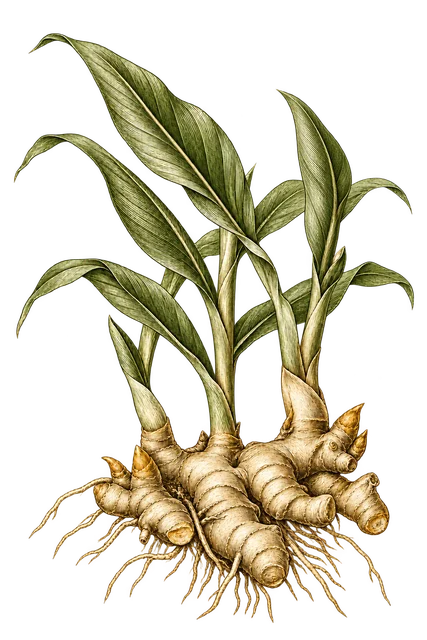
Zingiber officinale Roscoe; rhizome, the underground stem often called ginger root.
Ingredient details, preparation and research
Source plant or material
Zingiber officinale Roscoe; rhizome (underground stem).
Plant family / material: Zingiberaceae (ginger family).
Forms and route
Fresh or dried culinary rhizome, oral tea, powdered capsules, and extracts/tinctures. Food, powder and extracts differ; the current EMA monograph covers specified dried powder and tinctures, not every ginger drink or supplement.
Traditional and reported uses
- Traditional use: digestive discomfort, bloating and gas; EMA also records temporary appetite loss, minor joint pain and common-cold symptoms for specified medicinal preparations.
- Human research: some ginger supplements may ease pregnancy-related nausea and menstrual cramps; pregnancy use needs maternity advice.
- Motion sickness: EMA recognizes a specified powder for adult prevention, while NCCIH finds most motion-sickness studies unhelpful. Results should not be generalized to every preparation.
Contraindications and cautions
- May cause heartburn, stomach upset, diarrhea or mouth/throat irritation; stop for an allergic reaction.
- Check medicinal ginger with a pharmacist if taking warfarin, other anticoagulants, antiplatelet drugs or multiple medicines. Bleeding evidence is mixed; ordinary culinary ginger is not proven to cause bleeding.
- Pregnancy advice differs by source and preparation: NCCIH describes potential benefit, while EMA advises precautionary avoidance of its ginger medicines. Ask the maternity team before supplement use; breastfeeding data are insufficient.
- Do not extrapolate adult medicinal use to children. EMA age limits vary by indication and preparation, and alcohol-containing tinctures need their own precautions.
- Persistent vomiting, dehydration or unexplained abdominal pain needs assessment rather than a stronger preparation.
- Joint pain accompanied by swelling, redness or fever needs medical assessment rather than continued treatment with a ginger preparation.
- Most EMA ginger-medicine uses are adult-only. One specified traditional motion-sickness powder has a separate framework for ages six and older; that is a product-specific rule, not permission to adapt an adult dose at home.
Similar items and how they compare
- Turmeric
Both are ginger-family rhizomes used as culinary spices and in digestive traditions, with distinct pungent or colored phenolic constituents.
Ginger emphasizes gingerols and nausea-related use; turmeric emphasizes curcuminoids and digestive/joint traditions.
- Peppermint leaf
Both are familiar digestive tea ingredients used for discomfort after meals, and concentrated preparations differ from ordinary infusions.
Ginger is pungent rhizome material; peppermint is menthol-containing leaf and may worsen reflux.
Similar items
Turmeric is another ginger-family culinary rhizome, with different curcuminoid chemistry. Peppermint leaf shares a digestive-tea tradition but has a menthol-rich profile and can aggravate reflux. Similar traditional uses do not make these herbs interchangeable or establish a blend.
Entry sources
- NCCIH: Ginger, updated February 2025
- EMA: Ginger rhizome, final monograph revision 1, adopted 7 May 2025
- Jiang et al. Ginger and warfarin in 12 healthy volunteers, randomized crossover study, 2005
- Shalansky et al. Prospective observational study of complementary products and bleeding during warfarin therapy, 2007
- Kew Plants of the World Online: Zingiber officinale Roscoe
- EMA: Ginger rhizome, final assessment report revision 1, 2025
- Zick et al. Human pharmacokinetics of gingerols, shogaol and conjugate metabolites, 2008
- USDA FoodData Central, SR Legacy: ground ginger, FDC 170926; downloadable dataset
- FDA: Daily Values on Nutrition and Supplement Facts labels
- NCCIH: Turmeric, botanical family and curcuminoids
- EMA: Peppermint leaf, traditional digestive use and reflux precautions
- ESCOP: Herb–drug interaction table
- Primary study: Heat-related gingerol conversion
- Human ginger constituent pharmacokinetics study
- Kaori O’Connor: Ginger and gingerbread, Horniman Museum (2013)
- Wang et al. (2023): Earliest curry in Southeast Asia and the global spice trade 2000 years ago
Reference entry 06 · Recorded content review: 2026-10-05 · Review scope and dates