


Key cautions
- Check medicines, bleeding risk, epilepsy, surgery and pregnancy before leaf-product use.
- Seed toxins can cause serious poisoning even after cooking; seeds are not a substitute for leaf extract.
What’s inside
Flavonol glycosides, ginkgolide terpene lactones and bilobalide characterize leaf extracts. Unwanted ginkgolic acids are reduced during refining; the European Pharmacopoeia extract described by EMA limits them to 5 ppm. Ginkgotoxin in seeds is a different safety issue.
EMA: European Union herbal monograph on Ginkgo biloba L., folium (2015)
Uses in brief

- Defined dry leaf extracts have a specific EMA mild-dementia symptom indication; overall evidence remains inconsistent.
- Powdered leaf has a European traditional-use role for minor circulation complaints.
History, folklore and reported uses
Cough and asthma in the seed tradition
Traditional Chinese medicine used dried ripe ginkgo seeds, called bai guo, for persistent cough and asthma with abundant phlegm.
Hong Kong Polytechnic University: Ginkgo Seed, traditional Chinese medicine profile · Hong Kong Centre for Food Safety: Ginkgo seed poisoning (2023)
Frequent urination and discharge
The Chinese seed tradition also used bai guo for bed-wetting, frequent urination and persistent whitish vaginal discharge. Hong Kong Polytechnic University records these as part of its traditional role in reducing discharges and fluid loss.
Hong Kong Polytechnic University: Ginkgo Seed, traditional Chinese medicine profile · Hong Kong Centre for Food Safety: Ginkgo seed poisoning (2023)
Memory and later-life cognition
The familiar use of ginkgo leaf extracts for cognitive function developed much later in Europe, as Peter Crane’s cultural history explains. Defined dry extracts, rather than traditional Chinese seed preparations, became the basis of this modern herbal-medicine chapter.
Peter Crane: An evolutionary and cultural biography of ginkgo, 2019 · EMA: Ginkgo leaf, HMPC conclusions and preparation-specific uses
Minor circulation complaints
European herbal practice also used powdered ginkgo leaf for heavy legs or cold hands and feet associated with minor circulation complaints. EMA records this traditional leaf use separately from the defined extracts used for cognitive symptoms.
EMA: Ginkgo leaf, HMPC conclusions and preparation-specific uses
Longevity, prayer and continuity
Old ginkgo trees in Buddhist temple grounds and Shinto shrines, places of worship in Japan’s Shinto tradition, became places of reverence. Ribbons and inscriptions expressed hopes and prayers. Crane connects the tree’s longevity and distinctive leaves with East Asian religious symbolism and art.
Peter Crane: An evolutionary and cultural biography of ginkgo, 2019
From ancient lineage to Chinese gardens
Ginkgo belongs to an ancient evolutionary lineage, but its firm written record in China begins with eleventh-century Song-dynasty poems. Peter Crane describes it then as a valued nut-bearing tree that people carried into gardens, settlements and religious landscapes.
Peter Crane: An evolutionary and cultural biography of ginkgo, 2019 · Hong Kong Centre for Food Safety: Ginkgo seed poisoning (2023)
A Kew tree and Japanese city planting
A ginkgo planted at Kew in 1762 survives as a marker of the tree’s eighteenth-century arrival in European gardens. After the fires following Japan’s Great Kantō earthquake in 1923, planting trials favoured ginkgo for tolerating city conditions and showing some resistance to fire.
Peter Crane: An evolutionary and cultural biography of ginkgo, 2019 · Kew: Ginkgo biloba—the tree that outlived the dinosaurs
Regional reading paths
These sourced notes describe cultivation, trade, food traditions or material history. A regional connection does not claim exclusive origin.
Asia
Native source tree: China; long cultivation and cultural history also extend to Japan and Korea. Tree heritage is separate from modern leaf-extract use.
Botanical and herbal reference. Leaf extracts and the potentially toxic seeds are different materials, and the tree’s cultural symbolism is not a treatment claim.
Identity & detailed reference
Identity
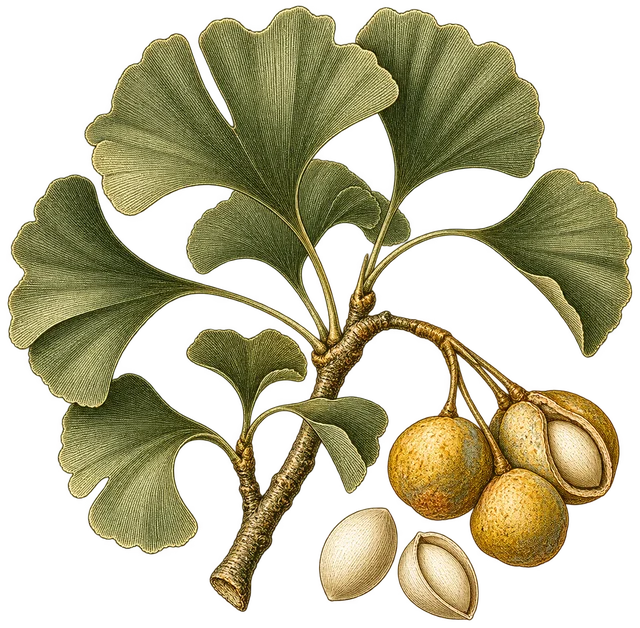
Ginkgo biloba L., a tree in Ginkgoaceae. This entry primarily concerns the leaf and characterized leaf extracts. The seeds, sometimes called ginkgo nuts or bai guo, are a separate food/traditional material with distinct toxicity.
Ingredient details, preparation and research
Source plant or material
Ginkgo biloba L.; dried leaf for leaf preparations. Seeds and their fleshy outer covering must be distinguished from the medicinal leaf material.
Plant family / material: Ginkgoaceae (ginkgo family). Ginkgo is a gymnosperm tree, not a flowering herb.
Forms and route
Refined, quantified dry leaf extracts; separately, powdered leaf, tinctures and teas. An extract studied clinically is defined by its manufacturing process and chemical specification, not just its milligram weight. Homemade tea, crude leaf tincture and seed products are not substitutes for it.
Food sources
The medicinal leaf is not a routine food or dependable micronutrient source. Ginkgo seeds occur in some Asian dishes, but their toxicity makes them unsuitable as a nutrient-boosting strategy; no seed recipe or safe serving is proposed here.
Vitamins and minerals
Do not transfer seed nutrient-composition values to leaf extracts, teas or tinctures. This entry makes no vitamin/mineral serving claim for a ginkgo medicinal product.
Absorption and preparation
EMA describes a small human study in which food delayed uptake of selected terpene lactones without changing overall exposure. Follow the actual preparation’s instructions; special oils, herbs or companion supplements are not established ways to improve clinical benefit.
Traditional and reported uses
- Traditional European powdered-leaf use: relief of heavy legs or cold hands/feet associated with minor circulation complaints, after serious causes have been excluded.
- Preparation-specific medicinal use: EMA recognizes a defined dry extract for age-related cognitive impairment and quality of life in mild dementia. This is distinct from preventing dementia.
- Modern promotion includes memory and concentration. Human evidence does not establish general cognitive enhancement in healthy people; symptom findings in dementia are inconsistent.
Contraindications and cautions
- Review blood-thinning or antiplatelet medicines, bleeding disorders and planned surgery with a clinician. Bleeding risk is a precaution supported by reports and possible interactions; it is not a certainty for every standardized extract.
- Epilepsy needs particular review: EMA states that further seizures with ginkgo preparations cannot be excluded. Seed poisoning can itself cause convulsions.
- Do not use raw seeds or improvise seed remedies. Cooking does not eliminate every seed toxin. Seek urgent medical care for illness after seed consumption.
- Leaf products can cause headache, dizziness, digestive upset or allergy. Pregnancy use may be unsafe; breastfeeding safety is not established.
- Have a pharmacist check the actual product with all medicines, including anticoagulants, antiplatelet drugs, efavirenz and nifedipine. New cognitive or circulation symptoms deserve assessment.
- EMA reports inadequate evidence for medicinal leaf use under age 18; do not use it as a child or adolescent cognitive remedy without clinical assessment.
Similar items and how they compare
- Lion’s mane mushroom
Both are promoted for cognition.
Lion’s mane is a fungus with smaller, heterogeneous human trials; ginkgo is a leaf preparation with distinct medicine and bleeding precautions.
- Garlic
Both feature in circulation-oriented supplement marketing.
They have different chemistry and evidence. Combining concentrated products is not an established circulation treatment and warrants a medicine review.
Identity and the material on the label
Ginkgo biloba is the accepted tree species in Ginkgoaceae. Most contemporary cognitive research concerns leaf extracts. Seeds used in food or historical practice, unrefined leaves and standardized extracts must be kept separate when discussing either benefit or harm. A bottle should identify the botanical species, plant part and actual preparation; a picture of the tree is not a specification.
Traditional use and modern extract medicine
NCCIH describes a long Chinese history of ginkgo use for cough and diarrhea. EMA separately recognizes a European traditional-use role for powdered leaf in minor peripheral-circulation complaints. These are descriptions of particular traditions and materials, not proof that modern leaf capsules treat all historical indications. EMA’s mild-dementia conclusion concerns a defined dry extract and a different evidence pathway.
Prevention and symptom relief are different questions
The GEM trial randomized 3,069 adults aged 75 or older, with normal cognition or mild impairment, and followed them for a median 6.1 years. Ginkgo did not lower dementia incidence. The five-year GuidAge trial also did not show a significant reduction in probable Alzheimer disease. Neither finding implies that every short-term symptom question was tested; conversely, a better symptom score would not demonstrate prevention or disease modification.
What symptom findings can support
EMA accepts a particular dry extract for cognitive impairment associated with ageing and quality of life in mild dementia. NCCIH’s broader assessment describes possible modest dementia-symptom benefit but inconsistent evidence, and uncertainty in healthy people or milder impairment. Different populations, endpoints and products help explain the distinction. Persistent or worsening memory problems call for clinical assessment rather than a generic brain-health purchase.
Composition, refining and product equivalence
The pharmacopoeial dry extract described by EMA contains defined flavonoid and terpene-lactone ranges and tightly limits ginkgolic acids. Those manufacturing controls distinguish it from powdered leaves or homemade preparations. Standardization helps describe what was tested; it does not establish that every product bearing the word standardized is interchangeable, effective or free of interactions.
Bleeding evidence and medicine review
Bleeding has been reported, but a secondary analysis of a 513-participant randomized EGb 761 trial found similar bleeding events and no relevant changes in measured coagulation parameters versus placebo. One author worked for the extract manufacturer; its small anticoagulant subgroup does not settle every interaction or rare-event risk. EMA retains precautions with anticoagulants/antiplatelets and planned surgery, and flags possible interactions involving dabigatran, nifedipine and efavirenz. Review the real regimen rather than assuming either inevitable bleeding or universal safety.
Seizures, seeds and special groups
The epilepsy precaution for leaf products is uncertainty about provoking further seizures; it is not a quantified common adverse effect. Seed poisoning is a separate, documented hazard: ginkgotoxin disrupts vitamin-B6-related physiology and can cause gastrointestinal illness, confusion and convulsions. Cooking reduces some toxins but does not reliably remove this risk. Pregnancy and breastfeeding warrant avoidance or clinical review according to the product’s medicinal guidance; pregnancy is contraindicated in EMA’s monograph. EMA reports inadequate supporting data for medicinal leaf use in children and adolescents under 18.
Meals, preparation and nutrition
A small pharmacokinetic study summarized by EMA found slower absorption of selected extract constituents with food, with unchanged overall bioavailability. This does not establish a preferred food pairing or a cognitive benefit from faster absorption. Use the product’s instructions, not home extraction or a supplement stack. Seed food values do not describe leaf medicines; no micronutrient target or seed-serving recommendation follows from this evidence.
Entry sources
- NCCIH: Ginkgo, usefulness and safety (updated 2025)
- EMA: Ginkgo leaf, HMPC conclusions and preparation-specific uses
- DeKosky et al.: Ginkgo biloba for prevention of dementia, GEM randomized trial (2008)
- Vellas et al.: Long-term standardized ginkgo extract for Alzheimer disease prevention, GuidAge trial (2012)
- EMA: European Union herbal monograph on Ginkgo biloba L., folium (2015)
- Hong Kong Centre for Food Safety: Ginkgo seed poisoning (2023)
- Kew Plants of the World Online: Ginkgo biloba L., Ginkgoaceae
- EMA: Assessment report on Ginkgo biloba L., folium (2015)
- Kloft and Hoerr: EGb 761, coagulation and bleeding, secondary analysis of a randomized trial (2021)
Reference entry 25 · Recorded content review: 2026-10-05 · Review scope and dates