


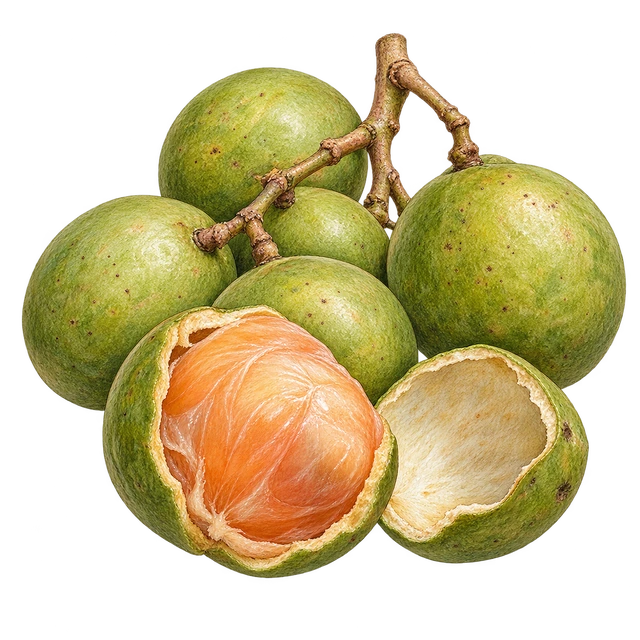
Key cautions
- Large seeds are a choking hazard.
- Never blend or eat seeds.
- Green peel does not mean unripe or prove ripeness.
What’s inside
The sweet aril supplies carbohydrate, with modest calcium and phosphorus reported by UF/IFAS. Its composition depends on cultivar and ripeness; seed chemistry is distinct.
Uses in brief

- Ripe aril as fresh fruit
- Strained drinks and preserves
- Puerto Rican bilí tradition
History, folklore and reported uses
History, folklore and traditional uses
UF/IFAS places mamoncillo’s origin in northern South America and Margarita Island, followed by wide distribution around the Caribbean and other tropical regions. Jamaica’s Forestry Department explicitly lists guinep as Melicoccus bijugatus.
The aril changes from tart to sweet with maturity while the shell stays green. Regional foodways include fresh fruit, preserves and drinks; Puerto Rican records also preserve the name bilí for a quenepa-and-rum drink.
Traditional, historical and reported uses
- Fresh ripe aril
Food or household practiceWhy this label?
This records an identified food preparation or material practice, without claiming a medical outcome.
UF/IFAS identifies fresh fruit as the principal food use. The succulent aril usually clings to a large seed; separate edible pulp with particular care for anyone at risk of choking.
- Jams and jellies
Food or household practiceWhy this label?
This records an identified food preparation or material practice, without claiming a medical outcome.
The pulp is also used for jam and jelly. This records a culinary use without supplying an improvised shelf-stable canning process; choose a tested preservation recipe or refrigerate an ordinary prepared dish as appropriate.
- Strained fruit drinks
Food or household practiceWhy this label?
This records an identified food preparation or material practice, without claiming a medical outcome.
Jamaican chef Noel Cunningham documents guinep juice flavored with ginger and lime. This card retains the beverage tradition, without adopting the recipe article’s health claims or blending the seeds.
- Puerto Rican bilí
Food or household practiceWhy this label?
This records an identified food preparation or material practice, without claiming a medical outcome.
The Spanish-language academies record bilí as a Puerto Rican quenepa-and-rum drink; a University of Puerto Rico thesis describes the tradition in Vieques. This is an alcoholic food tradition, not a tonic.
Distinct documented practices are featured without filling a quota. Food, material use and traditional remedy accounts retain separate evidence labels; none is a cure claim.
Historical-use additions reviewed 2026-10-09
Story sources
- UF/IFAS: Mamoncillo (Genip) Growing in the Florida Home Landscape
- USDA GRIN: Melicoccus bijugatus Jacq.
- Jamaica Forestry Department: Food and fruit tree inventory
- Sanford et al. (2018): Quantitative HPLC-MS/MS Analysis of Toxins in Soapberry Seeds
- Chef Noel Cunningham: Guinep juice, published by the Jamaica Gleaner
- ASALE Diccionario de americanismos: bilí
- Sierra Gómez (2006), University of Puerto Rico: Physical-chemical analysis of selected quenepa varieties
- Heart Foundation of Jamaica instructor interview: Don’t Panic! Just Pump! CPR Saves Lives
- FDA: Selecting and Serving Produce Safely
Regional reading paths
These sourced notes describe cultivation, trade, food traditions or material history. A regional connection does not claim exclusive origin.
North America
Native to northern South America and introduced throughout the Caribbean and Central America; also cultivated in southern Florida.
The ripe fruit’s aril is eaten; the large seed is not part of this food use and presents a choking hazard.
South America
Native in northern South America; USDA records native occurrence in Venezuela, Colombia and Brazil.
Ripe fruit aril is eaten fresh; separate and discard the large seed.
Identity & detailed reference
Identity
The ripe translucent aril surrounding the large seed of Melicoccus bijugatus. Ginep, guinep, genip, mamoncillo and quenepa are documented names for this fruit; Spanish lime is not a citrus lime.
Ingredient details, preparation and research
Also known as: ginep; Genip; Guinep; Guenepa; Quenepa; Mamoncillo; Spanish lime; Limoncillo; Quenep
Source plant or material
Melicoccus bijugatus Jacq.
Plant family / material: Sapindaceae
Forms and route
Fresh ripe seed-free aril; pulp used in strained drinks and preserves. Peel and seeds are excluded from the edible form in this card.
Vitamins and minerals
This card covers the aril only. UF/IFAS notes small amounts of calcium and phosphorus; no universal serving value or high-nutrient claim is assigned. Juice, jam and alcoholic infusions have different ingredients and portions. No copper value from a different fruit or plant part is substituted.
Absorption and preparation
No special nutrient-absorption effect is established for ginep. Laboratory measurements of phenolics do not establish clinical benefits from the edible aril.
Practical preparation
Choose reliably identified, mature fruit. Wash and peel; separate the aril from the seed for processing and never put the seed in a blender. For children or anyone with swallowing difficulty, serve only suitably prepared seed-free pulp.
Combination context
No medicinal combination or required nutrient-absorption pairing is established for this food.
Combination notes
Lime and ginger are documented drink flavorings. Sweeteners and rum change the finished beverage; no medicinal synergy is implied.
Traditional and reported uses
- Ripe aril as fresh fruit
- Strained drinks and preserves
- Puerto Rican bilí tradition
Contraindications and cautions
- The slippery large seed can cause choking. Do not give whole fruits or pulp-covered seeds to young children; remove seeds and prepare any fruit for the eater’s abilities.
- Do not eat, crush or blend the seeds. CDC/USDA research measured hypoglycin A in mamoncillo seeds; historical roasted-seed accounts are not a validated safety protocol.
- Use fully mature fruit from a reliable supplier. The peel remains green even when ripe, so green color alone cannot establish maturity.
- Wash before peeling, keep prepared pulp clean and refrigerated, and discard spoiled fruit. Strained drinks still require safe handling.
- Bilí contains alcohol and is included as culinary history, not as a health recommendation or a children’s beverage.
Similar items and how they compare
- Citrus lime
Spanish lime is a common name for ginep.
Ginep is a soapberry-family fruit, not Citrus; its large seed and aril require different handling.
- Genipap / jagua
Some regional names sound similar.
Genipa americana is a different tree and fruit; this card does not identify it.
- Ackee
Both belong to Sapindaceae.
They are different species with different food preparation requirements. Ackee guidance must not be used as a recipe for ginep.
Seed chemistry is a reason for a firm boundary
A 2018 CDC/USDA analytical study detected hypoglycin A in all six mamoncillo seeds tested, with variable concentrations. This is seed evidence, not proof that an ordinary ripe-aril serving has the same risk. No safe home detoxification procedure was established.
Maturity and common names
Fruit should mature on the tree for good eating quality, and ripe fruit remains green. Ginep is not a citrus fruit, and an uncertain foraged fruit should not be identified by the phrase Spanish lime alone.
Evidence limits
Small laboratory studies and regional food descriptions do not establish treatment benefits or a safe seed dose. The card deliberately excludes seed ingestion and does not transfer ackee or lychee safety thresholds to ginep.
Entry sources
- UF/IFAS: Mamoncillo (Genip) Growing in the Florida Home Landscape
- USDA GRIN: Melicoccus bijugatus Jacq.
- Jamaica Forestry Department: Food and fruit tree inventory
- Sanford et al. (2018): Quantitative HPLC-MS/MS Analysis of Toxins in Soapberry Seeds
- Chef Noel Cunningham: Guinep juice, published by the Jamaica Gleaner
- ASALE Diccionario de americanismos: bilí
- Sierra Gómez (2006), University of Puerto Rico: Physical-chemical analysis of selected quenepa varieties
- Heart Foundation of Jamaica instructor interview: Don’t Panic! Just Pump! CPR Saves Lives
- FDA: Selecting and Serving Produce Safely
Reference entry 257 · Recorded content review: 2026-10-09 · Review scope and dates