

Research draft · Editorial review pending. Sources are linked below; these reports have not been approved as treatment advice.
Herbal leaf infusion
Raspberry leaf
Rubus idaeus
Read cautions first · Check the sources
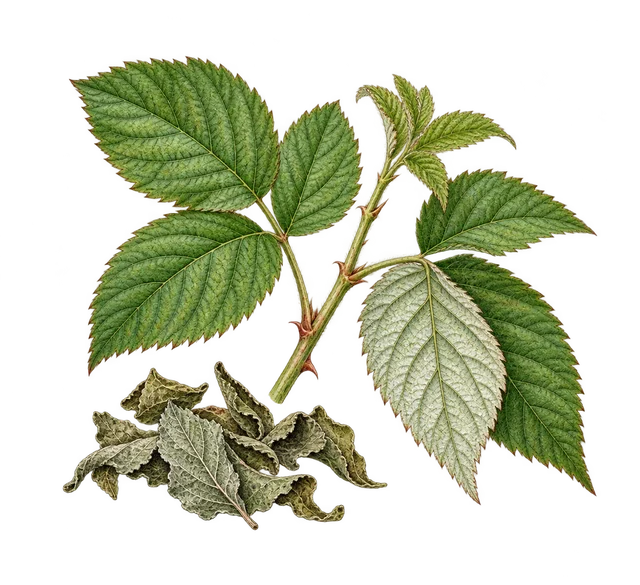
Raspberry leaves, rather than the berries, have a European herbal history. EMA’s traditional-use monograph distinguishes oral leaf tea for mild diarrhoea from a separate infusion used as a rinse for mild mouth or throat inflammation. Its minor-menstrual-spasm indication applies to a specified aqueous dry extract, not tea. Older sources also describe menstrual and childbirth uses; EMA did not include childbirth as an indication because pregnancy and breastfeeding safety data were insufficient.
History, folklore, traditional and unusual uses
Only source-documented traditions are included; no unsourced legends have been added.
Europe
Documented regional herbal tradition
Raspberry leaves, rather than the berries, have a long-standing European herbal use. EMA documents leaf tea and a separate mouth-rinsing infusion, with insufficient clinical evidence for the listed traditional uses.
- Traditional oral leaf-tea use for mild diarrhoea.
- A separate leaf infusion used as a mouth or throat rinse.
North America
Documented North American garden use; wider herbal tradition
University of Minnesota includes raspberry leaves in tea gardens for their black-tea-like flavor. European herbal monographs also record longstanding medicinal leaf use.
- Leaf beverage.
- Traditional astringent leaf-tea use for mild diarrhoea.
Sources
- www.ema.europa.eu · source 1
- beelab.umn.edu · source 2
- www.ema.europa.eu · source 3
- www.ema.europa.eu · source 4
- www.ema.europa.eu · source 5
- www.ema.europa.eu · source 6
Research selection updated 2026-10-15. Historical and traditional reports do not establish clinical effectiveness.