


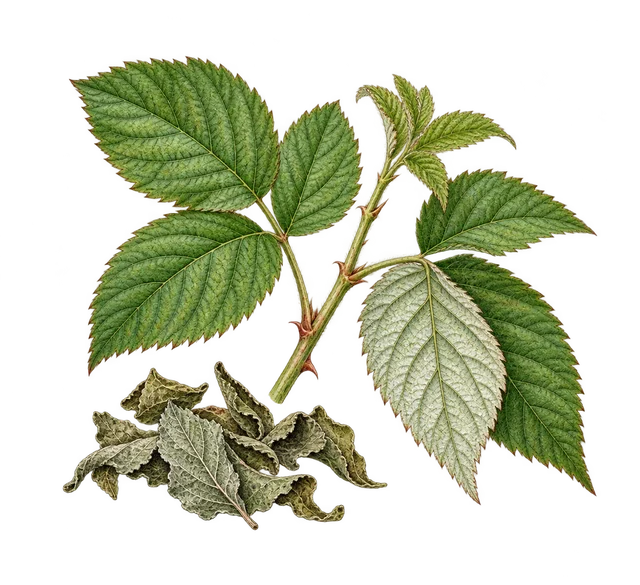
Key cautions
- EMA does not recommend medicinal raspberry leaf during pregnancy or lactation because adequate safety evidence is lacking. Do not use to induce labor or treat pregnancy complications.
- Do not use to induce labour or manage pregnancy complications.
- A leaf illustration is not sufficient for safe wild-plant identification.
What’s inside
The leaf is tannin-rich; this is a medicinal-leaf description, not the nutrient profile of raspberry fruit.
Uses in brief

- Traditional minor menstrual-spasm use; pregnancy benefit and safety unproven.
- Traditional mild diarrhoea and mouth/throat uses, with route distinctions.
History, folklore and reported uses
History, folklore and traditional uses
EMA records long-standing European use of raspberry leaves for minor menstrual spasms. The same leaf has an astringent history in mouth/throat complaints and mild diarrhea. This leaf medicine is distinct from eating raspberries.
Rubus idaeus is also cultivated for edible raspberries. The fruit and leaf are separate materials: fruit nutrition and food history should stay on the fruit card.
Traditional, historical and reported uses
- menstruation; pregnancy
Mixed/contextual sourcesWhy this label?
EMA classification is traditional use, not demonstrated clinical effectiveness. Pregnancy studies are too small and limited to establish benefit or safety.
Traditional minor period-spasm relief; pregnancy-related promotion is a separate claim. EMA classification is traditional use, not demonstrated clinical effectiveness. Pregnancy studies are too small and limited to establish benefit or safety.
- Mouth and throat tradition
Traditional accountWhy this label?
EMA records leaf preparations for mild mouth or throat inflammation on a traditional-use basis. This topical/oromucosal role is distinct from drinking a leaf preparation.
EMA records leaf preparations for mild mouth or throat inflammation on a traditional-use basis. This topical/oromucosal role is distinct from drinking a leaf preparation.
- Mild diarrhoea tradition
Traditional accountWhy this label?
EMA also records traditional use for mild diarrhoea. This does not establish treatment for infection, dehydration or persistent symptoms.
EMA also records traditional use for mild diarrhoea. This does not establish treatment for infection, dehydration or persistent symptoms.
Coverage reflects verified sources, without a minimum use quota.
Women’s Health: traditions, evidence and cautions
Historical use does not establish benefit or safety. Pregnancy, breastfeeding and fertility care require particular caution: food, tea, essential oil and concentrated extract are not interchangeable. These records are not treatment, dosing or pregnancy-management instructions. Discuss supplements with a qualified clinician or pharmacist; do not delay evaluation of persistent symptoms.
Red raspberry leaf
Rubus idaeus
- Plant part / material
- leaf
- Preparation studied or reported
- Dried comminuted leaf for oral tea or oromucosal infusion; specified dry aqueous extracts for oral use. EMA’s menstrual-spasm indication applies to the specified dry extract, not automatically to leaf tea.
Rubus idaeus; leaf. Related fruit card raspberries is not a leaf match.
menstruation; pregnancy
traditional use; insufficient clinical evidence
Reported or traditional useThe EMA minor menstrual-spasm traditional-use indication concerns a specified dry aqueous leaf extract. Pregnancy-related promotion is a separate claim.
What the evidence supportsTraditional-use recognition does not establish clinical effectiveness. The menstrual indication must not be applied automatically to leaf tea. Pregnancy studies are too limited to establish benefit or safety.
EMA does not recommend medicinal raspberry leaf during pregnancy or lactation because adequate safety evidence is lacking. Do not use to induce labor or treat pregnancy complications.
One exact-material card. dried leaf tea; specified dry extracts. Keep preparations distinct; do not transfer findings from a named extract to every tea or powder.
- EMA does not recommend medicinal raspberry leaf during pregnancy or lactation because adequate safety evidence is lacking. Do not use to induce labor or treat pregnancy complications.
- Do not use to induce labour or manage pregnancy complications.
- A leaf illustration is not sufficient for safe wild-plant identification.
Read the complete historical reference and its material distinctions
Identity & detailed reference
Identity
Rubus idaeus; leaf. Related fruit card raspberries is not a leaf match.
Ingredient details, preparation and research
Also known as: red raspberry leaf; Rubi idaei folium
Source plant or material
Rubus idaeus — leaf
Plant family / material: Rosaceae (rose family)
Forms and route
Dried comminuted leaf for oral tea or oromucosal infusion; specified dry aqueous extracts for oral use. EMA’s menstrual-spasm indication applies to the specified dry extract, not automatically to leaf tea.
Vitamins and minerals
No nutrient quantities or daily-value claims are assigned to this medicinal material. Do not borrow the food nutrient profile of another plant part or use an extract as a dietary substitute.
Absorption and preparation
Preparation and route matter. A tea, whole powder, alcohol extract and isolated constituent can give different exposures. No food pairing or absorption-enhancement technique is established by the sources reviewed.
Traditional and reported uses
- Traditional minor period-spasm relief; pregnancy-related promotion is a separate claim. EMA classification is traditional use, not demonstrated clinical effectiveness. Pregnancy studies are too small and limited to establish benefit or safety.
- EMA records leaf preparations for mild mouth or throat inflammation on a traditional-use basis. This topical/oromucosal role is distinct from drinking a leaf preparation.
- EMA also records traditional use for mild diarrhoea. This does not establish treatment for infection, dehydration or persistent symptoms.
Contraindications and cautions
- EMA does not recommend medicinal raspberry leaf during pregnancy or lactation because adequate safety evidence is lacking. Do not use to induce labor or treat pregnancy complications.
- Do not use to induce labour or manage pregnancy complications.
- A leaf illustration is not sufficient for safe wild-plant identification.
Similar items and how they compare
- Raspberry fruit
Same species
The fleshy fruit is a food; fruit safety and nutrients do not establish medicinal-leaf safety.
- Blackberry leaf
Another Rosaceae astringent leaf
A different taxon and monograph; do not transfer findings.
Identity and composition
Rubus idaeus; leaf. Related fruit card raspberries is not a leaf match. The leaf is tannin-rich; this is a medicinal-leaf description, not the nutrient profile of raspberry fruit.
menstruation; pregnancy: what evidence can say
EMA classification is traditional use, not demonstrated clinical effectiveness. Pregnancy studies are too small and limited to establish benefit or safety. EMA does not recommend medicinal raspberry leaf during pregnancy or lactation because adequate safety evidence is lacking. Do not use to induce labor or treat pregnancy complications.
Exact material and preparation boundaries
One exact-material card. dried leaf tea; specified dry extracts. Keep preparations distinct; do not transfer findings from a named extract to every tea or powder.
Medicines, pregnancy and breastfeeding
The EMA leaf monograph does not recommend pregnancy or breastfeeding use because adequate safety data are lacking. Its absence of reported interactions should not be presented as proof that every leaf product can be combined with medicines.
Source-supported safety summary
EMA does not recommend medicinal raspberry leaf during pregnancy or lactation because adequate safety evidence is lacking. Do not use to induce labor or treat pregnancy complications. Do not use to induce labour or manage pregnancy complications. A leaf illustration is not sufficient for safe wild-plant identification.
Indication-specific preparation limits
The EMA monograph assigns minor menstrual spasms to its specified dry aqueous extract. Comminuted-leaf infusions are listed separately for mouth/throat use and mild diarrhoea. These preparation and route boundaries do not validate pregnancy or labour uses.
Evidence limits
- This is a focused educational source review, not a systematic review or a treatment plan.
- Traditional use documents a practice; it does not establish clinical benefit. Laboratory findings and multi-ingredient trials cannot establish a single ingredient’s effects.
- Avoid repeating the marketing claim that raspberry leaf prepares the uterus for childbirth; the checked evidence does not establish this.
Entry sources
- EMA: rubi-idaei-folium
- EMA: raspberry leaf assessment report
- NC State Extension Plant Toolbox: rubus idaeus
- EMA: Rubus idaeus leaf monograph
Reference entry 522 · Recorded content review: 2026-10-11 · Review scope and dates