The Herb Notebook™Return to ingredients

THE APPROVED FIVE-CARD STUDY

Botanical art.
Ancient words.

Explore the illustrations, the dove marker and the names behind the KJV. This approved study introduced the art and language treatment now used throughout the notebook.

The dove marks a card with biblical references. Identification notes explain the connection.

Edible seed

Almonds

Prunus amygdalus · also called Prunus dulcis

Biblical references

An explicitly named biblical nut, now enjoyed as sweet kernels, meal and butter. A small handful supplies vitamin E, magnesium, fiber and unsaturated fat; bitter almonds and almond oil need separate identification.
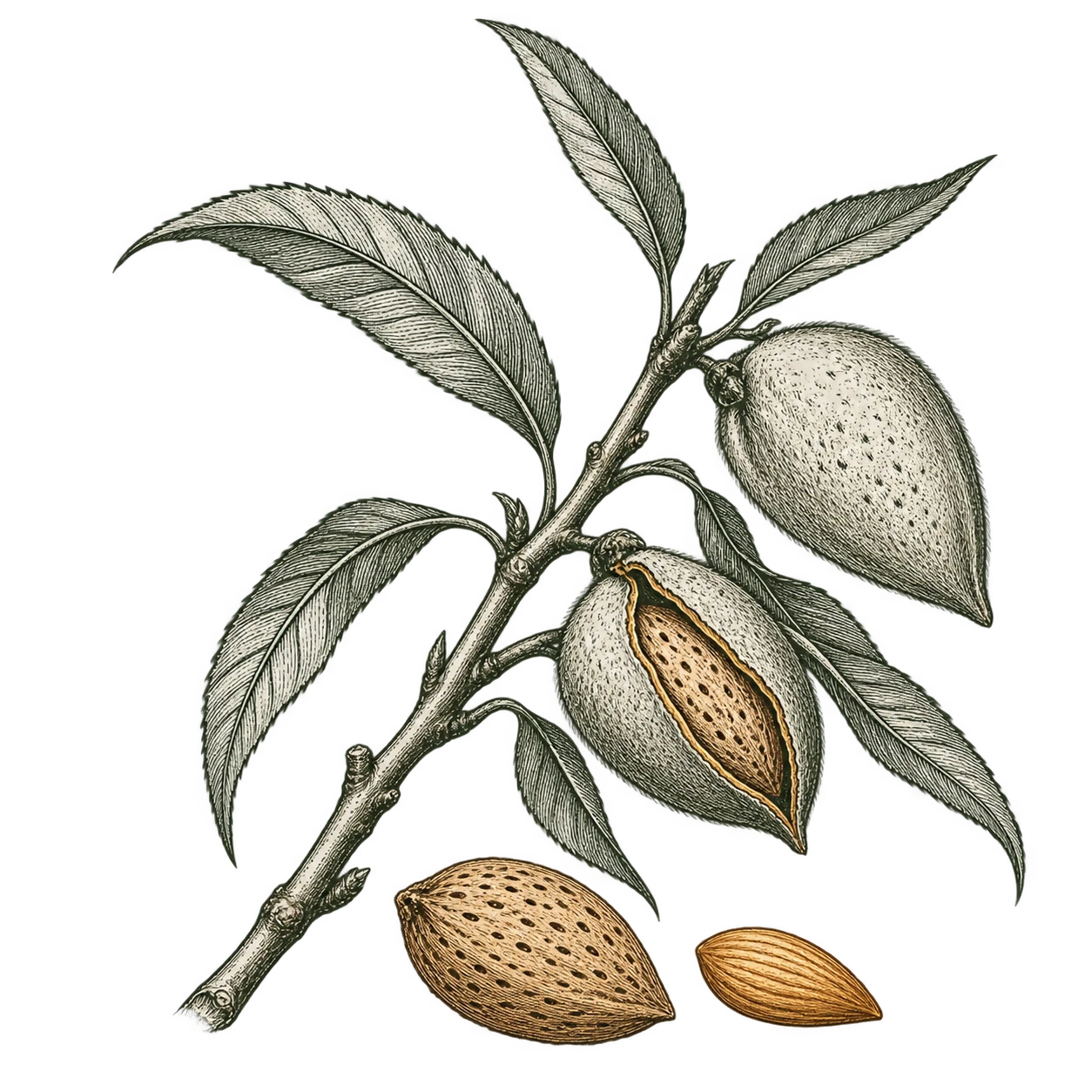
Engraved almond branch showing fruit, a split hull, shell and an edible kernel.
Original botanical illustration
Read scripture, story and ingredient details

Almonds in the KJV

Named material

Almonds are explicitly named in Genesis 43:11 and Numbers 17:8. The conventional botanical identification is the cultivated almond, commonly called Prunus dulcis and now accepted by Kew as Prunus amygdalus. Neither verse distinguishes sweet from bitter cultivars or names almond oil. Modern food guidance here is for commercially edible sweet kernels.

And their father Israel said unto them, If it must be so now, do this; take of the best fruits in the land in your vessels, and carry down the man a present, a little balm, and a little honey, spices, and myrrh, nuts, and almonds:

Genesis 43:11 (KJV)

And it came to pass, that on the morrow Moses went into the tabernacle of witness; and, behold, the rod of Aaron for the house of Levi was budded, and brought forth buds, and bloomed blossoms, and yielded almonds.

Numbers 17:8 (KJV)
Scripture and identification sources

WORDS & THEIR STORIES

The name behind the KJV

Biblical Hebrew · Genesis 43:11 (KJV)

וּשְׁקֵדִים

ūšəqēdīm

“And almonds,” among the valued produce sent as a gift.

Dictionary form: שָׁקֵד · šāqēd

The verse has ū- (“and”) plus the plural šəqēdīm. The dictionary form is singular.

Word sources

Biblical Hebrew · Numbers 17:8 (KJV); Numbers 17:23 in the Hebrew edition

שְׁקֵדִים

šəqēdīm

Almonds borne by Aaron’s rod after it buds and blossoms.

Dictionary form: שָׁקֵד · šāqēd

This is the same plural noun without “and.” The Hebrew and KJV chapter divisions give the event different verse numbers.

Word sources

What the language reveals

The conventional almond identification is strong. Neither quoted verse specifies sweet versus bitter almonds, a modern cultivar or almond oil.

Language and identification bibliography
History, folklore and traditional uses

History, folklore and traditional uses

Almonds stand at the meeting point of orchard, kitchen and sacred imagery. Genesis places them among the valued goods sent from Canaan to Egypt, while Numbers describes Aaron’s staff bearing buds, flowers and nuts at once. In an ordinary orchard those stages unfold in sequence. The tree’s early blossoms also made it a vivid seasonal presence, and almond-shaped decoration appears in the tabernacle lampstand. The biblical name is clear, but the text does not label its almonds as modern sweet or bitter cultivars.

Centuries later, the medieval English recipe collection The Forme of Cury shows how much cooks could do with an almond. Its almond milk enters rice, leafy dishes and fish preparations; other recipes turn ground blanched almonds into cream or combine them with oats. This was a practical kitchen technique, not simply a modern beverage trend. The same kernel could be kept dry and then transformed into a pale, rich liquid or a thickening ingredient when needed.

Pressing opened a different branch of the story. Historical accounts describe almond oil in Chinese, Ayurvedic and Greco-Persian skin care, while pharmacognosy treats the fixed oil as a useful preparation in its own right. Modern farming finds value even in the outer hull, which can enter livestock feed. These histories explain the almond’s broad usefulness, but the bowl of sweet kernels, bottle of cosmetic oil and pile of hulls remain different materials.

Traditional, historical and reported uses
  1. Food, gifts and culinary richness
    Food or household practiceWhy this label?

    Culinary kernel use and food-gift tradition.

    Sweet kernels have served as portable food and valued gifts; Genesis records almonds in Jacob’s offering, and later cookbooks use them in substantial dishes.

  2. Almond milk and thickened dishes
    Food or household practiceWhy this label?

    Historical cookbook records culinary almond-milk processing and dishes.

    The Forme of Cury documents almond milk in rice, greens and fish dishes, as well as almond cream and gruel: a distinct processing tradition.

  3. Oil for dry-skin care
    Traditional accountWhy this label?

    Chinese, Ayurvedic and Greco-Persian topical oil-care traditions.

    Ahmad’s historical account records almond oil in Chinese, Ayurvedic and Greco-Persian care for dry or irritated skin. This concerns topical fixed oil.

  4. Apothecary carrier and mild laxative tradition
    Mixed/contextual sourcesWhy this label?

    Pharmacognosy textbook describes pharmaceutical carrier and laxative context.

    Trease and Evans describes fixed almond oil in pharmaceutical vehicles and a mild laxative role. This is preparation history, not a home medicinal dose.

  5. Hulls as livestock feed
    Food or household practiceWhy this label?

    Agricultural by-product use in livestock feed.

    USDA describes almond hulls and shells as agricultural by-products, including hull use in livestock feeding. Human kernel nutrition does not describe these feed materials.

Five distinct documented uses are presented with the plant part or product specified; historical practices are not preparation instructions.

Story sources
140Full ingredient reference
Read the journal page

The almond is the edible seed within a stone-fruit shell. This food card concerns commercially edible sweet almonds. Kew currently accepts Prunus amygdalus Batsch; Prunus dulcis remains widespread in food science. Bitter almonds contain much more cyanogenic material and are not a home-food substitute.

Ask about this ingredient

What’s inside

Kernels provide mostly unsaturated fat, protein, fiber, alpha-tocopherol (vitamin E), magnesium, calcium and riboflavin. The skin contributes phenolic compounds. Amygdalin and related cyanogenic glycosides are especially relevant to bitter almonds; their presence is a safety issue, not a desirable vitamin.

Ingredient details, preparation and research

Also known as: Sweet almond; Prunus dulcis; Amygdalus communis

Source plant or material

Prunus amygdalus / Prunus dulcis; mature sweet seed kernels, with or without their thin brown skin.

Plant family / material: Rosaceae, the rose family; related to peach, plum and apricot.

Forms and route

Whole or sliced sweet kernels; raw-style or roasted; skin-on or blanched; meal/flour and almond butter. Almond beverages may be diluted and fortified. Sweet almond fixed oil and processed flavoring extracts have different compositions.

Food sources

Plain sweet almond kernels are the food basis. Blanching removes the skin; oil pressing removes most protein, fiber and minerals from the oil fraction. A fortified beverage may supply added calcium or vitamins, which are not the same as nutrients supplied by its almond content.

Vitamins and minerals

For 28.35 g edible plain almonds, 1 oz or a small handful: about 164 kcal, 6.0 g protein, 14.2 g fat, 6.1 g carbohydrate, 3.5 g fiber, 1.2 g sugars, 76 mg calcium, 77 mg magnesium, 208 mg potassium, 1.05 mg iron, 7.3 mg vitamin E and 0.32 mg riboflavin. Calculated from USDA SR28 food 12061 per 100 g; the shell is excluded. These are whole-kernel values, not almond-oil or beverage values.

Absorption and preparation

The kernel is a food matrix: chewing and grinding break cells and influence release of oil and other nutrients. Human mastication studies show that some fat remains inside intact cells after chewing; finely ground products are not identical to whole kernels. Eat in an ordinary meal or snack. No extra oil, fasting schedule or mandatory soaking is needed to obtain the food benefits.

Practical preparation

Choose unsalted sweet almonds if limiting salt. Weigh a handful once to learn the portion; slices and flour pack differently. Refrigerate homemade almond beverages promptly and follow their food-safety guidance. No bitter-almond detoxification method is offered.

Combination context

Add chopped almonds to oats, vegetables or a yogurt bowl for texture. If almond drink replaces dairy regularly, compare its protein and fortification label. Adding honey or sugar changes the finished food without increasing the amount of almond protein.

Traditional and reported uses

  • Eat a small handful of unsalted sweet almonds or scatter chopped kernels over oats, vegetables or yogurt.
  • Use ground almonds or almond butter for texture and richness in cooking; count the actual portion rather than treating all almond products alike.
  • Historical uses include almond milk, soothing skin oils, apothecary oil preparations and agricultural use of hulls. These concern distinct preparations and parts.

Contraindications and cautions

  • Avoid almonds with an almond allergy; tree-nut reactions can be severe, and mixed-nut products may introduce other allergens.
  • Do not eat unknown bitter almonds or make home bitter-almond extracts: cyanogenic compounds can release cyanide. Buy food-grade sweet almonds.
  • Whole nuts and thick spoonfuls of nut butter can present a choking risk for young children or people with swallowing difficulties; use an age-appropriate finely ground or thinned form.
  • Use clean, dry handling and reputable suppliers. Keep kernels sealed and cool, refrigerating or freezing for longer storage; discard visibly moldy nuts.
  • Almond beverages are not nutritionally identical to whole nuts. Check added sugar, protein and fortification; cosmetic almond oil is not automatically edible.

Preparation-specific cautions

  • Almond allergy can cause a severe reaction. Check ingredients and cross-contact information.
  • Cyanogenic glycosides in bitter almonds can release cyanide; use commercially edible sweet kernels rather than home detoxification.
  • Serve in an age-appropriate texture to avoid choking.
  • Keep clean, dry and cool; damaged or moldy nuts are unsuitable food.

Similar items and how they compare

  • Sweet almond oil

    Comes from the same edible kernel.

    Oil supplies fat but essentially none of the whole nut’s fiber and protein; cosmetic and culinary grades differ.

  • Pistachios

    Another biblical-associated edible kernel.

    Almond is explicitly named in the KJV; pistachio is a probable interpretation of a generic nut word, and the botanical families differ.

  • Bitter almonds

    Closely related almond material.

    Cyanogenic glycosides create a serious poisoning hazard; they are not interchangeable with commercial sweet kernels.

Copper in this food

Approximate reference values for the exact form and portion shown. The label Daily Value (DV) is 0.9 mg for adults and children age 4+, not an individual intake prescription. Portions differ, so this is not a per-gram ranking.

Compare copper food sources and read the mineral cautions

Food composition does not establish a deficiency or predict a treatment effect. Oils and extracts do not inherit these food values.

Species name and sweet-kernel boundary

Taxonomic naming and food naming overlap: Kew now accepts Prunus amygdalus, while USDA and much research use Prunus dulcis. The nutritional discussion is limited to the sweet food kernel, not to seed extracts or a claim that every almond cultivar is edible.

What a handful contributes

A 1 oz portion supplies about 6 g protein and 3.5 g fiber along with vitamin E and magnesium. Meal and butter retain much of the kernel, whereas expressed oil separates a fat-rich fraction. Commercial almond drinks vary considerably in dilution and added nutrients.

Chewing, grinding and accessible nutrients

A randomized mastication study found that many almond cells survived chewing intact. A later trial in 31 adults found a modest increase in predicted lipid availability after commercial grinding. These are preparation-and-digestion findings; they do not require elaborate food combinations or prove that soaking is necessary.

The useful plant beyond its kernel

Historical pharmacognosy describes fixed almond oil as a pharmaceutical vehicle, while skin traditions use its softening qualities. Modern agriculture also uses hulls as livestock feed. Those uses belong to the wider plant story and do not convert the hull or cosmetic oil into an ordinary human food.

Parts and materials used

Mature sweet kernel for this food. Expressed fixed oil, hard shell, outer hull and bitter kernels are separate materials.

Food forms and ingredient distinctions

Plain sweet almond kernels are the food basis. Blanching removes the skin; oil pressing removes most protein, fiber and minerals from the oil fraction. A fortified beverage may supply added calcium or vitamins, which are not the same as nutrients supplied by its almond content.

Practical preparation

Choose unsalted sweet almonds if limiting salt. Weigh a handful once to learn the portion; slices and flour pack differently. Refrigerate homemade almond beverages promptly and follow their food-safety guidance. No bitter-almond detoxification method is offered.

Meal ideas and combinations

Add chopped almonds to oats, vegetables or a yogurt bowl for texture. If almond drink replaces dairy regularly, compare its protein and fortification label. Adding honey or sugar changes the finished food without increasing the amount of almond protein.

Food reference portions

Food composition reference

Nuts, almonds · 1 oz (a small handful) (28.35 g). Approximate values, rounded to about three significant digits.

Nuts, almonds nutrient comparison
NutrientPer 100 gPer stated serving
Energy579 kcal164 kcal
Protein21.1 g6 g
Total fat49.9 g14.2 g
Carbohydrate21.6 g6.11 g
Fiber12.5 g3.54 g
Sugars4.35 g1.23 g
Calcium269 mg76.3 mg
Magnesium270 mg76.5 mg
Potassium733 mg208 mg
Iron3.71 mg1.05 mg
Vitamin E, alpha-tocopherol25.6 mg7.27 mg
Riboflavin1.14 mg0.323 mg

USDA SR28 reference data, currently accessible; not newly collected 2026 measurements; USDA NDB 12061

per-100-g value × edible serving grams / 100; displayed prose rounded

Evidence limits

  • The Bible names almonds without specifying sweet/bitter cultivar or an oil preparation.
  • USDA reference composition is not a test of the purchased batch; roasting, coating, blanching and beverage fortification change the product.
  • Historical skin and pharmacy uses concern oil or prepared products, not treatment claims for eating kernels.

Entry sources

View this ingredient in the current reference

Aromatic resin

Frankincense resin and extract

Boswellia species

Biblical references

Frankincense is an aromatic tree resin with distinct incense, perfume and medicinal traditions. Indian frankincense, Boswellia serrata, supplies most studied oral extracts; the resin, distilled essential oil and specially formulated extracts carry different chemistry and evidence.

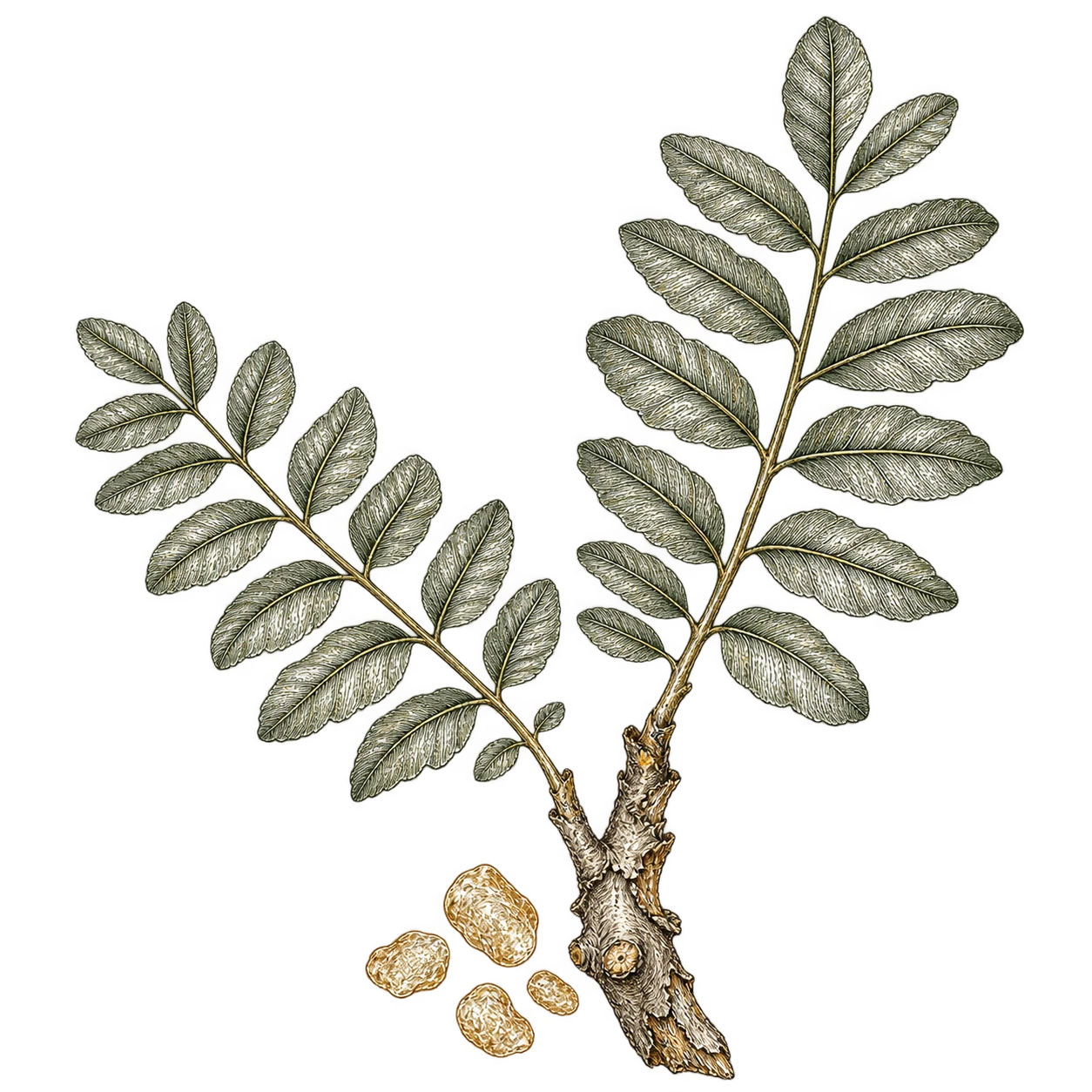
Engraved Boswellia foliage and woody stem beside golden frankincense resin tears.
Boswellia study; the biblical species is unspecified
Read scripture, story and ingredient details

Frankincense in the KJV

Named material

Frankincense appears in the sacred incense of Exodus and among the wise men’s gifts to Jesus. These references concern aromatic Boswellia resin. Its precise species is unspecified, so the connection does not identify Boswellia serrata in particular or an extracted supplement.

And the LORD said unto Moses, Take unto thee sweet spices, stacte, and onycha, and galbanum; these sweet spices with pure frankincense: of each shall there be a like weight:

Exodus 30:34 (KJV)

And when they were come into the house, they saw the young child with Mary his mother, and fell down, and worshipped him: and when they had opened their treasures, they presented unto him gifts; gold, and frankincense and myrrh.

Matthew 2:11 (KJV)
Scripture and identification sources

WORDS & THEIR STORIES

The name behind the KJV

Biblical Hebrew · Exodus 30:34 (KJV)

וּלְבֹנָה

ūləbōnāh

“And frankincense,” one ingredient of the sacred incense.

Dictionary form: לְבוֹנָה · ləbōnāh

The opening ū- means “and.” The verse uses a shorter spelling of the dictionary form; both name frankincense.

Word sources

Koine Greek · Matthew 2:11 (KJV)

λίβανον

líbanon

Frankincense presented among the gifts to Jesus.

Dictionary form: λίβανος · líbanos

Líbanon is the accusative form of líbanos. Checked in Scrivener’s 1894 Textus Receptus, a later reconstruction of the KJV’s Greek textual basis.

Word sources

What the language reveals

Both passages name aromatic resin without fixing its Boswellia species. They do not specifically identify B. serrata, distilled essential oil or a modern extract.

Language and identification bibliography
History, folklore and traditional uses

Species, geography and resin identity

Kew accepts Boswellia serrata Roxb. in Burseraceae and gives its native range as the Indian subcontinent. This avoids transferring the broader geography of frankincense-producing species to B. serrata itself. Resin exudes from bark-associated tissues; B. sacra and B. dalzielii are different source species. Common names and a high percentage on a label are insufficient to establish botanical or extract equivalence.

Kew: Boswellia serrata Roxb., accepted species and Indian-subcontinent range · NCCIH (updated April 2025): Boswellia, usefulness and safety · Primary chemistry study (2019): Boswellia dalzielii essential oils and two chemotypes

A landscape shaped by incense

Frankincense has a landscape as well as a fragrance. UNESCO’s Land of Frankincense in Oman links the Boswellia sacra trees of Wadi Dawkah with an inland caravan oasis and coastal ports. Together they show how resin traveled from a harsh growing environment into a far-reaching luxury trade. The Metropolitan Museum describes incense burned in temples, palaces and homes across the ancient world, with camel caravans carrying frankincense alongside myrrh and other goods.

UNESCO: Land of Frankincense, Oman · Metropolitan Museum of Art: The World Between Empires, southwestern Arabian incense trade · NCCIH (updated April 2025): Boswellia, usefulness and safety

Indian frankincense and Ayurveda

Indian frankincense, Boswellia serrata, belongs to a related but distinct medicinal story. NCCIH records its use in Ayurveda for arthritic discomfort, inflammation and other complaints. This is the species behind much modern interest in oral Boswellia extracts. Holding the Arabian incense story beside the Indian herbal story makes the differences useful rather than inconvenient: “frankincense” names a family of traded resins, not one uniform remedy. A resin burned for fragrance, its distilled oil and an extract selected for boswellic acids represent different ways people have worked with these remarkable trees.

UNESCO: Land of Frankincense, Oman · Metropolitan Museum of Art: The World Between Empires, southwestern Arabian incense trade · NCCIH (updated April 2025): Boswellia, usefulness and safety

Reading the medicinal traditions

The uses below describe historical practice or claims recorded in official herbal monographs. They distinguish swallowed B. serrata resin from B. sacra skin preparations and local mouth rinses. A traditional-use monograph is not a clinical trial, and its manufacturing or labeling directions do not make different preparations interchangeable.

Egyptian Drug Authority (2023): Boswellia serrata resin monograph · Health Canada (2025): Boswellia sacra, topical traditional uses · Health Canada: Boswellia sacra, buccal traditional uses

Arthritic and rheumatic complaints

Ayurvedic practice used Indian frankincense, Boswellia serrata oleogum resin, for arthritic pain and inflammation. NCCIH records this tradition, which continues in dried-resin and extract preparations.

NCCIH (updated April 2025): Boswellia, usefulness and safety · Egyptian Drug Authority (2023): Boswellia serrata resin monograph

Respiratory complaints

Indian boswellia has an Ayurvedic respiratory tradition; Egypt’s 2023 herbal compendium records dried B. serrata resin and resin extracts for asthma and cough. This concerns medicinal resin preparations rather than burning incense for breathlessness.

NCCIH (updated April 2025): Boswellia, usefulness and safety · Egyptian Drug Authority (2023): Boswellia serrata resin monograph

Bowel inflammation in modern herbal medicine

The Egyptian Drug Authority’s B. serrata monograph records oral dried resin and extracts used for inflammatory bowel complaints. It represents the continuing development of medicinal-resin practice in modern herbal compendia.

Egyptian Drug Authority (2023): Boswellia serrata resin monograph

Chinese injury and sore preparations

Traditional Chinese medicine used ru xiang resin preparations for painful swelling, minor injuries and sores. Health Canada’s topical monograph identifies B. sacra stem-bark resin in salves, pastes and related preparations.

Health Canada (2025): Boswellia sacra, topical traditional uses

Gum, mouth and throat rinses

A separate Chinese medicinal tradition used frankincense resin preparations as rinses or gargles for inflamed gums, mouth and throat. Health Canada records this local gum-resin practice under B. sacra.

Health Canada: Boswellia sacra, buccal traditional uses

Omani incense and household fragrance

WIPO describes Boswellia sacra resin in Oman’s incense and fragrance traditions, linked to the growing landscape of Dhofar. This is an aromatic cultural use of resin, not treatment of respiratory illness by smoke inhalation.

WIPO: Designs, fragrances, and sustaining traditions

Omani perfume-making

Frankincense also supplies Omani perfume-making. WIPO traces the local Boswellia sacra fragrance tradition, and the National Museum of Oman displays Amouage perfume bottles associated with frankincense, rose and amber.

National Museum of Oman: Frankincense perfume bottles · WIPO: Designs, fragrances, and sustaining traditions

A separate Ayurvedic skin tradition

Health Canada’s B. sacra topical monograph also records traditional Ayurvedic use for ringworm, a fungal skin infection. This is an attributed historical use of resin preparations, not evidence that frankincense is a proven antifungal treatment.

Health Canada (2025): Boswellia sacra, topical traditional uses

Preparation, nutrition and similar materials

An extract’s mass, solvent, acid standardization and delivery system matter, so trial regimens should not be converted to generic capsule counts, resin spoonfuls or oil drops. No reliable dietary vitamin/mineral serving or synergy stack is established. Myrrh shares the Burseraceae resin tradition but comes from Commiphora and has different chemistry; frankincense essential oil shares the source resin but not the whole extract.

Al-Harrasi et al. (2018): Chemical and structural analysis of Boswellia triterpenes · Kew: Boswellia serrata Roxb., accepted species and Indian-subcontinent range · Kew: Commiphora myrrha, identity and Burseraceae family · Riva et al. (2016): Twelve-person crossover absorption study of lecithin-formulated Boswellia

What bioavailability means

Bioavailability concerns how much of a substance reaches the bloodstream after a dose. Food and a delivery formulation such as lecithin can change exposure without demonstrating better pain relief. The research below keeps those absorption experiments separate from patient-outcome trials; neither is a recipe for mixing resin with kitchen oil.

Sterk et al. (2004): Food effects on boswellic-acid exposure from BSE-018 · Riva et al. (2016): Twelve-person crossover absorption study of lecithin-formulated Boswellia

106Full ingredient reference
Read the journal page

Frankincense/olibanum is oleo-gum-resin from Boswellia trees in Burseraceae. Most oral-extract evidence summarized here concerns Boswellia serrata Roxb., Indian frankincense. Other species, incense grades, distilled oils and engineered extract formulations can differ substantially.

Ask about this ingredient

What’s inside

The whole exudate combines gum carbohydrates, aromatic volatile compounds and nonvolatile resin constituents. Extraction selects among these fractions, so a familiar scent does not establish equivalent composition.

Al-Harrasi et al. (2018): Chemical and structural analysis of Boswellia triterpenes · Egyptian Drug Authority (2023): Boswellia serrata resin monograph

Understanding the chemical names

Boswellic acids are resin triterpenes: molecules with a five-ring carbon framework. KBA means 11-keto-beta-boswellic acid; AKBA is its acetylated relative. These named compounds are not essential dietary fatty acids, vitamins or mineral nutrients. An extract standardized to AKBA describes a selected chemical marker, not the entire resin.

Al-Harrasi et al. (2018): Chemical and structural analysis of Boswellia triterpenes · Egyptian Drug Authority (2023): Boswellia serrata resin monograph

Boswellic acids are nonvolatile resin chemistry

Chemical analysis distinguishes pentacyclic triterpenes, including several boswellic acids, from the essential-oil terpene fraction. A study of 21 B. dalzielii resin samples found markedly different alpha-pinene- and myrcene-rich oil profiles. Ordinary distilled oil lacks a useful equivalent of the boswellic-acid fraction in standardized resin extracts; uncommon reports using unusual fractionation do not make a perfume bottle equivalent to a studied oral product.

Al-Harrasi et al. (2018): Chemical and structural analysis of Boswellia triterpenes · Primary chemistry study (2019): Boswellia dalzielii essential oils and two chemotypes

Ingredient details, preparation and research

Source plant or material

Boswellia serrata Roxb. gum-resin exudate for the main oral-extract evidence. Kew places this species’ native range in the Indian subcontinent; other frankincenses, such as B. sacra and B. dalzielii, are separate species.

Plant family / material: Burseraceae (incense family).

Forms and route

Resin tears or powder; defined oral extracts, sometimes enriched for specified boswellic acids; lecithin or other absorption-modified formulations; topical extract products; separately distilled essential oil and incense. Milligrams of one extract are not interchangeable with another or with raw resin.

Food sources

Not a routine nutritional food. Incense or aroma supplies no dietary nutrients, and resin sold to burn is not automatically a quality-controlled oral supplement.

Vitamins and minerals

Boswellic acids are triterpenes, not vitamins, minerals or essential dietary fatty acids. Resin/extract products have no verified standard nutrient serving here. Milligrams or percent boswellic acids describe botanical composition, not a nutritional Daily Value.

Absorption and preparation

Boswellic-acid exposure depends on the extract, food and formulation. A small BSE-018 study found higher exposure with a high-fat meal; a 12-person single-dose crossover found greater absorption of most measured acids from one lecithin formulation. Pharmacokinetic improvements do not prove superior patient outcomes or justify adding large amounts of fat. Follow the particular product’s directions.

Practical preparation

If considering an oral product, compare the full species, extract mass, stated standardization, formulation and label directions with the actual studied product, with a clinician/pharmacist when treating symptoms. Do not convert trial extract doses to raw resin or oil drops. Keep incense, topical and oral products separate; a high-fat meal is not prescribed as an absorption strategy.

Combination notes

Trials of combinations with turmeric or other ingredients describe those formulations and cannot prove that every added ingredient helps or that effects are synergistic. Lecithin can alter exposure in a particular preparation, but this is not a universal recommendation to combine resin with kitchen oil or supplements. Count all ingredients and avoid duplicating products.

Traditional and reported uses

  • Traditional Ayurvedic resin use includes inflammatory and joint complaints; frankincense also has aromatic/incense traditions.
  • Some small oral B. serrata-extract trials report better knee-osteoarthritis pain/function, but NCCIH finds insufficient high-quality evidence to determine usefulness for any condition. Products are not interchangeable.
  • Digestive and respiratory conditions have been studied, with limited or mixed evidence. A placebo-controlled Crohn’s-remission trial did not establish benefit. These findings do not establish treatment of lactose maldigestion.
  • Aromatherapy/topical use is separate from oral-extract research. Cancer-cell or animal experiments do not show a cancer cure in people.

Contraindications and cautions

  • Oral extracts can cause digestive upset; topical products can cause contact allergy. Excessive raw-resin intake has caused a gastric bezoar in a case report, so do not improvise large resin doses.
  • Check anticoagulant/antiplatelet medicines and other regular treatment with a clinician or pharmacist. Platelet and drug-transporter findings raise possible interactions, but their clinical size is not well established.
  • Medicinal-dose pregnancy/breastfeeding safety and child-use evidence are inadequate. Do not replace prescribed treatment for arthritis, asthma, bowel disease or cancer.
  • Do not swallow frankincense essential oil or incense preparations. Select a product intended for the route, with species and extract details; stop and seek advice if symptoms worsen.
  • Health Canada’s B. sacra topical monograph excludes deep or puncture wounds, animal bites and serious burns. Avoid eyes and mucous membranes; rinse thoroughly with water after accidental contact. Stop and seek advice for symptoms lasting more than seven days or new symptoms. Keep out of children’s reach; if a topical product is swallowed, contact poison control or obtain medical help promptly.
  • The Canadian B. sacra topical and buccal monographs apply to adults 18 and older and contraindicate use during pregnancy or breastfeeding. Buccal means local contact inside the mouth, not a swallowed supplement. Both monographs advise professional guidance for prolonged use.
  • Egypt’s 2023 B. serrata monograph lists pre-existing gastritis and hypersensitivity to the ingredient or plants in its family as contraindications. If these apply, do not self-start a medicinal resin product; discuss a suitable alternative with a clinician. The monograph also advises against crude-resin medicinal use in children under 12.

Similar items and how they compare

  • Frankincense essential oil

    Derived from the aromatic resin of Boswellia trees.

    Distilled oil mainly contains volatile constituents and lacks the substantial nonvolatile boswellic-acid fraction of resin extracts. Oral-extract doses and evidence cannot be reused for the oil.

  • Myrrh (gum-resin)

    Another traditional aromatic gum-resin in the same botanical family.

    Myrrh comes from Commiphora and has different chemistry and preparation-specific uses; it is not interchangeable with B. serrata extract.

Traditional use and the overall evidence judgment

NCCIH records Ayurvedic use for joint/inflammatory and other complaints and modern supplement marketing for joints and digestion. Its April 2025 review concludes that small, generally low-quality studies leave insufficient high-quality evidence to determine usefulness for any condition. Traditional use and laboratory target activity are legitimate research context, but are not substitutes for adequately powered clinical trials.

A product-specific osteoarthritis example

The 2008 5-Loxin trial randomized 75 knee-osteoarthritis patients, with 70 completing 90 days. It compared placebo with two doses of an extract enriched to 30% AKBA and reported improvements in pain/function scores. Small groups, one center, short follow-up and manufacturer-associated investigators limit certainty. This is evidence about the tested enriched product, not proof that all frankincense preparations repair cartilage or outperform standard treatment.

Negative bowel-disease evidence matters

In the Boswelan Crohn’s-remission study, 82 patients were randomized and 66 were analyzed for efficacy before early termination for lack of separation. Estimated maintained-remission proportions were 59.9% with extract and 55.3% with placebo, with no significant advantage. An older or different extract study cannot erase this negative result. Crohn’s disease, IBS and lactose maldigestion also have distinct mechanisms; resin is not shown to replace lactase.

Cancer claims and retracted preclinical work

NCCIH emphasizes that no complementary approach is established to cure cancer or cause remission. Reduced treatment-associated brain edema in a small extract study is not tumor eradication. A frequently cited 2011 AKBA pancreatic-tumor mouse paper was retracted by PLOS ONE in 2022 over animal-research-policy noncompliance; it is excluded as efficacy support. Nonretracted cell experiments would still not establish a human cancer treatment.

Food can alter exposure without proving extra benefit

Sterk and colleagues compared one B. serrata dry extract in healthy men while fasting or with a standardized high-fat meal. Several boswellic acids showed substantially higher measured plasma exposure with food. This was a single-dose pharmacokinetic experiment, not a trial of pain relief or a recommendation to eat a high-fat diet. Results should be applied only with formulation-specific instructions.

Lecithin formulation is a separate pharmacokinetic question

A 12-volunteer randomized open crossover compared a standard extract with its lecithin formulation. Most measured boswellic acids, with KBA the exception, had higher/quicker absorption in the formulated product. Several authors were associated with the manufacturer. Blood-level differences support formulation dependence, but do not establish that every enhanced-absorption product produces better symptoms, long-term safety or interchangeability.

Gastrointestinal, skin and liver safety

LiverTox describes mostly mild digestive effects and no convincing association with clinically apparent liver injury from Boswellia itself as of its 2020 review, while noting limited prospective data. This is not proof of zero risk or of the safety of every multi-ingredient product. MSK reports topical allergic reactions and a gastric bezoar following excessive frankincense ingestion; raw-resin self-dosing is not a benign substitute for a defined extract.

Interaction signals versus established clinical harm

Boswellia extracts/constituents can inhibit platelet aggregation and affect transporters such as P-glycoprotein, OATP1B3 and MRP2 in laboratory systems. MSK marks clinical significance as unresolved. Review anticoagulants, antiplatelets and other important medicines before medicinal use, especially when bleeding risk or a procedure is relevant; do not stop prescribed drugs independently. Pregnancy and breastfeeding medicinal use remains insufficiently studied.

Entry sources

View this ingredient in the current reference

Biblical plant name

Hyssop (biblical plant)

Origanum syriacum · proposed identification

Biblical references

A biblical plant of Passover, purification and poetic cleansing. Syrian oregano is a leading candidate, while the identity should remain qualified.

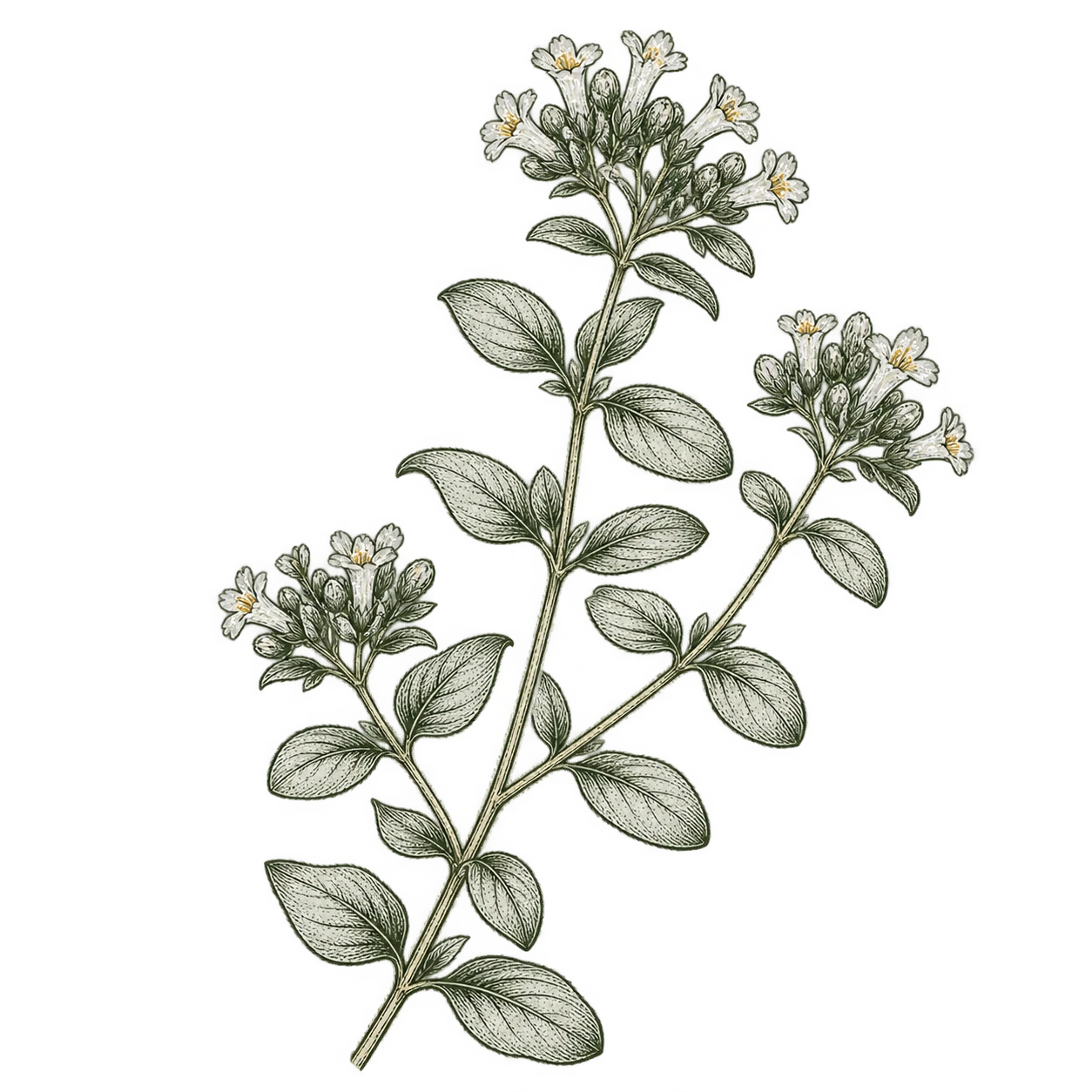
Engraved Syrian oregano sprig with opposite oval leaves and pale flowers.
Syrian oregano, a proposed biblical identification
Read scripture, story and ingredient details

In the King James Bible

Probable botanical identification

A bunch of hyssop carries the Passover blood in Exodus, and the psalm uses hyssop in a prayer for cleansing. Origanum syriacum is a well-supported botanical candidate, including a reported Samaritan ritual tradition, but the identification remains uncertain. The name should not be equated automatically with Hyssopus officinalis.

And ye shall take a bunch of hyssop, and dip it in the blood that is in the bason, and strike the lintel and the two side posts with the blood that is in the bason; and none of you shall go out at the door of his house until the morning.

Exodus 12:22 (KJV)

Purge me with hyssop, and I shall be clean: wash me, and I shall be whiter than snow.

Psalm 51:7 (KJV)
Scripture and identification sources

WORDS & THEIR STORIES

The name behind the KJV

Biblical Hebrew · Exodus 12:22 (KJV)

אֵזוֹב

ʾēzōb

The plant conventionally translated “hyssop,” gathered in a bunch for the Passover doorway rite.

Dictionary form: אֵזוֹב · ʾēzōb

The verse-form and dictionary form are the same. The familiar spelling “ezov” reflects another transliteration convention.

Word sources

Biblical Hebrew · Psalm 51:7 (KJV); Psalm 51:9 in the Hebrew edition

בְאֵזוֹב

bəʾēzōb

“With hyssop,” in a prayer for cleansing.

Dictionary form: אֵזוֹב · ʾēzōb

The attached bə- means “with” here. The Hebrew edition counts the psalm’s two introductory lines as verses, shifting this reference by two.

Word sources

What the language reveals

Origanum syriacum is a leading candidate, not a settled identification for every passage. The Hebrew name does not establish modern garden hyssop, Hyssopus officinalis.

Language and identification bibliography
History, folklore and traditional uses

History, folklore and traditional uses

Hyssop is small enough to be gathered into a bunch, yet its biblical associations are large. In Exodus it is used in the Passover instructions; Leviticus and Numbers connect it with ceremonies of purification. Psalm 51 then draws on this world of cleansing to express a desire for inner renewal. That repeated ritual setting gave the small plant a lasting symbolic force.

Musselman favors Origanum syriacum, an eastern Mediterranean aromatic herb, and reports that Samaritans identified the plant used in their Passover sprinkling rites as za’atar. The same candidate belongs to an everyday culinary tradition. Yet familiar English names can mislead: modern garden hyssop, Syrian oregano and anise hyssop are not a single botanical entity. The puzzling wall-growing plant in 1 Kings and the sponge-bearing hyssop in John also discourage an overconfident identification of every occurrence.

Traditional, historical and reported uses
  1. Passover application
    Historical recordWhy this label?

    Specific Exodus passage documents ritual handling of plant material.

    Exodus 12:22 describes a gathered bunch in the Passover doorway rite. This is one of the clearest biblical details about how the plant material was handled.

  2. Ceremonial purification
    Historical recordWhy this label?

    Named Leviticus and Numbers passages document purification rites.

    Leviticus 14 associates hyssop with cedar wood and scarlet in purification; Numbers 19 includes it in the red-heifer rite and sprinkling. These repeated appearances made it a recognizable ritual material.

  3. An image of spiritual cleansing
    Historical recordWhy this label?

    Specific Psalm documents devotional literary imagery.

    Psalm 51:7 turns the familiar language of ritual cleansing into a plea for renewal. Its pairing of hyssop with washing and snow gives the plant an enduring devotional association.

  4. The crucifixion sponge
    Historical recordWhy this label?

    Specific Gospel passage documents the sponge account.

    John 19:29 places hyssop with a vinegar-filled sponge offered to Jesus. The exact physical arrangement remains a question in discussions of the plant’s identity.

  5. Candidate herb as a culinary seasoning
    Food or household practiceWhy this label?

    Candidate species used in the za'atar culinary tradition.

    Musselman describes Origanum syriacum in the za’atar food tradition. This is a documented use of the candidate species, kept separate from certainty about the biblical name.

Five entries cover ritual, literary and candidate-culinary uses.

Story sources
125Full ingredient reference
Read the journal page

The biblical plant called hyssop or ezov has a strong ritual history but an uncertain modern identification. Origanum syriacum is a prominent candidate; the name does not prove Hyssopus officinalis.

Ask about this ingredient

What’s inside

No single chemical profile is established for biblical hyssop. Constituents of a verified modern Origanum or Hyssopus preparation cannot settle the ancient name.

Ingredient details, preparation and research

Also known as: Ezov / esov (transliterations); Syrian hyssop (candidate common name)

Source plant or material

A small plant used as a bunch in Exodus and in purification rites. Modern Syrian oregano is a plausible candidate; alternative proposals and difficult passages remain.

Plant family / material: Unresolved for the biblical name; the Origanum syriacum candidate belongs to Lamiaceae.

Forms and route

A bunch or plant material used in ritual settings in the biblical text. Culinary Syrian oregano/za’atar and commercial hyssop essential oil are different modern products, not interchangeable biblical forms.

Vitamins and minerals

This is a historical-material entry, not a dietary recommendation. The biblical name supplies no dependable modern food identity, serving size or vitamin/mineral values.

Absorption and preparation

No absorption guidance or medicinal dose is assigned to this uncertain ancient material. A modern product would require its own verified identity, preparation and safety assessment.

Traditional and reported uses

  • Biblical ritual application and purification; an image of spiritual cleansing.
  • A leading candidate, Origanum syriacum, also has a separate culinary za’atar tradition.

Contraindications and cautions

  • Do not infer that a product labeled “hyssop,” especially an essential oil, is the biblical plant or has the same preparation.
  • “Purge me” in Psalm 51 is not a recommendation to drink a purgative or use hyssop to treat infection.

Similar items and how they compare

  • Garden hyssop

    Hyssopus officinalis is commonly sold simply as hyssop.

    Its modern name does not establish that it is the biblical ezov.

  • Syrian oregano / za’atar

    Origanum syriacum is a leading biblical-hyssop candidate.

    A culinary herb or seasoning blend still requires its own ingredient identity.

Candidate botany

Kew accepts Origanum syriacum as a Lamiaceae subshrub native from the eastern Mediterranean to the Arabian Peninsula. This establishes the candidate’s botany, not the identity of every biblical hyssop.

Ritual continuity and its limits

Musselman’s report of Samaritan za’atar use supports continuity of a candidate tradition. It does not eliminate the textual and botanical difficulties he discusses.

What the passages do not supply

The cited verses do not specify distilled oil, nutrient intake, oral dosing or an absorption method. Their uses are presented in their ritual and literary settings.

Evidence limits

  • Ancient names do not provide a verified modern species or product specification.
  • Historical practice is recorded as history and does not establish present-day medical benefit or safety.

Entry sources

View this ingredient in the current reference

Fruit oil

Olive oil

Olea europaea

Biblical references

Olive oil is extracted from the fleshy olive fruit. Mediterranean cooking, athletic rituals, household care and soap-making all form part of its history.

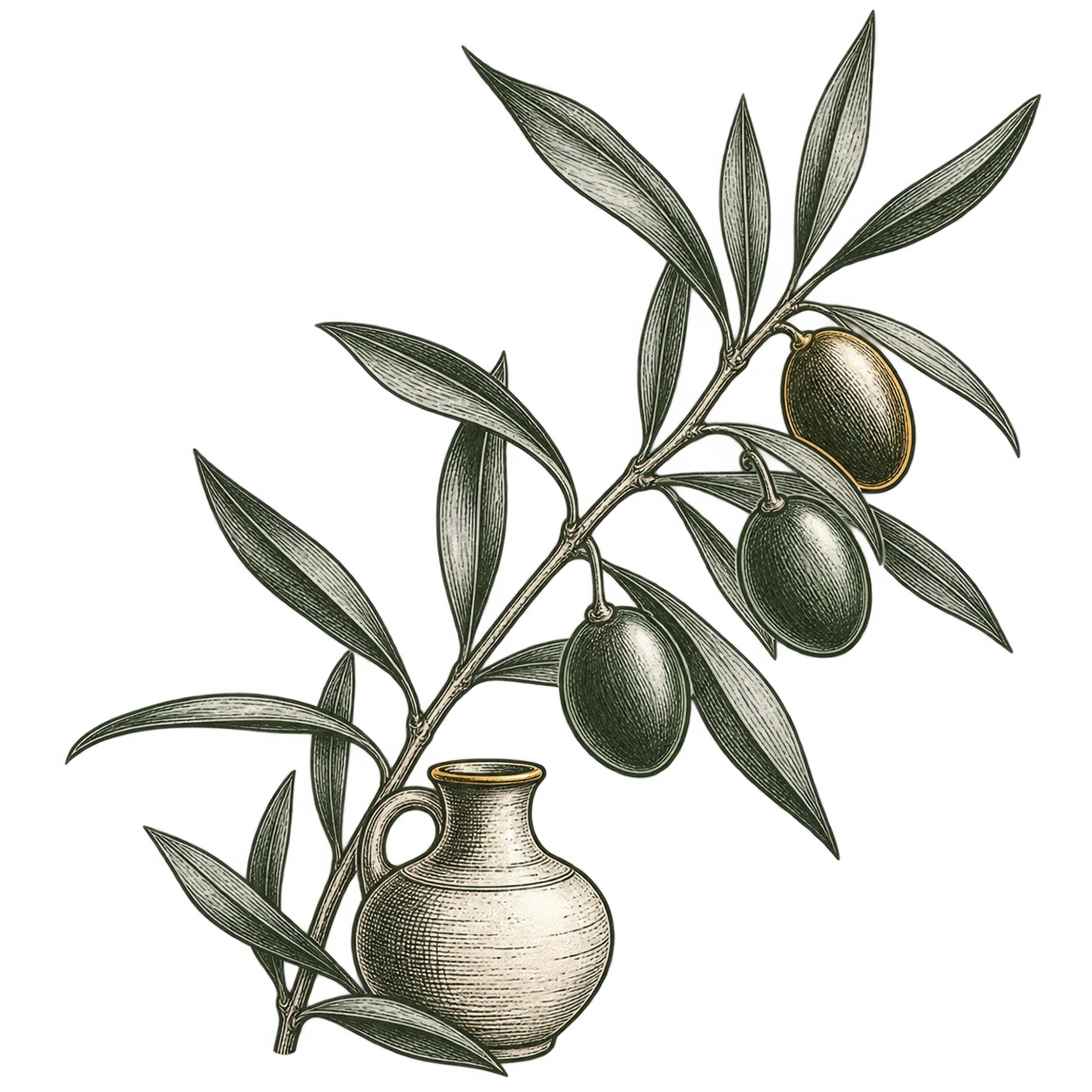
Engraved olive branch with narrow leaves, olive fruit and a small oil vessel.
Original botanical illustration
Read scripture, story and ingredient details

Olive oil in the KJV

Named material

Beaten olive oil supplies the tabernacle lamps in Exodus. Deuteronomy also includes “oil olive” among the good produce of the promised land, connecting olive oil with both worship and everyday provision.

And thou shalt command the children of Israel, that they bring thee pure oil olive beaten for the light, to cause the lamp to burn always.

Exodus 27:20 (KJV)

A land of wheat, and barley, and vines, and fig trees, and pomegranates; a land of oil olive, and honey;

Deuteronomy 8:8 (KJV)
Scripture and identification sources

WORDS & THEIR STORIES

The name behind the KJV

Biblical Hebrew · Exodus 27:20 (KJV)

שֶׁמֶן זַיִת

šemen zayit

Olive oil, literally “oil of olive,” supplied for the lamp.

Dictionary form: שֶׁמֶן · זַיִת · šemen · zayit

Dictionary forms: šemen means oil; zayit means olive or olive tree.

Word sources

Biblical Hebrew · Deuteronomy 8:8 (KJV)

זֵית שֶׁמֶן

zēt šemen

Oil-yielding olive, in a description of the land’s produce.

Dictionary form: זַיִת · שֶׁמֶן · zayit · šemen

Zēt is the linking, or construct, form of zayit. The KJV renders the phrase “oil olive.”

Word sources

What the language reveals

The olive identification is strong, but these words specify no modern cultivar, extra-virgin classification or medicinal effect.

Language and identification bibliography
History, folklore and traditional uses

Skin softening in household care

A survey at four shopping malls in Riyadh, Saudi Arabia, found moisturizing was the leading reason participants applied olive oil to their skin. Friends and relatives were their main sources of advice, showing how this household practice travels through personal relationships.

Alnemer et al.: The use of olive oil for skin health in a Saudi population

A base for liniments and rubbing oils

Grieve describes olive oil as a carrier in liniments, rubbing preparations used for muscle and joint complaints. The oil helped the other ingredients spread across the skin.

Maud Grieve, A Modern Herbal (1931): Olive, oil uses

An old laxative and soothing internal oil

In A Modern Herbal, expressed olive fruit oil appears as a laxative and a demulcent, a preparation intended to soothe irritated tissues. This historical internal use is separate from olive-leaf medicine.

Maud Grieve, A Modern Herbal (1931): Olive, oil uses

Softening obstructive earwax

NHS self-care guidance describes olive oil for softening earwax. This concerns a wax blockage, not treatment of an ear infection.

NHS: Earwax build-up, olive and almond oil

Mediterranean food and convalescent cooking

Olive oil traditionally supplied both cooking fat and a raw dressing in Mediterranean meals. Grieve also describes it as a food for people recovering from illness, connecting everyday nourishment with the older sickroom.

International Olive Council: Olive oil and gastronomy · Maud Grieve, A Modern Herbal (1931): Olive, oil uses

Fuel for Mediterranean lamps

Olive fruit oil supplied sanctuary lamps around the Mediterranean in antiquity and the Middle Ages. The Metropolitan Museum connects this lighting tradition with surviving lamps and manuscript imagery, showing an everyday material role beyond food and bodily care.

Metropolitan Museum of Art: Light and Life

The soap-making craft of Nablus

Nablus, a Palestinian city, developed a longstanding soap industry around locally produced olive oil. The State of Palestine’s tentative World Heritage submission, published by UNESCO, describes oil-storage cisterns and purpose-built factories that shaped the city’s economy and identity.

UNESCO World Heritage Centre: The Historic City of Nablus and its environs, State of Palestine tentative-list submission

Athletes, sacred groves and prize jars

Ancient Greek athletes oiled their bodies before exercise and removed the oil and dirt with a strigil, a curved scraping tool. At the Panathenaic games, held in Athens in honour of the goddess Athena, victors received valuable oil from her sacred groves. The prize amphorae, large painted storage jars, showed Athena and the sporting event.

The Metropolitan Museum of Art: The Ancient Olympics and Other Athletic Games · The Metropolitan Museum of Art: Greek Art, resource for educators, athlete and strigil discussion

26Full ingredient reference
Read the journal page

Olea europaea L.; fixed oil from the fleshy olive fruit, principally its pulp. Olive-leaf extracts are a separate preparation.

Ask about this ingredient

What’s inside

Oleic-rich triglycerides, smaller amounts of other fatty acids, and minor tocopherols and sterols. Cultivar and processing affect the finished profile; no universal phenolic content is assigned.

Analysis of olive and hazelnut oil mixtures by HPLC of triacylglycerols and chromatography of tocopherols and sterols

Ingredient details, preparation and research

Also known as: Olive fruit oil; Olea europaea fruit oil; Extra virgin olive oil; Extra-virgin olive oil; Virgin olive oil; EVOO

Source plant or material

Olea europaea L.; Fleshy olive fruit, principally the pulp; fruit oil rather than leaves or an isolated seed nutrient profile.

Plant family / material: Oleaceae (olive family)

Forms and route

Food-grade virgin/extra-virgin oils and refined/virgin blends; separately labeled cosmetic oils, soaps and topical mixtures. Herbal-infused oils also require review of the added herb.

Vitamins and minerals

USDA’s reference tablespoon of olive oil weighs 13.5 g and provides 1.94 mg vitamin E (about 13% Daily Value). NIH ODS lists about 8 micrograms vitamin K per tablespoon (about 7% DV). These are food-reference values, not a medicinal dose or a guarantee for a particular bottle.

Absorption and preparation

Food-grade oil contributes meal fat that supports uptake of fat-soluble nutrients; no separate therapeutic spoonful is implied. Skin use is local and has its own tolerance questions, and does not count toward dietary vitamin E or K intake.

Traditional and reported uses

  • Traditional food use: cooking, dressing and meal fat. Dietary benefit concerns replacing more saturated fat.
  • Household/cosmetic use: skin softening, makeup removal and a carrier for massage or salves.
  • Hair lengths: olive oil can coat and soften strands for lubrication and shine; this is different from treating hair loss.

Contraindications and cautions

  • Only food-grade oil belongs in food; do not swallow cosmetic oils, soaps or fragranced mixtures. Avoid a product containing an ingredient you are known to be allergic to. Repeated direct application can irritate skin; use particular caution with eczema, inflamed or acne-prone skin, and stop if it worsens. Do not substitute a homemade oil or herbal infusion for care of a significant wound. The added herb needs its own review.

Preparation-specific cautions

  • Only food-grade oil belongs in food; do not swallow cosmetic oils, soaps or fragranced mixtures. Avoid a product containing an ingredient you are known to be allergic to.
  • Repeated direct application can irritate skin; use particular caution with eczema, inflamed or acne-prone skin, and stop if it worsens.
  • Do not substitute a homemade oil or herbal infusion for care of a significant wound. The added herb needs its own review.

Similar items and how they compare

  • Avocado oil

    Another oleic-rich fruit-pulp fixed oil.

    Different fruit, processing and minor constituents; the olive-oil nutrient serving cannot be copied to it.

  • Hazelnut oil

    A broadly similar oleic-rich fixed oil.

    A kernel oil with its own allergy considerations and nutrient profile.

Botanical identity and grades

Olea europaea L., family Oleaceae, supplies fixed oil from the fleshy fruit, principally its pulp. Virgin/extra-virgin oil is obtained mechanically or physically; retail olive oil commonly blends refined and virgin oil. Grade describes processing/quality, not a medicinal dose. Some technical or unfit grades are not directly edible. Olive-leaf extracts are different products.

Traditional food and household use

Olive oil is a longstanding Mediterranean food for cooking and dressing. Reported household/cosmetic uses include skin softening, loosening makeup, massage and carrying ingredients in salves. These are food, use and formulation roles, not proof that kitchen oil treats eczema or wounds. An added herb needs its own review.

Composition and verified food serving

Olive oil is oleic-rich, with tocopherols and sterols among its minor constituents. USDA’s reference 1 tablespoon portion is 13.5 g and provides 1.94 mg vitamin E, about 13% DV. NIH ODS lists about 8 micrograms vitamin K per tablespoon, about 7% DV. The household/mass pairing comes from a dated USDA reference; no unverified mL conversion is added. Cultivar, processing and the actual bottle can differ.

Meal fat and dietary context

Meal fat supports uptake of fat-soluble nutrients. A small crossover trial found greater carotenoid absorption from salad with olive oil than coconut oil; it does not establish a required tablespoon amount or superiority for every nutrient. Dietary benefit concerns replacing fats higher in saturated fat. FDA describes the oleic-acid coronary-risk evidence as supportive, not conclusive; adding extra oil is not a treatment.

Topical tolerance and safety

Two small forearm-controlled studies totaling 19 adults found impaired outer-skin barrier integrity and mild redness after repeated application. This does not quantify everyone’s risk, but supports caution with eczema-prone, inflamed or acne-prone skin. Stop if it worsens. Avoid known allergenic ingredients, do not swallow cosmetic/fragranced mixtures and do not replace significant-wound care with homemade oil.

Food and skin routes stay separate

Food use and topical response are different outcomes. Topical oil is not a dietary vitamin E/K serving and does not reproduce meal-fat absorption effects. A cosmetic formulation may include other ingredients; an infused oil cannot be assessed from the carrier alone. Brand-specific nutrients or phenolics require a label or assay.

Related fixed oils

Avocado is another oleic-rich fruit-pulp oil. Hazelnut oil has a broadly similar fatty-acid pattern but comes from kernels, with its own allergy and processing questions. Similarity does not make oils interchangeable or justify copying olive-oil nutrient amounts to another oil.

Hair care: cosmetic role and evidence limits

Hair-fiber laboratory evidence addresses oil penetration and surface behavior, not new follicle growth. Olive oil can be used cosmetically for coating, softness and lubrication, but individual feel and detangling depend on hair and formulation. Existing cautions about irritation and eczema-prone skin still apply; a hair-shaft use is not a reason to coat an inflamed scalp. Cosmetic conditioning can improve the feel or appearance of existing lengths; it is not evidence of new hair growth. Oils do not add water to hair: laboratory moisture studies address changes in water movement, not a universal “hydration” effect. Use a small amount of a tolerated hair product on lengths or ends according to its label, alongside conditioner and gentle detangling. Stop for irritation; persistent scalp itching, redness or loss needs assessment.

Evidence limits

  • A particular bottle may have a different nutrient or phenolic profile; a product label or assay is needed for brand-specific amounts.
  • The live FoodData Central detail endpoint did not render during this review. The nutrient amounts and household/mass pairing were independently checked against USDA’s direct SR28 vitamin E report and NIH ODS vitamin K table; the legacy date is explicit.
  • Cosmetic formulation, concentration, other ingredients and the added herb in an infusion need their own assessment.

Entry sources

View this ingredient in the current reference

Culinary and scalp herb

Rosemary leaf

Salvia rosmarinus

Rosemary is a fragrant Mediterranean evergreen shrub with narrow leaves used fresh or dried in cooking. Its sprigs also have a long place in household remedies, garden writing and ceremonies of remembrance.

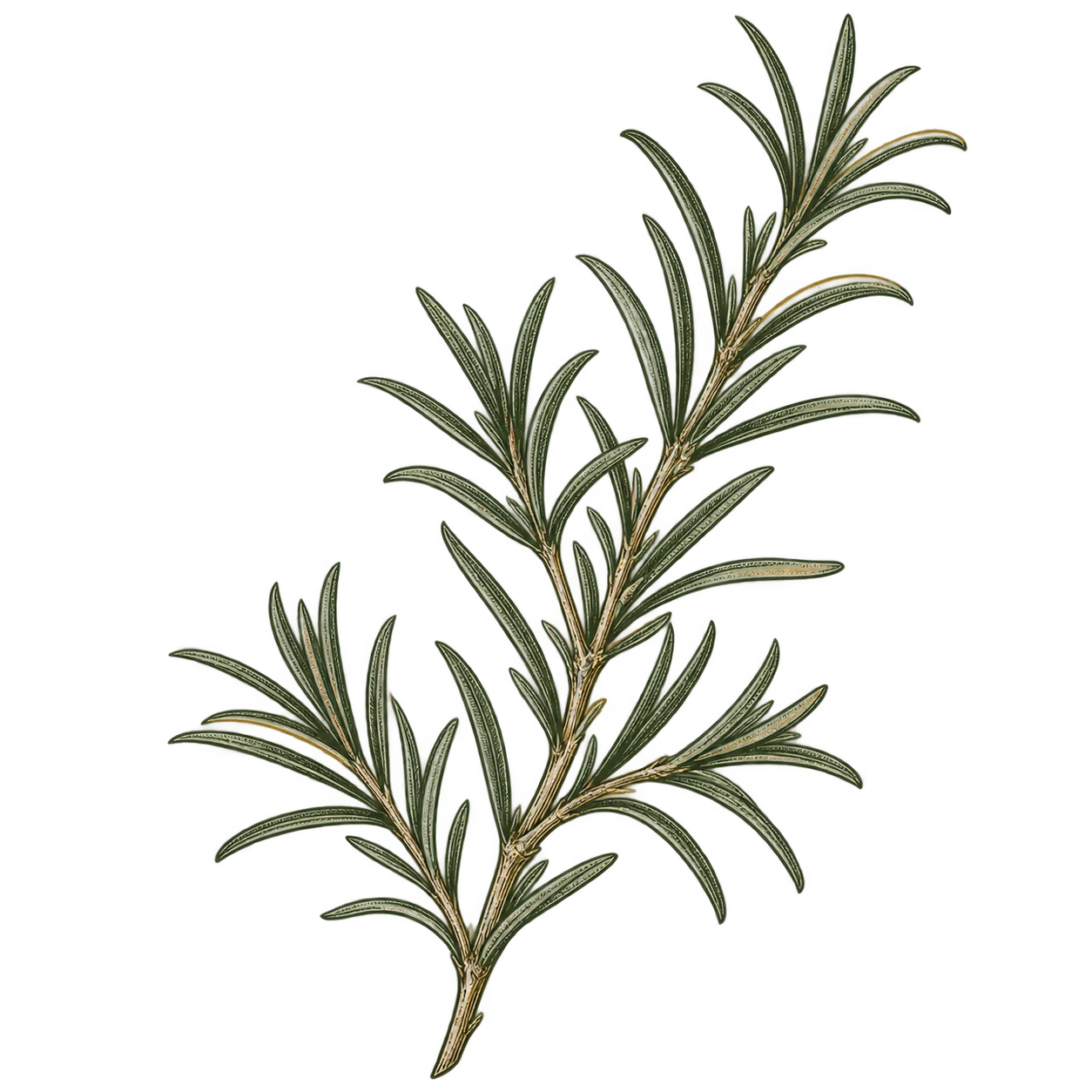
Engraved rosemary sprig with fine linear leaves and a woody stem.
Original botanical illustration
Read scripture, story and ingredient details
History, folklore and traditional uses

Food and local knowledge

A survey in Ancona, in the Marche region of central Italy, records leaves and flowers as seasonings and ravioli ingredients. Informants also described giving leaves to dairy cattle to flavour milk. That second practice is ethnographic reporting, not animal-feeding advice.

Lucchetti et al. (2019): Ethnobotanical uses in the Ancona district, Table 1

Leaf teas, baths and household remedies

EMA documents European leaf teas for mild digestive discomfort and leaf baths for minor muscle, joint and circulation complaints. Its historical review also records hair tonics and wound or eczema dressings. In Ancona, informants described digestive decoctions, meaning leaves simmered in water, hair-shine rinses, scented baths and skin ointments. These are attributed practices; current guidance advises against leaf preparations on broken or irritated skin.

EMA: Rosemary leaf public assessment summary, published March 2026 · EMA: Final rosemary leaf and oil assessment, revision 1, May 2024 · Lucchetti et al. (2019): Ethnobotanical uses in the Ancona district, Table 1 · EMA: Rosemary leaf monograph, revised May 2024

Medieval remedies and remembrance

The Met describes the Old English Herbarium, translated around 1000, recording rosemary in a fatty wound preparation and its juice for itching and toothache. A translated remedy is not proof that the shrub grew in England then. Early writers credited it with strengthening memory. John Parkinson later described sprigs at weddings and funerals, while Shakespeare used rosemary’s remembrance symbolism through Ophelia in Hamlet.

The Met: The Virtues of Rosemary

Growing advice and protective lore

Henry Daniel, a late-fourteenth-century English friar and medical writer, combined rosemary remedies, gardening and sacred lore. He warned that the Mediterranean shrub needed shelter from English frost and cold winds. Later medieval writings credited carried powdered flowers with cheerfulness and comfort, and a branch over the doorway with keeping snakes out. These protective powers belong to historical belief.

University of Toronto, Henry Daniel Project: Henry Daniel and his rosemary writing · The Met: The Virtues of Rosemary

St John’s-night customs

The Ancona survey also records rosemary among herbs placed in pockets or under pillows as protection against witches on St John’s night, the Christian midsummer celebration. This is a regional custom, rather than a property of the plant.

Lucchetti et al. (2019): Ethnobotanical uses in the Ancona district, Table 1

Fragrance in plague-time Europe

Odeuropa places rosemary among fragrant materials burned to scent rooms, scattered on floors and carried for protection during European plague outbreaks. Under the miasma theory, illness was attributed to harmful air, so scent was believed to change that air rather than simply hide an odour.

Odeuropa Encyclopedia of Smell History and Heritage: Plague · CDC: Clinical Care of Plague

Antioxidant research in plants and the laboratory

A 2017 study tested carnosic acid and carnosol in laboratory lipid systems and in plant tissues. Both limited oxidative damage to fats, but through different mechanisms. The work helps explain rosemary’s own chemical defences against environmental stress; it did not test disease prevention in people eating rosemary.

Loussouarn et al. 2017: Carnosic acid and carnosol antioxidant mechanisms

Anti-inflammatory cell research

A 2011 experiment tested a leaf extract made using pressurised carbon dioxide, together with purified carnosic acid, in cultured mouse immune cells. Both reduced several signals involved in inflammation. This was a specialised extract and a cell experiment, not evidence that rosemary tea or a bath treats inflammatory disease.

Kuo et al. 2011: Rosemary leaf extract and carnosic acid in mouse immune cells

Dried-leaf memory research

A small crossover trial enrolled 28 healthy older adults and tested dried rosemary powder in tomato juice. At 750 mg, performance on a memory-speed measure was better than with placebo; at 6,000 mg it was worse. Some other attention and memory measures also worsened. Tests lasted only hours, and the spice-industry-funded study does not establish lasting memory improvement or dementia treatment.

Pengelly et al. 2012: Short-term dried-rosemary study in older adults

The separate rosemary-oil hair trial

A 2015 trial assigned 100 people with pattern hair loss to a rosemary-oil preparation or 2% minoxidil for six months. Hair counts improved in both groups at six months, but not at three. There was no placebo group; a nonsignificant difference between treatments does not prove they work equally well. Itching increased in both groups. This study did not test homemade rosemary water.

Panahi et al. 2015: Rosemary oil compared with 2% minoxidil

14Full ingredient reference
Read the journal page

Salvia rosmarinus Spenn. (syn. Rosmarinus officinalis L.); leaves. EMA retains the older botanical name in its medicinal monographs.

Ask about this ingredient

What’s inside

Edible leaf, water infusion, alcohol extract, carrier-oil infusion and steam-distilled essential oil contain different mixtures.

EMA: Final rosemary leaf and oil assessment, revision 1, May 2024

Nutrients in a culinary serving

These approximate values describe one teaspoon of dried rosemary, about 1.2 g. They apply to the eaten leaf, not to a strained tea or a scalp rinse. This is a food portion, not a medicinal dose.

  • Energy: about 4 kcal
  • Carbohydrate: 0.77 g, including 0.51 g fiber
  • Protein: 0.06 g
  • Fat: 0.18 g
  • Calcium: about 15 mg
  • Iron: 0.35 mg
  • Magnesium: about 2.6 mg
  • Potassium: about 11.5 mg

USDA FoodData Central: SR Legacy dried rosemary, FDC 171333 · University Hospitals: Dried rosemary, one-teaspoon nutrient table · NIH-hosted USDA nutrient table: iron in a teaspoon of dried rosemary

Phenolic compounds

Rosmarinic acid is a phenolic acid; carnosic acid and carnosol are phenolic diterpenes. These are research constituents, not proof of a health effect from a meal or rinse.

EMA: Final rosemary leaf and oil assessment, revision 1, May 2024 · Loussouarn et al. 2017: Carnosic acid and carnosol antioxidant mechanisms

Other plant compounds

Other leaf compounds include flavonoids such as apigenin and diosmin, and triterpene acids such as ursolic and oleanolic acid.

EMA: Final rosemary leaf and oil assessment, revision 1, May 2024

Aromatic oil

The volatile oil includes 1,8-cineole, also called eucalyptol, camphor, pinene and borneol. Distillation concentrates fragrance without reproducing the leaf’s nonvolatile phenolic mixture.

EMA: Final rosemary leaf and oil assessment, revision 1, May 2024

Ingredient details, preparation and research

Source plant or material

Salvia rosmarinus Spenn. (syn. Rosmarinus officinalis L.); fresh culinary leaves or dried medicinal leaf.

Plant family / material: Lamiaceae (mint family).

Forms and route

Culinary leaf, labeled medicinal leaf tea, bath preparations and manufactured extracts. Household leaf rinses, oil infusions and distilled rosemary essential oil are distinct materials; the EMA leaf monograph centers on tea and bath use.

Absorption and preparation

Human absorption from an ordinary rosemary leaf rinse or bath is poorly characterized. Water, alcohol extracts and steam-distilled oil are not equivalent. Do not use laboratory permeation studies to justify stronger alcohol preparations, heating, covering the treated skin with an airtight dressing or application to damaged skin.

Traditional and reported uses

  • Traditional European oral use: mild indigestion and digestive cramps.
  • Traditional European external use: aromatic leaf baths for minor muscle/joint discomfort and minor peripheral-circulation symptoms.
  • Folk body/scalp use: hair tonics and skin dressings, recorded in EMA’s historical review. Household hair-rinse use is not established treatment for pattern hair loss, dandruff or eczema.
  • Emerging human scalp research concerns a manufactured rosemary-extract lotion, not culinary leaf water.

Contraindications and cautions

  • For oral medicinal leaf use, bile-duct blockage or inflammation, gallstones or liver disease require medical advice.
  • Avoid known rosemary allergy and do not apply leaf bath/rinse preparations to broken or irritated skin. Stop for contact dermatitis.
  • EMA does not recommend medicinal leaf use below age 12 or during pregnancy/breastfeeding. Culinary seasoning is a different exposure.
  • Hot/full baths are inappropriate with major skin injury, fever, severe infection, serious circulatory problems or heart failure; hypertension warrants caution.
  • Persistent or sudden hair loss, scalp pain or marked inflammation needs assessment. Painful, red or swollen legs and joints with fever should not be managed with an herbal bath.
  • Do not swallow essential oil in place of tea or store a homemade water rinse as though it were a preserved cosmetic.
  • Seek medical advice if digestive symptoms last beyond two weeks, bath-treated symptoms beyond four weeks, or symptoms worsen.
  • Do not increase rosemary intake in an attempt to improve memory. The small dried-leaf trial found adverse cognitive effects as well as favourable results, and did not establish a long-term medicinal regimen.

Similar items and how they compare

  • Rosemary essential oil

    Same plant with some shared aromatic constituents.

    The oil concentrates volatiles and does not reproduce the leaf’s nonvolatile phenolic mixture or tea exposure.

  • Lavender flowers

    Both are fragrant mint-family herbs with culinary and bath/body-care traditions.

    Lavender uses flowers and emphasizes floral/calming traditions; rosemary uses leaves with different digestive and bath roles.

Botanical naming

Kew accepts the name Salvia rosmarinus for this mint-family shrub. Older research and EMA monographs use Rosmarinus officinalis, so both names matter when looking up evidence.

What traditional-use recognition means

EMA’s leaf-tea and bath indications rest on long-standing medicinal use. That category is different from a conclusion based on sufficient clinical trials, and it does not extend to every homemade preparation.

Why extract composition varies

In EMA’s review, laboratory methanol extracts showed phenolic levels varying with Turkish growing region and harvest season. These measurements do not describe every tincture or water rinse.

Hair-growth findings in mice and cells

Murata and colleagues studied rosemary leaf extract in mice and in laboratory assays involving androgen hormones. They identified 12-methoxycarnosic acid as a candidate inhibitor of an enzyme involved in forming DHT, a hormone linked to pattern hair loss. This does not demonstrate DHT reduction or hair regrowth in people using a household rinse.

A small trial for a flaky, itchy scalp

A 2024 trial enrolled 42 adults with scalp seborrheic dermatitis, an inflammatory condition causing flaking and itch; 39 completed two months. A manufactured 5% rosemary-extract lotion reduced itch more, while 2% ketoconazole reduced scaling more. Two rosemary users withdrew with burning or itching. The small study and incomplete chemical description limit its application to other products, especially leaf water or distilled oil.

Simple preparation concepts

For oral use, select food/herbal-tea-grade leaf and follow its label. A cooled, strained leaf infusion used as an intact-scalp rinse is a household aromatic preparation, not the tested lotion. Keep utensils clean, use promptly and discard leftovers. Do not add it to stored shampoo or rely on rosemary to preserve a water-based blend.

Route-specific safety

Oral medicinal leaf warnings include biliary and liver disease; these should not automatically be assigned to every diluted topical product. EMA leaf medicines are not recommended below 12 or during pregnancy/breastfeeding. Contact dermatitis can occur. Bath suitability also depends on skin integrity, fever and cardiovascular health.

Putting dietary values in context

A teaspoon’s calcium and iron amount to roughly 1% and 2% of the FDA Daily Values. Those percentages describe dietary contribution, not a reason to use larger medicinal amounts or to expect nutrients to reach the body through a scalp rinse.

Similar items

Rosemary essential oil is the concentrated volatile companion; lavender flowers offer a different fragrant mint-family herb used in food and body care. Neither similarity validates a therapeutic blend or substitution.

Plague care boundary

No historical plant or material here is established to prevent or cure plague. Suspected plague requires urgent medical assessment and prompt antibiotics.

Entry sources

View this ingredient in the current reference