


Key cautions
- Do not infer that a product labeled “hyssop,” especially an essential oil, is the biblical plant or has the same preparation.
- “Purge me” in Psalm 51 is not a recommendation to drink a purgative or use hyssop to treat infection.
What’s inside
No single chemical profile is established for biblical hyssop. Constituents of a verified modern Origanum or Hyssopus preparation cannot settle the ancient name.
Uses in brief

- Biblical ritual application and purification; an image of spiritual cleansing.
- A leading candidate, Origanum syriacum, also has a separate culinary za’atar tradition.
In the King James Bible
In the King James Bible
Probable botanical identification
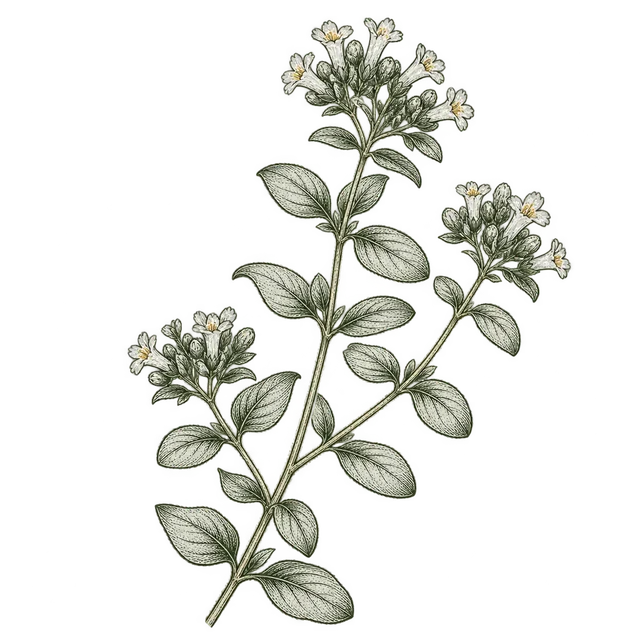
A bunch of hyssop carries the Passover blood in Exodus, and the psalm uses hyssop in a prayer for cleansing. Origanum syriacum is a well-supported botanical candidate, including a reported Samaritan ritual tradition, but the identification remains uncertain. The name should not be equated automatically with Hyssopus officinalis.
And ye shall take a bunch of hyssop, and dip it in the blood that is in the bason, and strike the lintel and the two side posts with the blood that is in the bason; and none of you shall go out at the door of his house until the morning.
Exodus 12:22 (KJV)
Purge me with hyssop, and I shall be clean: wash me, and I shall be whiter than snow.
Psalm 51:7 (KJV)
Words & their stories
WORDS & THEIR STORIES
The name behind the KJV
Biblical Hebrew · Exodus 12:22 (KJV)
אֵזוֹבʾēzōb
The plant conventionally translated “hyssop,” gathered in a bunch for the Passover doorway rite.
Dictionary form: אֵזוֹב · ʾēzōb
The verse-form and dictionary form are the same. The familiar spelling “ezov” reflects another transliteration convention.
Biblical Hebrew · Psalm 51:7 (KJV); Psalm 51:9 in the Hebrew edition
בְאֵזוֹבbəʾēzōb
“With hyssop,” in a prayer for cleansing.
Dictionary form: אֵזוֹב · ʾēzōb
The attached bə- means “with” here. The Hebrew edition counts the psalm’s two introductory lines as verses, shifting this reference by two.
What the language reveals
A bunch becomes an image
Exodus describes a bunch of the plant used in the Passover doorway rite. Psalm 51 uses hyssop in a poetic prayer for cleansing from sin.
A word is not a species label
Brown–Driver–Briggs already cautioned that the name may lack botanical precision. Musselman favors Syrian oregano and records Samaritans identifying their Passover plant as za’atar.
Origanum syriacum is a leading candidate, not a settled identification for every passage. The Hebrew name does not establish modern garden hyssop, Hyssopus officinalis.
Language and identification bibliography
History, folklore and reported uses
History, folklore and traditional uses
Hyssop is small enough to be gathered into a bunch, yet its biblical associations are large. In Exodus it is used in the Passover instructions; Leviticus and Numbers connect it with ceremonies of purification. Psalm 51 then draws on this world of cleansing to express a desire for inner renewal. That repeated ritual setting gave the small plant a lasting symbolic force.
Musselman favors Origanum syriacum, an eastern Mediterranean aromatic herb, and reports that Samaritans identified the plant used in their Passover sprinkling rites as za’atar. The same candidate belongs to an everyday culinary tradition. Yet familiar English names can mislead: modern garden hyssop, Syrian oregano and anise hyssop are not a single botanical entity. The puzzling wall-growing plant in 1 Kings and the sponge-bearing hyssop in John also discourage an overconfident identification of every occurrence.
Traditional, historical and reported uses
- Passover application
Historical recordWhy this label?
Specific Exodus passage documents ritual handling of plant material.
Exodus 12:22 describes a gathered bunch in the Passover doorway rite. This is one of the clearest biblical details about how the plant material was handled.
- Ceremonial purification
Historical recordWhy this label?
Named Leviticus and Numbers passages document purification rites.
Leviticus 14 associates hyssop with cedar wood and scarlet in purification; Numbers 19 includes it in the red-heifer rite and sprinkling. These repeated appearances made it a recognizable ritual material.
- An image of spiritual cleansing
Historical recordWhy this label?
Specific Psalm documents devotional literary imagery.
Psalm 51:7 turns the familiar language of ritual cleansing into a plea for renewal. Its pairing of hyssop with washing and snow gives the plant an enduring devotional association.
- The crucifixion sponge
Historical recordWhy this label?
Specific Gospel passage documents the sponge account.
John 19:29 places hyssop with a vinegar-filled sponge offered to Jesus. The exact physical arrangement remains a question in discussions of the plant’s identity.
- Candidate herb as a culinary seasoning
Food or household practiceWhy this label?
Candidate species used in the za'atar culinary tradition.
Musselman describes Origanum syriacum in the za’atar food tradition. This is a documented use of the candidate species, kept separate from certainty about the biblical name.
Five entries cover ritual, literary and candidate-culinary uses.
Identity & detailed reference
Identity
The biblical plant called hyssop or ezov has a strong ritual history but an uncertain modern identification. Origanum syriacum is a prominent candidate; the name does not prove Hyssopus officinalis.
Ingredient details, preparation and research
Also known as: Ezov / esov (transliterations); Syrian hyssop (candidate common name)
Source plant or material
A small plant used as a bunch in Exodus and in purification rites. Modern Syrian oregano is a plausible candidate; alternative proposals and difficult passages remain.
Plant family / material: Unresolved for the biblical name; the Origanum syriacum candidate belongs to Lamiaceae.
Forms and route
A bunch or plant material used in ritual settings in the biblical text. Culinary Syrian oregano/za’atar and commercial hyssop essential oil are different modern products, not interchangeable biblical forms.
Vitamins and minerals
This is a historical-material entry, not a dietary recommendation. The biblical name supplies no dependable modern food identity, serving size or vitamin/mineral values.
Absorption and preparation
No absorption guidance or medicinal dose is assigned to this uncertain ancient material. A modern product would require its own verified identity, preparation and safety assessment.
Traditional and reported uses
- Biblical ritual application and purification; an image of spiritual cleansing.
- A leading candidate, Origanum syriacum, also has a separate culinary za’atar tradition.
Contraindications and cautions
- Do not infer that a product labeled “hyssop,” especially an essential oil, is the biblical plant or has the same preparation.
- “Purge me” in Psalm 51 is not a recommendation to drink a purgative or use hyssop to treat infection.
Similar items and how they compare
- Garden hyssop
Hyssopus officinalis is commonly sold simply as hyssop.
Its modern name does not establish that it is the biblical ezov.
- Syrian oregano / za’atar
Origanum syriacum is a leading biblical-hyssop candidate.
A culinary herb or seasoning blend still requires its own ingredient identity.
Candidate botany
Kew accepts Origanum syriacum as a Lamiaceae subshrub native from the eastern Mediterranean to the Arabian Peninsula. This establishes the candidate’s botany, not the identity of every biblical hyssop.
Ritual continuity and its limits
Musselman’s report of Samaritan za’atar use supports continuity of a candidate tradition. It does not eliminate the textual and botanical difficulties he discusses.
What the passages do not supply
The cited verses do not specify distilled oil, nutrient intake, oral dosing or an absorption method. Their uses are presented in their ritual and literary settings.
Evidence limits
- Ancient names do not provide a verified modern species or product specification.
- Historical practice is recorded as history and does not establish present-day medical benefit or safety.
Entry sources
- Lytton John Musselman, Old Dominion University: Hyssop
- Kew Plants of the World Online: Origanum syriacum L.
- King James Bible: Exodus 12:22
- King James Bible: Psalm 51:7
- Project Gutenberg: The King James Version of the Bible, ebook 10
- King James Bible: John 19:29
- King James Bible: Leviticus 14:4-7
- King James Bible: Numbers 19:6-18
Reference entry 125 · Recorded content review: 2026-10-06 · Review scope and dates