


Key cautions
- Check product/route and medicines, especially anticoagulants or antiplatelets
- Do not swallow essential oil/incense or substitute for established medical care
- Health Canada’s B. sacra topical monograph excludes deep or puncture wounds, animal bites and serious burns. Avoid eyes and mucous membranes; rinse thoroughly with water after accidental contact. Stop and seek advice for symptoms lasting more than seven days or new symptoms. Keep out of children’s reach; if a topical product is swallowed, contact poison control or obtain medical help promptly.
- The Canadian B. sacra topical and buccal monographs apply to adults 18 and older and contraindicate use during pregnancy or breastfeeding. Buccal means local contact inside the mouth, not a swallowed supplement. Both monographs advise professional guidance for prolonged use.
- Egypt’s 2023 B. serrata monograph lists pre-existing gastritis and hypersensitivity to the ingredient or plants in its family as contraindications. If these apply, do not self-start a medicinal resin product; discuss a suitable alternative with a clinician. The monograph also advises against crude-resin medicinal use in children under 12.
What’s inside
The whole exudate combines gum carbohydrates, aromatic volatile compounds and nonvolatile resin constituents. Extraction selects among these fractions, so a familiar scent does not establish equivalent composition.
Al-Harrasi et al. (2018): Chemical and structural analysis of Boswellia triterpenes · Egyptian Drug Authority (2023): Boswellia serrata resin monograph
Understanding the chemical names
Boswellic acids are resin triterpenes: molecules with a five-ring carbon framework. KBA means 11-keto-beta-boswellic acid; AKBA is its acetylated relative. These named compounds are not essential dietary fatty acids, vitamins or mineral nutrients. An extract standardized to AKBA describes a selected chemical marker, not the entire resin.
Al-Harrasi et al. (2018): Chemical and structural analysis of Boswellia triterpenes · Egyptian Drug Authority (2023): Boswellia serrata resin monograph
Boswellic acids are nonvolatile resin chemistry
Chemical analysis distinguishes pentacyclic triterpenes, including several boswellic acids, from the essential-oil terpene fraction. A study of 21 B. dalzielii resin samples found markedly different alpha-pinene- and myrcene-rich oil profiles. Ordinary distilled oil lacks a useful equivalent of the boswellic-acid fraction in standardized resin extracts; uncommon reports using unusual fractionation do not make a perfume bottle equivalent to a studied oral product.
Al-Harrasi et al. (2018): Chemical and structural analysis of Boswellia triterpenes · Primary chemistry study (2019): Boswellia dalzielii essential oils and two chemotypes
Uses in brief

- Ayurvedic resin tradition; preliminary extract-specific osteoarthritis research
- Aroma and topical products are separate from oral-extract evidence
In the King James Bible
Frankincense in the KJV
Named material
Frankincense appears in the sacred incense of Exodus and among the wise men’s gifts to Jesus. These references concern aromatic Boswellia resin. Its precise species is unspecified, so the connection does not identify Boswellia serrata in particular or an extracted supplement.
And the LORD said unto Moses, Take unto thee sweet spices, stacte, and onycha, and galbanum; these sweet spices with pure frankincense: of each shall there be a like weight:
Exodus 30:34 (KJV)
And when they were come into the house, they saw the young child with Mary his mother, and fell down, and worshipped him: and when they had opened their treasures, they presented unto him gifts; gold, and frankincense and myrrh.
Matthew 2:11 (KJV)
Scripture and identification sources
Words & their stories
WORDS & THEIR STORIES
The name behind the KJV
Biblical Hebrew · Exodus 30:34 (KJV)
וּלְבֹנָהūləbōnāh
“And frankincense,” one ingredient of the sacred incense.
Dictionary form: לְבוֹנָה · ləbōnāh
The opening ū- means “and.” The verse uses a shorter spelling of the dictionary form; both name frankincense.
Koine Greek · Matthew 2:11 (KJV)
λίβανονlíbanon
Frankincense presented among the gifts to Jesus.
Dictionary form: λίβανος · líbanos
Líbanon is the accusative form of líbanos. Checked in Scrivener’s 1894 Textus Receptus, a later reconstruction of the KJV’s Greek textual basis.
What the language reveals
An ingredient and a blend
Exodus names frankincense individually; the next verse describes making the ingredients into incense. The resin and the finished mixture are distinct materials in the passage.
From gift to traded cargo
The same Greek form, λίβανον, appears in Revelation 18:13 among merchants’ cargo. Frankincense belonged to the world of valuable traded goods as well as worship.
Both passages name aromatic resin without fixing its Boswellia species. They do not specifically identify B. serrata, distilled essential oil or a modern extract.
Language and identification bibliography
- Hebrew text: Exodus 30:34–35 (Mechon-Mamre)
- Greek text: Matthew 2:11, Scrivener’s Textus Receptus 1894 (Bible Hub)
- Brown–Driver–Briggs: לְבֹנָה / לְבוֹנָה, frankincense (H3828; Bible Hub transcription)
- Thayer’s Greek Lexicon: λίβανος, frankincense (G3030; Bible Hub transcription)
- Greek text: Revelation 18:13, Scrivener’s Textus Receptus 1894 (Bible Hub)
- Royal Botanic Gardens, Kew: Frankincense, resin with many stories
- Maurice A. Robinson: Introduction to the Scrivener 1894 Greek text (Scripture4All)
History, folklore and reported uses
Species, geography and resin identity
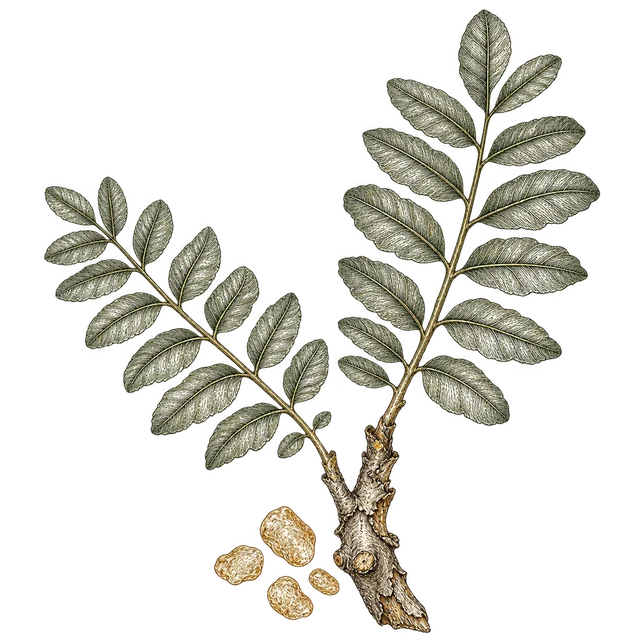
Kew accepts Boswellia serrata Roxb. in Burseraceae and gives its native range as the Indian subcontinent. This avoids transferring the broader geography of frankincense-producing species to B. serrata itself. Resin exudes from bark-associated tissues; B. sacra and B. dalzielii are different source species. Common names and a high percentage on a label are insufficient to establish botanical or extract equivalence.
Kew: Boswellia serrata Roxb., accepted species and Indian-subcontinent range · NCCIH (updated April 2025): Boswellia, usefulness and safety · Primary chemistry study (2019): Boswellia dalzielii essential oils and two chemotypes
A landscape shaped by incense
Frankincense has a landscape as well as a fragrance. UNESCO’s Land of Frankincense in Oman links the Boswellia sacra trees of Wadi Dawkah with an inland caravan oasis and coastal ports. Together they show how resin traveled from a harsh growing environment into a far-reaching luxury trade. The Metropolitan Museum describes incense burned in temples, palaces and homes across the ancient world, with camel caravans carrying frankincense alongside myrrh and other goods.
UNESCO: Land of Frankincense, Oman · Metropolitan Museum of Art: The World Between Empires, southwestern Arabian incense trade · NCCIH (updated April 2025): Boswellia, usefulness and safety
Indian frankincense and Ayurveda
Indian frankincense, Boswellia serrata, belongs to a related but distinct medicinal story. NCCIH records its use in Ayurveda for arthritic discomfort, inflammation and other complaints. This is the species behind much modern interest in oral Boswellia extracts. Holding the Arabian incense story beside the Indian herbal story makes the differences useful rather than inconvenient: “frankincense” names a family of traded resins, not one uniform remedy. A resin burned for fragrance, its distilled oil and an extract selected for boswellic acids represent different ways people have worked with these remarkable trees.
UNESCO: Land of Frankincense, Oman · Metropolitan Museum of Art: The World Between Empires, southwestern Arabian incense trade · NCCIH (updated April 2025): Boswellia, usefulness and safety
Reading the medicinal traditions
The uses below describe historical practice or claims recorded in official herbal monographs. They distinguish swallowed B. serrata resin from B. sacra skin preparations and local mouth rinses. A traditional-use monograph is not a clinical trial, and its manufacturing or labeling directions do not make different preparations interchangeable.
Egyptian Drug Authority (2023): Boswellia serrata resin monograph · Health Canada (2025): Boswellia sacra, topical traditional uses · Health Canada: Boswellia sacra, buccal traditional uses
Arthritic and rheumatic complaints
Ayurvedic practice used Indian frankincense, Boswellia serrata oleogum resin, for arthritic pain and inflammation. NCCIH records this tradition, which continues in dried-resin and extract preparations.
NCCIH (updated April 2025): Boswellia, usefulness and safety · Egyptian Drug Authority (2023): Boswellia serrata resin monograph
Respiratory complaints
Indian boswellia has an Ayurvedic respiratory tradition; Egypt’s 2023 herbal compendium records dried B. serrata resin and resin extracts for asthma and cough. This concerns medicinal resin preparations rather than burning incense for breathlessness.
NCCIH (updated April 2025): Boswellia, usefulness and safety · Egyptian Drug Authority (2023): Boswellia serrata resin monograph
Bowel inflammation in modern herbal medicine
The Egyptian Drug Authority’s B. serrata monograph records oral dried resin and extracts used for inflammatory bowel complaints. It represents the continuing development of medicinal-resin practice in modern herbal compendia.
Egyptian Drug Authority (2023): Boswellia serrata resin monograph
Chinese injury and sore preparations
Traditional Chinese medicine used ru xiang resin preparations for painful swelling, minor injuries and sores. Health Canada’s topical monograph identifies B. sacra stem-bark resin in salves, pastes and related preparations.
Health Canada (2025): Boswellia sacra, topical traditional uses
Gum, mouth and throat rinses
A separate Chinese medicinal tradition used frankincense resin preparations as rinses or gargles for inflamed gums, mouth and throat. Health Canada records this local gum-resin practice under B. sacra.
Omani incense and household fragrance
WIPO describes Boswellia sacra resin in Oman’s incense and fragrance traditions, linked to the growing landscape of Dhofar. This is an aromatic cultural use of resin, not treatment of respiratory illness by smoke inhalation.
Omani perfume-making
Frankincense also supplies Omani perfume-making. WIPO traces the local Boswellia sacra fragrance tradition, and the National Museum of Oman displays Amouage perfume bottles associated with frankincense, rose and amber.
National Museum of Oman: Frankincense perfume bottles · WIPO: Designs, fragrances, and sustaining traditions
A separate Ayurvedic skin tradition
Health Canada’s B. sacra topical monograph also records traditional Ayurvedic use for ringworm, a fungal skin infection. This is an attributed historical use of resin preparations, not evidence that frankincense is a proven antifungal treatment.
Health Canada (2025): Boswellia sacra, topical traditional uses
Preparation, nutrition and similar materials
An extract’s mass, solvent, acid standardization and delivery system matter, so trial regimens should not be converted to generic capsule counts, resin spoonfuls or oil drops. No reliable dietary vitamin/mineral serving or synergy stack is established. Myrrh shares the Burseraceae resin tradition but comes from Commiphora and has different chemistry; frankincense essential oil shares the source resin but not the whole extract.
Al-Harrasi et al. (2018): Chemical and structural analysis of Boswellia triterpenes · Kew: Boswellia serrata Roxb., accepted species and Indian-subcontinent range · Kew: Commiphora myrrha, identity and Burseraceae family · Riva et al. (2016): Twelve-person crossover absorption study of lecithin-formulated Boswellia
What bioavailability means
Bioavailability concerns how much of a substance reaches the bloodstream after a dose. Food and a delivery formulation such as lecithin can change exposure without demonstrating better pain relief. The research below keeps those absorption experiments separate from patient-outcome trials; neither is a recipe for mixing resin with kitchen oil.
Sterk et al. (2004): Food effects on boswellic-acid exposure from BSE-018 · Riva et al. (2016): Twelve-person crossover absorption study of lecithin-formulated Boswellia
Identity & detailed reference
Identity
Frankincense/olibanum is oleo-gum-resin from Boswellia trees in Burseraceae. Most oral-extract evidence summarized here concerns Boswellia serrata Roxb., Indian frankincense. Other species, incense grades, distilled oils and engineered extract formulations can differ substantially.
Ingredient details, preparation and research
Source plant or material
Boswellia serrata Roxb. gum-resin exudate for the main oral-extract evidence. Kew places this species’ native range in the Indian subcontinent; other frankincenses, such as B. sacra and B. dalzielii, are separate species.
Plant family / material: Burseraceae (incense family).
Forms and route
Resin tears or powder; defined oral extracts, sometimes enriched for specified boswellic acids; lecithin or other absorption-modified formulations; topical extract products; separately distilled essential oil and incense. Milligrams of one extract are not interchangeable with another or with raw resin.
Food sources
Not a routine nutritional food. Incense or aroma supplies no dietary nutrients, and resin sold to burn is not automatically a quality-controlled oral supplement.
Vitamins and minerals
Boswellic acids are triterpenes, not vitamins, minerals or essential dietary fatty acids. Resin/extract products have no verified standard nutrient serving here. Milligrams or percent boswellic acids describe botanical composition, not a nutritional Daily Value.
Absorption and preparation
Boswellic-acid exposure depends on the extract, food and formulation. A small BSE-018 study found higher exposure with a high-fat meal; a 12-person single-dose crossover found greater absorption of most measured acids from one lecithin formulation. Pharmacokinetic improvements do not prove superior patient outcomes or justify adding large amounts of fat. Follow the particular product’s directions.
Practical preparation
If considering an oral product, compare the full species, extract mass, stated standardization, formulation and label directions with the actual studied product, with a clinician/pharmacist when treating symptoms. Do not convert trial extract doses to raw resin or oil drops. Keep incense, topical and oral products separate; a high-fat meal is not prescribed as an absorption strategy.
Combination notes
Trials of combinations with turmeric or other ingredients describe those formulations and cannot prove that every added ingredient helps or that effects are synergistic. Lecithin can alter exposure in a particular preparation, but this is not a universal recommendation to combine resin with kitchen oil or supplements. Count all ingredients and avoid duplicating products.
Traditional and reported uses
- Traditional Ayurvedic resin use includes inflammatory and joint complaints; frankincense also has aromatic/incense traditions.
- Some small oral B. serrata-extract trials report better knee-osteoarthritis pain/function, but NCCIH finds insufficient high-quality evidence to determine usefulness for any condition. Products are not interchangeable.
- Digestive and respiratory conditions have been studied, with limited or mixed evidence. A placebo-controlled Crohn’s-remission trial did not establish benefit. These findings do not establish treatment of lactose maldigestion.
- Aromatherapy/topical use is separate from oral-extract research. Cancer-cell or animal experiments do not show a cancer cure in people.
Contraindications and cautions
- Oral extracts can cause digestive upset; topical products can cause contact allergy. Excessive raw-resin intake has caused a gastric bezoar in a case report, so do not improvise large resin doses.
- Check anticoagulant/antiplatelet medicines and other regular treatment with a clinician or pharmacist. Platelet and drug-transporter findings raise possible interactions, but their clinical size is not well established.
- Medicinal-dose pregnancy/breastfeeding safety and child-use evidence are inadequate. Do not replace prescribed treatment for arthritis, asthma, bowel disease or cancer.
- Do not swallow frankincense essential oil or incense preparations. Select a product intended for the route, with species and extract details; stop and seek advice if symptoms worsen.
- Health Canada’s B. sacra topical monograph excludes deep or puncture wounds, animal bites and serious burns. Avoid eyes and mucous membranes; rinse thoroughly with water after accidental contact. Stop and seek advice for symptoms lasting more than seven days or new symptoms. Keep out of children’s reach; if a topical product is swallowed, contact poison control or obtain medical help promptly.
- The Canadian B. sacra topical and buccal monographs apply to adults 18 and older and contraindicate use during pregnancy or breastfeeding. Buccal means local contact inside the mouth, not a swallowed supplement. Both monographs advise professional guidance for prolonged use.
- Egypt’s 2023 B. serrata monograph lists pre-existing gastritis and hypersensitivity to the ingredient or plants in its family as contraindications. If these apply, do not self-start a medicinal resin product; discuss a suitable alternative with a clinician. The monograph also advises against crude-resin medicinal use in children under 12.
Similar items and how they compare
- Frankincense essential oil
Derived from the aromatic resin of Boswellia trees.
Distilled oil mainly contains volatile constituents and lacks the substantial nonvolatile boswellic-acid fraction of resin extracts. Oral-extract doses and evidence cannot be reused for the oil.
- Myrrh (gum-resin)
Another traditional aromatic gum-resin in the same botanical family.
Myrrh comes from Commiphora and has different chemistry and preparation-specific uses; it is not interchangeable with B. serrata extract.
Traditional use and the overall evidence judgment
NCCIH records Ayurvedic use for joint/inflammatory and other complaints and modern supplement marketing for joints and digestion. Its April 2025 review concludes that small, generally low-quality studies leave insufficient high-quality evidence to determine usefulness for any condition. Traditional use and laboratory target activity are legitimate research context, but are not substitutes for adequately powered clinical trials.
A product-specific osteoarthritis example
The 2008 5-Loxin trial randomized 75 knee-osteoarthritis patients, with 70 completing 90 days. It compared placebo with two doses of an extract enriched to 30% AKBA and reported improvements in pain/function scores. Small groups, one center, short follow-up and manufacturer-associated investigators limit certainty. This is evidence about the tested enriched product, not proof that all frankincense preparations repair cartilage or outperform standard treatment.
Negative bowel-disease evidence matters
In the Boswelan Crohn’s-remission study, 82 patients were randomized and 66 were analyzed for efficacy before early termination for lack of separation. Estimated maintained-remission proportions were 59.9% with extract and 55.3% with placebo, with no significant advantage. An older or different extract study cannot erase this negative result. Crohn’s disease, IBS and lactose maldigestion also have distinct mechanisms; resin is not shown to replace lactase.
Cancer claims and retracted preclinical work
NCCIH emphasizes that no complementary approach is established to cure cancer or cause remission. Reduced treatment-associated brain edema in a small extract study is not tumor eradication. A frequently cited 2011 AKBA pancreatic-tumor mouse paper was retracted by PLOS ONE in 2022 over animal-research-policy noncompliance; it is excluded as efficacy support. Nonretracted cell experiments would still not establish a human cancer treatment.
Food can alter exposure without proving extra benefit
Sterk and colleagues compared one B. serrata dry extract in healthy men while fasting or with a standardized high-fat meal. Several boswellic acids showed substantially higher measured plasma exposure with food. This was a single-dose pharmacokinetic experiment, not a trial of pain relief or a recommendation to eat a high-fat diet. Results should be applied only with formulation-specific instructions.
Lecithin formulation is a separate pharmacokinetic question
A 12-volunteer randomized open crossover compared a standard extract with its lecithin formulation. Most measured boswellic acids, with KBA the exception, had higher/quicker absorption in the formulated product. Several authors were associated with the manufacturer. Blood-level differences support formulation dependence, but do not establish that every enhanced-absorption product produces better symptoms, long-term safety or interchangeability.
Gastrointestinal, skin and liver safety
LiverTox describes mostly mild digestive effects and no convincing association with clinically apparent liver injury from Boswellia itself as of its 2020 review, while noting limited prospective data. This is not proof of zero risk or of the safety of every multi-ingredient product. MSK reports topical allergic reactions and a gastric bezoar following excessive frankincense ingestion; raw-resin self-dosing is not a benign substitute for a defined extract.
Interaction signals versus established clinical harm
Boswellia extracts/constituents can inhibit platelet aggregation and affect transporters such as P-glycoprotein, OATP1B3 and MRP2 in laboratory systems. MSK marks clinical significance as unresolved. Review anticoagulants, antiplatelets and other important medicines before medicinal use, especially when bleeding risk or a procedure is relevant; do not stop prescribed drugs independently. Pregnancy and breastfeeding medicinal use remains insufficiently studied.
Entry sources
- Kew: Boswellia serrata Roxb., accepted species and Indian-subcontinent range
- NCCIH (updated April 2025): Boswellia, usefulness and safety
- Al-Harrasi et al. (2018): Chemical and structural analysis of Boswellia triterpenes
- Primary chemistry study (2019): Boswellia dalzielii essential oils and two chemotypes
- Sengupta et al. (2008): 5-Loxin enriched extract trial in knee osteoarthritis
- Sengupta et al. (2008): Full 90-day 5-Loxin trial, methods and competing interests
- Holtmeier et al. (2011): Boswelan did not maintain Crohn’s remission better than placebo
- Sterk et al. (2004): Food effects on boswellic-acid exposure from BSE-018
- Riva et al. (2016): Twelve-person crossover absorption study of lecithin-formulated Boswellia
- Memorial Sloan Kettering: Boswellia evidence, adverse reactions and interaction uncertainties
- NIH LiverTox: Boswellia serrata, adverse effects and liver-injury evidence
- PLOS ONE (2022): Retraction of the 2011 AKBA pancreatic-tumor mouse paper
- NIDDK: Eating, diet and nutrition for lactose intolerance
- National Capital Poison Center: Essential oils can be poisonous when misused
- Kew: Commiphora myrrha, identity and Burseraceae family
- WIPO: Designs, fragrances, and sustaining traditions
- National Museum of Oman: Frankincense perfume bottles
Reference entry 106 · Recorded content review: 2026-10-05 · Review scope and dates