


Key cautions
- Variable iodine: thyroid conditions and medicines matter.
- Not a routine smoothie or family-recipe supplement.
- Check species, food-grade quality, iodine and contaminants.
What’s inside
Iodine and brown-algal polysaccharides, including alginates and fucoidans. Composition varies; the presence of a constituent does not establish a medicinal amount or effect in a meal.
Uses in brief

- Brown-seaweed identity and herbal history.
- Fucoidan research, clearly separated from whole-food use.
History, folklore and reported uses
History, folklore and traditional uses
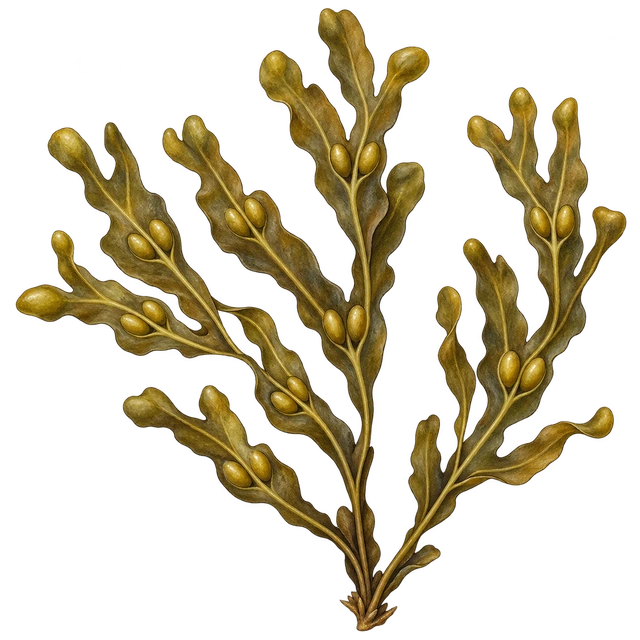
Bladderwrack’s story begins on the rocky shore, where its branching fronds and buoyant bladders make it a familiar member of the wracks.
The dried thallus has a place in European herbal medicine. The EMA monograph records a traditional use of its powdered form, based on long-standing practice rather than established clinical efficacy.
Traditional, historical and reported uses
- A recorded herbal-medicine tradition
Traditional accountWhy this label?
The EMA monograph records a specified traditional medicinal use, not well-established clinical efficacy or a recipe recommendation.
Powdered bladderwrack was used alongside a reduced-calorie diet to help with weight management in overweight adults. The EMA monograph describes this traditional use after a doctor has ruled out serious underlying conditions.
This account focuses on the powdered thallus in European herbal medicine.
Identity & detailed reference
Identity
The thallus (frond-like body) of Fucus vesiculosus, a brown seaweed of rocky shores. Its often-paired air bladders give bladderwrack its name. This card does not identify a wild specimen or treat all brown seaweeds as interchangeable.
Ingredient details, preparation and research
Also known as: Bladder wrack; Fucus vesiculosus; Rockweed (an ambiguous common name)
Source plant or material
Fucus vesiculosus L., a brown marine alga rather than a land plant.
Plant family / material: Fucaceae (brown-algal family).
Forms and route
Whole or dried thallus and powdered products; only explicitly food-grade material belongs in food. Concentrated extracts and isolated fucoidan are different preparations, not equivalent spoonfuls of seaweed.
Vitamins and minerals
Iodine is needed for normal thyroid-hormone production, but excess can also disrupt thyroid function. A bladderwrack product’s iodine contribution must be known; no uniform per-spoon nutrient value or recommended serving is assigned here.
Absorption and preparation
An isolated fucoidan extract is not nutritionally or pharmacologically equivalent to eating the whole thallus. Laboratory concentrations cannot be converted into an oral dose or recipe amount.
Practical preparation
This reference does not give a homemade medicinal preparation or generic recipe quantity. Use only an identified, food-grade product whose iodine content and contaminant controls are documented, and follow its intended-use instructions after checking personal suitability.
Combination context
Bladderwrack is not an automatic partner for watercress or other ingredients just because different constituents affect inflammation-related pathways in a laboratory. That rationale does not demonstrate a useful, safe or synergistic meal.
Combination notes
For recipe decisions, establish the exact product and edible use first, then assess iodine from the whole meal and any supplements. If product composition or suitability is unknown, leave bladderwrack out rather than guess an amount.
Traditional and reported uses
- Traditional herbal reference: powdered bladderwrack has a recorded weight-management history, not established weight-loss efficacy.
- Research context: isolated fucoidan has been studied in laboratory models; that is not a home preparation.
Contraindications and cautions
- Iodine can affect thyroid function. Do not self-treat a thyroid condition with bladderwrack; seek professional advice if you have thyroid disease.
- Do not combine bladderwrack medicinal products with thyroid medicines, iodine preparations or other Fucus products. If taking lithium or other medicines, have a pharmacist review the product first.
- Bladderwrack medicinal use is not recommended in pregnancy or breastfeeding, or for children and adolescents under 18. Do not add it to family recipes as a health supplement.
- Before any food use, require identified Fucus vesiculosus, food-grade sourcing, iodine information and contaminant testing. An unidentified beach harvest or unknown powder is not a suitable recipe ingredient.
- No universal teaspoon dose is given: iodine varies by product and also comes from the rest of the diet. Neither a fucoidan assay nor another seaweed’s serving size supplies a bladderwrack dose.
Similar items and how they compare
- Iodine, including seaweed-derived products, entry 54
Iodine is an important safety consideration for bladderwrack.
A nutrient reference is not evidence that every iodine-containing seaweed or supplement is interchangeable.
- Wakame, entry 290
Another brown seaweed.
Wakame is a different species and culinary material; its food portions and preparation instructions do not establish bladderwrack use.
Fucoidan and COX-2: an isolated-material laboratory result
A 2020 study tested fucoidan extracted from Fucus vesiculosus, with an average molecular weight of 735 kDa. In an enzyme assay, the reported COX-2 IC50 was 4.3 micrograms per millilitre. This describes that extract and test system, not a dose of whole bladderwrack, an anti-inflammatory effect in people or superiority to an anti-inflammatory medicine. The study did not test a bladderwrack–watercress recipe.
Iodine and quality before recipe design
The EMA assessment calls for known total iodine and controlled contaminants, including heavy metals. NIH guidance explains why too much iodine can harm thyroid function, including in susceptible people at intakes tolerated by others. Product-specific information is therefore more useful than a generic spoon measure.
A shore species, not a garden crop
MarLIN describes bladderwrack on rocky intertidal shores, with branching fronds, a midrib and often paired air bladders. USDA garden hardiness zones are not a suitable growing guide for this marine alga. Habitat notes and decorative artwork are not a harvesting or identification guide.
Evidence limits
This card separates traditional use, isolated-compound laboratory findings and product-specific safety. It does not establish clinical anti-inflammatory benefit, a weight-loss treatment, a safe universal food dose or synergy with watercress.
Entry sources
- Marine Biological Association, MarLIN: Bladder wrack (Fucus vesiculosus)
- European Medicines Agency: Assessment report on Fucus vesiculosus L., thallus (2014; published 2015)
- European Medicines Agency: Community herbal monograph on Fucus vesiculosus L., thallus (2014)
- Pozharitskaya et al. (2020): Mechanisms of Bioactivities of Fucoidan from Fucus vesiculosus; laboratory study
- NIH Office of Dietary Supplements: Iodine, health-professional fact sheet
Reference entry 615 · Recorded content review: 2026-10-28 · Review scope and dates