


Key cautions
- Do not identify wild berries from this card.
- Warfarin: keep intake consistent.
- Chill fruit; use tested preservation recipes.
What’s inside
Fiber, vitamin C and vitamin K; anthocyanin pigments contribute the dark fruit color.
Uses in brief

- Fresh fruit with meals
- Baking and pie fillings
- Jam and jelly
History, folklore and reported uses
History, folklore and traditional uses
Blackberries include multiple species, growth habits and cultivated hybrids. A single scientific species name would give false precision to all fruit sold as blackberry.
USDA-ARS and Oregon State researchers describe the Pacific Northwest’s long blackberry-production history and the 1956 release of Marion, marketed as marionberry. Regional breeding and processing helped make the fruit part of Oregon’s food identity.
Traditional, historical and reported uses
- Fresh fruit over oats or yogurt
Food or household practiceWhy this label?
The specific claim documents a food preparation or recorded culinary practice; safety qualifications remain attached and no treatment effect is inferred.
Virginia Tech describes whole berries eaten fresh or added to oats and yogurt. This keeps the fruit as a recognizable ingredient; optional sweeteners are separate additions.
- Baked fruit and tested pie fillings
Food or household practiceWhy this label?
The specific claim documents a food preparation or recorded culinary practice; safety qualifications remain attached and no treatment effect is inferred.
Berries can be baked in desserts. Oregon State gives preservation guidance for berry pie fillings with an appropriate tested formula rather than treating any homemade filling as shelf-stable.
- Jam and seedless jelly
Food or household practiceWhy this label?
The specific claim documents a food preparation or recorded culinary practice; safety qualifications remain attached and no treatment effect is inferred.
Blackberry jam retains crushed fruit; jelly is made from extracted juice. National Center recipes document both, with specified pectin, sugar and processing rather than a universal no-sugar substitution.
3 supported featured uses; food practices are not claims of treatment benefit.
Historical-use additions reviewed 2026-10-09
Story sources
- Virginia Tech Extension: Blackberry Fruit: Nutrition Facts and Health Benefits
- Finn and Strik: Blackberry production in the Pacific Northwest
- Oregon State Extension: Growing Berries on the Oregon Coast: Raspberries and Blackberries
- Oregon State Extension: Preserving foods: berries
- National Center for Home Food Preservation: Jams & Jellies
- CDC: Preventing Food Poisoning
- NIH ODS: Vitamin K, health-professional fact sheet
- AAAAI: Food Allergy
Regional reading paths
These sourced notes describe cultivation, trade, food traditions or material history. A regional connection does not claim exclusive origin.
Europe
Food tradition and cultivation: British blackberry picking and preserves are documented by Kew; RHS also describes cultivated garden blackberries in the UK.
Ripe, identified cultivated blackberries eaten fresh or cooked in desserts and preserves; the linked card is not a guide to identifying wild Rubus.
Identity & detailed reference
Identity
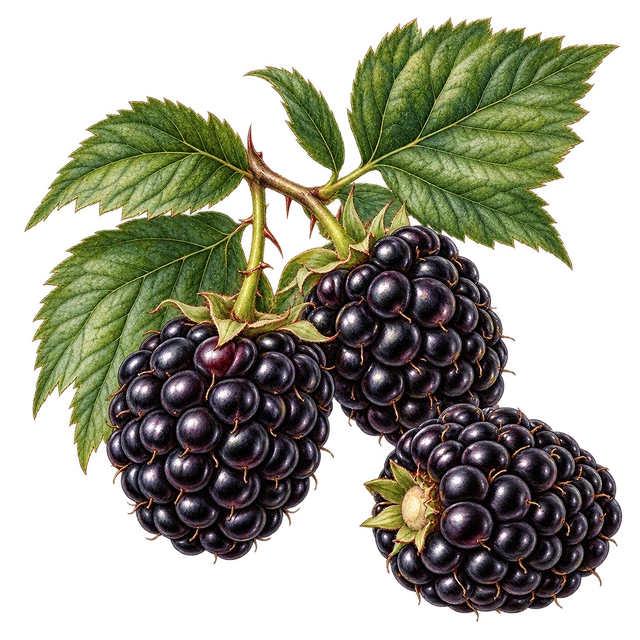
Edible blackberry fruits from identified cultivated Rubus plants. A blackberry is an aggregate of small drupelets that retains its central receptacle when picked; black raspberry is a different fruit.
Ingredient details, preparation and research
Also known as: Blackberry; Bramble fruit; Marionberry (blackberry cultivar); Black berry; Black berries
Source plant or material
Rubus species and cultivated blackberry hybrids
Plant family / material: Rosaceae
Forms and route
Fresh or frozen whole fruit, cooked desserts, purées, jams and jellies. Leaf tea, root preparations and concentrated extracts are not the fruit serving.
Vitamins and minerals
Virginia Tech’s USDA-based reference gives about 30 mg vitamin C and 8 g fiber per cup of raw blackberries. These values describe whole raw fruit, not seedless jelly or juice.
Absorption and preparation
Whole-fruit fiber remains relevant to the food choice; strained products can remove much of it. No blackberry-specific absorption advantage or treatment dose is established here.
Practical preparation
Refrigerate promptly. Gently rinse before eating or cooking and remove spoiled fruit. Follow the named tested method for freezing, canning or making spreads.
Combination context
No special medicinal food combination is established.
Combination notes
Use in oats, yogurt or a baked dish according to taste; consider the whole recipe’s sweeteners and fat.
Traditional and reported uses
- Fresh fruit with meals
- Baking and pie fillings
- Jam and jelly
Contraindications and cautions
- Use identified food fruit, not an unknown wild dark berry. A common name or illustration is not a foraging identification tool.
- Avoid if you have a known blackberry allergy. Refrigerate, rinse before eating and prevent contact with raw-meat juices.
- If taking warfarin, keep vitamin K intake consistent and discuss major dietary changes with your care team; blackberries need not be automatically excluded.
- Use tested canning directions for jams and pie fillings. A strained juice or sweetened preserve does not have the same fiber and sugar profile as whole fruit.
Similar items and how they compare
- Black raspberry
Another dark Rubus fruit.
Raspberries separate from the receptacle, leaving a hollow center; blackberries retain it. Common color does not settle identity.
- Marionberry
A cultivated blackberry.
A named hybrid cultivar developed in the Pacific Northwest, not a separate universal species or a guarantee of superior nutrition.
Cultivar history is not clinical evidence
Marion’s regional origin is documented by crop researchers. It does not establish that one blackberry cultivar prevents disease or has a special medicinal dose.
Use the fruit values, not the article’s overbroad health language
The food-composition reference and culinary examples are useful. Laboratory effects of isolated compounds do not establish cancer, diabetes or cognitive treatment by eating berries.
Evidence limits
No medicinal use of leaves or roots, wild-plant identification, or berry-extract efficacy is inferred. The source’s vitamin K number has a unit error and is deliberately not reproduced.
Entry sources
- Virginia Tech Extension: Blackberry Fruit: Nutrition Facts and Health Benefits
- Finn and Strik: Blackberry production in the Pacific Northwest
- Oregon State Extension: Growing Berries on the Oregon Coast: Raspberries and Blackberries
- Oregon State Extension: Preserving foods: berries
- National Center for Home Food Preservation: Jams & Jellies
- CDC: Preventing Food Poisoning
- NIH ODS: Vitamin K, health-professional fact sheet
- AAAAI: Food Allergy
Reference entry 283 · Recorded content review: 2026-10-09 · Review scope and dates