


Key cautions
- Verify the plant; avoid eyes and damaged skin
- Stop if skin reacts
- No validated homemade storage time
What’s inside
The flower head contains a slippery, mucus-like plant fluid, often called mucilage. Its feel and scent do not tell us how well it cleans, preserves a mixture, or changes hair color. Research on chemicals in the rhizome cannot be treated as research on fresh flower-head fluid.
Uses in brief

- Documented Hawaiian hair-washing tradition
- Flower-head fluid; not kitchen ginger root
History, folklore and reported uses
History, folklore and traditional uses
In Hawaiʻi, ʻawapuhi has a place in daily care as well as cultural life. Bishop Museum records its squeezed fluid as a shampoo. The same entry describes powdered rhizome used to scent kapa, a bark cloth, and notes that the plant was sometimes placed on hula altars. These are uses of different parts of one plant, not a single recipe. The museum identifies ʻawapuhi as a Polynesian introduction. Kew places its native range in tropical and subtropical Asia, so its strong Hawaiian history should not be confused with a Hawaiian botanical origin.
A separate field record gives a more local view of hair care in the Pacific. In September 1997, ethnobotanist Michael J. Balick collected Zingiber zerumbet at a healer's home in Sokehs Municipality, Pohnpei. Notes attached to that specimen describe flower-head juice used with another plant in a women's hair-growth practice. The record preserves a reported custom. It does not test whether the mixture grew hair, and it does not mention restoring gray hair.
Another 1997 collection from Kosrae records hair and body washing. Its wording mixes a “Rhizomes” heading with a reference to the gummy flower head, so the precise part is unclear in that record. It is useful evidence of local washing traditions, but not a sound basis for a step-by-step formula.
A closer look at its history
A plant of scent, cooking and cultural meaning
NTBG’s account, drawing on Hawaiian ethnobotanical works by Beatrice Krauss and Angela Kepler, records fragrant leaves and stalks used in imu cooking and identifies ʻawapuhi as a kinolau, or form, of Kāne. These are attributed Hawaiian cultural records. They should not be flattened into a universal Pacific practice or interpreted as laboratory proof of hair-care effects.
Following the plant through its seasons
The same botanical account describes shoots dying back and returning from creeping rhizomes, with flower heads developing on separate stalks after the leaves. This seasonal pattern helps place a summer bathing tradition in the life of a particular plant. A red flower head is not a bottle of preserved commercial shampoo.
Additional history reviewed 2026-10-12
Traditional, historical and reported uses
- ʻAwapuhi in Hawaiian hair care
Traditional accountWhy this label?
Bishop Museum records squeezed fragrant fluid used as shampoo in Hawaiʻi. This is historical use, not a clinical claim.
Bishop Museum records squeezed fragrant fluid used as shampoo in Hawaiʻi. This is historical use, not a clinical claim.
- A Pohnpei hair-care field record
Traditional accountWhy this label?
A 1997 collection records flower-head juice in a local hair-growth practice. It does not establish growth or return of hair color.
A 1997 collection records flower-head juice in a local hair-growth practice. It does not establish growth or return of hair color.
- A Kosrae washing record
Traditional accountWhy this label?
A second 1997 specimen record describes hair and body washing, but its wording leaves the precise plant part unclear.
A second 1997 specimen record describes hair and body washing, but its wording leaves the precise plant part unclear.
Named cultural and collection records describe reported practices; none is a human efficacy trial.
Growing notes
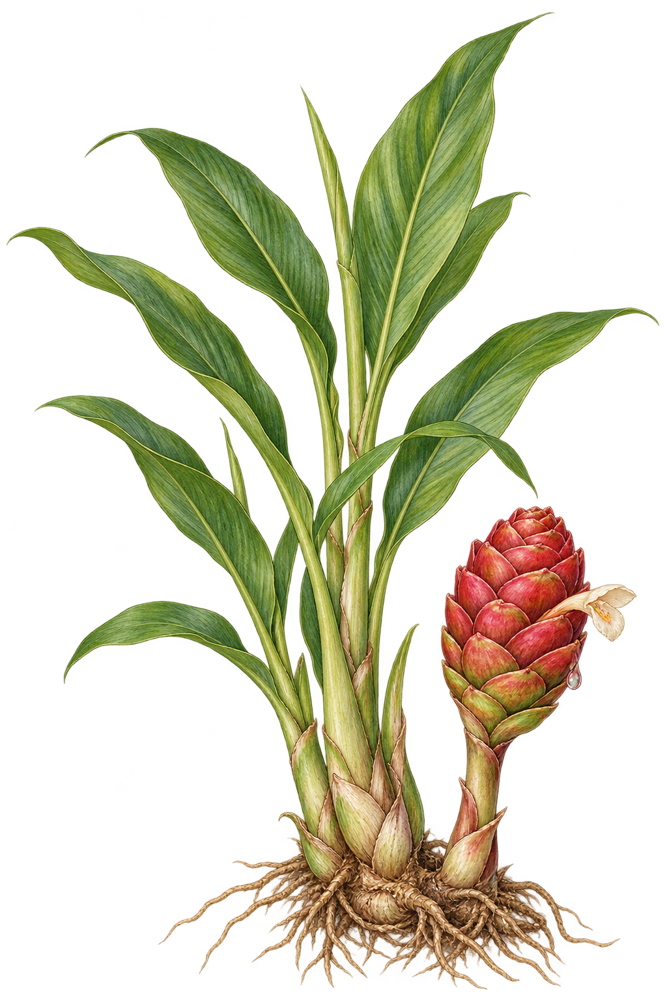
Living Zingiber zerumbet (ʻawapuhi), the source of the flower-head fluid on this card; not a guide to growing shampoo or making a preserved cosmetic.
- Climate and lifecycle
- A rhizomatous perennial with winter dormancy. NC State lists zones 8a–10b but also warns of frost sensitivity; exposed sites and wet winter soils can fail. In cold climates use a container and shelter it before freezing weather. [1]
- Light, soil and active growth
- Give shade or partial shade, organic soil and moisture during growth. Allow room for a spreading clump. The source describes a moist habitat; keep containers drained rather than interpreting that as permission for stagnant water. [1]
- Seasonal care
- Move protected plants outdoors only after the last spring frost. Above-ground stems can disappear during dormancy without the plant being dead. NC State recommends dry storage while dormant; resume active-growth care with new shoots. [1]
- Flower heads and timing
- NTBG describes leafy shoots first, followed by separate, shorter flowering stems in summer. Bracts redden as the head matures and accumulates fluid. Neither source promises a first-year bloom or a fixed number of days to collect fluid. [2]
- Pollination and pests
- This card concerns flower-head fluid, not a seed crop, and gives no pollination treatment. NC State notes occasional whitefly and root-grub problems and warns that rhizomes can spread weedily. Contain spread and check local planting restrictions. [1]
Growing sources and regional guidance
Growing notes reviewed 2026-10-12
Identity & detailed reference
Identity
The fragrant, slippery fluid held in the cone-shaped flower heads of Zingiber zerumbet. Each cone has overlapping bracts, which are modified leaves. Small pale flowers appear between them. The fluid is the material used in hair washing; loose petals and ginger-root extracts are different materials.
Ingredient details, preparation and research
Also known as: ʻawapuhi; awapuhi; ʻawapuhi kuahiwi; pinecone ginger; shampoo ginger; bitter ginger
Source plant or material
Zingiber zerumbet (L.) Roscoe ex Sm.; also called shampoo ginger, pinecone ginger, bitter ginger, and ʻawapuhi or ʻawapuhi kuahiwi in Hawaiʻi.
Plant family / material: Zingiberaceae, the ginger family.
Forms and route
Fresh flower-head fluid in traditional use; extracts or juice in formulated hair products. Check the ingredient list and plant part. A bottled shampoo with ʻawapuhi can also contain other cleansers and conditioners, so its effects do not show what raw plant fluid does on its own.
Vitamins and minerals
This is a topical hair-care material, not a nutrient supplement. No nutritional benefit for hair or correction of a nutrient deficiency was established for applying this fluid in the sources reviewed.
Absorption and preparation
Reliable human data on absorption through the scalp were not identified for the raw flower-head fluid. A smooth feel on hair does not show that an ingredient reaches hair follicles or changes the pigment they make.
Traditional and reported uses
- Traditional hair washing: Bishop Museum records fragrant fluid squeezed from ʻawapuhi for shampoo in Hawaiʻi. This documents a practice, not a controlled test of cleansing performance.
- Hair conditioning: A published review describes Hawaiian use of the flower-head material as a shampoo and conditioner. Softness and manageability are different outcomes from new growth or return of hair color.
- Gray-hair reports: A reliable source for the specific report, and human evidence that this flower-head fluid prevents or reverses graying, were not identified in this review. The claim remains unverified.
- Hand washing: The description fits informal use of the slippery fluid on hands. A clear, authoritative record of that exact custom was not found. Use ordinary soap and water for hand hygiene.
Contraindications and cautions
- Confirm the species before any use. Similar common names are not reliable identification.
- Raw fluid is not a tested cosmetic formula. Keep it out of the eyes and off broken or irritated skin. These are cautious use limits, not a claim of a measured toxicity rate for this plant.
- Botanical ingredients can still irritate skin or cause allergy. Stop and rinse if burning, itching, redness, or swelling occurs. A home spot check does not prove that a raw mixture is safe.
- Do not keep a homemade bottle on the assumption that “natural” means self-preserving. Raw ingredients, water, fingers, and storage can introduce microbes. No validated home formula or safe storage time for this fluid was established here.
- Do not use it in place of soap for infection-control hand washing, or as a treatment for hair loss, scalp infection, or graying.
What the evidence shows
The strongest evidence for this card is botanical and historical: identification of the plant and records of its hair-washing use. A herbarium note records a reported use at a particular place and time. It is not a clinical trial.
Gray hair: a claim not verified
Studies of extracts, isolated chemicals, or the underground rhizome cannot establish that fresh cone fluid reverses gray hair. Neither an antioxidant result in a laboratory nor a hair-growth tradition answers a question about human hair pigment. No controlled human evidence for gray-hair reversal by this material was identified in the sources reviewed. This is a limit of this review, not proof that an effect is impossible.
Finished shampoo versus raw fluid
Commercial products also need separate review. One manufacturer's shampoo lists Zingiber zerumbet juice alongside other washing and conditioning ingredients. Any result from that product cannot be credited to raw ʻawapuhi fluid alone.
Growing the plant
NC State Extension describes a clumping perennial for moist, shaded conditions. In cold areas it can be grown in a container and protected from frost. Keep it dry during winter dormancy. It can spread by underground stems and become weedy; check local growing guidance before planting.
Preparation and safety boundaries
No preparation ratio, dose, usage schedule, preservation recipe, or shelf life was established for raw cone fluid. Skin and eye precautions are conservative guidance, not plant-specific clinical safety findings.
Evidence limits
- Focused educational review, not a systematic review or a personal treatment plan.
- A reliable source for the gray-hair report and controlled human evidence for gray-hair reversal by raw flower-head fluid were not identified in the sources reviewed. This does not prove an effect impossible.
- The specific hand-washing custom was not verified; hair and body washing records should not be rewritten as evidence for infection-control hand washing.
- Species identity, plant part, and commercial formulation matter. Rhizome research cannot be transferred to cone fluid.
Entry sources
- Royal Botanic Gardens, Kew, Plants of the World Online
- NC State Extension, Plant Toolbox: Zingiber zerumbet
- Bishop Museum Ethnobotany Database: ʻawapuhi
- Yob et al., 2011, “Zingiber zerumbet (L.) Smith: A Review of Its Ethnomedicinal, Chemical, and Pharmacological Uses.” Supports plant-part distinction and historical shampoo/conditioner use
- National Tropical Botanical Garden herbarium, PTBG1000037596, Balick 3836, 5 September 1997, Pohnpei
- American Academy of Dermatology, “How to test skin care products.” General skin-reaction and botanical/fragrance guidance; not plant-specific safety testing.
- FDA, “Microbiological Safety and Cosmetics.” General contamination/preservation risks; no shampoo-ginger shelf life established.
- NParks Flora & Fauna Web: Alpinia zerumbet
- Nu Skin, Epoch Ava puhi moni shampoo ingredient disclosure
- CDC handwashing guidance
- NTBG herbarium, PTBG1000037603, Balick 3879, 11 September 1997, Kosrae
Reference entry 608 · Content review date not recorded · Review scope and dates