


Key cautions
- The cited lactation evidence does not establish medicinal-use safety during pregnancy; postpartum traditions must not be extrapolated to pregnancy.
- This is Asparagus racemosus root, not Asparagus officinalis food.
- Pregnancy and breastfeeding safety is not established by this traditional record. Do not self-prescribe medicinal preparations when pregnant, trying to conceive, or breastfeeding; obtain clinician review.
What’s inside
Root constituents include steroidal saponins such as shatavarins and polysaccharides. These are chemical descriptions, not evidence of a universal hormone-balancing effect.
Uses in brief

- Indian postpartum root tradition; lactation findings mixed.
- Short, product-specific menopause studies; no fertility guarantee.
History, folklore and reported uses
History, folklore and traditional uses
LactMed documents longstanding Indian galactagogue use and inclusion for this purpose in the Ayurvedic pharmacopoeia.
Shatavari is an Ayurvedic root medicine with a well-documented Indian lactation tradition. Contemporary menopause research is an extension of its women’s-health use, rather than proof of an ancient diagnosis matching modern menopause scores.
LactMed identifies Indian galactagogue use and inclusion in the official Ayurvedic pharmacopoeia. The tradition concerns Asparagus racemosus root, not ordinary asparagus shoots.
Traditional, historical and reported uses
- Lactation / milk-supply tradition
Human researchWhy this label?
Results are mixed; some small placebo-controlled studies report milk-volume, prolactin or infant-weight signals. Mixture trials cannot isolate shatavari.
A postpartum root medicine intended to support milk production. Results are mixed; some small placebo-controlled studies report milk-volume, prolactin or infant-weight signals. Mixture trials cannot isolate shatavari.
- menopause
Human researchWhy this label?
An eight-week, 135-person trial compared shatavari, shatavari plus ashwagandha, and placebo; the combination showed stronger symptom improvement. Short, product-specific trials do not establish fertility improvement or long-term safety.
Traditional women’s-health use includes postpartum lactation; modern studies also examine menopausal symptoms. An eight-week, 135-person trial compared shatavari, shatavari plus ashwagandha, and placebo; the combination showed stronger symptom improvement. Short, product-specific trials do not establish fertility improvement or long-term safety.
Coverage reflects verified sources, without a minimum use quota.
Women’s Health: traditions, evidence and cautions
Historical use does not establish benefit or safety. Pregnancy, breastfeeding and fertility care require particular caution: food, tea, essential oil and concentrated extract are not interchangeable. These records are not treatment, dosing or pregnancy-management instructions. Discuss supplements with a qualified clinician or pharmacist; do not delay evaluation of persistent symptoms.
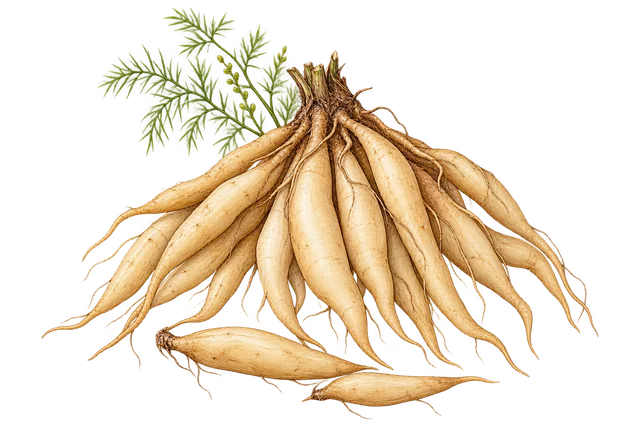
Shatavari / wild asparagus root
Asparagus racemosus Willd.
- Plant part / material
- Root
- Preparation studied or reported
- Root powders and extracts; not food asparagus shoots.
Asparagus racemosus Willd.; Root.
Lactation / milk-supply tradition
Human research
Reported or traditional useA postpartum root medicine intended to support milk production. Results are mixed; some small placebo-controlled studies report milk-volume, prolactin or infant-weight signals. Mixture trials cannot isolate shatavari.
What the evidence supportsResults are mixed; some small placebo-controlled studies report milk-volume, prolactin or infant-weight signals. Mixture trials cannot isolate shatavari.
The cited lactation evidence does not establish medicinal-use safety during pregnancy; postpartum traditions must not be extrapolated to pregnancy. This is Asparagus racemosus root, not Asparagus officinalis food. Pregnancy and breastfeeding safety is not established by this traditional record. Do not self-prescribe medicinal preparations when pregnant, trying to conceive, or breastfeeding; obtain clinician review. Review pregnancy, breastfeeding, medicines and hormone-sensitive conditions with a clinician before medicinal use. Avoid with a relevant asparagus allergy. Do not let a galactagogue replace skilled assessment of low milk supply or infant growth.
menopause
Human research
Reported or traditional useTraditional women’s-health use includes postpartum lactation; modern studies also examine menopausal symptoms. An eight-week, 135-person trial compared shatavari, shatavari plus ashwagandha, and placebo; the combination showed stronger symptom improvement. Short, product-specific trials do not establish fertility improvement or long-term safety.
What the evidence supportsAn eight-week, 135-person trial compared shatavari, shatavari plus ashwagandha, and placebo; the combination showed stronger symptom improvement. Short, product-specific trials do not establish fertility improvement or long-term safety.
The cited lactation evidence does not establish medicinal-use safety during pregnancy; postpartum traditions must not be extrapolated to pregnancy. This is Asparagus racemosus root, not Asparagus officinalis food. Pregnancy and breastfeeding safety is not established by this traditional record. Do not self-prescribe medicinal preparations when pregnant, trying to conceive, or breastfeeding; obtain clinician review. Review pregnancy, breastfeeding, medicines and hormone-sensitive conditions with a clinician before medicinal use. Avoid with a relevant asparagus allergy. Do not let a galactagogue replace skilled assessment of low milk supply or infant growth.
One exact-material card. Root powders and extracts; not food asparagus shoots.. Keep preparations distinct; do not transfer findings from a named extract to every tea or powder.
- The cited lactation evidence does not establish medicinal-use safety during pregnancy; postpartum traditions must not be extrapolated to pregnancy.
- This is Asparagus racemosus root, not Asparagus officinalis food.
- Pregnancy and breastfeeding safety is not established by this traditional record. Do not self-prescribe medicinal preparations when pregnant, trying to conceive, or breastfeeding; obtain clinician review.
- Review pregnancy, breastfeeding, medicines and hormone-sensitive conditions with a clinician before medicinal use.
- Avoid with a relevant asparagus allergy.
- Do not let a galactagogue replace skilled assessment of low milk supply or infant growth.
- LactMed: Wild Asparagus
- Ademola et al. (2025): Shatavari root extract for menopausal symptoms
- Kew POWO: Asparagus racemosus
- Madhya Pradesh Forest Department: Sustainable harvesting protocols, 2022, p62
Read the complete historical reference and its material distinctions
Identity & detailed reference
Identity
Asparagus racemosus Willd.; Root.
Ingredient details, preparation and research
Also known as: Asparagus racemosus; wild asparagus root; satavari
Source plant or material
Asparagus racemosus Willd. — Root
Plant family / material: Asparagaceae (asparagus family)
Forms and route
Root powders and extracts; not food asparagus shoots.
Vitamins and minerals
No nutrient quantities or daily-value claims are assigned to this medicinal material. Do not borrow the food nutrient profile of another plant part or use an extract as a dietary substitute.
Absorption and preparation
Preparation and route matter. A tea, whole powder, alcohol extract and isolated constituent can give different exposures. No food pairing or absorption-enhancement technique is established by the sources reviewed.
Traditional and reported uses
- A postpartum root medicine intended to support milk production. Results are mixed; some small placebo-controlled studies report milk-volume, prolactin or infant-weight signals. Mixture trials cannot isolate shatavari.
- Traditional women’s-health use includes postpartum lactation; modern studies also examine menopausal symptoms. An eight-week, 135-person trial compared shatavari, shatavari plus ashwagandha, and placebo; the combination showed stronger symptom improvement. Short, product-specific trials do not establish fertility improvement or long-term safety.
Contraindications and cautions
- The cited lactation evidence does not establish medicinal-use safety during pregnancy; postpartum traditions must not be extrapolated to pregnancy.
- This is Asparagus racemosus root, not Asparagus officinalis food.
- Pregnancy and breastfeeding safety is not established by this traditional record. Do not self-prescribe medicinal preparations when pregnant, trying to conceive, or breastfeeding; obtain clinician review.
- Review pregnancy, breastfeeding, medicines and hormone-sensitive conditions with a clinician before medicinal use.
- Avoid with a relevant asparagus allergy.
- Do not let a galactagogue replace skilled assessment of low milk supply or infant growth.
Similar items and how they compare
- Food asparagus
Shared genus
Asparagus officinalis shoots are a different species/part and do not validate medicinal-root safety.
- Ashwagandha
Combined in a menopause trial
Combination findings cannot establish shatavari-alone benefit.
Identity and composition
Asparagus racemosus Willd.; Root. Root constituents include steroidal saponins such as shatavarins and polysaccharides. These are chemical descriptions, not evidence of a universal hormone-balancing effect.
Lactation / milk-supply tradition: what evidence can say
Results are mixed; some small placebo-controlled studies report milk-volume, prolactin or infant-weight signals. Mixture trials cannot isolate shatavari. Small trials reported no adverse maternal/infant effects, but rigorous safety and milk-transfer studies are lacking. Do not infer pregnancy safety from postpartum trials.
menopause: what evidence can say
An eight-week, 135-person trial compared shatavari, shatavari plus ashwagandha, and placebo; the combination showed stronger symptom improvement. Short, product-specific trials do not establish fertility improvement or long-term safety. Pregnancy safety is not established. Lactation safety has not been rigorously studied despite traditional use; obtain professional advice. Review hormone-sensitive conditions and avoid with a relevant asparagus allergy.
Exact material and preparation boundaries
One exact-material card. Root powders and extracts; not food asparagus shoots.. Keep preparations distinct; do not transfer findings from a named extract to every tea or powder.
Medicines, pregnancy and breastfeeding
The current LactMed monograph reports mixed studies and no rigorous safety assessment despite some small trials without reported maternal or infant harms. Lack of observed harm in small postpartum trials is not proof of pregnancy safety. No well-established clinical interaction list for these root preparations was located; identify the exact supplement and any mixture components.
Source-supported safety summary
The cited lactation evidence does not establish medicinal-use safety during pregnancy; postpartum traditions must not be extrapolated to pregnancy. This is Asparagus racemosus root, not Asparagus officinalis food. Pregnancy and breastfeeding safety is not established by this traditional record. Do not self-prescribe medicinal preparations when pregnant, trying to conceive, or breastfeeding; obtain clinician review. Review pregnancy, breastfeeding, medicines and hormone-sensitive conditions with a clinician before medicinal use. Avoid with a relevant asparagus allergy.
Evidence limits
- This is a focused educational source review, not a systematic review or a treatment plan.
- Traditional use documents a practice; it does not establish clinical benefit. Laboratory findings and multi-ingredient trials cannot establish a single ingredient’s effects.
- The menopause study was reviewed at abstract level; short follow-up and a combination arm limit conclusions.
- Root morphology checked independently in a government botanical/harvest manual; no therapeutic claims inherited from that manual.
Entry sources
- LactMed: Wild Asparagus
- Ademola et al. (2025): Shatavari root extract for menopausal symptoms
- Kew POWO: Asparagus racemosus
- Madhya Pradesh Forest Department: Sustainable harvesting protocols, 2022, p62
Reference entry 530 · Recorded content review: 2026-10-11 · Review scope and dates