


Key cautions
- Never ingest pennyroyal essential oil. Avoid reproductive self-treatment, especially during pregnancy or breastfeeding. Toxic exposure requires urgent poison-control or emergency advice.
- Never ingest pennyroyal essential oil.
- Avoid pennyroyal reproductive self-treatment and pregnancy or breastfeeding use.
What’s inside
Pulegone and its toxic metabolites are important in pennyroyal-oil injury. Composition varies, so no single concentration or safe exposure is assigned.
Uses in brief

- Toxicity/history reference only; never ingest pennyroyal essential oil.
History, folklore and reported uses
History, folklore and traditional uses
Pennyroyal appears in historical menstrual and pregnancy-ending folk records and in insect-repellent use. This is a toxicity-history entry only. Historical use does not establish an effective or safe reproductive treatment.
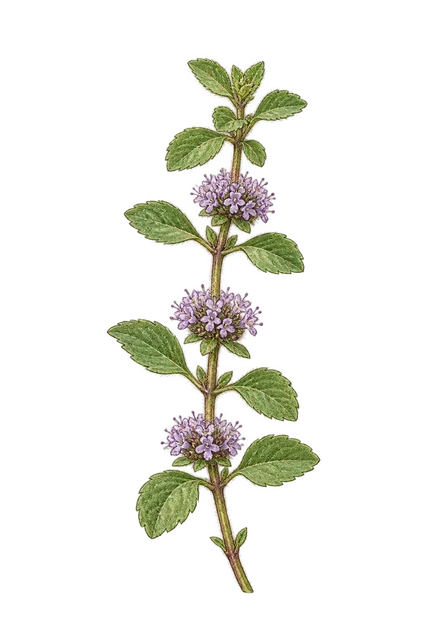
Kew accepts Mentha pulegium and Hedeoma pulegioides as separate species. Mentha pulegium is a perennial with an Old World native range; Hedeoma pulegioides is an annual native to eastern/central North America. Neither is ordinary peppermint.
Traditional, historical and reported uses
- menstruation and pregnancy safety
Mixed/contextual sourcesWhy this label?
Oral pennyroyal oil has caused liver failure, multiorgan injury and death. It has no role as a recommended reproductive remedy.
Hazardous historical reproductive use, documented only for context. Oral pennyroyal oil has caused liver failure, multiorgan injury and death. It has no role as a recommended reproductive remedy.
- Insect-repellent and aromatic history
Historical recordWhy this label?
LiverTox records aromatic and insect-repellent uses as part of pennyroyal history. This is not a modern safety endorsement, an instruction to make an oil, or proof of dependable protection from disease-carrying insects.
LiverTox records aromatic and insect-repellent uses as part of pennyroyal history. This is not a modern safety endorsement, an instruction to make an oil, or proof of dependable protection from disease-carrying insects.
Coverage reflects verified sources, without a minimum use quota.
Women’s Health: traditions, evidence and cautions
Historical use does not establish benefit or safety. Pregnancy, breastfeeding and fertility care require particular caution: food, tea, essential oil and concentrated extract are not interchangeable. These records are not treatment, dosing or pregnancy-management instructions. Discuss supplements with a qualified clinician or pharmacist; do not delay evaluation of persistent symptoms.
Pennyroyal — toxicity reference
Mentha pulegium; Hedeoma pulegioides is a separate pennyroyal species
- Plant part / material
- leaf-derived volatile oil; leaf preparations differ
- Preparation studied or reported
- Qualified common-name toxicity reference covering Mentha pulegium and Hedeoma pulegioides. Leaves, aerial herb and concentrated oils are different materials. Published pennyroyal-oil poisonings do not authenticate every species or preparation and do not establish a safe herbal alternative.
Qualified common-name toxicity reference covering Mentha pulegium and Hedeoma pulegioides. Leaves, aerial herb and concentrated oils are different materials. Published pennyroyal-oil poisonings do not authenticate every species or preparation and do not establish a safe herbal alternative.
Pennyroyal appears in historical menstrual and pregnancy-ending folk records and in insect-repellent use. This is a toxicity-history entry only. Historical use does not establish an effective or safe reproductive treatment.
Kew accepts Mentha pulegium and Hedeoma pulegioides as separate species. Mentha pulegium is a perennial with an Old World native range; Hedeoma pulegioides is an annual native to eastern/central North America. Neither is ordinary peppermint.
menstruation and pregnancy safety
Mixed/contextual sources
Reported or traditional useHazardous historical reproductive use, documented only for context. Oral pennyroyal oil has caused liver failure, multiorgan injury and death. It has no role as a recommended reproductive remedy.
What the evidence supportsOral pennyroyal oil has caused liver failure, multiorgan injury and death. It has no role as a recommended reproductive remedy.
Never ingest pennyroyal essential oil. Avoid reproductive self-treatment, especially during pregnancy or breastfeeding. Toxic exposure requires urgent poison-control or emergency advice. Never ingest pennyroyal essential oil. Avoid pennyroyal reproductive self-treatment and pregnancy or breastfeeding use. An exposure requires urgent poison-control or emergency advice.
Insect-repellent and aromatic history
Historical record
Reported or traditional useLiverTox records aromatic and insect-repellent uses as part of pennyroyal history. This is not a modern safety endorsement, an instruction to make an oil, or proof of dependable protection from disease-carrying insects.
What the evidence supportsLiverTox records aromatic and insect-repellent uses as part of pennyroyal history. This is not a modern safety endorsement, an instruction to make an oil, or proof of dependable protection from disease-carrying insects.
Never ingest pennyroyal essential oil. Avoid reproductive self-treatment, especially during pregnancy or breastfeeding. Toxic exposure requires urgent poison-control or emergency advice. Never ingest pennyroyal essential oil. Avoid pennyroyal reproductive self-treatment and pregnancy or breastfeeding use. An exposure requires urgent poison-control or emergency advice.
Qualified common-name toxicity reference covering Mentha pulegium and Hedeoma pulegioides. Leaves, aerial herb and concentrated oils are different materials. Published pennyroyal-oil poisonings do not authenticate every species or preparation and do not establish a safe herbal alternative.
- Never ingest pennyroyal essential oil. Avoid reproductive self-treatment, especially during pregnancy or breastfeeding. Toxic exposure requires urgent poison-control or emergency advice.
- Never ingest pennyroyal essential oil.
- Avoid pennyroyal reproductive self-treatment and pregnancy or breastfeeding use.
- An exposure requires urgent poison-control or emergency advice.
- NIH LiverTox: Pennyroyal Oil
- Kew POWO: Mentha pulegium
- Kew POWO: Hedeoma pulegioides
- Anderson et al. 1996: Pennyroyal toxicity case series
Read the complete historical reference and its material distinctions
Identity & detailed reference
Identity
Mentha pulegium; Hedeoma pulegioides is a separate pennyroyal species; leaf-derived volatile oil; leaf preparations differ. Do not combine with mint or peppermint cards. LiverTox source conflates species geography; no geography claim copied for Hedeoma.
Ingredient details, preparation and research
Also known as: Mentha pulegium; Hedeoma pulegioides; European pennyroyal; American pennyroyal
Source plant or material
Mentha pulegium; Hedeoma pulegioides is a separate pennyroyal species — leaf-derived volatile oil; leaf preparations differ
Plant family / material: Lamiaceae (mint family)
Forms and route
Qualified common-name toxicity reference covering Mentha pulegium and Hedeoma pulegioides. Leaves, aerial herb and concentrated oils are different materials. Published pennyroyal-oil poisonings do not authenticate every species or preparation and do not establish a safe herbal alternative.
Vitamins and minerals
No nutrient quantities or daily-value claims are assigned to this medicinal material. Do not borrow the food nutrient profile of another plant part or use an extract as a dietary substitute.
Absorption and preparation
Safety/history reference only. No preparation, dosing, extraction, absorption-enhancement or home detoxification instructions are provided.
Traditional and reported uses
- Hazardous historical reproductive use, documented only for context. Oral pennyroyal oil has caused liver failure, multiorgan injury and death. It has no role as a recommended reproductive remedy.
- LiverTox records aromatic and insect-repellent uses as part of pennyroyal history. This is not a modern safety endorsement, an instruction to make an oil, or proof of dependable protection from disease-carrying insects.
Contraindications and cautions
- Never ingest pennyroyal essential oil. Avoid reproductive self-treatment, especially during pregnancy or breastfeeding. Toxic exposure requires urgent poison-control or emergency advice.
- Never ingest pennyroyal essential oil.
- Avoid pennyroyal reproductive self-treatment and pregnancy or breastfeeding use.
- An exposure requires urgent poison-control or emergency advice.
Similar items and how they compare
- Peppermint
Mint-family name resemblance
Mentha × piperita is a different material; do not substitute pennyroyal.
- Mentha pulegium and Hedeoma pulegioides
Both called pennyroyal
Separate species. Labelled oil may lack reliable species authentication.
Identity and composition
Mentha pulegium; Hedeoma pulegioides is a separate pennyroyal species; leaf-derived volatile oil; leaf preparations differ. Do not combine with mint or peppermint cards. LiverTox source conflates species geography; no geography claim copied for Hedeoma. Pulegone and its toxic metabolites are important in pennyroyal-oil injury. Composition varies, so no single concentration or safe exposure is assigned.
menstruation and pregnancy safety: what evidence can say
Oral pennyroyal oil has caused liver failure, multiorgan injury and death. It has no role as a recommended reproductive remedy. Never ingest pennyroyal essential oil. Avoid reproductive self-treatment, especially during pregnancy or breastfeeding. Toxic exposure requires urgent poison-control or emergency advice.
Exact material and preparation boundaries
Qualified common-name toxicity reference covering Mentha pulegium and Hedeoma pulegioides. Leaves, aerial herb and concentrated oils are different materials. Published pennyroyal-oil poisonings do not authenticate every species or preparation and do not establish a safe herbal alternative.
Medicines, pregnancy and breastfeeding
A safe medicine-combination profile has not been established. The central warning is intrinsic oil toxicity, not just an interaction. Leaf infusions and concentrated oils have very different exposures, but the absence of severe effects in a few leaf reports does not establish a safe home-use regimen.
Poisoning case evidence
Published human cases document severe toxicity after pennyroyal exposure. The case literature is often about oil sold under a common name; do not retrospectively assign every case to an independently verified species.
Source-supported safety summary
Never ingest pennyroyal essential oil. Avoid reproductive self-treatment, especially during pregnancy or breastfeeding. Toxic exposure requires urgent poison-control or emergency advice. Never ingest pennyroyal essential oil. Avoid pennyroyal reproductive self-treatment and pregnancy or breastfeeding use. An exposure requires urgent poison-control or emergency advice.
Evidence limits
- This is a focused educational source review, not a systematic review or a treatment plan.
- Traditional use documents a practice; it does not establish clinical benefit. Laboratory findings and multi-ingredient trials cannot establish a single ingredient’s effects.
- LiverTox incorrectly generalizes the two species’ geography; corrected with Kew taxonomy, without copying its geography claim.
- Leaf and oil exposures are not interchangeable; no preparation instructions or numerical toxic thresholds are provided.
Entry sources
- NIH LiverTox: Pennyroyal Oil
- Kew POWO: Mentha pulegium
- Kew POWO: Hedeoma pulegioides
- Anderson et al. 1996: Pennyroyal toxicity case series
Reference entry 562 · Recorded content review: 2026-10-11 · Review scope and dates