


Key cautions
- Food history does not validate a medicinal extract or therapeutic course during pregnancy or breastfeeding.
- Concerns about milk supply or infant growth need a breastfeeding and health assessment.
What’s inside
A reliable composition profile for the exact preparation was not established in this review; chemistry from another plant part is not transferred.
Uses in brief

- Leaf vegetable and soups (food or household practice).
- Ghanaian lactation-associated food (food or household practice).
History, folklore and reported uses
History, folklore and traditional uses
Baobab supports many kinds of use, but this card concerns the leaves. Kew documents them as vegetables and soup ingredients; the fruit and bark have separate histories.
Traditional, historical and reported uses
- Leaf vegetable and soups
Food or household practiceWhy this label?
The source is retained with its design and preparation limits; reported use is not upgraded to clinical effectiveness.
Kew records baobab leaves as a vegetable or soup ingredient. Fruit-pulp vitamin claims are not automatically claims about dried leaves.
- Ghanaian lactation-associated food
Food or household practiceWhy this label?
The source is retained with its design and preparation limits; reported use is not upgraded to clinical effectiveness.
The Ghana survey names kuuka, dried baobab leaves, among foods believed to support milk supply. It did not test milk output or infant outcomes.
Includes only uses and context documented for this material. Historical reporting is not proof of benefit; no use-count quota is applied.
Women’s Health: traditions, evidence and cautions
Historical use does not establish benefit or safety. Pregnancy, breastfeeding and fertility care require particular caution: food, tea, essential oil and concentrated extract are not interchangeable. These records are not treatment, dosing or pregnancy-management instructions. Discuss supplements with a qualified clinician or pharmacist; do not delay evaluation of persistent symptoms.
Baobab leaf / kuuka
Adansonia digitata L.
- Plant part / material
- Dried leaves
- Preparation studied or reported
- Dried leaf vegetable named kuuka; the Ghana study does not supply a standardized recipe, serving or extract specification.
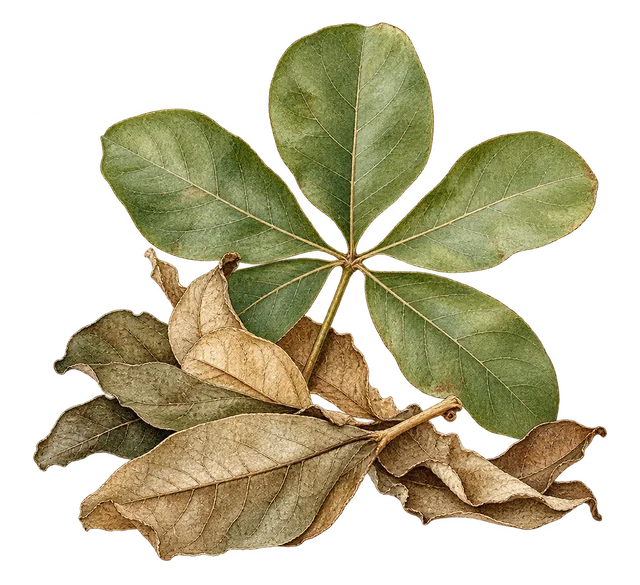
Kuuka here is dried Adansonia digitata leaves. It is not baobab fruit pulp or seed oil. Kew describes the living leaves as several leaflets joined at a central point; dried material may be fragmented.
Leaf vegetable and soups
Food or household practice
Reported or traditional useKew records baobab leaves as a vegetable or soup ingredient. Fruit-pulp vitamin claims are not automatically claims about dried leaves.
What the evidence supportsThe source is retained with its design and preparation limits; reported use is not upgraded to clinical effectiveness.
Food history does not validate a medicinal extract or therapeutic course during pregnancy or breastfeeding. Concerns about milk supply or infant growth need a breastfeeding and health assessment. No specific interaction profile or standardized medicinal preparation was established; do not treat missing data as reassurance.
Ghanaian lactation-associated food
Food or household practice
Reported or traditional useThe Ghana survey names kuuka, dried baobab leaves, among foods believed to support milk supply. It did not test milk output or infant outcomes.
What the evidence supportsThe source is retained with its design and preparation limits; reported use is not upgraded to clinical effectiveness.
Food history does not validate a medicinal extract or therapeutic course during pregnancy or breastfeeding. Concerns about milk supply or infant growth need a breastfeeding and health assessment. No specific interaction profile or standardized medicinal preparation was established; do not treat missing data as reassurance.
Only the exact part and formulation described here; related existing cards do not inherit these claims.
- Food history does not validate a medicinal extract or therapeutic course during pregnancy or breastfeeding.
- Concerns about milk supply or infant growth need a breastfeeding and health assessment.
- No specific interaction profile or standardized medicinal preparation was established; do not treat missing data as reassurance.
- Ali et al. 2020: Special foods and local herbs used to enhance breastmilk production in Ghana
- Kew Plants of the World Online: Adansonia digitata
Read the complete historical reference and its material distinctions
Identity & detailed reference
Identity
Kuuka here is dried Adansonia digitata leaves. It is not baobab fruit pulp or seed oil. Kew describes the living leaves as several leaflets joined at a central point; dried material may be fragmented.
Ingredient details, preparation and research
Also known as: kuuka; baobab leaves
Source plant or material
Adansonia digitata L.; Dried leaves
Plant family / material: Malvaceae
Forms and route
Dried leaf vegetable named kuuka; the Ghana study does not supply a standardized recipe, serving or extract specification.
Vitamins and minerals
No nutrient amounts are assigned to the unspecified dried-leaf food serving. Drying, cooking and recipe ingredients change the relevant comparison.
Absorption and preparation
No absorption-enhancement directions are established for this material. An extract, food, infusion and isolated chemical can deliver different substances; study results do not establish a home preparation.
Traditional and reported uses
- Leaf vegetable and soups: Kew records baobab leaves as a vegetable or soup ingredient. Fruit-pulp vitamin claims are not automatically claims about dried leaves.
- Ghanaian lactation-associated food: The Ghana survey names kuuka, dried baobab leaves, among foods believed to support milk supply. It did not test milk output or infant outcomes.
Contraindications and cautions
- Food history does not validate a medicinal extract or therapeutic course during pregnancy or breastfeeding.
- Concerns about milk supply or infant growth need a breastfeeding and health assessment.
- No specific interaction profile or standardized medicinal preparation was established; do not treat missing data as reassurance.
Similar items and how they compare
- Baobab fruit pulp and seed oil
These materials share the source tree.
They are different parts and forms; their nutrients and uses are not a substitute for leaf evidence.
Identity and exact material
Kuuka here is dried Adansonia digitata leaves. It is not baobab fruit pulp or seed oil. Kew describes the living leaves as several leaflets joined at a central point; dried material may be fragmented. Dried leaf vegetable named kuuka; the Ghana study does not supply a standardized recipe, serving or extract specification.
Evidence and preparation boundaries
The source identifies the leaf and reported food context, but does not establish a clinical galactagogue effect, therapeutic dose, pregnancy safety of concentrated products, or drug interactions. A dried-leaf powder used in food can differ substantially from an extract. No claim is made that leaves cleanse the womb, balance hormones or improve fertility.
Safety and uncertainty
Food history does not validate a medicinal extract or therapeutic course during pregnancy or breastfeeding. Concerns about milk supply or infant growth need a breastfeeding and health assessment. No specific interaction profile or standardized medicinal preparation was established; do not treat missing data as reassurance.
Evidence limits
- This is a focused source review, not a systematic clinical review. A traditional indication or laboratory result does not establish an effective or safe treatment.
- A lack of reported adverse effects is not proof of safety. No therapeutic dose or preparation is recommended.
Entry sources
- Ali et al. 2020: Special foods and local herbs used to enhance breastmilk production in Ghana
- Kew Plants of the World Online: Adansonia digitata
Reference entry 549 · Recorded content review: 2026-10-11 · Review scope and dates