


Key cautions
- Medicinal preparations need review with gallbladder/bile-duct disease, kidney/heart disease, diabetes, fluid restriction or regular medicines.
- Whole greens are high in vitamin K: keep intake consistent with warfarin. Food portions and concentrated remedies are different exposures.
What’s inside
Root contains inulin-type fructans, bitter sesquiterpene lactones, phenolic acids and triterpenes; root inulin varies markedly with season. Leaves contain flavonoids and phenolic acids with mineral salts and carotenoids. Neither root nor a strained infusion inherits the nutrient profile of a serving of whole greens.
EMA: Dandelion root assessment report · EMA: Dandelion leaf assessment report
Uses in brief

- Food: raw or cooked leaf greens.
- Traditional root use: fullness, gas, slow digestion and temporary appetite loss; leaf/root urinary use remains traditional.
History, folklore and reported uses
A weak stomach and digestion
Gerard’s herbal describes cooked dandelion as a remedy for a weak stomach. The U.S. National Library of Medicine’s historical account also records root teas and tonics as digestive preparations, and flower wine taken as a digestive drink.
National Library of Medicine: The Dandelion, historical collections
Urinary complaints
Culpeper’s dandelion account used root-and-leaf preparations for urinary passage complaints, while the plant’s familiar piss-a-bed nickname reflects its diuretic reputation. Gerard also recorded preparations intended to ease painful urination.
National Library of Medicine: The Dandelion, historical collections
Liver and gallbladder remedies
Historical dandelion tonics were associated with liver complaints and the movement of bile. The NLM traces this strand through older Asian medicine and European herbals, including Culpeper’s language of clearing obstructions.
National Library of Medicine: The Dandelion, historical collections
Hair growth
William Langham’s sixteenth-century Garden of Health records dandelion juice applied with the hope of encouraging hair growth. This topical grooming remedy is a separate historical use from the root’s digestive and urinary reputation.
National Library of Medicine: The Dandelion, historical collections
Household tonics for weakness
The NLM’s account of home-garden remedies includes dandelion for weakness, lethargy and fever. The broader tonic tradition helps explain why the plant was deliberately kept in household medicinal gardens.
National Library of Medicine: The Dandelion, historical collections
Roasted-root coffee substitute
University of Nevada Extension recounts Euell Gibbons’s use of roasted older dandelion roots as a coffee substitute, a beverage purpose distinct from digestive-root tea.
Donald Deever: The Good Weed Series: Common Dandelion, University of Nevada Extension (2022)
A useful garden plant, remembered in its names
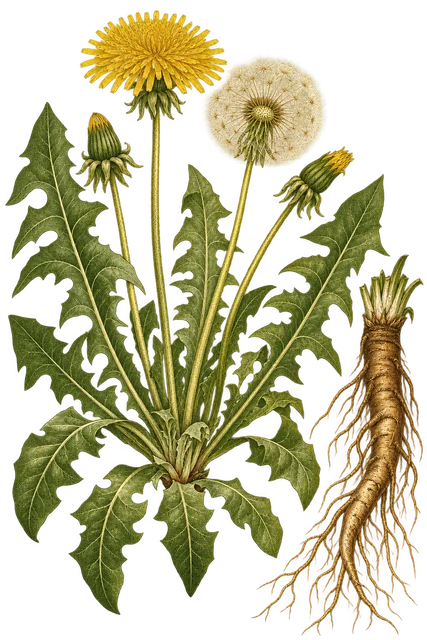
Dandelion crossed between vegetable and medicinal gardens: leaves became greens, flowers became wine and roots supplied bitter remedies. Its toothed leaves gave it the lion’s-tooth name; French and English bed-wetting nicknames preserve its urinary reputation. A plate of leaves, root preparation and flower wine are different materials, even when they share one cultural history.
National Library of Medicine: The Dandelion, historical collections
Identity & detailed reference
Identity
Taraxacum officinale F.H. Wigg. aggregate, Asteraceae. Leaf, root and root-with-herb are distinct medicinal materials; this entry separates edible greens from root and leaf remedies.
Ingredient details, preparation and research
Source plant or material
Taraxacum officinale aggregate; leaves as greens or medicinal leaf, and separately the root.
Plant family / material: Asteraceae (daisy family).
Forms and route
Washed raw or cooked leaf greens; dried-leaf infusion and fresh-leaf extracts; cut dried-root decoction, root juices, liquid extracts and tinctures. Roasted-root beverages and root-with-herb products have their own composition. All medicinal forms discussed here are oral; topical use has no established benefit in the reviewed evidence.
Vitamins and minerals
USDA: one cup raw chopped greens (55 g) supplies about 428 micrograms vitamin K, 279 micrograms of vitamin A measured in retinol activity equivalents (RAE), 19 mg vitamin C and 103 mg calcium. One-half cup cooked, boiled, drained, unsalted greens (52.5 g) supplies about 289 micrograms vitamin K, 180 micrograms RAE vitamin A, 9.5 mg vitamin C and 74 mg calcium. These are separate food records, not a cooking-retention experiment. Root tea and tincture are not equivalent servings.
Absorption and preparation
Human pharmacokinetic data for dandelion root are lacking. Root decoction, leaf infusion and alcohol extracts retrieve different mixtures. Traditional before-meal timing for appetite preparations concerns their intended use, not proven improved absorption. No universal fresh/dried conversion or absorption-enhancing pairing is established.
Practical preparation
Choose correctly identified food-grade greens, wash well and avoid plants from chemically treated lawns. Tender leaves can be eaten as greens; for cooked leaves, a Maryland DNR recipe first blanches for 2 minutes before further cooking. A half-cup cooked portion is a food example, not a medicinal regimen. Prepare a labeled dried-root product as its directed decoction; do not replace its measured dry root with a guessed handful of fresh leaves.
Food notes
Food-grown Taraxacum officinale flower material is a culinary option separate from root or leaf preparations. University of Minnesota describes younger flowers as honey-like and older flowers as more bitter. Select identified flowers grown for eating, remove unwanted green bases, and wash gently; do not use treated lawn flowers. Leaf nutrient values and root-monograph doses do not apply to a flower garnish.
Combination notes
Dandelion and nettle appear in urinary-herb traditions, but combining them has not been shown to improve clinical outcomes or safely replace prescribed diuretics. Mixed dandelion/burdock beverages vary in root quantity, sweeteners and extracts; a beverage name does not define a medicinal dose.
Traditional and reported uses
- European root tradition: mild digestive fullness, flatulence, slow digestion and temporary appetite loss.
- European leaf and root tradition: increased urine output for minor urinary complaints, with adequate fluid intake; this is not a kidney-disease or urinary-infection treatment.
- Food use: leaves as bitter greens. A tiny, uncontrolled human leaf-extract pilot does not establish root efficacy or a detoxification effect.
- Young food-grade dandelion flowers for culinary flavor and decoration; not a substitute for root or leaf preparations.
Contraindications and cautions
- Medicinal root use is not recommended with bile-duct blockage or inflammation, liver disease, gallstones or other bile-duct/gallbladder disease. The leaf monograph also lists these conditions and active peptic ulcer as contraindications.
- Do not use urinary-flushing remedies when fluid restriction is advised. EMA's medicinal-leaf warning also advises avoidance in renal failure, diabetes or heart failure because of possible high blood potassium; this is not a blanket ban on ordinary food portions.
- Avoid known dandelion/Asteraceae allergy; contact reactions can occur.
- NCCIH describes potential interactions with diabetes medicines, anticoagulants, antiplatelets and diuretics as theoretical. Separately, vitamin-K-rich greens require consistent intake with warfarin.
- Medicinal use under 12 or during pregnancy/breastfeeding is not recommended because safety is insufficiently established. Fever, painful urination, blood in urine, worsening symptoms or symptoms lasting over two weeks need assessment.
Similar items and how they compare
- Milk thistle
Both occur in digestive and liver-associated herbal traditions and belong to the daisy family, but their medicinal materials differ.
Dandelion uses root/leaf; milk thistle fruit contains silymarin rather than a similar inulin profile.
- Stinging nettle leaf
Both have traditional urinary-flushing uses and can be prepared as teas, with adequate-fluid requirements and appropriate medical cautions.
Nettle uses aerial herb; dandelion root also has bitter digestive and appetite-related traditions.
Botanical identity, parts and constituents
Taraxacum officinale F.H. Wigg. aggregate, Asteraceae. Leaf, root and root-with-herb are distinct medicinal materials; this entry separates edible greens from root and leaf remedies. Root contains inulin-type fructans, bitter sesquiterpene lactones, phenolic acids and triterpenes; root inulin varies markedly with season. Leaves contain flavonoids and phenolic acids with mineral salts and carotenoids. Neither root nor a strained infusion inherits the nutrient profile of a serving of whole greens.
Root and leaf traditions
The root monograph attributes mild digestive and appetite uses to European tradition, alongside urinary flushing. The separate leaf monograph covers urinary flushing. These traditional registrations do not establish a general liver detox, organ repair or treatment for an infection. NCCIH finds no compelling evidence for treating a health condition.
Preparation-specific human evidence
A 2009 pilot followed 17 volunteers for one day after fresh-leaf hydroethanolic extract. Urination frequency increased in one interval and the urine-to-fluid-intake ratio in another; the third administration changed neither. There was no placebo group, blinding or long-term follow-up. This preliminary leaf result is not evidence for root tea, stone prevention, kidney repair or safe substitution for a prescribed diuretic.
Laboratory evidence and absorption
Root extracts and isolated constituents have been studied in cell and animal models, including inflammatory and metabolic pathways. These results do not establish human anticancer, antiviral or liver-restoring effects. Human pharmacokinetic data for dandelion root are lacking. Root decoction, leaf infusion and alcohol extracts retrieve different mixtures. Traditional before-meal timing for appetite preparations concerns their intended use, not proven improved absorption. No universal fresh/dried conversion or absorption-enhancing pairing is established.
Edible portions and useful nutrients
USDA: one cup raw chopped greens (55 g) supplies about 428 micrograms vitamin K, 279 micrograms of vitamin A measured in retinol activity equivalents (RAE), 19 mg vitamin C and 103 mg calcium. One-half cup cooked, boiled, drained, unsalted greens (52.5 g) supplies about 289 micrograms vitamin K, 180 micrograms RAE vitamin A, 9.5 mg vitamin C and 74 mg calcium. These are separate food records, not a cooking-retention experiment. Root tea and tincture are not equivalent servings. The raw portion provides approximately 357% of the adult label Daily Value for vitamin K, 31% for vitamin A and 21% for vitamin C.
A fair vegetable comparison
At the same 55 g raw weight, spinach supplies approximately 266 micrograms vitamin K, 258 micrograms RAE vitamin A and 15 mg vitamin C. Dandelion is therefore a nutrient-dense green, but its mineral and vitamin amounts are not proof of medicinal activity. USDA records: dandelion raw 169226, cooked unsalted 169227; spinach raw 168462.
Food and tea preparation
Choose correctly identified food-grade greens, wash well and avoid plants from chemically treated lawns. Tender leaves can be eaten as greens; for cooked leaves, a Maryland DNR recipe first blanches for 2 minutes before further cooking. A half-cup cooked portion is a food example, not a medicinal regimen. Prepare a labeled dried-root product as its directed decoction; do not replace its measured dry root with a guessed handful of fresh leaves. Root, root-with-herb and leaf labels should remain distinct, including the solvent and extract ratio.
Biliary, renal and population cautions
EMA advises against medicinal root use with bile-duct blockage or inflammation, gallstones, liver disease or other bile-duct/gallbladder disease. The medicinal-leaf monograph additionally contraindicates active peptic ulcer and warns against use in renal failure, diabetes or heart failure because of possible high blood potassium. These are preparation-specific medicinal cautions, not evidence that a normal salad portion injures healthy kidneys. Fluid-restriction advice takes priority over urinary-flushing traditions. Medicinal use under 12 and during pregnancy or breastfeeding is not recommended.
Medicine interactions and food vitamin K
NCCIH's diabetes-drug, diuretic, anticoagulant and antiplatelet cautions are theoretical, while EMA reports no established drug interactions. Whole greens have a separate, well-characterized vitamin-K issue: people using warfarin should keep intake consistent and discuss substantial dietary changes. That does not mean all blood thinners interact with vitamin K, or that every strained tea supplies a greens-sized dose.
When to seek assessment
Fever, painful urination, blood in urine, worsening symptoms, or persistent digestive/appetite/urinary complaints require assessment rather than more tea. Allergy can occur, including contact reactions from plant handling.
Culinary flowers and exact edible part
Food-grown Taraxacum officinale flower material is a culinary option separate from root or leaf preparations. University of Minnesota describes younger flowers as honey-like and older flowers as more bitter. Select identified flowers grown for eating, remove unwanted green bases, and wash gently; do not use treated lawn flowers. Leaf nutrient values and root-monograph doses do not apply to a flower garnish.
Entry sources
- EMA: Dandelion root assessment report
- EMA: Dandelion leaf assessment report
- EMA: Dandelion root monograph, adopted 2021 and published 2022
- EMA: Final dandelion leaf monograph
- NCCIH: Dandelion, updated November 2024
- Clare et al. (2009): One-day fresh dandelion leaf-extract urinary pilot
- USDA FoodData Central: Official SR Legacy downloadable composition and portion records
- FDA: Daily Values on nutrition labels
- Maryland Department of Natural Resources: Dandelion greens preparation
- NIH Office of Dietary Supplements: Vitamin K and warfarin consistency
- University of Minnesota Extension: Edible flowers
- Donald Deever: The Good Weed Series: Common Dandelion, University of Nevada Extension (2022)
Reference entry 19 · Recorded content review: 2026-10-07 · Review scope and dates