


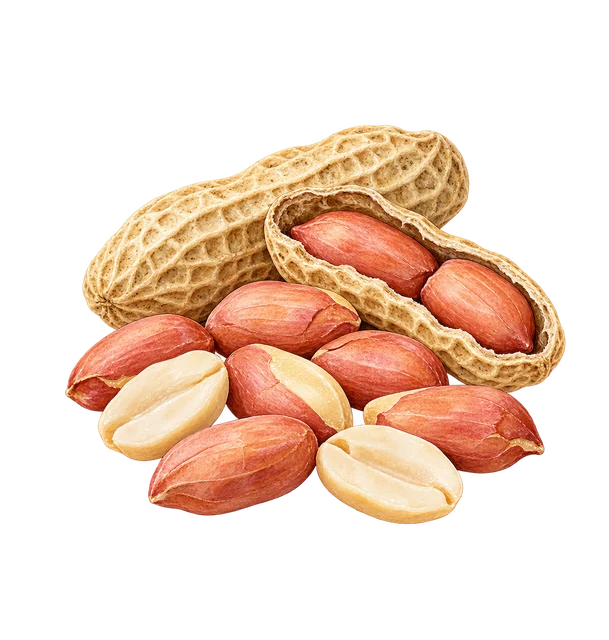
Key cautions
- Peanut is a major food allergen; people with peanut allergy must avoid relevant products and cross-contact.
- Whole peanuts and thick spoonfuls of nut butter can be choking hazards for young children; use age-appropriate food guidance.
- Buy food-grade kernels, never chemically treated planting seed, and discard visibly spoiled products.
What’s inside
Protein, unsaturated fats, fiber and minerals. Variety and processing affect composition; an extracted oil lacks the whole seed’s protein and fiber profile.
Uses in brief

- Roasted kernels
- Pastes and confectionery
History, folklore and reported uses
History, folklore and traditional uses
Embrapa describes peanut as a South American domesticated crop, with its origin discussed around Brazil, Bolivia and northern Argentina. Cultivation and food use subsequently extended into Mexico and the United States; those regional connections do not make it a North American native domesticate.
Traditional, historical and reported uses
- Roasted kernels
Food or household practiceWhy this label?
Label describes the stated practice or evidence, not an efficacy grade. Exact form and cautions remain attached.
Utah State documents harvested peanuts roasted for eating and processing. Plain and salted versions share a seed identity but differ in added sodium.
- Pastes and confectionery
Food or household practiceWhy this label?
Label describes the stated practice or evidence, not an efficacy grade. Exact form and cautions remain attached.
Embrapa records peanut in the food-processing sector, including sweets. Ground seed retains components that are removed when only oil is extracted.
2 supported uses; records describe the named form and are not treatment recommendations.
Historical-use additions reviewed 2026-10-09
Regional reading paths
These sourced notes describe cultivation, trade, food traditions or material history. A regional connection does not claim exclusive origin.
North America
Introduced/cultivated/traditional food: Mexico.
Edible legume kernels eaten roasted or used in foods.
South America
native domesticate and cultivated; Brazil, Argentina, Bolivia
Seeds used in foods and pastes.
Australia & Oceania
Introduced agricultural crop with a well-documented Queensland cultivation and processing history, particularly around Kingaroy and the South Burnett.
Food-grade seeds are eaten cooked or roasted and made into peanut butter; retain allergy and food-storage cautions.
Identity & detailed reference
Identity
Shelled seed of Arachis hypogaea. Although commonly grouped with nuts in the kitchen, peanut is a legume rather than a botanical tree nut.
Ingredient details, preparation and research
Also known as: Groundnut; Cacahuate; Amendoim
Source plant or material
Arachis hypogaea
Plant family / material: Fabaceae
Forms and route
Food-grade kernels, roasted or boiled peanuts and peanut butter or paste. Shells, treated planting seed and peanut oil are not interchangeable with the whole seed.
Vitamins and minerals
Peanuts supply energy as well as protein and fat. Salted snacks, sugar-containing spreads and confectionery need their own label-based assessment rather than borrowing the profile of plain kernels.
Absorption and preparation
Grinding changes texture without making an allergenic peanut safe. The whole food differs from purified protein or oil used in experiments; no medicinal dose is proposed.
Practical preparation
Use commercially prepared peanuts or a reliable cooking method for raw food-grade kernels. Store dry kernels cool and sealed. Refrigerate perishable peanut dishes and follow the product label for spreads.
Traditional and reported uses
- Roasted kernels
- Pastes and confectionery
Contraindications and cautions
- Peanut is a major food allergen; people with peanut allergy must avoid relevant products and cross-contact.
- Whole peanuts and thick spoonfuls of nut butter can be choking hazards for young children; use age-appropriate food guidance.
- Buy food-grade kernels, never chemically treated planting seed, and discard visibly spoiled products.
Crop evidence and allergy
Agricultural references establish crop identity, preparation and origin. FDA’s allergen guidance separately establishes a consequential food-safety boundary; neither source type proves a therapeutic benefit for an individual consumer.
Evidence limits
Regional history and food/material practice do not establish treatment efficacy. Composition depends on the named species, part and preparation; no medicinal dose or universal nutrient ranking is inferred.
Entry sources
- Embrapa: O Amendoim (2003)
- Utah State University: Peanuts in the garden
- Embrapa: Segurança e qualidade na produção primária do amendoim
- FDA: Food Allergies, What You Need to Know
- CONABIO: Alimentos y bebidas
- CONABIO: Especies domesticadas en México
- Embrapa: Evolução da produção de amendoim
Reference entry 418 · Recorded content review: 2026-10-09 · Review scope and dates